Processing
Likes
Comments
Share
@
Follow
Likes
10
Share
@Dreadnug
Follow
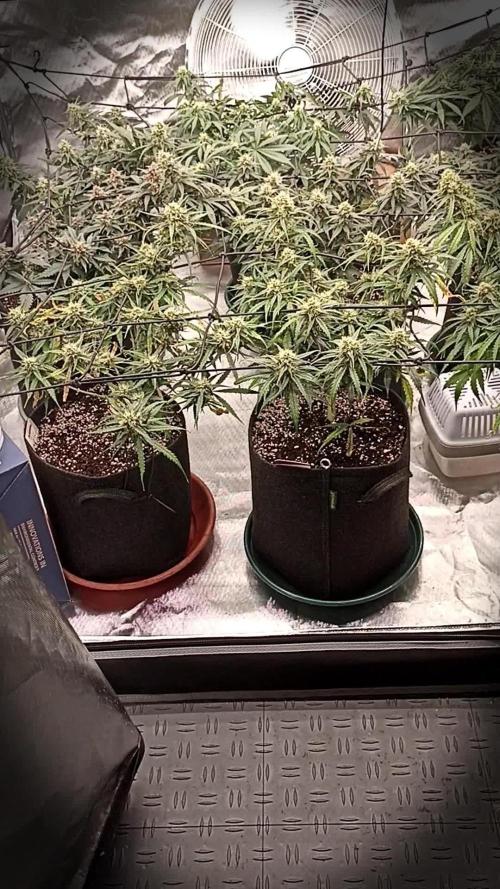
5/14- Buds are getting fat - some are starting to droop. The Calcium issue is resolved and feeding pH balanced water and not switching with well seems to have helped. Hopefully we can stay stead to harvest. Noticing some light burn so will have to potentially keep an eye on dialing back the lights a bit.
Likes
4
Share
@Kronen
Follow
Mohawk Meds: Banana Flambe (BF): Day 42, 7 Weeks from seed. Healthy & green. Battled some High temps this week. Built a DIY water cooling system in the duck work along with lowering power to the lights but moving them closer to maintain PPFD & created an intake of cooler air to my closed loop system. All these things brought temps back to low-mid 70's from low 90's I was having. Through the week BF never wilted from the heat but didn't grow as much as it should have. Weekly Environment: 85-91F, 48-54% RH, 750-850 PPFD, & 550-875 CO2. Also topped BF #2 & #3 on the 5th Node. Decided to keep #1 as a Mother.
Likes
4
Share
@eurorack
Follow
Adding some PK 13/14 as its pushing out flowers well. No real issues, slightly yellow leaf tips on top of plant, I'm not overly concerned, I think I might have overdone the CalMag a little.
Likes
31
Share
Esta semana han aparecido los malditos trips en las hojas, estoy tratando este problema con aceite de neem . Con el tema de fertilizantes he regado con melaza únicamente, a las macetas con 3 litros de agua cada 3 días.
Likes
9
Share
@Bizarrr
Follow
Zdravím všechny. Svítíme už 12/12.Proběhla první zálivka s přidáním top max a bio bloom a vše se zdá v pořádku akorát jedna holka trošku změnila barvu některých listů. Trošku holky vyrostly,je tam celkem husto,tak snad taky pořádně vystřelí nahoru a po třech týdnech bude velká defoliace a oholení spodků.Tak zase za týden,ať to všem roste✌️💚
Likes
54
Share
~ AirCube Active Oxygen Ebb/Flow System sponsored by GrowAce, featuring Strawberry Gorilla Auto by FastBuds ~ Well guy's and gal's here we go again on another exciting Autoflower run together! This time will be different as I will be doing a 'Hydroponic' run utilizing the AirCube Active Oxygen Ebb/Flow System by GrowAce, who were kind enough to sponsor me for this run, so it should be interesting to see what results I get and have some fun along the way! •Let me first tell you about this 6 Pot Ebb/Flow system from GrowAce: "The AirCube system is the one and only Ebb & Flow grow system on the market that combines the benefits of air pruning with a fully automated Ebb+Flow system! With the AirCube's proprietary fabric pot in bucket design, this system is guaranteed to outgrow any other Ebb + Flow system on the market. The results speak for themselves- grow MASSIVE roots that result in MASSIVE fruits! Air Pruning- Air Pruning only happens with fabric pots. As the roots reach the fabric walls of the pot, they penetrate and grow into the breathable fabric. Once penetrated, the roots are exposed to air, which causes the tips of the root to dehydrate and naturally prune themselves. This natural pruning process forces the roots to grow tons of lateral fibrous feeder roots. This results in a plant that utilizes the entire root zone and fills the entire pot with tons of roots. These fibrous feeder roots are incredibly effective in uptaking water and nutrients, resulting in a plant that grows healthier and more vigorously! Oxygen Benefits- Without oxygen, nutrient absorption cannot occur. On a molecular level, oxygen is needed to transmit nutrients across the cell walls and into the roots of a plant. With the AirCube's proprietary bottom lifted draining design, the system actively draws all of the water out of the bucket pulls vital oxygen into the root zone. Maximum Versatility with Any Grow Medium: The AirCube System is the only system on the market that allows you to use any growing medium you like. Use coco coir, soil, peat moss, perlite, vermiculite, hydroton, rockwool or any other medium you wish! This system is the most versatile Ebb and Flow bucket system in today's hydroponics industry. Temperature Control- with the fabric pots constructed with highly porous polypropylene fabric, heat dissipates easily and effectively. Unlike standard plastic pots, heat isn't trapped in the root zone. Heat in standard plastic containers can reach temperatures of up to 125 degrees. When this type of heat is trapped and unable to escape, it can damage your plant's health and limit the potential of your harvest. Growing in the AirCube System, plant roots grow cooler, healthier, and more vigorous. Largest Pots in its Class- this system features 5 Gallon grow buckets, the largest pot size of any other ebb and flow hydroponic system in the market. Modular and Expandable- start with 6 grow buckets and expand up to 36 grow buckets with the optional 105 gallons PopTank reservoir!" For my medium and nutrients I decided to also switch things up from my regular Organic runs, going with Plagron Nutrients and Root Royale 70/30 Coco/Perlite. When filling the fabric pots with medium, I first added just under a gallon of horticulture perlite from Nor-Cal as a base layer to ensure good drainage and then filled the remainder with the Root Royale. •Now for one of my favorites, and award winning strain from my friends at FastBuds... Strawberry Gorilla Auto: I'll be running Strawberry Gorilla Autoflower which is a 55/45 Sativa/Indica Hybrid. "ATTENTION ALL! Due to our continuous efforts in evolving our breeding process, we are proud to confirm that our Strawberry Gorilla Auto has now become one of the most potent autoflowers in the world! Paving the way to our recent success where she ranked on top & brought home the gold at the very first American Autoflower Cup in California. Moreover, she proved that not only modern autoflowers can compete with photoperiods, but they can even beat them in their field. At the most recent edition of the Farmer’s Cup and competing against various photoperiodic strains, Strawberry Gorilla Auto took home the title of 'Highest Combined Terpenes' in the highly sought-after 'Home Grow Hash' category, with an impressive 97.163 mg/g total terpene content! Our exceptional genetic selection's crowning Strawberry Gorilla Auto strain is a spectacular hybrid known for producing yields of up to 600 gr/m2 in 70 days. This is a very manageable grow that can reach heights of up to 150 cm - due to its magnitude we recommend it for more experienced growers, as a huge plant may be a little overwhelming for first-timers. This show stopping sativa heavy hybrid is perfect as an all day smoke, producing a taste bud tingling, pungent berry and diesel terpene-rich flavor combo that leaves you with a grin from ear to ear, a perfect choice for those looking for a day-and-night autoflower! "* *References: GrowAce.com, 2fast4buds.com ______________________________________________________________________________________________________________________________________________________________________________________________________________________________________________________________________________________________________________________________________ The Setup: • AC Infinity 4x4 tent •AC Infinity Cloudline T6 Exhaust Fan w/ Controller 67 •HLG 650R w/UVA Bar *** For some reason GD does NOT have a listing for the USA version of the 650R so I selected the closest match to it. •AirCube Active Oxygen Ebb/Flow 6 pot System •TrolMaster Hydro-X Controller for light •AutoPilot APC8200 co2 controller fed by a 50# tank •16" Hurricane oscillating fan and 8" floor fan •Tent cooling via filtered outside air delivered by AC Infinity Cloudline T6 fan •BlueLab instruments: PH Pen and Truncheon Nutrient Meter ______________________________________________________________________________________________________________________________________________________________________________________________________________________________________________________________________________________________________________________________________ Weekly Updates: 11/8- The first full week of flower is here for the FastBuds Strawberry Gorilla auto's and they are all looking fantastic! The feed schedule of six 15 minute feeds daily continues with a 900ppm nutrient level. The HLG 650R remains at 100% output, and is hung 30" from the canopy now as I had to raise it for some taller plants in the tent. 11/10- The Strawberry Gorilla's just hit the one week mark in their flowering and the #2 definitely has the most developed flowers of the three plants, with the #1 and #3's flowers about equal in development. I'm continuing to adjust the LST wires on all three plants to try and keep as much light penetration down into the centers of the plants which has been working well. I have also removed a shade leaf here and there when necessary. 11/12- Today I drained, cleaned the reservoir and distribution bucket, then refilled the reservoir with 90L of 70℉ well water to which Plagron nutrients were added to give a 900ppm concentration, then ph'd to 5.8. All I am doing now in between drain/refills of the reservoir is adding straight water to maintain the 90L level and checking the ph. Over the course of the 7 days in between reservoir changes the ppm's will slowly drop, but will still be adequate, never dropping below 750ppm's. The plants are really doing well in this AirCube system and I'm slowly getting a better handle on its 'in's & out's'. I did also check the ppm's of the return solution to see if there was a wide variance from what was going in, and all was good with only a 50-100ppm difference. 11/14- There goes a full week of flower for the FastBuds Strawberry Gorilla's! They all should really get going in the next couple of weeks and I can't wait to see their progression through flower! 💚 Thank you for checking out my passion in life! Please visit as often as you wish and I hope you enjoy this journey as much as I know I will! Grow what you love, Love what you grow!💚
Processing
Likes
24
Share
@GrowGuy97
Follow
Day 21 - Ladies are looking nice & healthy! Everything seems to be going great, one is still growing a little slow but all in all extremely happy with this grow so far! Thanks for following & happy growing friends!✌️🏼🌱 Day 22 - They are really starting to take off now😍😍 Day 23 - not sure if it’s the pheno type or the nutrient but the plant that is getting the Technaflora Nutrients is starting to get a little bigger🤷‍♂️🏼 Day 24 - Babies are really starting to take off😍😍 got my New420GuySeed gear in today as well👍🏼🙏🏼 Day 25 - Starting to really grow now, the smaller of the 3 I starting mainlining today to do another comparison at harvest time! Day 26 - Another good day of growth! Thank you for following & happy growing friends!🌱✌️🏼 Day 27 - End of the week & these ladies just keep looking better & better😍
Likes
36
Share
Took some clones & defoliated/lollipopped I started building a veg tent and went with a 2x2 AC Infiniti equipped with the 4inch cloud line duct system was a boring grow week.. ready for flower
Likes
21
Share
Day 57 of flower, we’re on the home stretch now. I’ve been flushing them out for the past week or so now. I like to flush for 21 days. IMO, I think the buds taste better and smoke smoother when you flush longer than usually but that’s just me! No specific pics/vids of the white widow but I thought I share my entire garden with you guys. I said I would harvest on day 70 but I might harvest on day 63-65 because I’m seeing more amber trichomes every day. My next update will either be harvesting or I’ll be letting them go for another week. Until next update! 🙏🏾
Likes
26
Share
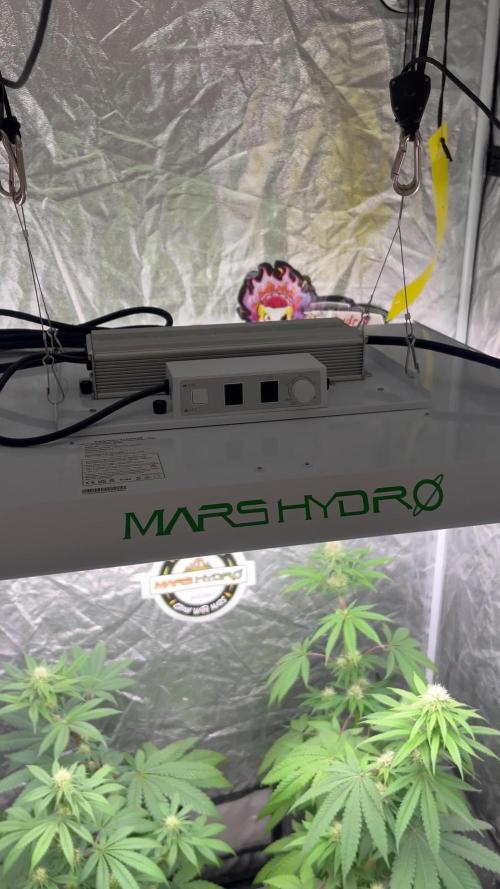
we will carry out this cultivation under the sponsorship of Mars Hydro with an FC-E 4800 lamp , to view this lamp or any other marshydro product go to: https://instagram.com/marshydro_aliexpress?igshid=YmMyMTA2M2Y=
Likes
4
Share
@Aleks555
Follow
Week 10 – Gorilla Girl in Full Bloom! We’ve hit Week 10, and our Gorilla Girl by Sweet Seeds is deep into the flowering stage — and looking absolutely stunning! Standing at around 70 cm, she’s fully adapted to the SCROG setup, with buds forming beautifully across the canopy. Her structure is strong, her leaves vibrant, and the aroma is starting to intensify. We continue feeding her with Xpert Nutrients Bloom Formula, and the results speak for themselves — healthy growth, solid bud formation, and great vitality. Massive thanks to Sweet Seeds for this incredible strain and to Xpert Nutrients for the excellent bloom support. The final stretch is getting close — and it’s looking promising!
Likes
12
Share
Hello guys😍😍 We have reached the 5th week of flowering. The plants are almost done with their longitudinal growth and most of the plant is focused on buds. I used overdrive fertilizer this week. The smell of the buds has increased a lot. And the buds have a stronger smell than the mother (cakes n cream) and give off a stronger OG smell😍 Because I increased the temperature difference between night and day, the color of the buds started to change. Thanks for commenting🙏 "farah4weed"
Likes
22
Share
@EelGrows
Follow
Week 6 Summary: First off, Happy New Year! May the new year filled with peace, love, joy and dank buds! 😄😉 Day 36-39: Despite my heavy defoliation they seem to bounce back quite quickly every time, but this is my first grow so I could be completely wrong and slowly murdering my plants... 😅 WC1 starting to frost up, the two double buds are starting to split themselves up while stretching: WIN! WC2 and WC3 really starting to show their size compared to just a week or 2 ago, really spread out now, and starting to stretch. Day 40-42: WC2 and WC3 really stretching now. WC2 almost catching up to WC1's height, and has probably spread out the most out of all plants when you compare it to a few weeks ago. Maybe defoliating is a good thing for Autos after all? I'm stoked about these. Although WC2 and WC3 are a few days behind of frost production it's definately starting to show itself by the end of week 6. Stoked for these!! These are stinking aswell, but for now the 4AM in the tent is sweetening it up! On to week7!!!
Likes
3
Share
02.04.2025 Tropicana Poison F1 DWC The plants are looking great the tipps of the colas at starting to get purple 💜 I need to invest in to another clip fan because of the humidity on the stem I will never grow in will blocks again ther are going to get reals nasty Hoping for a good harvest
Likes
72
Share
Week number 4 , I had to swap the 55w neons ramps for the HID 600w MH , plants were overtaking the light coverage surface meaning it’s time to give some more growing space under more coverage ! Also, I will start giving the first feeding by the end of the week, around 700ppm’s / 1.4mS, Cellmax Soil Mix is pre-fertilized ( like most of all horticultural Soil Mix ) and as you can see plants didn’t need any extra feeding ! Topping the plants at the 3rd node at the seedlings stage didn’t make any stress at all , they just have redirected the energy in the sides shoots as you can see on the video. (Tip of the week : If you wanna play the chemist with your super duper nootz without burning your sh*t you better get an EC/TDS meter 😉 Following this diary to the end will learn you how to Water/or/Feed your plants) [Day 24] I was planning to Feed the plants by the end of the week, but as always things can changes from what you were expecting 😊 - Water + Earth Grow Mix + RootBooster + AllZymes [Day 27] - Water (P.S: Looking for a job in the Cannabis industry as Master Grower, Mineralogist, Quality Control 🐞) This Diary is updated daily ☝️
Likes
56
Share
What's in the soil? What's not in the soil would be an easier question to answer. 16-18 DLI @ the minute. +++ as she grows. Probably not recommended, but to get to where it needs to be, I need to start now. Vegetative @1400ppm 0.8–1.2 kPa 80–86°F (26.7–30°C) 65–75%, LST Day 10, Fim'd Day 11 CEC (Cation Exchange Capacity): This is a measure of a soil's ability to hold and exchange positively charged nutrients, like calcium, magnesium, and potassium. Soils with high CEC (more clay and organic matter) have more negative charges that attract and hold these essential nutrients, preventing them from leaching away. Biochar is highly efficient at increasing cation exchange capacity (CEC) compared to many other amendments. Biochar's high CEC potential stems from its negatively charged functional groups, and studies show it can increase CEC by over 90%. Amendments like compost also increase CEC but are often more prone to rapid biodegradation, which can make biochar's effect more long-lasting. biochar acts as a long-lasting Cation Exchange Capacity (CEC) enhancer because its porous, carbon-rich structure provides sites for nutrients to bind to, effectively improving nutrient retention in soil without relying on the short-term benefits of fresh organic matter like compost or manure. Biochar's stability means these benefits last much longer than those from traditional organic amendments, making it a sustainable way to improve soil fertility, water retention, and structure over time. Needs to be charged first, similar to Coco, or it will immobilize cations, but at a much higher ratio. a high cation exchange capacity (CEC) results in a high buffer protection, meaning the soil can better resist changes in pH and nutrient availability. This is because a high CEC soil has more negatively charged sites to hold onto essential positively charged nutrients, like calcium and magnesium, and to buffer against acid ions, such as hydrogen. EC (Electrical Conductivity): This measures the amount of soluble salts in the soil. High EC levels indicate a high concentration of dissolved salts and can be a sign of potential salinity issues that can harm plants. The stored cations associated with a medium's cation exchange capacity (CEC) do not directly contribute to a real-time electrical conductivity (EC) reading. A real-time EC measurement reflects only the concentration of free, dissolved salt ions in the water solution within the medium. 98% of a plants nutrients comes directly from the water solution. 2% come directly from soil particles. CEC is a mediums storage capacity for cations. These stored cations do not contribute to a mediums EC directly. Electrical Conductivity (EC) does not measure salt ions adsorbed (stored) onto a Cation Exchange Capacity (CEC) site, as EC measures the conductivity of ions in solution within a soil or water sample, not those held on soil particles. A medium releases stored cations to water by ion exchange, where a new, more desirable ion from the water solution temporarily displaces the stored cation from the medium's surface, a process also seen in plants absorbing nutrients via mass flow. For example, in water softeners, sodium ions are released from resin beads to bond with the medium's surface, displacing calcium and magnesium ions which then enter the water. This same principle applies when plants take up nutrients from the soil solution: the cations are released from the soil particles into the water in response to a concentration equilibrium, and then moved to the root surface via mass flow. An example of ion exchange within the context of Cation Exchange Capacity (CEC) is a soil particle with a negative charge attracting and holding positively charged nutrient ions, like potassium (K+) or calcium (Ca2+), and then exchanging them for other positive ions present in the soil solution. For instance, a negatively charged clay particle in soil can hold a K+ ion and later release it to a plant's roots when a different cation, such as calcium (Ca2+), is abundant and replaces the potassium. This process of holding and swapping positively charged ions is fundamental to soil fertility, as it provides plants with essential nutrients. Negative charges on soil particles: Soil particles, particularly clay and organic matter, have negatively charged surfaces due to their chemical structure. Attraction of cations: These negative charges attract and hold positively charged ions, or cations, such as: Potassium (K+) Calcium (Ca2+) Magnesium (Mg2+) Sodium (Na+) Ammonium (NH4+) Plant roots excrete hydrogen ions (H+) through the action of proton pumps embedded in the root cell membranes, which use ATP (energy) to actively transport H+ ions from inside the root cell into the surrounding soil. This process lowers the pH of the soil, which helps to make certain mineral nutrients, such as iron, more available for uptake by the plant. Mechanism of H+ Excretion Proton Pumps: Root cells contain specialized proteins called proton pumps (H+-ATPases) in their cell membranes. Active Transport: These proton pumps use energy from ATP to actively move H+ ions from the cytoplasm of the root cell into the soil, against their concentration gradient. Role in pH Regulation: This active excretion of H+ is a major way plants regulate their internal cytoplasmic pH. Nutrient Availability: The resulting decrease in soil pH makes certain essential mineral nutrients, like iron, more soluble and available for the root cells to absorb. Ion Exchange: The H+ ions also displace positively charged mineral cations from the soil particles, making them available for uptake. Iron Uptake: In response to iron deficiency stress, plants enhance H+ excretion and reductant release to lower the pH and convert Fe3+ to the more available form Fe2+. The altered pH can influence the activity and composition of beneficial microbes in the soil. The H+ gradient created by the proton pumps can also be used for other vital cell functions, such as ATP synthesis and the transport of other solutes. The hydrogen ions (H+) excreted during photosynthesis come from the splitting of water molecules. This splitting, called photolysis, occurs in Photosystem II to replace the electrons used in the light-dependent reactions. The released hydrogen ions are then pumped into the thylakoid lumen, creating a proton gradient that drives ATP synthesis. Plants release hydrogen ions (H+) from their roots into the soil, a process that occurs in conjunction with nutrient uptake and photosynthesis. These H+ ions compete with mineral cations for the negatively charged sites on soil particles, a phenomenon known as cation exchange. By displacing beneficial mineral cations, the excreted H+ ions make these nutrients available for the plant to absorb, which can also lower the soil pH and indirectly affect its Cation Exchange Capacity (CEC) by altering the pool of exchangeable cations in the soil solution. Plants use proton (H+) exudation, driven by the H+-ATPase enzyme, to release H+ ions into the soil, creating a more acidic rhizosphere, which enhances nutrient availability and influences nutrient cycling processes. This acidification mobilizes insoluble nutrients like iron (Fe) by breaking them down, while also facilitating the activity of beneficial microbes involved in the nutrient cycle. Therefore, H+ exudation is a critical plant strategy for nutrient acquisition and management, allowing plants to improve their access to essential elements from the soil. A lack of water splitting during photosynthesis can affect iron uptake because the resulting energy imbalance disrupts the plant's ability to produce ATP and NADPH, which are crucial for overall photosynthetic energy conversion and can trigger a deficiency in iron homeostasis pathways. While photosynthesis uses hydrogen ions produced from water splitting for the Calvin cycle, not to create a hydrogen gas deficiency, the overall process is sensitive to nutrient availability, and iron is essential for chloroplast function. In photosynthesis, water is split to provide electrons to replace those lost in Photosystem II, which is triggered by light absorption. These electrons then travel along a transport chain to generate ATP (energy currency) and NADPH (reducing power). Carbon Fixation: The generated ATP and NADPH are then used to convert carbon dioxide into carbohydrates in the Calvin cycle. Impaired water splitting (via water in or out) breaks the chain reaction of photosynthesis. This leads to an imbalance in ATP and NADPH levels, which disrupts the Calvin cycle and overall energy production in the plant. Plants require a sufficient supply of essential mineral elements like iron for photosynthesis. Iron is vital for chlorophyll formation and plays a crucial role in electron transport within the chloroplasts. The complex relationship between nutrient status and photosynthesis is evident when iron deficiency can be reverted by depleting other micronutrients like manganese. This highlights how nutrient homeostasis influences photosynthetic function. A lack of adequate energy and reducing power from photosynthesis, which is directly linked to water splitting, can trigger complex adaptive responses in the plant's iron uptake and distribution systems. Plants possess receptors called transceptors that can directly detect specific nutrient concentrations in the soil or within the plant's tissues. These receptors trigger signaling pathways, sometimes involving calcium influx or changes in protein complex activity, that then influence nutrient uptake by the roots. Plants use this information to make long-term adjustments, such as Increasing root biomass to explore more soil for nutrients. Modifying metabolic pathways to make better use of available resources. Adjusting the rate of nutrient transport into the roots. That's why I keep a high EC. Abundance resonates Abundance.
Likes
9
Share
First of all, Big thank you to the Super Sativa Seed Club for allowing me to Compete in the autoflower contest and providing the seeds. Day 1- Placed into water, leaving in warm dark place for 24-48hrs. Day 2 - seed sank, now decided to place in paper towel, in a bag in the cupboard. Will wait 24 hrs for tap root to emerge and to 2-3cm this time. Day 3- Tap root emerged about 1-2cm. I have transplanted to final 3gal fabric pot. I have used, 60% canna terra pro plus, 30%perlite and 10% canna terra potting mix. The potting mix I use only as a transplant medium within its final container, just to allow around the seed a better chance for roots to develop as I found just using terrapro plus they struggle to establish because of how rich it is. After planting I gave a light pH water only and covered with jug. I find this helps retain humidity on the little seedlings. Day 5 - seedling emerged from soil, a very happy, healthy seed to pop so far 😁✌️ Day 6- Showing fast growth for this little auto, she is definitely designed for a race 🤣 still only water pH balanced.
Likes
2
Share
Looking good...