


Likes
Comments
Share

@oldschoolS2
Follow
Hey bro's!😜
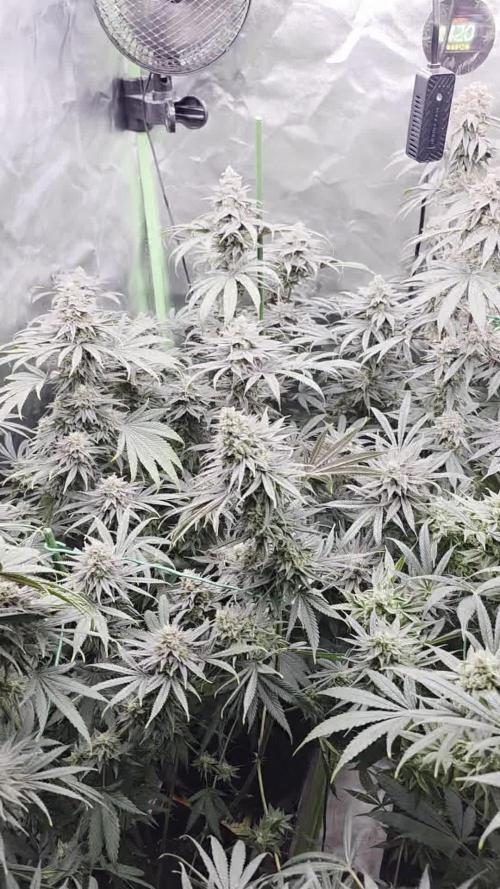
Week 7 bloom is done day 53 after flip..Franco's Fullgas.. lovely smell frosty sour nice buds...
Was the last week feeding from now on phd water and thricomes
check up... almost there!

Likes
31
Share


@Wicked_Stix
Follow
She has been on 12/12 for 2 weeks now and transitioning to flower nicely. This bubble bomb might be the smallest of the bunch but she is stretching some and it looks like she is going to put off about 20 top buds so no complaints. Couldn't be happier with how these 6 girls are playing well together so far. Going to start them on some liquid Koolbloom next week.
Nutrients per gallon
.5 tsp maxibloom
.25 tsp maxigro
.5 tsp calimagic
.25 tsp armor si
.1 tsp 90/10 humic/fulvic acid.
Ph to 6.0

Likes
42
Share


@AutoCrazy
Follow
I can’t believe how big this plant is!! She is really bursting into flowering. There are already trichomes showing at the little bud sites which is incredible. Sweet seeds genetics always seem to bring the frost!!
I can’t recommend these genetics enough! She’s the biggest Fast Photoperiod I’ve ever grown!! I bet she will push over the 1lb mark!
She’s super resistant to mould/mildew and bugs. She can take the heat like a champ and down pours don’t affect her at all!! I have been spraying her with OMRI fungicide which I’m sure has helped. Like I always say, a little prevention goes a long way! Although I also believe strong stable genetics help!!
I can’t wait to see what another week brings!!
Bravo sweet seeds you nailed it with these genetics!! 🔥🔥🔥
😎🍿🍻🌱

Likes
13
Share


@WeedM8
Follow
Hello m8 welcome to this journey with me in this diary will have very interesting strains hope u find something useful
Persian Girl
- [ ] 1st week Veg: germinated in substrate lighting very close so it jets medium high humidity after the 3rd day they started sprouting
- [ ] 2nd week Veg: this week my ventilator broke down and as the temperature stayed very warm nothing developed much i did change light hight put them more far
- [ ] 3rd week Veg:fortunately this week i had fixed the ventilation and the temperature has go down a bit allowing the little plants to develop and reinforce
- [ ] 4th week:very good developments in this week I already started feeding a bit two times but i didn’t have to…once was enough
- [ ] 5th week Veg:
- [ ] 6th week Veg
- [ ] 7th week Veg
- [ ] 1st week Fl
- [ ] 2nd week Fl
- [ ] 3rd week Fl
- [ ] 4th week Fl
- [ ] 5th week Fl
- [ ] 6th week Fl
- [ ] 7th week Fl
if this was useful please like and follow

Processing
Likes
1
Share


@Greenpalace_420
Follow
La 3 semana de crecimiento las niñas están en su máxima potencia comprobamos que no tienen falta fe ningún nutriente están super verdes con unas hojas muy grandes

Likes
26
Share


@pifflestikkz
Follow
Day 22
22/07/24 Monday
Nothing new to report. Starting to see them beautiful fans appear that's all 😁✌️
Day 23
23/07/24 Tuesday
Feed today, giving them straight all nutes Inc flowering nutes.
I will update the dose as they grow and develop a bigger hunger.
(Not sure what's wrong with Overdose #2, bit mutated, we'll see how she gets on 😅)
Video updates 👌💚
Day 26
26/07/24 Friday
De-chlorinated watering pH 6 with 5ml calmag to 5L water.
Watered each with 250ml and had small run off.
I will continue to feed/water with small run offs to help prevent salt build ups.
Video update.


Processing
Likes
1
Share


@Lifted
Follow
Hooked up my carbon filter today. I'm only using it to scrub the air on a timer. Decided to poke a few holes in the ducting to help move scrubbed air around my plant. Added the other fan back in to keep air circulating. Since I don't have fresh air coming in I plan on using a supplement for co2. What are you guys using? It's only a small 2×2×6 tent with one plant and running a 150w HP's light.

Likes
75
Share


@Pungolian
Follow
Well post tropical storm Ophilia report. Made it through with only minor damage. Thank goodness! I had to laeve town for a wedding in NC over the weekend and realized i might not be able to get back in time to protect the girls. They did ok. Drinking a lot less water now that it has cooled down. From 4 gals/ day back to 2 gal / day! Ill update with some better pics later, happy growing all!

Likes
17
Share


@Noob_quest
Follow
Such Bittersweet Joy
Added this week as ‘Flowering’ although technically should be harvested as I but I haven’t had a chance to weigh or anything. I will do that next week once trimmed etc.
So finally cut them down on D89, it was a beautiful day outside and it just felt right.
Although when it came to the deed itself I felt sadder than I thought I would for my girls and the time we had together.
All 6 (I’m growing another 3 different strains but not included on this diary) are now hanging to dry in the tent. Temp -18 C; Humidity-60% seems to be holding steady with no tinkering thankfully.
After the 3 days they have all dried noticeably, perhaps 4/5 more before trimming / curing.
I’ve had quite a close look at most of the harvest and as far as this noob can tell, there doesn’t seem to be any issues with mould / bud rot. Fingers remain crossed.
I did have one very profound moment this week... It happened as I was surveying the harvest hanging up for the first time.
I could feel my mindset change suddenly from the constant paranoia over their health and overcoming my impatience to “I actually have a crap load of weed”.
It was beautiful beautiful moment...
Thanks for reading. Have a great week 😊

Likes
15
Share

@jellyjelly
Follow
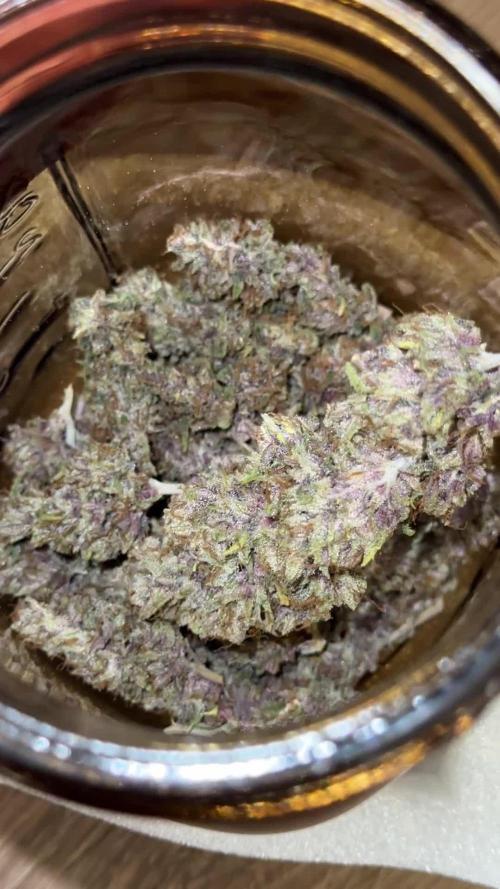
Each one has such a unique smell and flower structure. I really neglected the hell our most of these plants given the tiny 3 gallon container and arid conditions - however these plants were resilient.
Crystal Light x Pelee Sword stands out as gassy pungent strain covered in trichomes.
(Purple Haze x Malawi) x pelee sword was also very note worthy. Very citrusy/floral notes, airy bud structure but surprisingly very resinous.
Super stoked and thanks again DaDankSeed bank for the genetics and pointers!
Likes
85
Share


@420DeepGrow
Follow
Septima semana de floracion, se ha formado una preciosa cola la cual se esta llenando de blanca resina, espero ansioso a que engorde del todo para proceder al lavado de raiz.
📅 Dia 43: Riego con nutrientes EC 1100 EC escurrida 1650. Perfect.
📅 Dia 44: Descanso
📅 Dia 45: Riego con nutrientes EC 1100 EC escurrida 1550
📅 Dia 46: Riego con nutrientes EC 1300 EC escurrida 1650, se nota como empieza a engordar el cogollo.
📅 Dia 47: Riego con nutrientes EC 1300 EC escurrida 1650
📅 Dia 48: Descanso, comienza a comer mas lento, se aproxima el lavado de raices
📅 Dia 49:


Processing
Likes
3
Share


@StonyHemp
Follow
Week 4 and buds are beginning to fatten up nicely, I’ve changed the position of the gelato and one of the Zkittles to improve light penetration into the canopy as the leaves have began to defoliate themselves from the plants. This being said all plants are looking green and healthy and show minimum environment stress. Hopefully this change in the canopy will allow each of the strains to grow to their full potential with the limited space that I have.


Likes
3
Share

@lasonda
Follow
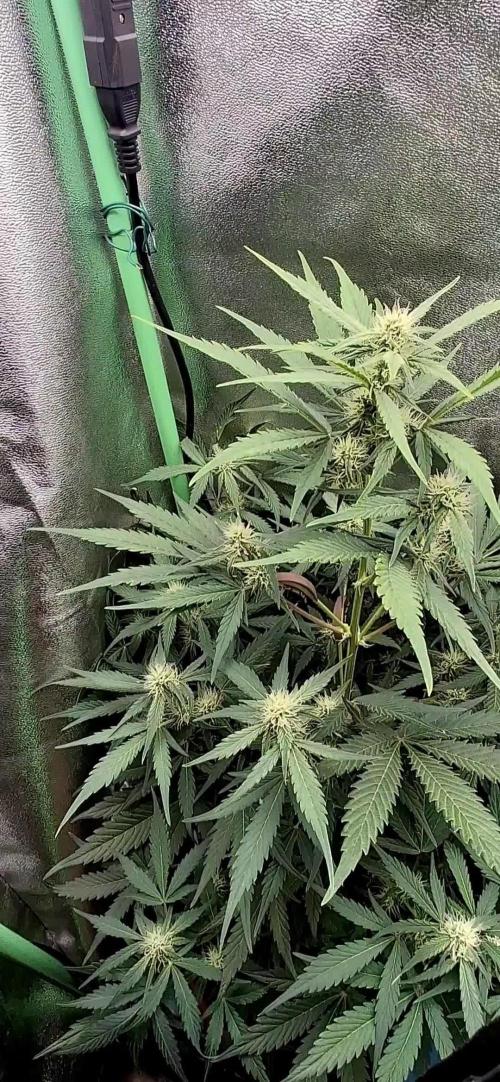
The flowering phase is proceeding admirably.
The plant is truly strong and imposing, and indeed sacrificed in the space of a grow tent of this size. But I see that it is holding up very well! Congratulations on this strain @SensiSeeds
It could use some defoliation, but I'll wait a few more days.
We'll keep you updated.
❤️💪🏻💪🏻🌱🍀🌴🌴🌴🌴🌲🌲🌲

Likes
15
Share


@Kayotic
Follow
NOT the best week....
-Day 47 since sprouting
- Day 12, week 2 of flower ? ??
Possibly?? Honestly, no idea
Inside
- Last time watered was Sunday
- Tiger Bloom
- Grew tall QUICK , got too close to the light- Broke off the top few inches of the main cola while raising the light and taking fan and filter down on Tuesday
- Very high humidity in tent, started too many at once, didn't expect them to be so big! Got it under control , but too crowded. Now sharing with Zkittles Auto, I believe.
Outside
- Watered Tuesday ( didn't ph water)
- Weather has been very inconsistent- tornado, high winds, rainy, humid, cool, hot
- Seems happy, been having to move her around a lot, hoping today is the LAST time.
They both smell amazing! Not going to lie. I will be disappointed if I mess them both up. One of my favorite strains to use and grow. Next time will be topping and keeping inside, lesson learned. No bugs!
-
Likes
7
Share

@RakonGrow
Follow
+
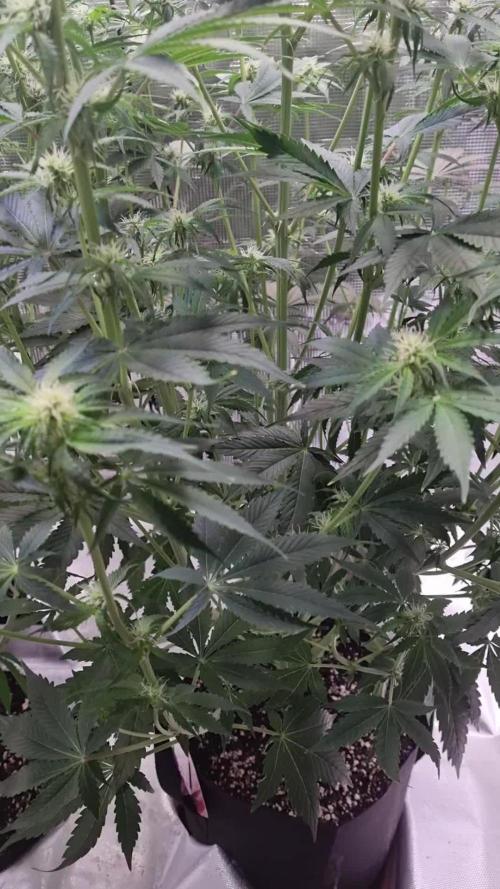
Day 51:
96cm , wow more rocket sience , 70cm is given
DayLight Cycle : 12h (about 970PPFD at top) + 4h (about 730PPFD at top) + 1h sunrise + 1h sunset
3.25L bottle water EC 0.35 + 0.3ml/L CalMag + Terra Flores 4.5ml/L Final PH 6.13
---------------------- all values are weight in grams ( assumption : 1000g = 1000ml.) -------------
Date Time..................Seed......messure..change...watering.....surplus.....DayLight.....Night.....within 24h
07.11.2025 06:00.....Runtz...........4702.......-206.....................................................................-206................-1624
07.11.2025 07:00.....Runtz...........7927.......3225.........3225..............26
07.11.2025 23:45.....Runtz...........6484.....-1443.................................................-1443
08.11.2025 06:00.....Runtz...........6221.......-263.......................................................................-263..............-1706
+

Likes
125
Share


@LegacyMarketFarm
Follow
MAY 20TH - TODAY is the first day the plants wake up from their 18/6 cycle down from 2 weeks at 20/4. They got their first SCHWAZZE and shaping at this stage getting them ready to grow into the beautiful sea of green each of these beds are to become. The uniformity of the clones reminds me how much of this has become muscle memory to me, From doing thousands of plants per grow this has become second nature for me. The ladies are 100% organic at this point and our feed I am considering releasing it for anybody who is interested as a way to fund raise at the same time !
If anybody is interested in the recipe let me know in the comments, If we get enough interest I will put up a site that will constantly update with each weekly feed & steps done on the plants.
ANNOUNCEMENT :
** It has taken me 20 re trys & double the amount of ERROR codes to get this update LIVE. I will be staying on this website until the end of this grow year, Then I will be setting up a Patreon & migrating over to Patreon and Twitter ( X ) I am completely done with GROW DIARIES.**
SUPPORT OUR SPONSORS !!!
PROMO CODE GREEN PLANET : LEGACY
PROMO CODE MARS HYDRO : LEGACY
PROMO CODE SEEDSMAN : LEGACY10
MAY 22ND 2024 - SCHWAZZE COMPLETED YESTERDAY. These photos where taken DIRECTLY after their SCHWAZZE. NOW 2-3 WEEKS of 18/6 then another SCHWAZZE, Top DRESSING of Mineralized Phosphate, Power Bloom and Glacial Rock Dust and swap to 14/10. We will be using 14/10 for 3 weeks then going to 12/12 to flower these beauties out.
MAKE SURE TO FOLLOW OUR SOCIALS & JOIN OUR GREAT COMMUNITIES !
TWITTER : https://x.com/LegacyMrketFarm
YOUTUBE : www.youtube.com/channel/UCR89iF2Iqy3zlHZhFfU2MMg
YOUTUBE GAMING : www.youtube.com/channel/UCw8-qCFg-PUf00waTO5JOGw


Likes
62
Share


@masterofsmeagol
Follow
10/5 Im still alive. Just incredibly busy with no help. Still have a few outside. Pulled the dreamcatchers and they are drying. A week or so for the others. I'm letting the last ones go as long as possible. I'll try to complete the harvest and smoke reports as i had taken tester branches before the harvest. So much work though. For some reason trichs pics aren't showing up.
10/6 Watered today. Calyxes are swollen and I've got SOME Amber trichs but we have good weather for the upcoming week. Lots of sun so I'm leaving the remainder for a little bit. I'm checking daily.


Likes
24
Share


@SooSan
Follow
90x60x140 (Mars Hydro)
FC-E4800 (Mars Hydro)
Easy2go Aquavalve5 (Autopot)
Living Soil (Demetearth)
Bruce Banner (PEV Seed)
Gorilla GG4 (Ganja Farmer)
Cream Caramel (Sweet Seed)
Gorilla Gelato (Ganja Farmer)
Blueberry (00 Seed)
Kalini Asia (Zamnezia)
Biscotti Mintz (Barney's Farm)
Blackberry Cake (Sensi Seed)
Amsterdam Amnesia (Dutch Passion)
Gelato Cookie (Ganja Farmer)
Purple OG Punch (Ganja Farmer)
Sweet ZZ (RQS)
Rainbow Road (Paradise Seed)
Substrat ~50L:
30L Super Light Mix Biotechnologie
18L coco
2L perlite
1,7kg lombricompost
350g guano de chauve-souris
350g Zéolithe
350g Basalte
170g guano vers de farine
170g biochar
0,7g Endomychorise glomus intraradices
0,7g Bacillus Amyloliquefaciens
Paillage de luzerne alfalfa
Arrosage avec 2ml/L de mélasse de canne 1x par semaine
Pulvérisation avec 1% d’huile de neem jusqu'à la 2eme semaine de floraison


Likes
14
Share


@EaRtH
Follow
5.5. - Watered 💧
8.5. - Watered 💧
10.5. - Week wrap-up: Plants are really smelly and buds stopped gaining on height and started to fatten up. I hope everything will go smoothly till the harvest 👌
4.5. - 10.5.2024
Likes
4
Share

@Sammy420
Follow
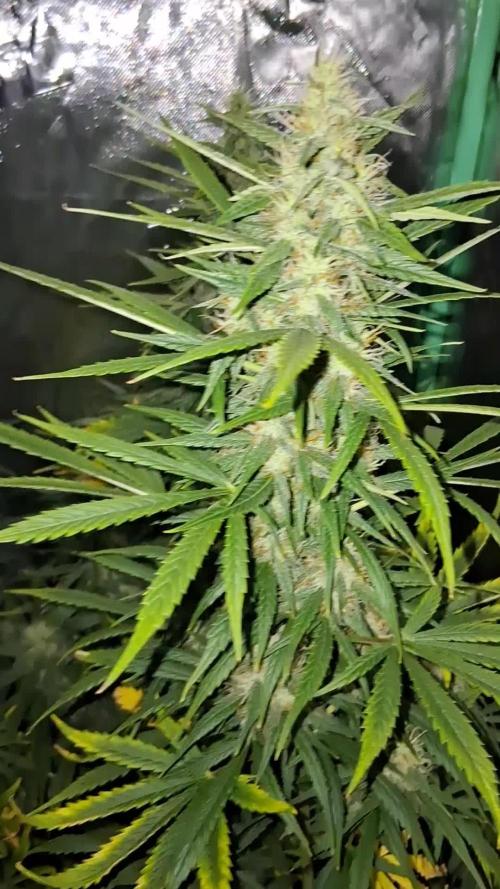
C’est une super bonne semaine, ça avance, je continue d'arroser à l’eau, un peu minérale et beaucoup du robinet. Ça donne un bon ph mais les feuilles continuent de jaunir et de tomber pour certaines... je crois qu’on approche de la fin. Je vais tester, si je le reçois, le monster bud booster pack. Ce sont des engrais liquides avec du pk 13/14 , un truc pour les racines et du sucre... je devait l'essayer là mais il y a eu une erreur sur ma commande. J’ai reçu les engrais en granulés que j’ai déjà mis au début de cette culture. Je devrais recevoir ça dans la semaine prochaine.