


Likes
Comments
Share

@DerEkstaseHase
Follow
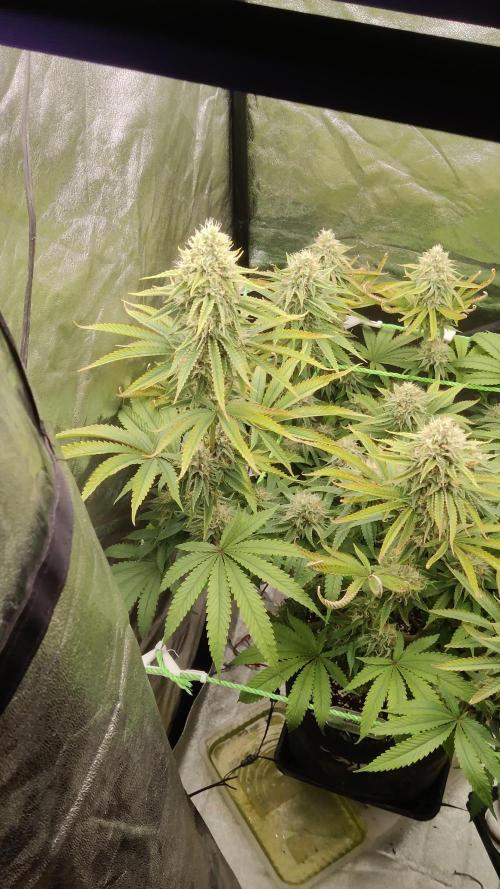
Diese Woche gab es ein paar Probleme, sowohl Salzaufbau im Substrat sowie Stress durch zu viel Licht.
Der EC im Drain lag bei 3,0 mS und der Ph bei 7,5, dadurch ist die Kaliumaufnahme blockiert.
Um da dagegen zu steuern habe ich ein Mal 6l Wasser mit CalMag und Ph 5,7 gegossen, um die Salzablagerung abzubauen.
Außerdem habe ich das Licht wieder auf 75% gedimmt.
Salzablagerungen sind zu diesem Zeitpunkt der Blüte relativ häufig, in Coco!


Likes
26
Share


@XxxAuto
Follow
I’ll try them next again, then I should remember the net for trying a Scrog.
It’s a old classic strain that no one forget
;-) if you not have try the white widow, then you must go on !

Likes
3
Share

@Daddy_farmer
Follow
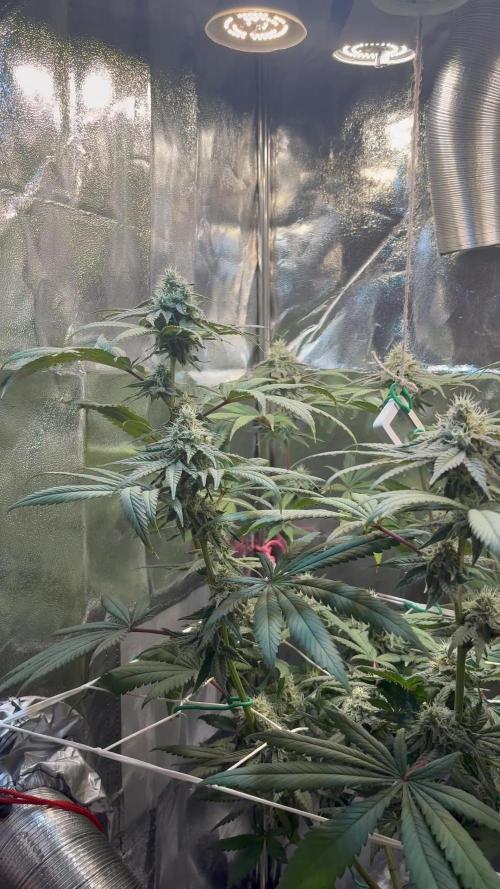
No action required. Autopilot mode on.
Dechlorinated tap water + autopot works great so far.
Genetics are brilliant to be honest- trichomes grows on the fan leaves😳
Start to smell herb candy a bit, no lemon yet.

Likes
252
Share


@Tropicannibis_Todd
Follow
💩Alrighty then Growmies We Are Back At it 💩
Well folks we just finished up the last run and so we are back to do it all over again 😁
So what do you say we have some fun 👈And what we got here folks is a Strawberry Blast 🍓 🍓 🍓 🍓
Strawberry 🍓 Gorilla , Strawberry 🍓 Banana 🍌 and there new release 🍓 Ztrawberriez 🍓 from FastBuds
And we also got Strawberry 🍓 Cola from Exotic Seeds
👉 Well we are now around day 56 growmies and its been a good week 👈
So I've been having a few issues here and there 😳 but it's not too bad and I think I got it under control 👍
So all 4 are preforming really well even the Strawberry Banana shes really moving now finally😉 The TinyPot is doing exceptional 👏 maybe first to chop 😀 soon 😀 😉
They all smell awsome , each is very different , sweet , berry 😋 Really happy with them .... 😌
FC4800 from MarsHydro Lights being readjusted and chart updated .........👍I've added a RU45 to the mix 👍
www.marshydro.ca
👉I am using Agrogardens for nutrients for my grows and welcome anyone to give them a try .👈
👉 www.agrogardens.com 👈
Agrogardens Cal MAG
Agrogardens Grow A+B
Agrogardens Bloom A+B
Agrogardens Bud Booster
Agrogardens PK13/14
I GOT MULTIPLE DIARIES ON THE GO 😱 please check them out 😎
👉THANKS FOR TAKING THE TIME TO GO OVER MY DIARIES 👈
Would you like to hang with the growdiary community 👉 https://discord.gg/gr4cHGDpdb 👈


Likes
22
Share


@TechDCo
Follow
16/08/2024
Lights On!
Mid-day! Looking very colourfull!
17/08/2024
Lights On!
I think my 'plants' are turning gay as they mature! Being very colourfull!
Mid-day check: Took some photos of all the colours 😍 👌 📸
"Daydream; I feel asleep amongst the flowers for a couple of hours on such a beautiful day!" 🎶
18/08/2024
Lights On!
They're Sprouting new pistils!
Going to just judge harvest by what the trichcomes are saying because the buds are still growing! Might be able to push to week 10-
Night time before sleep check!
#Night time before sleep check video! video!
19/08/2024
Lights On!
All is swell!
I've inserted colour coding within all my diaries of/for prior events vier the title for predictions.
I planted On the 1st.
Pablo Pisasso X The Future X Monkey Slapz
The Future = Yellow/Green {Warning!)
Bubblegum GPP = Blue {Blue Lipz)
Monkey Slapz = Yellow {Yellow Fever) SlaPped with a diagnosis of proxy!
Red - Pablo Picasso = Red {Alert! Dangerous Art Show of Chemicals)
20/08/2024
Lights On! I can see some more colours coming through on Peyote Wifi CBD 2:1
Overall; the colours seem more vibrant this evening!
20/08/2024
Mid-day:
Early try cut; just over 1'ounce wet.
"Mind I have been smoking the leaves and the very very early buds underneath, I kept a few branches I could nibble at as I wait! Smoking leaves and very early buds, doesn't get you stoned in that way! But it's very spacey feeling with no buzz! Defdo gets rid of anxiety smoking the leaves alone! FHC is one of my best I've grown in euphoric-wise highs".
21/08/2024
Lights On!
PB is sprouting new pistils and still phattening up! I've dimmed light to 333watts21/08/2024
Lights On!
PB is sprouting new pistils and still phattening up! I've dimmed light to 333watts for the last two weeks; unless they ask and show they csn handle more! They need a rest to mature a little!
21/08/2024
Lights Off!
You can Zoom right into the trichcomes and see that they're all mostly cloudly and clear! 75%25% - I would like about 15-20% Amber
23/08/2024
Lights On!
23/08/2024
Some little FHC early nugs to try! Very colourfull!
23/08/2024
Little early nugs to try!


Likes
22
Share


@romi27
Follow
Yellow climbed all the way up both plants. Been flushing for a while. Trichs seemed to be maturing very slow, since the sugar and fan leafs were already yellow and crispy. About to harvest even with only about 15% amber trichs. Should reach normal maturity while drying and curing. I'm going to give them a full 48 hours of darkness before the chop.

Processing
Likes
38
Share


@snowybudz
Follow
Flipped into flower 2 days ago. I added some of the purple diesel from veg to fill up more floor space that way I'm covering a 5x10 no unused space. Max yeilds only! Plus who doesn't love a good diesel! Can't wait to see what these girls do... and the show begins ! 😁😎

Likes
144
Share


@roro_204
Follow
Out of the 155 plants one room is starting to get a whole bunch of yellow leaves. And yellow plants. It started after I used the fish emulsion. :S
The other two rooms are looking very green and bushy.
Continuing LST on most of the plants. The leaves grow in every week or so.
Processing
Likes
52
Share


@CBD_Sweden
Follow
@MephistoGenetics,
Hi all the happy people here in GrowDiaries.
This is my second cultivation ever and it will be fun to try a bigger space than my closet grow.
First, I'm just going to say I'm done with the construction of my new growroom.
The room is 2.14 meters by 1.7 meters and has a ceiling height of 2 meters.
It provides a floor area of 3.6 square meters.
I use a 54 Watt Lightwawe T5 for germination and 2 Pcs 400 Watt HPS lamps.
I have a channel fan that replaces the room air about 40 times an hour to get a comfortable environment in the room, the air enters a fresh air intake from the outside.
The air is purified through a carbon filter to then leave the room to the rest of the basement.
Then I use that heat to heat the rest of the basement.
I will use 10 pcs 15 liter Autopots to grow with and a 100 liter water tank that supplies the pots of water and nutrition.
I will grow completely organically in soil and will watercure my buds to get the best possible medicine for me.
But there are no cultivation rooms to be displayed here, so I continue with what is most important.
Today I have put my seeds in paper towel and hope the seeds have germinated within a few days.
I am very excited to see how the new growroom will work and how this Stilton Special will turn out.
Strain Name: Stilton Special F1
Genetic heritage - Sour Livers F3 x Northern Cheese Haze F3
Strain behaviour - Stilton grows well from the off, and develops into a stout but branchy specimine that leads to a fine yield of awesome flowers. She's not too stretchy but also is sizeable enough with good growth, to train and shape to your liking. Flowers develop pretty fast and grow to a good size, it may to advised to clear out some undergrowth and if needs be a very gentle defoliation mid-way through the grow, although leaf tucking may suffice well enough.The end product is of top shelf quality and she doesn't lack in yield either.Give your garden, nose, and body a treat and be sure to indulge in a slice of Stilton this year, You won't regret it.
Size - 50 - 70 cm
Structure - Medium height but bushy
Flower Density - 9/10
Indica/Sativa - 65/35
Cycle Time - 65 to 70 days from sprout
Yield - 90 to 140 grams as a single plant
Best Method for overall high yield - 9-12 per 1,2m x 1,2m sq in 10-15 Liter pots (Soil)
Aroma - Very strong, Cheesey/fruity/sour/spicey/ with a dash of coffee.
Taste - Dank berries
Effect - Good hybrid powerful but balanced effect
Medicinal Benefits - TBA
Best Grown - Indoor/Greenhouse
Cannabinoids - TBA
Extract information - Ideal extract candidate - High in resin, oil and terps.
.................................................................................................................................................................................................................................................................................................................................................
2017-08-21. Started to germinate the seed.
.....................................................................................................................................................................................................................................................................................................................................................
2017-08-23. Seed germinated and put in small pot in the humidity dome.
.........................................................................................................................................................................................................................................................................................................................................................
2017-08-27. Slow and steady she grows.
----------------------------------------------------------------------------------------------------------------------------------------------------------------------------------------------------
2017-08-28. Transplanted to the 15 liter autopot.
--------------------------------------------------------------------------------------------------------------------------------------------------------------------------------------------------------------
2017-08-29. New movie of the girl and a new pic of the grow room from now.
-------------------------------------------------------------------------------------------------------------------------------------------------------------------------------------------------------------
2017-08-29.
Hello to you who read my diary, I just want to say that I am pleased that you have chosen to check in with me and in my diary.
I just want to say that I do this for myself and for a steady flow of my medicine.
Everything you read and see in my diary is 100% honest and I will never distort or beautify anything here.
I document my crops so that I can learn from my mistakes and also to look back at those different crops.
I try to update with pictures every day and with text if something special has happened in the garden.
This is my strainhunt for the best medicine and the beginning of my journey with cannabis and the cultivation of it.
-----------------------------------------------------------------------------------------------------------------------------------------------------------------------
2017-08-30. Cleaned the room this morning, just vacuuming and cleaning with chlorine solution. Im testing the fan to control temp and humidity, it works great.
Added a movie. Everything is looking great right now.
------------------------------------------------------------------------------------------------------------------------------------------------------------------------------------------
2017-08-31. 3 new pics.
--------------------------------------------------------------------------------------------------------------------------------
2017-09-01. New pics and a video of the room from today.
-----------------------------------------------------------------------------------------------
2017-09-02. New pic
----------------------------------------------------------------
2017-09-03. Video of the girl this morning.
----------------------------------------------------------------------------------------------------------------------

Likes
4
Share


@Barcelona_Farmers710
Follow
Muy buenos resultados para el poco cuidado por falta de tiempo! Una maravilla.
Likes
24
Share


@GrowGuy97
Follow
Day 28 - RH 58% Temp 81F . Ladies are growing great, they are really starting to turn into little bushes & the double mainline is going strong 💪🏻 Thanks for following friends & make sure to check back for daily updates! Happy growing✌️🏼🌱
Day 29 - RH 57% Temp 78F . Couldn’t be happier with the growth!
Day 30 - RH 60% Temp 78F . Everything is looking great!
Day 31 - RH 51% Temp 78F . Watered today with PH at 6.5, all 3 ladies are doing amazing!👍🏼
Day 32 - RH 53% Temp 81F . Considering topping the ladies tomorrow not sure yet! Still growing beautifully!
Day 33 - RH 52% Temp is 80F - Bushing out like crazy & growing strong! The double mainline seems to be bouncing back as well! So far very impressed with this strain😍👍🏼
Day 34 - RH 56% Temp is 79F - Decided to top the two bushy plants today, they also got fed today with PH about 6.3


Likes
15
Share


@Master_weeda
Follow
Bonjour à tous les padawans et maîtres jedis
Je me suis régalé de cultiver cette souche d'une incroyable robustesse et qui m'offre un très bon rendement.
Merci à tout mes aïs grower's qui m'ont donné de bons conseils et la force pour mener à bien ce projet


Likes
128
Share

@Tropicannibis_Todd
Follow
💩Holy Crap We Are Back At It And Loving It💩
Growing in a 11 ounce pot 👈 👀 👀 👈
Growmies we are at DAY 56 and she's just killing💀it👌 TALK ABOUT FROSTY 👈 Amazing results thus far for the Tiny Pot 😀
👉Added straws within the Tiny pot to help watering in week 4 👈
So I'm starting to see she needs watering every single day and now need nutrients 🙃
Lights being readjusted and chart updated .........👍rain water to be used entire growth👈
WATERING SINGLE TO TWICE DAILY 😋
👉I used NutriNPK for nutrients for my grows and welcome anyone to give them a try .👈
👉 www.nutrinpk.com 👈
NutriNPK Cal MAG 14-0-14
NutriNPK Grow 28-14-14
NutriNPK Bloom 8-20-30
NutriNPK Bloom Booster 0-52-34
I GOT MULTIPLE DIARIES ON THE GO 😱 please check them out 😎
👉THANKS FOR TAKING THE TIME TO GO OVER MY DIARIES 👈
Likes
4
Share


@Ieiogrow94
Follow
Eccoci qui...
Tutto va per il meglio, questa settimana si inizia a vedere la resina e ora si inizieranno a formare le cime, per questo aggiungo Sugar Shot di @xpertnutrients vedremo l'evoluzione settimana prossima.
Purtroppo lei è rimasta piccola ma ha lo strato di resina è il più prestante del ciclo, staremo a vedere come gonfieranno le cime.
Grazie a tutti per il supporto🔥🌲❤️
Likes
8
Share


@LoraxPubes
Follow
Entering Week 5 of Flower.
Plants are doing great, really starting to fill out. The strongest of the 3 is thickening up, and the middle one is really starting to stretch. The runt even has good buds forming.
I do think that I am starting to see signs of Nitrogen Toxicity in the fast grower, darker leaves and a tendency to curl downwards, so I will be watering with no Nutes this week.
Looking like my first harvest will be a good one. Fingers Crossed.
10/14/24- Pruned a few leaves that were getting big and blocking bud sites. Starting to smell amazing, sharp lemon and berry notes. Thickening up every day.
10/15/24 - Nothing new to report. Watered again tonight without nutes.
10/16/24 - Officially 30 days of Flower! I can finally envision the nugs. Shaping up to be a good first run.
10/18/24 - Coming into the end of the week strong. Still fattening up. Glad I decided to flush these girls with plain water, because the first signs of tip burn are showing, so I definitely overfed. Beginner mistake I guess. Hopefully I caught it early enough that I can reverse it or keep it at bay until harvest. Tonight I did a little pruning on the fast grower. I cleaned up a ton of lower larf sites that were just taking up energy and space in the interior of the plant, so I carefully pruned what I was comfortable removing, making sure not to touch or disturb the pistols and sugar leaves. It has drastically increased the airflow and light saturation, and hopefully wont come at too much of a cost in the form of recovery. She always recovered super fast from training, so I'm not worried.
Likes
10
Share


@FrulaFrulaki
Follow
Amazing growth this week, they've just exploded. The training was worth it as they're growing evenly, except for a few branches that I need to get under control. I probably won't install a net just because I'm a little late and don't see the benefits in this stage. Next thing I'm going to do is some cleaning up, defoliation to get them perfect for flowering.

Likes
1
Share


@whereist2
Follow
Day 11 10/1/25
Feed Time 8:30am
5Litres tap Water
5ml Micro
6ml Grow
4ml Bloom
Silicate 3g
Calmag 5ml
ph down
PH - - 6.0
H202
Feed was 350ml
just to see how she would hold the nutrients
doesnt look to bad right now 10hours later
Light 75%
Day 10 9/1/25
No Feed As Coco Was Still Damp
Day 9 8/1/25
Water with 750ml
PH - 5.8/5.9
20% Run off
Feed Time was 10:30pm(GMT)
Lights off 1am (GMT)
Lights Stayed on 75%
Day 8 7/1/25
Feed Time 5:15pm
.5litres Coco was dry today
up light to 75% at 5pm (see how it goes)
Day 7.....6/1/25
Feed Time 5pm
.3 litres(half pint)
PH-5.9-6
Day 6......5/1/25 After Germination
no feed to day as Coco still damp from previous feed (4/1/25)
1st offical day 5/1/25
4/1/25 Sat
Feed time was 5:30pm
5litres water 0.1ml h202
Starting ppm - 320
Starting EC - 658
Starting PH - 6.4
Nutrients Added
Silicate - 2.5g Per 5litres
Cal-mag - 5ml
micro - 3
grow - 3.5ml
bloom - 3.5ml
Finshed ppm 862
Finished EC - 1722
Finished PH - 5.9
2x 8ltr Fabric pot Nute Feed!
gorilla cookies - 1ltr 10/15% run off
banana cookies - 1ltr 10/15% run off