Likes
Comments
Share
@RakonGrow
Follow
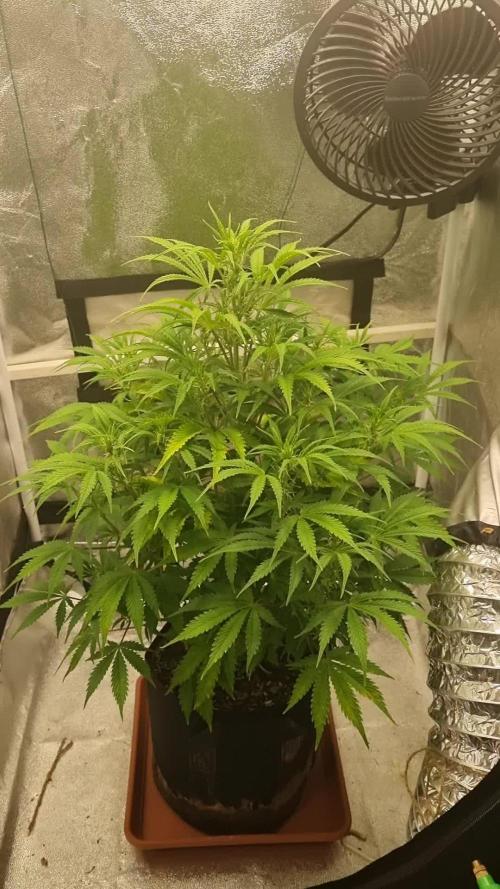
+ data+charts online rakongrow.lima.zone/growme-mango-kush-auto-015.html Tag 54: die knospen fangen an !!! Aber sie wächst noch jeden tag 2-3cm Tag 52: es blüht, es wächst und macht ordentlich blätter und säuft jeden tag mehr . Tag 50: läuft alles , gibt jetzt ca alle 42 Stunden 1.5Liter . 0.5Liter von unten und 1.0 Liter von oben . es entwickelt sich gut . Licht ist auf max und immer ca 4-5cm mehr abstand (ca 35cm bei der LED) zum wachsen . Ich habs sehr sauer gemacht, weil ich ja noch die anfangs ph fehler drinne habe. CalMag geb ich so wenig wie möglich , solange es grünt scheint es nicht falsch zu sein . +

Likes
1
Share
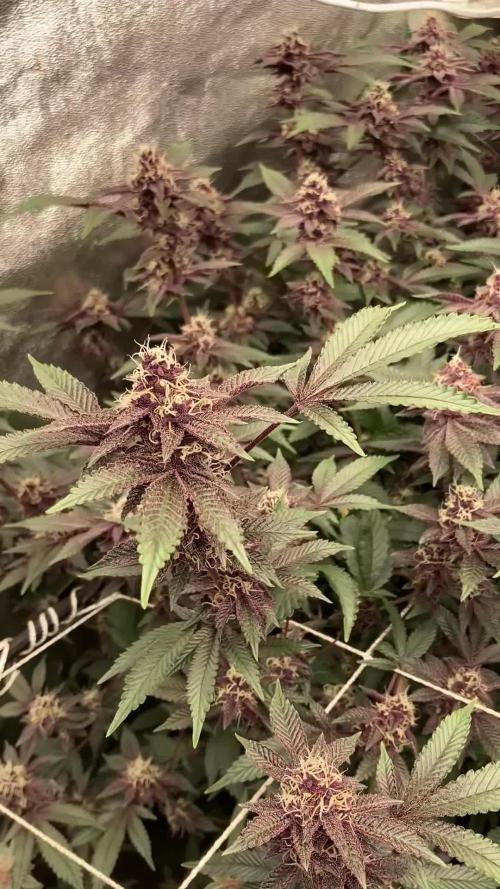
So week 4 of flower is in the books and things are going well. Noticing a cal/mag issue in the jehovas witness but not the others. Growth has been strong and the fatality has taken over she has outgrown my five foot tent so am moving everything to a brand new 5x5 that’s 8 feet tall so I’m hoping I can spread them out some and allow light to reach the middle canopy because I have lollipopped all the lower larfy bullshit. Looking forward to a strong finish.
Likes
13
Share
@valiotoro
Follow
Another super terpy tasty baby strain💜 Rockdense buds
Likes
6
Share
12/12 first week #starskreamstash looking pro,ising Dropping the night temps.... Happy Growing added some strawberry fields soil repotted to gallons
Likes
47
Share
@Reyden
Follow
È arrivato il momento di pulire i boccioli delle ragazze di @anesiaseeds che sono fenomenali con dei fiori gelidi, pieni di resina, un ottimo profumo che ancora dovrà migliorare nel tempo…cercando di fare una buona concia che è sempre importantissima nel processo di guarigione per avere un fumo delicato e non pesante per la gola, questo fumo è già ottimo! Ottimo lavoro Anesia Seeds
Likes
1
Share
@Crwfz1
Follow
The girl came out great fat dense buds and boy they are skunky cant wait to taste 😋 was a joy to grow and easy as could be as usual a little slow but decent yield for the second run on that soil time for new stuff next round
Likes
2
Share
We become aware at such times of man's wonderful ability to bring seemingly unrelated elements into harmonic balance, and receive a glimpse into a world where everything exists in conscious sympathetic attunement to everything else. When we listen to a piece of music that seems to strike a beautiful chord somewhere inside us, or view a painting that simply glows with harmonic awareness well executed, we probably do not spare much time to contemplate the wonderfully intricate combination of vibrations that our sensors make it possible for us to perceive. We tend to appreciate the relationship between the parts of something by an awareness of the harmony or dissonance of the whole. This ability enables us to say "what a beautiful house!" instead of "analysis has proven that this collection of building materials exhibits certain elements of harmonic proportion." While this ability to instinctively appreciate the beauty of true harmony has an important role to play in evolution, a more analytical understanding of the laws involved can be most useful. This is especially so if we wish to create works of art where each part exists in true harmony, not only with the other part of that particular whole, but with the universe within which the creator and the created exist. Everything vibrates. From the most dense matter to the most subtle cosmic rays, everything which our senses allow our thoughts to become aware of, can be specified in terms of wavelength or frequency of vibration. These two terms define the same thing, but from different points of view. The following are the approximate wavelengths of various energy carriers: Cosmic rays 0.000,000,001 mm Gamma rays 0.000,000,1 mm X rays 0.000,500 mm Ultraviolet rays 0.003 mm Visible light 0.006 mm Infrared 0.01 mm Sound waves 1 meter Radio waves 300 meters Violet light 400 nm to 450 nm Blue light 450 nm to 500 nm Green light 500 nm to 570 nm Yellow light 570 nm to 590 nm Orange light 590 nm to 610 nm Red light 610 to 700 nm 1 nanometer (nm) = 0.000,000,1 cm = 1/10,000,000 cm If a guitar string is plucked and we hear a sound, it is not too difficult for the human mind to associate this sound with the vibration of the guitar string. With color it is quite different. It is difficult for us to conceive that the color of a substance is not an inherent property of the substance itself, but an indication picked up by our senses of that substance's ability to absorb or reflect the light which happens to be shining on it at that moment. Neither the matter nor the light is colored. What happens is that the brain learns to differentiate between the frequencies reflected or transmitted by the substance the eyes are focused on. The same thing happens with sound. When we say "Oh! Listen, they're playing my favorite song," what we really mean is: "My brain has stored within it a particular pattern of frequencies. I have compared the new information being received with this stored pattern and have deduced the answer that the two patterns are similar within certain specified tolerances." The 'pleasure' involved could have something to do with our running the pre-recorded pattern at the same time, in 'sympathy' with the new pattern as it is received. The word sympathy describes very well our ability to appreciate color and sound. It also describes the reason behind certain elements of harmony. For instance, if a substance vibrating at 100 cycles per second (tone 1) is in the proximity of another substance vibrating at 200 cycles per second (tone 2), we could perceive, if we had the right equipment, a certain sympathetic relationship between the two. We will see from this that there is a uniform doubling of the first tone seen in the second. At various points along the waves, the two are the same in amplitude. At other points, they are at opposite poles to each other. This doubled frequency has more points of similarity to the original than any other frequency except the original itself. If the equipment we had available for measuring these two frequencies was a soundboard amplifier and a pair of ears, then we would hear what would sound to us like one tone. If we had the opportunity to hear one at a time, we would hear that although they sound the same, one is higher in pitch than the other. This characteristic of 'the same but different in pitch', musicians have called the octave. Any two tones produced where one has exactly doubled the frequency of the other is called an octave. Speaking in ratios, an octave would appear then as the ratio 2:1 or 1:2, depending on whether we are talking of an octave up or down. A single note produced by almost any instrument will contain more than one wavelength or frequency. It will have a dominant frequency, the wavelength of which we would call the note's 'fundamental' or 1st harmonic. It will also have a varying number of upper harmonics, gradually fading in intensity into infinity or silence. Natural harmonics always have the same pattern of intervals between them. The interval between the 1st and 2nd harmonic is a perfect octave; between the 2nd and 3rd a perfect fifth; between the 3rd and 4th a perfect 4th; and so on, the intervals becoming smaller and smaller until they lose any relationship with the western 12 tone scale as it exists at the moment. Just as an octave has certain elements of sympathy with its fundamental, so some intervals have been noted to be more perfectly in sympathy with the fundamental than others. The ratio of the 'perfect 5th' or interval of 7 semitones, as it occurs in the harmonic series, is 3:2 or 2:3, while that of the 'perfect fourth" is 4:3 or 3:4. All the tones in the western 12 tone scale can be expressed in terms of the ratio between the upper tone and its fundamental. This would seem to be an ideal way of generating a scale from any given fundamental and several attempts have been made to do this, the Pythagorean system being probably the most well known. Although when working with a single tone instrument playing on its own, the Pythagorean formula works wonderfully well, if we had several instruments tuned this way together and asked them to play almost any western music, we would find that at times they sounded quite out of tune to each other. The lack of flexibility of the various scale systems based on the harmonic series has led to what is known as the 'tempered' scale. This uses as its primary unit of interval the ratio of the octave or 2:1. It then proceeds to divide the interval between any fundamental and its upper octave into 12 smaller intervals by applying the ratio: two to the one-twelfth power, to one (21/12:1). This equals 1.059463094, so by multiplying any frequency by this number, we will obtain the tempered semitone next up from our fundamental. We will also find that any tone twelve semitones up from any other tone, in a scale generated in this way, will have exactly double the frequency. If we took the note middle C on a piano and halved the wavelength, we would have the note C one octave above. If we halved this, we would have the C above, and so on. However, within about 6 octaves, we would find that although a 'sound' was being produced, no human ear could perceive it. If we kept on going, halving and producing upper octaves of our fundamental C, we would proceed through the infrared band, into the visible light spectrum. If we happened to be outside during the day, we would, for one octave only, see the note C with our eyes. The next octave above would already be in the ultraviolet band, and outside the eye's sensitivity range. If we can think of color as being an indication of a substance's vibratory rate or wavelength, we may begin to see a relationship that could exist between the color and sound spectrums. The logical extension of what has so far been said is that there exists a scale in the color spectrum that corresponds exactly to the scale in the sound spectrum, each color tone being an octave of the equivalent note in the sound range. This is not the end of the story but only the beginning. If we can for the moment accept that any wavelength in one band has upper and lower octave stretching out to infinity, then the next question is 'fine, but what shall we use as our fundamental? A particular color? A particular sound frequency?' The musicians among us will probably say 'A 440'. This means that the note A should vibrate at 440 Hertz, or 440 times per second. They would tell us that this is standard pitch has been adopted by most orchestras around the world; pianos are tuned to it, instruments are constructed to formulas based on it, and so to them it would probably seem the most appropriate place to begin. Some of these musicians may know of the battle that is still raging with regards to this being the standard, but few would know why A = 440 Hz was chosen except that it worked when it was set to be a suitable compromise between the many different pitches in use at the time. 432 Hz is said to be mathematically consistent with the patterns of the universe. Studies reveal that 432 Hz tuning vibrates with the universe’s golden mean PHI and unifies the properties of light, time, space, matter, gravity, and magnetism with biology, the DNA code, and consciousness. When our atoms and DNA start to resonate in harmony with the spiraling pattern of nature, our sense of connection to nature is said to be magnified. Another interesting factor to consider is that the A=432 Hz tuning correlates with the color spectrum, while the A=440 Hz is off. Audiophiles have also stated that A = 432 Hz music seems to be non-local and can fill an entire room, whereas A=440 Hz can be perceived as directional or linear in sound propagation. Once you adopt the idea that sound (or vibration in general) can have an equalizing and harmonizing effect (as well as a disturbing effect), the science of harmony can be applied to bring greater harmony into one's life or tune to specific energies. There is a form of absolute and relative harmony. Absolute harmony can, for example, be determined by the tuning of an instrument. The ancients tuned their instruments at an A of 432 Hz instead of 440 Hz - and for a good reason. There are plenty of music examples on the internet that you can listen to in order to establish the difference for yourself. Attuning the instrument to 432 Hz results in a more relaxing sound, while 440 Hz slightly tenses up the body. This is because 440 Hz is out of tune with both macro and micro cosmos. On the contrary, 432 Hz is in tune. To give an example of how this is manifested microcosmically: our breath (0,3 Hz) and our pulse (1,2 Hz) relate to the frequency of the lower octave of an A of 432 Hz (108 Hz) as 1:360 and 1:90. It is interesting to note that 432 Hz was the standard pitch of many old instruments and that it was only recently (19th and 20th century) the standard pitch was increased. This was done in order to be able to play for bigger audiences. Bigger audiences (more bodies) absorb more of the lower frequencies, so the higher pitch was more likely to “cut through”. One of the oldest instruments of the world is the bell ensemble of Yi Zeng (dated 423 BC), tuned to a standard F4 of 345 Hz, which gives an A= 432 Hz. The frequency of 345 Hz is that of the platonic year! Similarly, many old organs are tuned in A=432 as well; for example, St. Peter’s Capella Gregoriana, St. Peter’s Capella Giulia, S. Maria Maggiore in Rome. Maria Renold’s book “Intervals Scales Tones and the Concert Pitch C=128 Hz” claims conclusive evidence that 440 Hz and raising concert pitch above scientific “C” Prime=128 Hz (Concert A=432 Hz) disassociates the connection of consciousness to the body and creates anti-social conditions in humanity. The difference between concert pitch A=440 Hz and Concert A=432 Hz is only 8 cycles per second, but it is a perceptible difference of awareness in the human consciousness experience of the dream we share called existence.
Likes
16
Share
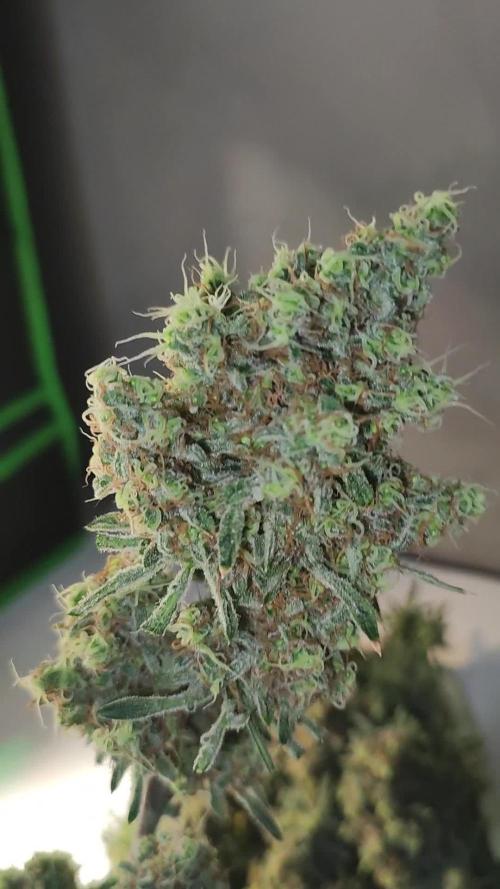
Today marks the 7th week of flowering for my cannabis plant, and it's truly fascinating to observe the changes that are taking place. The stretching phase has officially come to an end, and now the plant is fully focused on developing its buds. I can see that the buds are starting to swell and gain size, which is a promising sign of a healthy flowering process. I've adjusted the feeding schedule with BioBizz products to match the plant's current needs. Overall, the plant looks healthy and vigorous. The pistils are turning a beautiful shade, and the resin production is beginning to increase. I’m excited to see how the buds will continue to develop over the next few weeks. I’ll keep monitoring closely and make sure everything stays on track. Be excited for the coming weeks 💚🌱🌱
Likes
31
Share
I did feed her with Recharge and Big Bloom last weekend, but since then I've been giving water only and gave a good flush watering on Thursday. I am planning on harvesting her in stages. I'm going to cut the top 2 nodes (the ones with the most LED burn) on Monday, then cut the rest of the plant next weekend. I'm curious to see how much the lower buds benefit from this. Green Crack is the plant on the far right in the group shots. Update: I started cutting her down today. Cut down the top 2 nodes and left the rest of the plant. Will let the rest grow one more week before taking her down completely. So far 6.5 oz wet weight. That alone should be over an oz dried! 👍 New pics added too
Likes
19
Share
@RFarm21
Follow
Semana 6 ( 19Nov - 25 Nov) 20Nov - Alimentada com 1.5,L de água. Runoff EC: 1,18 / runoff pH: 6.4 24Nov - Alimentada com 2,25L de água: - BioGrow: 2ml ; BioBloom: 3ml; TopMax: 1ml; BioHeaven: 2ml; Acti-Vera: 2ml; calmag: 0.5ml Ec: 0.75 ; pH 6.2 Runoff EC: 1,61; pH 6.4
Likes
41
Share
15 Day dry then trimmed using the Trim Bin. Curing with Grove bags, first harvest filled 3, 1/4lb grove bags. *Updating with clone pictures of this pheno in late flower labeled in diary as you look through, If I pop a new seed of this strain Ill start another diary
Likes
12
Share
Good harvest ! We’ll see the results after dryin
Likes
15
Share
Processed 2 plants and took some colas off one of the remaining plants make sure my washing volume is consistent. Holy smokes some amazing rosin. Consistency and terps are loud and stinky. Very potent effects. This mfker will put you on ur ass. The fresh press rosin is just outta this world. This strain dumps trichromes. What a great experience. Half way done and I have nearly 80 grams of rosin. Insane! Business is boomin
Likes
37
Share
So nun endlich wieder Zeit gefunden um die 8. Woche hier einzupflegen. Ist schon paar Tage her. Auffällig ist das die OG Kush ziemlich lang braucht um in die Blüte zu gehen, da haben die anderen sich mehr beeilt. Die Zkittly zeigt das sie ein ein ordentlicher Sativa Pheno ist. Ansonsten super gesund, immer noch kein gelbes Blatt in sicht.
Likes
13
Share
Unfortunately I had to harvest early due to personal reasons. I am proud of my harvest though. The buds could have gone another week but that’s fine. The trichomes were to my liking. They’ve been drying for about 5 days now. All in all it was a pretty easy grow, just water every couple days and top dress every 3 to 4 weeks. I did make some very potent canabutter from the trim 😋
Likes
1
Share
Total days above ground: 63 Total flower nights: 24 Just beyond 3 weeks into flower and the plants are showing their potential. The Mountaintop Mint has made great strides but is still a lanky bitch. I had to HST every branch, and may need to bend a couple more down before vegetative growth abates. Not a fan of this growth pattern and still unhappy about 2 out of 9 seeds providing a viable outcome. The bright side is that yield should be fine given the plethora of bud sites. Despite being difficult to grow next to other plants, I feel much better about its prospective outcome than I did just 1 week ago. That whole "crazy shit can happen in flower" thing rings true, again. Overall the canopy has filled in nicely. I have a couple spots where light is wasted and I'll make some adjustments to the process to fix that for future grows. Now that I've settled on plant size and number of plants, improvements can be made each cycle until it's clockwork. I like the 12-cola vs 8 cola experiement. I've got a fairly long list of edits to make to various sections of my "bible," which means I liked the outcomes of most of my incremental adjustments. Continual, systematic improvement in action... One other incremental change on the docket but not yet realized will be dropping nutrient concnetration once vegetative growth ends. Exact timing will be based on what I see in the foliage. I see some minor tip curl and its a bit darker than I want. So, it may come sooner than later. This'll be something I tweak over the next few grow cycles until I'm happy with the late-flower health. I'll drop fertilizer concentration 10-15% on next refill and see how that plays out. It'll take a couple refills of reservoir to near 100% transition without draining it. If necessary, I'll drain and do a full refill for more pressing needs. A rez scrub before final stretch is coming, regardless. Side note: The impacts of VPD can be enormous. Last year (2025-2 diary) I had a humidifier wick get fouled and RH dropped while VPD spiked for more than a few days, thinking I could power through or that the canopy would soon provide more moisture. Nope, growth stalled in a significant way. By comparing day 34-42-49 of 2025-2 and day 38-42-49 of this diary, I can see a huge difference in growth at same point above ground. The consitency with which i do things makes it fairly certain it's the extende period with extremely high VPDs that caused the difference. Also, interesting that it mostly catches back up by completion of third week of flower. The size difference is nearly undone by this point, though 2025-2 took 4 days longer vege phase to get there. Even so, I still think this grow is more than 4 days ahead of 2025-2 (the difference in vegetative phae duration). Time will tell if the development is ahead of the pace in 2025-2 or whether it's simply mostly an offset due to a less efficient vege phase for 2025-2.
Likes
21
Share
@Wastent91
Follow
Eccoci ragazzi! Ultimo giorno Dell anno e anche ultimo giorno di vegetativa! Da stasera precisa si cambiano ore di luce e la porto in fioritura, nonostante la sorella è molto più piccola, nn posso aspettare oltre altriementi questa mi diventa troppo alta e grande e avrò problemi.. Quindi come potete vedere da voi, la ragazza sta davvero in ottima salute! Nessun segno di carenza, un verde intenso che è segno di benessere, e radici davvero enormi e giganti! I nodi del fusto sono grossi e spessi quidni penso proprio che nn dovrò mettere alcun sostegno alle cime, sono convinto che questa sarà una delle mie migliori piante idroponiche mai cresciute, è il mio secondo ciclo hydro e sto mettendo a frutto le conoscenze apprese dalla prima esperienza, dalla quale ho tirato fuori un erba spettacolare, ma le cime erano piccole e le piante erano troppo alte, speriamo questa volta che nn accada lo stesso con questa! Questa genetica unita ai nutrienti Terra Aquatica, ha fatto in modo che la pianta avesse un vigore eccezionale! Ma visto una pianta crescere così rapidamente, in suolo o in altro modo, l idroponica se fatta bene con i prodotti giusti ti da risultati impressionanti, basta che alla fine si fa un bel lavaggio delle radici con i prodotti giusti e acqua pura, e vedrete che avrete Dell erba spettacolare! Sono orgoglioso davvero di star avendo un risultato così spettacolare, mentre l altra volta ho avuto problemi di carenza di Cal/mag questa volta glielo ho dato fin dalle prime soluzioni nutritive, quidni verde intenso e foglie spesse, già ora fa odore nonostante nn ci siano fiori! Cmq sono davvero orgoglioso di far parte di questa famiglia spettacolare che è questo social! Mi sta dando le soddisfazioni poi grandi di tutta la mia vita! Grazie sopratutto a tutti voi che mi seguite e mi sostenete, xke senza di voi nn sarei nulla! Un buono anno a tutti e vi auguro un 2026 pieno di soddisfazioni e successi! L entropia Dell esistenza cosciente umana può solo aumentare! Speriamo. Che succeda anche nel mio paese dove non questa mia passione è illegale.. Speriamo bene per il. Prossimo anno venturo.. Un buono 420 a tutti 💪😸🌱🌿🎄🤞🍀🤤😽💨❄️🎉❤️❤️❤️
Likes
19
Share
@Lazuli
Follow
She finally puts on some decent weight, i keep feeding strong for another week
Likes
2
Share
@Xpie77
Follow
🌱 Kweekverslag – American Patriot (Weedseedsexpress) 📅 Week 5 – Laatste week vegetatieve fase (groei) Licht: Mars Hydro 450W LED (18/6 schema) Potten: 11 liter Medium: Potgrond Temperatuur: 24–27°C (dag), 19–21°C (nacht) Luchtvochtigheid: 50–55% Afstand lamp – planten: ±35–40 cm --- 🔍 Algemene Observaties: Hoogte: 35–45 cm Structuur: Compact maar breed door training Gezondheid: Planten zijn sterk, donkergroen blad, stevige hoofdstam Training: LST voortgezet op alle planten Laatste toppen uitgevoerd begin week --- 💧 Water & Voeding: Watergift: ±1–1.2 L per plant om de 2–3 dagen pH: 6.3 Voeding: Bio-Grow: verhoogd naar 1.5 ml/L Root Stimulator: 0.5 ml/L Drainage gecontroleerd, geen tekenen van overvoeding --- 🌿 Groei & Ontwikkeling: Nieuwe toppen ontwikkelen zich symmetrisch Zijtakken zijn krachtig → veel toekomstige bloeiplaatsen Bladoppervlak goed gevuld, maar luchtcirculatie blijft optimaal --- 🔄 Acties deze week: Laatste LST doorgevoerd voor begin bloei Diepere controle op ongedierte (alles schoon) Voorbereiding om over te schakelen naar 12/12 lichtschema eind van week 5 --- 🔮 Vooruitblik op Week 6 (start bloei): Lichtcyclus veranderen naar 12/12 Overschakelen op bloeivoeding (bijv. Bio-Bloom of vergelijkbaar) Eventueel defoliëren van onderste schaduwbladeren Nauwkeurig monitoren op stretch en bladkleur