


Likes
Comments
Share


@DigiDom
Follow
She seems to doing well but I'm curious to see what will happen if I keep trimming her to shape her. Instead of having to lollipop later in the grow.

Likes
14
Share


@Bread_n_Buds
Follow
We are about on earth since a month our photoperiod plants are multiplying their florets and then going into flowering.
The Black Runtz is a short lady like her normal colored little sister, with a low internodal distance. This characteristic greatly influences the application of growing techniques. In this case it is a plant that responds to topping a little slower than the others and it is best to wait for the branches to grow to avoid damaging the little ones. However, we are at 4 florets and between tomorrow and the day after tomorrow we will cut 8. My plan for photoperiod plants is to get to 16, wait a few days and go into flowering. 16 florets as I see it is the perfect size for the 11 liter pot.
Topping is an extremely delicate moment as regards cutting the tops to split them, we always pay attention not to damage the new branches growing.
Topping is also a delicate moment as regards fertilization because the plant slows down and absolutely does not need all that nitrogen that it would normally need and that the producers recommend in their sheets. So you should arrive with the plant green and perfectly in shape at this moment and dose the fertilizer very well for growth.
Mine came from a slightly deficient veg because I kept it low fearing this over effect during the topping that I know well and now I am a bit over. Nothing to worry about, of course, but if you do repeated topping, my advice is to use preferred soil or prepare the soil with Monster Bud Mix by Zamnesia or Plagron Super Mix, in short, enrich the soil at the start and only add nitrogen if necessary, especially during repeated topping.
In any case, everything is under control and I will demonstrate it to you during the flowering phase. Wait for the Uncle BreadandBuds and see what it does to you.
Remember that cold temperatures make the girls absorb food much more slowly than in summer, so be careful to give the right amount and let the plant dry in maximum 2 days or you risk imbalances.
We are always using soil, feeding and all the recommended additives from Plagron 100& organic, we have only lowered the amount of grow in this topping phase for the reasons mentioned above.
---- Decide on the right soil and calculate your fertilizer sheet based on the soil on the official website.
-- www.plagron.com
Try a seed of this strain that drives us crazy..
-------- https://www.zamnesia.io/en/11159-zamnesia-seeds-black-runtz.html
Zamnesia Description // Black Runtz comes from a truly legendary genetic pool. Our breeders used three modern classics from the United States to create this strain: Zkittlez, Gelato, and Runtz. With 20% THC and flavors of grapes and berries, Zkittlez passed on her delicious flavors and relaxing effects. Gelato contributed to Black Runtz's immense flavor profile by passing on high concentrations of the terpenes limonene and humulene. Finally, Black Runtz inherited the high potency of the original Runtz, a strain with a respectable 21% THC. The end result of this 3-way cross is a strain with 55% indica genetics and 45% sativa. Black Runtz boasts rapid flowering times, high potency, and contrasting yet balanced terpenes that supports its delicious flavor profile.
All the best that mother nature can offer is on ---- www.zamnesia.com

Likes
24
Share


@Tmasm
Follow
Zamnesia, obrigado por fornecer a genéticas para testes.
Entrega segura, dentro do prazo e muito discreta, como você pode ver nas fotos.
Experiência para possível plantio em massa, dependendo dos resolvidos.
1 BISCOTTI (ZAMNESIA SEEDS) FEMINIZED
Já germinada
1 JEALOUSY (ZAMNESIA SEEDS)
Já germinada
1 SUNSET SHERBET AUTOMATIC (ZAMNESIA SEEDS) FEMINIZED
Será germinada no próximo mês, devido temperatura elevadas, temos dias chegar 40c⁰, não quero automática stressada, logo ao início.
O diário será atualizado toda semana, espero que gostem (eu também).
Likes
17
Share


@Ieiogrow94
Follow
Eccoci alla fine!!!
Pianta dall’odore spaziale nel pulirla mi ha sballato! Super compatta e molto molto resinosa 💚
Sicuramente verrà riprovata in vaso più grande in quanto ha davvero un potenziale immenso, gradita veramente molto!
Grazie a tutti per il supporto ❤️🔥🌲
E grazie a @Exotic_Seed per la collaborazione ❤️

Likes
23
Share


@Gram_Solo
Follow
Final Week for 2 of the Runtz
🔥🔥🔥
I am flushing the 2 plants at the front of the tent! they looking super frosty and feel dense! 100% ready now!
I am doing all the others with same feed as last week , added overdrive aswell as there is some frost picking up and amber trichomes!
Smells so good! early harvest very soon!
2 front plants will be put into drying next week for 15 days. then others should be ready to repeat 😁
Update 03/05/25
I have now put the 2 plants being flushed in the 3x3 for a 3 day dark period then we doing the Chop and dry for around 15 days
Will take some snaps this weekend and pick up that frossst! update very soon! 1 looking so phat! I snapped a main stem off in early flower and its pumped into 2 massive colas!!
BOOM!
Nearly at the end of the grow!
its been Emotional! 😎


Processing
Likes
15
Share


@420Consinc
Follow
- WEEK 8 -
----- Day 50 -----
Woo hoo. End is in sight and the plants are still PACKING the pounds on.
Big Bertha is 11 inches long, 2 inches wide.
The hidden massive Gertha is 8 inches in circumference in the middle in just bud alone and isn't even the largest part of this 8 inch long nug...
Fed 1150ppm 13L 6.4pH
5-15+ days left.
2-4 days till I start looking into trichome finish period.
Forgot to take a regular full shot and shots of tropicanna glookies. oh well. Later tonight if I remember.
I stopped bud candy cause I'm using a lot more molasses and its literally a sugar in itself so why put in bud candy which is just sugars... seems redundant.
----- Day 51 -----
Easy day of watching.
Some nice bud shots today. The whole basement smells of weed candy. Back right Tropicanna is pineapple gummy bear, front right is just gummy bear.
Wedding Cake is like sweet weed, you get the regular smell of pot but instead of skunky its sweet but that Tropicanna is just alllll candy no weed smell at all.
I did the first 60x shot today. 5% cloudy 95% clear on the Tropicanna. Long ways to go.
I'll be doing the Wedding Cake later tonight, got side tracked.
----- Day 52 -----
Fed 1200ppm 6.4ph 12 Liters
Tropicanna Glookies is going full blown purple. Should be covered in dark purple coloration within the week.
Wedding Cake is just fat. Super fat large nugs.
Easy day. Forgot to take trichome pics of Wedding Cake will do that later today probably.
Well, the largest bud is 1 foot in circumference now... rofl
----- Day 53 -----
Easy day. Fed some water, they're getting thirsty again.
I'm going to do a 13L feeding , then next day 5L water. So that's what I did today.
I'll be dropping the Kool Bloom Powder & CaliMagic by day 56 and only feed 1/2 strength molasses only.
Will pick the buds off as they finish, not gonna do 1 big chop unless it manages to turn out that way.
Colors are going wild.
Will check Wedding Cake & Tropicanna trichomes before lights out will update pics then.
----- Day 54 -----
1300ppm 13L 6.4ph fed
Here's some pics.
Wedding Cake is nowhere near ready by the trichomes. Barely any cloudy, no amber.
----- Day 55 -----
Tropicanna really turning purple now starting to infect the leaves at top of canopy.
Can't wait for what Day 63 holds for all these ladies.
Not going to check trichomes till probably day 58
Easy day, last fert feed with chemical nutrients tomorrow, after that its just molasses.
----- Day 56 -----
Didnt even bother with ppm/pH.
Molasses. roughly 30-50ml in 13-15 Liters.
Smoked a tester of the Tropicana Glookies (Sativa)
God daaaamn. Shits fire. Extremely strong. Very Cerebral and its not even at its peak yet...
I've chosen Tuesday as Harvest day for both Tropicana Glookies plants (they're clones of each other)
A single Wedding Cake testing nug is drying right now, I'll judge when it gets harvested based on the high, and if not sufficiently near my level i'll give it 2 days before drying another nug and trying again. I want heavy ass couch-lock.
6 days for Tropicana.
Probably 8 for Wedding Cake.
Will send samples off to Canvas Labs for testing like I've done in the past and will be making both edibles and bubble hash and will post those here as they happen.
Once thats done I will see if I can restart veg mode in this grow, and if so I will keep this going until the plants die (and just make side diaries for each individual plant variety grow).
Should be interesting.
*** update ***
Where'd the 1.5 Liter water bottle go?
rofl

Likes
3
Share

@MrBurnone19
Follow
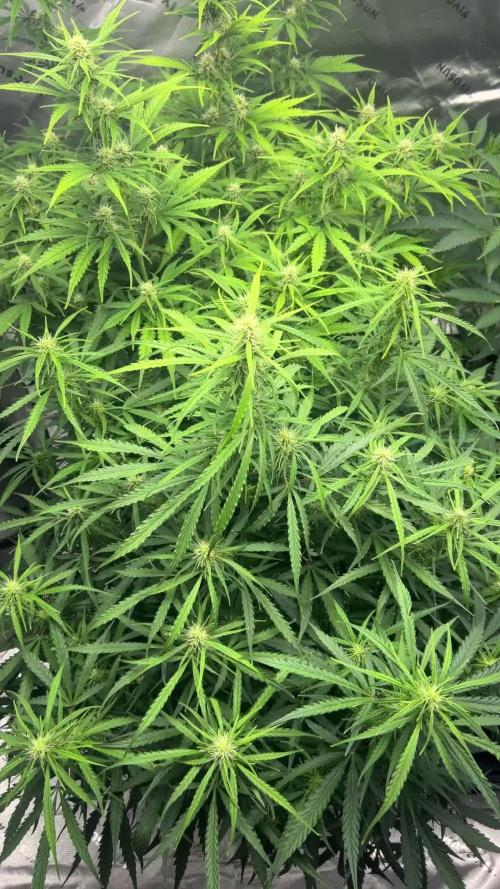
Both of them giving off two distinct olds one is given off for citrus fresh peeled orange smell. The other is given off a cookie dough, sweet sugar, cookie dough.

Likes
12
Share


@DutchBarnacle
Follow
Welcome to veg! 🎉🎉
Day 7: 300ml camomile cinnamon tea (pH 6.0)
Well, it seems the fungus gnats are out of troop replenishments. Activity has died down somewhat but there are still some adults crawling around. We'll have to be patient.
She's doing great though and we won't have to worry about her damping off. PPFD has been increased to 475 and we're now back on the 18/6 schedule, and the DLI is now 30.
Day 12: 300ml camomile cinnamon tea (pH 6.0)
The SQA was defoliated to slow down the main apex and allow more light to the lowest nodes. In hindsight, this might have been a bit too early but unfortunately we cannot reattach the leaves.

Likes
5
Share


@Grow_for_Happiness
Follow
So at start of week i raised the three smaller plants and evened out the canopy. That lasted maybe two days and then back right took off and is again 6-8" taller than any other plant hahah. Was able to raise the reservoir and the water lines to maintain flow to all the pots. Rest of week was hands off as I had family in town for a few days so just kept the reservoir filled. Last day of the week gave the girls a decent defoliation and adjusted the ties, attempting to fill every spot in the tent. Now there is a slight space in the center, but it will fill in as the girls grow.
Starting to get a little worried with how big these girls are getting. Already they are 8-10" bigger than the Night Howler autos I grew last year, and those were my biggest ever with two plants ending ABOVE the lights!! Hope the big one stops soon, but as a precaution I have removed the filter and placed on end of exhaust, gaining another 8" of room to raise the light. Driver also outside tent this run, so will gain 2" over previous ones.
Plants are needing a bit more defoliation than normal, with their enormous leaves they fill the tent very quickly! Before defoliation was full shade under canopy, now getting light/air through.
Let's see what happens this week, I'm expecting some decent growth from left two plants, hoping to get them off the Milk crates soon and nice to have an even canopy for more consistent bud quality and whatnot.
Lights 80% 8-18" averaging 700-750 umol/s
4" Intake 50% + 1 passive vent open
6" Exhaust 40%
Upper Oscillating fan 30%
Lower oscillating fan 50%

Likes
9
Share


@Grower2021253
Follow
This diary is going to be a day by day if I keep up. Unless I am on vacation I will take pictures every day.
Sorry for some of the potato quality pics earlier on. After week 2 or so I'm going to only take pics with my camera flash.
The first image is about a day after sprouting. No pictures for the pineapple for the first week as I wasn't sure if it was going to grow or perish. It must have had a mild root infection but it has won the battle against it as of now and is doubling in size daily after a week of not doing much.
I am using a uv light in the reservoir. My method is using 3-D printer root sprayers to pump water directly to the roots, I also have an air stone in each 5 gallon bucket. I have an overflow on each bucket to drain the water back into the reservoir. I positioned the buckets on top of chairs to let gravity do its thing there. Humidity has been fine lately so I am not using the dehumidifier. Future grows I will get a controller to turn the dehumidifier on if needed. I wanted to clone these but realized it's not good to do with autoflowers so I have ordered regular feminized purple haze and cbd blueberry for my next grow. Stay tuned!

Likes
19
Share


@TheCannaProphet
Follow
----------------------------------------------
~Sweet Seeds Sweet Zenzation (SWS84)~
----------------------------------------------
Zkittlez is one of the most famous and potent strains found on the west coast of the USA. Sweet Zenzation (SWS84) derives from a cross between an elite clone of Zkittlez combined with a specially selected Grape Ape clone, which is one of the strains used to develop the original Zkittlez.
The result is a predominantly Indica genetic hybrid. It produces a large amount of resin-soaked flowers. It is both relaxing and stress-relieving, yet it also stimulates the imagination and conversation, an effect that is normally associated with sativa strains.
The flowers have a high terpene content, an exquisite aroma and sweet taste, with hints of fruit-flavored candies, hardwood undertones, shades of lemon, cypress and subtle aromatic peppers.
Variety: Sweet Zenzation (SWS84)
Indica: 70%
Sativa: 30%
THC: 16-23%
CBD: 0.2%
Indoor Yield: 450-650 g/m²
Outdoor Yield: 400-700 g/plant
Effects: Creativity, Stimulating, Happiness, Relaxing
Taste: Spicy, Fruity, Citrus, Lemon, Candy, Cypress, Sweet
________________________________________________________________________________________________________________________________________________________________________________________________________________________________________________________________________________________________________________________________________________________________________________________________________________________________________________________
THE SETUP:
~Planted into Jiffy Peat Pellets that were hydrated with de-chlorinated water with SuperThrive added then ph'd to 6.0 @ 80℉
~Grown 100% organic in 10g fabric pots with Mother Earth 70/30 Coco/Perlite medium amended with 2tbs/g of Down To Earth 4-4-4 / 2 cups/g of Earthworm Castings / 1tbs/g of Dr. Earth Flower Girl 3-9-4, 1tbs/g of Dr. Earth Bat Guano, 3/4 cup of Down To Earth Azomite and 1 tsp/g Down To Earth Fish Bone Meal.
~24hr light cycle during Germination / 19/5 light cycle for Vegetation and 12/12 for Flower
~Straight water ph'd @ 6.2-6.8 when needed and weekly Compost Tea's.
__________________________________________________________________________________________________________________________________________________________________________________________________________________________________________________________________________________________________________________________________________________________________________________________________________________________________________________
Weekly Updates:
9/20- 💥BOOM!💥 Week Six of flower is here and my girl's in high gear, stacking her flowers and pumping out trichomes!
Today I watered her with 1.5g de-chlorinated water with 5ml/g of Botanicare CalMag+ added, then ph'd to 6.2 @ 72℉. I turned her pot and plucked a couple of yellow shade leaves...the basic daily maintenance.
9/22- I didn't water her yesterday as she looked great and was 'praying' hard. Today she was given 1.5g of de-chlorinated water which was ph'd to 6.2 @ 72℉ which I gave her through her drip pan (bottom chuggin) and I also gave her pot a turn.
I'm keeping an eye on what appears to be a few seeds developing. I'm hoping they're just fat calyx's that haven't matured yet however there's a strong possibility that, due to a temperature fluctuation that was excessive (20℉) may have caused her to stress and turn hermaphroditic... Fingers crossed! 🤔🤞
9/24- We're getting close to wrapping up Week Six of flower in a couple of days and she is right on track to be finishing up in the next 2-3 weeks.
I didn't water yesterday and today I went ahead and gave the last Top Dress of Dr. Earth Flower Girl 3-9-4, Dr. Earth Gold Premium 4-4-4, Down To Earth Bio-Fish, Down To Earth High Phosphorus Bat Guano and Worm Castings.
I watered in the Top Dress with 1.5g of de-chlorinated water which was ph'd to 6.2 @ 72℉ and let her enjoy her meal! 😜
9/26- After her heavy watering on the 24th I didn't water yesterday and when I checked her today at 'lights on' and she still had some weight to her pot and her leaves were praying hard so I held off on watering today and will hit her tomorrow with her usual 1.5g watering.
~Thanks for stopping in! Things should be getting a lot more interesting in the coming weeks...Stay lifted and be Blessed! 😎🙏~

Likes
5
Share

@Marijuanaut
Follow
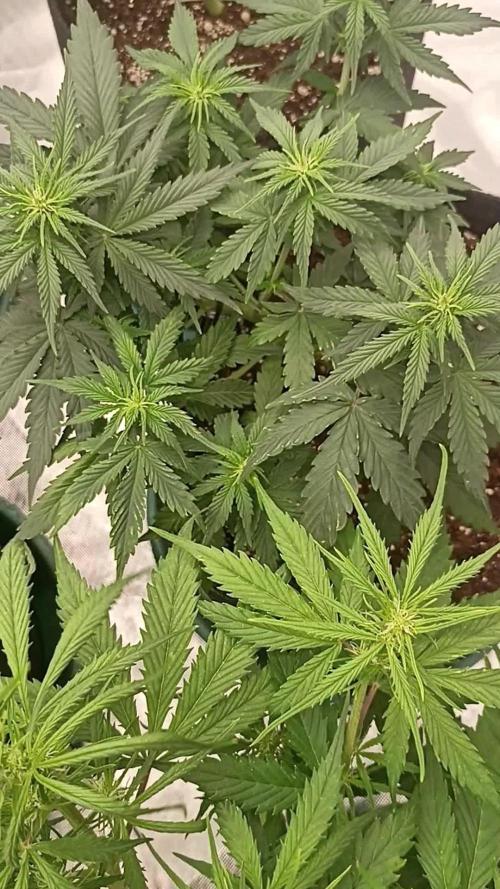
Tottaly forgot to take some pics from the dutch passion strains this week... all I got is a group photo and short video!
Could have been a bit more hands on with the training but seems a like a nice and even canopy it´s emerging 😍
Defoliated a bit and trimmed the lower branches.

Likes
62
Share


@JuanHaze_Arg
Follow
Las flores de la amnesia son rara, flores puntiagudas, como una mutación extraña pero formaron unas colas largas y llenas de cálices. Sin tanto olor apestoso.
17/05 se riega con 2 litros de agua + cal mag + trico+ Ec:0.8 PH:6.4
20/05 se riega con 2,5 litros de agua. De los cuales 1,5litros eran de 🌧️ lluvia. Se agregó calmag hasta llegar a EC:0.4 y se sumó agua de la canilla. + 2ml de solo-tek bloom + 0.1gr de monster bloom EC:1.7 PH6.4
23/05 se riega con 2,5 litros de agua de lluvia + cal mag hasta llegar a EC:0.4

Likes
6
Share


@KDcrew
Follow
In der 8 Woche schauen sie immer noch super aus die eine Gelato geht leicht ins lilaner aber denke mal so 2 Wochen noch wo ich sie Köpfen kann


Likes
10
Share


@Cocogrow1234
Follow
Week 6 flower : I stopped the pk half way through week 6 so it had a total of 10 days feed with pk13/14 I also cut out the silicone and calmag on the same day .
I defoliated a little as there was a lot bud sites covered . I am going to start the flush in 3 days which will be
. .6 1/2 weeks into flower , going to give them 2 weeks flush with plain water .
Still have a bit of leaf curl from the light being so close I did move it but because the canopy is not so even it’s hard to get it right .

Processing
Likes
2
Share


@AirDem
Follow
Jusqu’à présent ça va je pense . J’ai ajouté le 20 avril 20 un peu de tonte de gazon par dessus pour couvrir un peu et par temps chaud j’ai l’impression que ça garde la terre à la bonne humidité.
Likes
15
Share


@Luckydope69
Follow
Nun geht immer mehr mit den Buds doch leider wirkt auch der Mangel immer noch stark auf sie ein. Ich versuche weiterhin die Versorgung mit Komposttee zu gewährleisten.
Likes
2
Share


@4F1M6
Follow
Shes booming through the stretch! Got branches rowing up great as she fills right out. Did a big defoliating of most the leaves under the first net. Allow some air flow through the under skirt. Did a preventative treatment using dr zhymes. Than gave her a good shower to wash off any residual build up.
I'm just starting to see pre flowers coming in at the nodes. So she will still have some stretching period to go. I'd say atleast another week of stretching out and filling up my net. Before I start seeing those white stigma pom poms coming in at the bud sites. Lets see what this lady can do.
Until next update. Happy growing and stay lit fam.


