

Likes
Comments
Share
Likes
18
Share
Man I just can't seem to catch a brake with this strain. Both plants are looking a bit wilted but there still growing strong. I moved my SF-4000 light up a bit to see if it would help. I was really hoping g to have all the issues sorted before flower but that wasn't the case. They were looking good them wham wilted... oh well I'll just keep a really close eye on them. Temperature and humidity have been stable for the most part. Was having g issues with my dehumidifier tho for a few days. I believe it was over heating a bit and was auto shutting off. So the my humidity would spike up to 75-80% but luckily it was during lights off and I was home when it happened. After moving a few things around and turning it off for a hour it seems to have corrected itself. Good caz I don't really want to have to buy a new one yet lol. For my nutrients I'm slowly bring it up. By the end of week 2 I should have it closer to 1000 ppm. I also stopped using airstones in my tank because I was having a few issues. Now I'm just using a water pump on a timer. Turns off when lights turn on and the back on a hour before the turn off. I've got most of my fans now running at 100%. Only ones that are still only running at 50% are my two lower section fans. With them set to that I find the temperature and humidity at all 4 corners of the room are close enough that I should have zero issues. Well that's all for now so keep growing everyone!!!
Likes
19
Share
@Flavors
Follow
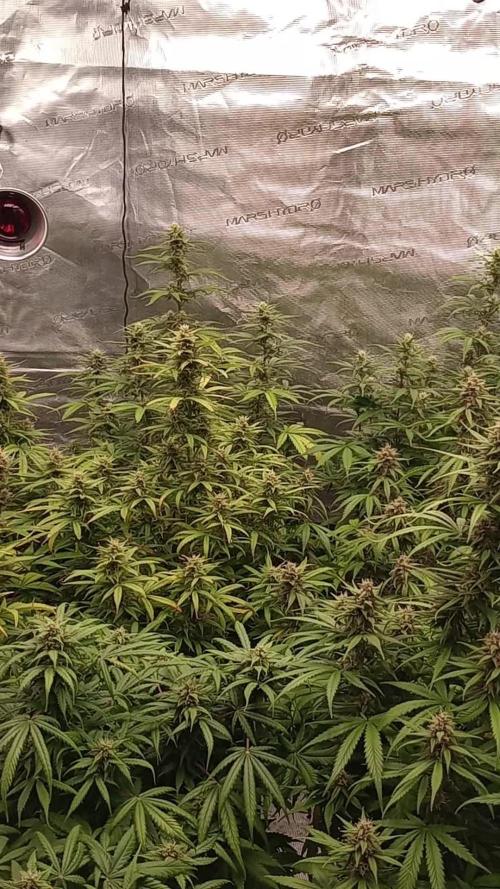
🌱 Week 17 Update (Veg) The girls are looking amazing 💪🌿 — tall, full, and ready to make the big move into flower 🔜🌸🔥. Canopy is thick and even 🌳✨ with strong branching and vibrant color 🌞🍃. Thrips are basically gone
Likes
9
Share
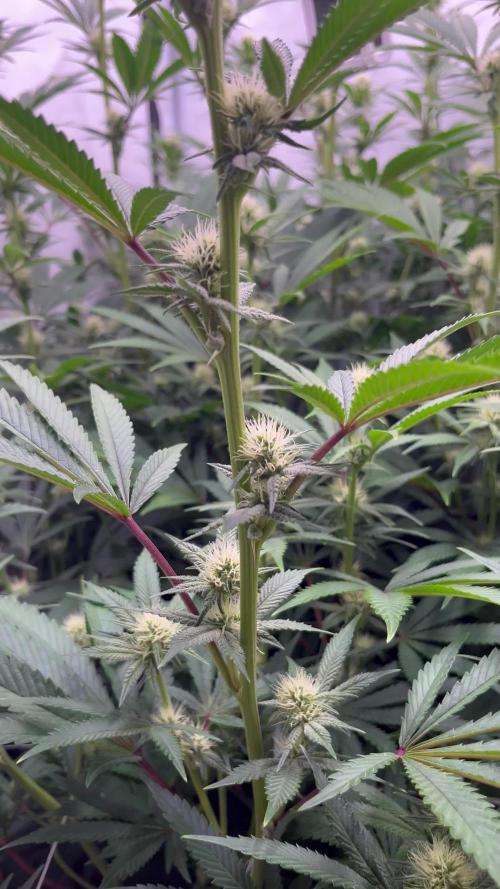
Hi gromie's, well were at day 29 of flowering & day 64 in total. She has grown some really nice chunky dense buds & has a fairly strong sweet/ lemon/citrus smell to her. She is getting closer to harvest, starting to get cloudy trichomes & pistills starting to change colour, Calyx closed & swelling. Nice & sticky!
Likes
2
Share
Likes
10
Share
Likes
16
Share
@Chucky324
Follow
Hello This is the end of week 14 and the beginning of week 15 of veg. Plant #6 is looking alot less yellow. It's green on the growing tips and still a bit yellow on the bottom leaves. When I repotted them the last time, I thought I put in enough compost in to keep them green without giving food for a month or so. But Plants #5 and #6 got compost from the top of the bin where there is less worm action... so less food. Since I've been giving full nutrient/food, they have been doing and looking a lot better.. It's still a couple of weeks before I force flowering. So I'll leave them alone for a week and a bit and then do a LST and take clones about 5 days before going into flowering. The plants smell great... Sorta a gelato type of smell that stays on the clothes for hours when working with them. So... Yes... I'll take clones of these great smelling plants and use the essential oil sprays (see weeks 2, 3 and 4) to get rid of any unwanted pests... OK. Keep Growing Straight. Chuck.
Likes
55
Share
What's in the soil? What's not in the soil would be an easier question to answer. 16-18 DLI @ the minute. +++ as she grows. Probably not recommended, but to get to where it needs to be, I need to start now. Vegetative @1400ppm 0.8–1.2 kPa 80–86°F (26.7–30°C) 65–75%, LST Day 10, Fim'd Day 11 CEC (Cation Exchange Capacity): This is a measure of a soil's ability to hold and exchange positively charged nutrients, like calcium, magnesium, and potassium. Soils with high CEC (more clay and organic matter) have more negative charges that attract and hold these essential nutrients, preventing them from leaching away. Biochar is highly efficient at increasing cation exchange capacity (CEC) compared to many other amendments. Biochar's high CEC potential stems from its negatively charged functional groups, and studies show it can increase CEC by over 90%. Amendments like compost also increase CEC but are often more prone to rapid biodegradation, which can make biochar's effect more long-lasting. biochar acts as a long-lasting Cation Exchange Capacity (CEC) enhancer because its porous, carbon-rich structure provides sites for nutrients to bind to, effectively improving nutrient retention in soil without relying on the short-term benefits of fresh organic matter like compost or manure. Biochar's stability means these benefits last much longer than those from traditional organic amendments, making it a sustainable way to improve soil fertility, water retention, and structure over time. Needs to be charged first, similar to Coco, or it will immobilize cations, but at a much higher ratio. a high cation exchange capacity (CEC) results in a high buffer protection, meaning the soil can better resist changes in pH and nutrient availability. This is because a high CEC soil has more negatively charged sites to hold onto essential positively charged nutrients, like calcium and magnesium, and to buffer against acid ions, such as hydrogen. EC (Electrical Conductivity): This measures the amount of soluble salts in the soil. High EC levels indicate a high concentration of dissolved salts and can be a sign of potential salinity issues that can harm plants. The stored cations associated with a medium's cation exchange capacity (CEC) do not directly contribute to a real-time electrical conductivity (EC) reading. A real-time EC measurement reflects only the concentration of free, dissolved salt ions in the water solution within the medium. 98% of a plants nutrients comes directly from the water solution. 2% come directly from soil particles. CEC is a mediums storage capacity for cations. These stored cations do not contribute to a mediums EC directly. Electrical Conductivity (EC) does not measure salt ions adsorbed (stored) onto a Cation Exchange Capacity (CEC) site, as EC measures the conductivity of ions in solution within a soil or water sample, not those held on soil particles. A medium releases stored cations to water by ion exchange, where a new, more desirable ion from the water solution temporarily displaces the stored cation from the medium's surface, a process also seen in plants absorbing nutrients via mass flow. For example, in water softeners, sodium ions are released from resin beads to bond with the medium's surface, displacing calcium and magnesium ions which then enter the water. This same principle applies when plants take up nutrients from the soil solution: the cations are released from the soil particles into the water in response to a concentration equilibrium, and then moved to the root surface via mass flow. An example of ion exchange within the context of Cation Exchange Capacity (CEC) is a soil particle with a negative charge attracting and holding positively charged nutrient ions, like potassium (K+) or calcium (Ca2+), and then exchanging them for other positive ions present in the soil solution. For instance, a negatively charged clay particle in soil can hold a K+ ion and later release it to a plant's roots when a different cation, such as calcium (Ca2+), is abundant and replaces the potassium. This process of holding and swapping positively charged ions is fundamental to soil fertility, as it provides plants with essential nutrients. Negative charges on soil particles: Soil particles, particularly clay and organic matter, have negatively charged surfaces due to their chemical structure. Attraction of cations: These negative charges attract and hold positively charged ions, or cations, such as: Potassium (K+) Calcium (Ca2+) Magnesium (Mg2+) Sodium (Na+) Ammonium (NH4+) Plant roots excrete hydrogen ions (H+) through the action of proton pumps embedded in the root cell membranes, which use ATP (energy) to actively transport H+ ions from inside the root cell into the surrounding soil. This process lowers the pH of the soil, which helps to make certain mineral nutrients, such as iron, more available for uptake by the plant. Mechanism of H+ Excretion Proton Pumps: Root cells contain specialized proteins called proton pumps (H+-ATPases) in their cell membranes. Active Transport: These proton pumps use energy from ATP to actively move H+ ions from the cytoplasm of the root cell into the soil, against their concentration gradient. Role in pH Regulation: This active excretion of H+ is a major way plants regulate their internal cytoplasmic pH. Nutrient Availability: The resulting decrease in soil pH makes certain essential mineral nutrients, like iron, more soluble and available for the root cells to absorb. Ion Exchange: The H+ ions also displace positively charged mineral cations from the soil particles, making them available for uptake. Iron Uptake: In response to iron deficiency stress, plants enhance H+ excretion and reductant release to lower the pH and convert Fe3+ to the more available form Fe2+. The altered pH can influence the activity and composition of beneficial microbes in the soil. The H+ gradient created by the proton pumps can also be used for other vital cell functions, such as ATP synthesis and the transport of other solutes. The hydrogen ions (H+) excreted during photosynthesis come from the splitting of water molecules. This splitting, called photolysis, occurs in Photosystem II to replace the electrons used in the light-dependent reactions. The released hydrogen ions are then pumped into the thylakoid lumen, creating a proton gradient that drives ATP synthesis. Plants release hydrogen ions (H+) from their roots into the soil, a process that occurs in conjunction with nutrient uptake and photosynthesis. These H+ ions compete with mineral cations for the negatively charged sites on soil particles, a phenomenon known as cation exchange. By displacing beneficial mineral cations, the excreted H+ ions make these nutrients available for the plant to absorb, which can also lower the soil pH and indirectly affect its Cation Exchange Capacity (CEC) by altering the pool of exchangeable cations in the soil solution. Plants use proton (H+) exudation, driven by the H+-ATPase enzyme, to release H+ ions into the soil, creating a more acidic rhizosphere, which enhances nutrient availability and influences nutrient cycling processes. This acidification mobilizes insoluble nutrients like iron (Fe) by breaking them down, while also facilitating the activity of beneficial microbes involved in the nutrient cycle. Therefore, H+ exudation is a critical plant strategy for nutrient acquisition and management, allowing plants to improve their access to essential elements from the soil. A lack of water splitting during photosynthesis can affect iron uptake because the resulting energy imbalance disrupts the plant's ability to produce ATP and NADPH, which are crucial for overall photosynthetic energy conversion and can trigger a deficiency in iron homeostasis pathways. While photosynthesis uses hydrogen ions produced from water splitting for the Calvin cycle, not to create a hydrogen gas deficiency, the overall process is sensitive to nutrient availability, and iron is essential for chloroplast function. In photosynthesis, water is split to provide electrons to replace those lost in Photosystem II, which is triggered by light absorption. These electrons then travel along a transport chain to generate ATP (energy currency) and NADPH (reducing power). Carbon Fixation: The generated ATP and NADPH are then used to convert carbon dioxide into carbohydrates in the Calvin cycle. Impaired water splitting (via water in or out) breaks the chain reaction of photosynthesis. This leads to an imbalance in ATP and NADPH levels, which disrupts the Calvin cycle and overall energy production in the plant. Plants require a sufficient supply of essential mineral elements like iron for photosynthesis. Iron is vital for chlorophyll formation and plays a crucial role in electron transport within the chloroplasts. The complex relationship between nutrient status and photosynthesis is evident when iron deficiency can be reverted by depleting other micronutrients like manganese. This highlights how nutrient homeostasis influences photosynthetic function. A lack of adequate energy and reducing power from photosynthesis, which is directly linked to water splitting, can trigger complex adaptive responses in the plant's iron uptake and distribution systems. Plants possess receptors called transceptors that can directly detect specific nutrient concentrations in the soil or within the plant's tissues. These receptors trigger signaling pathways, sometimes involving calcium influx or changes in protein complex activity, that then influence nutrient uptake by the roots. Plants use this information to make long-term adjustments, such as Increasing root biomass to explore more soil for nutrients. Modifying metabolic pathways to make better use of available resources. Adjusting the rate of nutrient transport into the roots. That's why I keep a high EC. Abundance resonates Abundance.
Likes
1
Share
@Naujas
Follow
28 dienos!!! Prasideda žydėjimas;) Mergaitė auga - šią savaitę naudojau LST, nes ji pradėjo greitai kilti :) Taigi, viskas atrodo gana gražiai:) Pamatysime, kaip ji keisis :) Bet manau, kad ji bus graži, skani, stipri:) Sėkmės visiems.
Likes
25
Share
@Fatnastyz
Follow
Week 8 10-14 Water, both drinking around 750 ml a day! Pretty much just fun with pictures from here. Kosher still seems a bit hungry, but doing awesome! Ztrawberriez is just nasty! Cant seem to get good enough pictures! Lol 10-17 Water and Guy was up to no good! 😻 10-15 Guy stopped in to pose today! 10-19 Flushed both today. I thought they should be low on food, but I over loaded again, I guess. K ppm starting was 1200, now 440 Z 1050 now 310 Sheesh! One day I may Not over feed. 🤣 I even thought 2 tbs was light. 🤣 .
Likes
10
Share
Likes
3
Share
@Tzoptzobe
Follow
It was my first grow They were 1meter80 tall. The soil was mixed with othe one from market, because they got to be yellow color, No Nutrients ,watered always before to take photos. I always preffer to give them the Sunn they know. It was a pleasure to care of Them, The next one hope will be Pandora or Sensi Star.
Likes
54
Share
@ASCBOOGS
Follow
Day 63 veg last day of veg going to.give plants a 36hour dark period before the flick some leafs are still looking slightly yellow super cropped few of the longer branches to.help maintainneven canopy when going 12/12 lights are on 600w settings to get it ready for.flowering
Processing
Likes
34
Share
@rhodes68
Follow
12/6 Week 16 The girls are slowly finishing waiting on more bud closure before flushing, trics are fine. May notice we dont so much flush as just remove nuets continuing 10-20% runoff and let the plant use up stores. 12/7 FF10 still has not closed up, not close, the 9 and 11 were pretty clearly done. These just wont stop so I wont mess with the nuets Not a lot of fade very slight 12/8 Slowing but still going 12/9 Putting FFT-11-1 on flush (front plant) this evening, she is there. At least a week 12/11 Putting FFT-11-2 into flush not because she is done but because if the buds get any bigger she is going to break. Triple caged her keep it from happening now.
Likes
12
Share
@TgOgFaRms
Follow
Hey there, lads! 👋🌱 It's time for the final update as we enter week 10 of this LED MephistoGenetics Grow. We're on the brink of harvest, and the excitement is Real! 🌿🌸🌞 The majority of my plants are reaching their peak and will be ready for harvest very soon. However, it seems that the Pink Panama and Tooth Decay strains require a few extra weeks to reach their full potential. 🌿🌱⏳ In the meantime, I've already commenced the drying process for my other plants—the beloved Copy Cat Genetics strains & ETHOS—within the tent. In a day or two, they will be eagerly awaiting their new home in designated jars. Proper drying is crucial to preserving the amazing aromas and aromas we've worked tirelessly to cultivate. 🌿🍃🌬️ When comparing this grow to my previous one, which utilized the Lumatek HPS lights, I must say that the buds under the LED lights have truly impressed me with their vibrant colors. The canopy is now a mesmerizing display of the full rainbow, boasting pink, purple, orange, white, Reds. and some exceptionally frosty buds. It's an awe-inspiring sight! 🌈🌿❄️ Today was the last day of providing nutrients, and from now on, I'll be giving them only water with a small dose of connoisseurs to maintain a pH level of 6.33 and a TDS of 50. The long-awaited harvest should take place within a couple of days. Meanwhile, tomorrow, I'll be transferring the Copycat Genetics grow from the drying tent to the jars. We're currently on day 65 of this Mephisto Grow. I'm beyond thrilled to finally harvest these ladies, especially the ones that have been under the LED lights. Their intense aromas fill the air, creating a tantalizing atmosphere in the grow room. 🌿🌸✨🌿 That's all for now, lads! Stay green, stay positive, and may your buds be fire. Cheers and happy growing, lads! 🌿🌼🌟🌿🔥🌿
Likes
45
Share
@psuperman
Follow
Stilly leggy but added some more soil with organic compost on top and they seem to be holding up ok. Lighting I think is an issue but I’ve had some days with 24 hour light and this when I notice a lot of growth. Still have the fan on throughout the day to try and help strengthen them up. Uploaded a video for day 23. Seeing new growth every day and I’m getting excited 😆 Makes me want to start germinating more! I also added another 65 watt LED full spectrum grow light.
Likes
3
Share
@Hempcules
Follow
WEEK 3 (Day15 - 21) The plants are growing well so far. One of the plants germinated four days later, which explains the difference in size. They are receiving plenty of light as they share a tent with older plants. Therefore, I always try to place them in areas with less light intensity. Otherwise, I am planning to top the plants this week.