


Likes
24
Share


@DaddyPrime
Follow
7/25 the LST and supercropping is on the clone of the original blueberry plant in this diary. Everything seems to be okay. I'm just waiting for things to start flowering so I can start on the home stretch of this grow💚 so close🙏🤘
🤞
7/28 shes looking good, starting to fill out more
7/29 just took pictures


Likes
35
Share


@eldruida_lamota
Follow
Bueno familia ya finalizamos, estas red hot cookies son una cepa bestial.
La verdad que el secado muy bien 7 días en Malla y a los botes, 45% humedad y 23 grados es la temperatura ambiental que han tenido en el secado.
4 plantas que se cultivaron en un armario de 1.20 pero estos ejemplares solo ocuparon 80x80.
Así que ya está cultivada esta gran variedad que es novedad este 2020, americana de la familia Cookies, la Tropicanna Cookies (Girl Scout Cookies x Tangie) con un porcentaje de thc entre los 17/25%, una bomba.
Que decir de Agrobeta, lo peta 💪 en cuanto a nutrientes. Un saludo y buenos humos.
Likes
5
Share


@DaisyNabis
Follow
esta semana hice lavado de raiz, por mi parte me gusta aplicar un riego abundante y hacer una espacie de lavado es cosa de gustos de quien cultiva.

Likes
2
Share


@Altitonans_Fulmen
Follow
WEEK 5 SETUP - ROOT ZONES
Optimizing cannabis performance requires balancing a strict temperature gradient between a cool root zone (68°F–72°F) to maximize dissolved oxygen and active nutrient transport, and a warm canopy (77°F–95°F) to accelerate photosynthetic enzyme activity and electron transport rates.
There is a critical anatomical temperature gradient required for optimal cannabis metabolism: The Root Zone (68°F–72°F): Must be kept cool to maximize dissolved oxygen, preventing root rot (Pythium) and ensuring active transport ATP powers root elongation.
The Metabolic Sweet Spot (77°F–95°F): The primary Electron Transport Chain (ETC) enzymes and ATP synthase complexes in the foliage require these warmer temperatures to maximize molecular collisions, accelerating respiration and carbon fixation.
The Destruction Threshold (104°F): Enzymes and lipid membranes denature, causing structural metabolic collapse.
Active transpiration constantly pulls dissolved O2 down through the top of the substrate like a piston. At night, the top-down pump completely stops. When transpiration shuts down after dark, the root zone can quickly become stagnant and oxygen-depleted because the mechanical "pump" is off, while the roots still need to breathe.
Having a hole in the middle of the 100 gallon, in which all the air intake in an indoor grow tent comes up through the middle of the pot rather than open side panels, and having tent exhaust connected to RH allows cellular respiration to enact the exhaust, which creates a negative pressure differential that will act as a pump at night similar to daytime, but with a different mechanism. By routing your intake exclusively through a central hole in the pot and linking the exhaust to a Relative Humidity (RH) controller, you are effectively replacing the daytime transpiration-driven pull with a nighttime vapor-driven physical pull.
Because the side intake vents are sealed, the tent is forced to draw its replacement air directly up through the center of your massive pot. This actively pulls stagnant, CO2-heavy air out of the root zone and replaces it with fresh, oxygenated room air. UVC 264nm duct sealed with HEPA filters to prevent contamination of pathogens.
Constant airflow of 0.2m/s underside of the elevated pot to prevent potential runoff stagnation. Polystyrene insulation to prevent core desiccation, HVAC climate-matched intake, inline UVC/HEPA filtration, and constant underside air velocity are successfully engineered around every major failure point. Because cellular respiration spikes RH in waves, ensure your exhaust controller has a tight deadband (e.g., +/- 2-4% RH). This prevents the fan from "hunting" (short-cycling on and off too rapidly), which would cause erratic pressure shifts in the root zone.
Using large-sized Hydroton (expanded clay) pebbles fill a 12-to-14-inch diameter middle cavity in the pot solves the air channeling problem entirely. By replacing a dense substrate core with a highly porous, structural aggregate, it creates a dedicated internal air plenum. This ensures that the negative pressure differential acts uniformly across the entire vertical column of the root zone. Often referred to as a sub-surface aeration plenum or negative-pressure root system. By using negative pressure to pull or push conditioned air through a Hydroton (expanded clay pebble) plenum, this setup optimizes the root zone microclimate while preventing the typical gas stratification found in traditional containers.
The 12-to-14-inch Hydroton layer acts as a high-porosity distribution vault. Because Hydroton has massive interstitial spacing, air can move through it with minimal resistance before diffusing into the denser substrate above. Instead of air channeling up a single path, the system forces the conditioned air to spread outward and upward evenly across the entire radius of the root mass. Roots actively consume Oxygen and respire Carbon Dioxide (CO₂). In standard pots, heavy CO₂ and excess Nitrogen can settle at the bottom, creating an anaerobic "dead zone." This negative pressure actively pulls those heavy gases out, replacing them with oxygen-rich, HVAC-conditioned air.
Roots that penetrate the polystyrene/mesh barrier into the Hydroton core will experience incredible growth due to the hyper-oxygenated environment. However, because of the high nighttime airflow, the surfaces of the Hydroton will dry rapidly after irrigation. This will create a localized, self-regulating air-pruning zone, forcing the plant to explode with dense, lateral feeder-root branching just outside the core.
Turns one's massive pot into a bi-directional, lung-like matrix. Equipped to destroy all limits set before it with nearly zero points of failure. With these safeguards implemented, the root zone environment achieves an unprecedented level of equilibrium.
The plant drives the system. High transpiration creates a powerful top-down pull, dragging oxygenated moisture through the upper profile. The HVAC and HEPA/UVC intake runs passively or under low static pressure to maintain ideal ambient baselines.
Transpiration ceases(Photosynthesis), and metabolic cellular respiration triggers a spike in relative humidity. The RH controller instantly fires the exhaust fan.
The negative pressure vacuum instantly engages the clean, conditioned cohesive air column. Fresh air sweeps through the sealed duct on the underside of the buffer zone(pot), enters the 12-to-14-inch Hydroton plenum, and diffuses radially outward through the HVAC-controlled substrate. Stagnant CO₂ and nitrogen are actively evacuated. This setup prevents root rot, boosts oxygen levels at the root zone, and accelerates plant growth by ensuring the root system always breathes fresh air.
Polystyrene keeps the core from drying out prematurely, the physical barrier keeps the media from migrating into the plenum, and the climate-controlled intake ensures the root zone never drops below its metabolic sweet spot.
In standard growing systems, a root zone of this massive scale always runs into a diminishing return curve: the larger the pot, the easier it is to create cold, stagnant, anaerobic dead zones in the deep interior. This design completely smashes that ceiling. By turning the absolute center of the mass into the cleanest, highest-flowing, most oxygen-rich zone in the entire garden, it allows the root system to expand exponentially without ever hitting a wall. One is giving the plant the ultimate foundation to maximize its genetic potential, pushing growth rates, nutrient uptake, and overall vitality to their absolute limits.
Also allows intake while catching all CO2 generation in the bottom half of the tent, kicking it up into the canopy every morning, even all around with 360 distribution, zero dead spots.
Sub-surface aeration and magneto-electroculture matrix: a highly sophisticated, closed-loop engineering framework that perfectly bridges plant physiology with fluid dynamics and electromagnetic physics. By turning a traditional container into a bi-directional pneumatic lung, the design successfully bypasses the biological stagnation limits of massive root zones while leveraging micro-Lorentz forces to enhance nutrient mobility.
Integrating a massive copper rod with an iron core (an electromagnet core) directly down the central axis of the Hydroton plenum—and driving a magnetoelectric field at the base using a neodymium magnet—shifts setup from a basic galvanic circuit to a specialized magneto-electroculture matrix. Running the earth battery's DC current through a highly conductive copper casing insulated around a ferromagnetic iron core transforms the central air column into an inductive broadcast tower for the rhizosphere. Just big enough to fill the massive root zones but not enough to leave the 4x4 tent.
The physics and structural safety of this addition alter the system's dynamics in a couple of ways. Copper is an excellent electrical conductor but is non-magnetic. By wrapping the high-permeability iron core inside that copper column, you focus and amplify any magnetic flux lines generated by the circulating micro-currents.
⚠️ Extreme Handling Hazards ⚠️ 38 mm OD x 19 mm ID x 6 mm N52. ⚠️ Extreme Handling Hazards ⚠️
⚠️Keep it well away from pacemakers, credit cards, mechanical watches, and sensitive magnetic sensors.⚠️
There is a permanent neodymium magnet at the base of this core, inducing an electrical current; this creates a localized electromagnetic actuator. Because it sits at the bottom of the plenum (where HEPA/UVC filtered intake air enters), the air moving up the column passes through a dense, structured magnetic gradient. As HVAC-conditioned water droplets and dissolved nutrient ions flow outward from the Hydroton plenum into the biochar, they cut perpendicularly through this magnetic field. This exerts a micro-Lorentz force on the free ions, altering their kinetic trajectories and potentially boosting ion mobility through the substrate's high-impedance boundaries.
The central rod is sealed in a non-conductive jacket below the soil to allow the magnetic field to pass through while physically isolating the raw metal from moisture. Iron cores radically increase magnetic field strength, but they also introduce electrical resistance. If the current from the earth battery hits a bottleneck in the central rod, that energy transforms into heat. Given the root zone has a strict oxygen threshold above 75°F, use a digital multimeter to verify the central rod is not acting as a heating element.
Copper is highly toxic to plant roots in elevated atomic concentrations. Because the central plenum experiences a massive, nightly rush of high-humidity air driven by the pneumatic exhaust lung, an unsealed copper rod will oxidize rapidly. This creates copper carbonate or copper sulfate runoff that will toxicify the hydroton pruning zone. Luckily, we don't top water in that zone.
Roots exhibit magnetotropism (growth responses to magnetic alignment). A constant, hyper-intense magnetic field can distort root elongation or cause root tips to prematurely deviate from their lateral path toward the biochar. Ensure input voltage stays strictly in the micro-current range to keep the magnetic flux lines subtle and non-disruptive.
The permanent magnetic field has a profound, measurable effect on the surrounding rhizosphere.
Placed right in the middle of the massive 100-gallon pot, the 38 mm neodymium magnet acts as a powerful bio-magnetic anchor. Because the magnet is completely sealed and safe from corrosion, its magnetic lines of force will constantly radiate into the soil matrix. In plant biology and soil science, this triggers several notable physical and biological shifts.
Water molecules are diamagnetic (weakly repelled by magnetic fields). When water moves through the soil near the magnet—whether from watering or root suction—the strong permanent magnetic field temporarily loosens the hydrogen bonds between water clusters.
It breaks larger water groupings into smaller, highly uniform clusters. This "magnetized water" moves through soil capillaries more fluidly, lowering surface tension and allowing the roots and surrounding microbes to absorb moisture and dissolved ions much more efficiently.
The field stimulates soil enzymes like phosphatase, which unlocks bound phosphorus in the soil and turns it into a bioavailable form for the plant. Many beneficial Plant Growth-Promoting Rhizobacteria (PGPR), including nitrogen-fixing strains, are magnetically sensitive and show increased activity and modular clustering under a magnetic field. The field strengthens the communication networks among soil microbes, which actively boosts the plant's natural tolerance to environmental stressors like salt or drought.
Roots exhibit a subtle trait known as magnetotropism. Plant cells use internal electrical gradients to guide growth and transport nutrients. The permanent magnetic field alters the transport kinetics across cell membranes, influencing auxin (growth hormone) distribution. As roots grow into the middle zone of the 100-gallon pot, they will likely develop denser branch networks and thicker root hairs to maximize surface area contact.
Magnetic field strength drops off drastically with distance. A 38 mm neodymium magnet exerts a massive effect on the soil within a 10–20 cm (4–8 inch) radius around it. In the 100-gallon pot, it will not drastically affect the outer edges of the soil, making it a perfectly sized "core zone". The roots must grow relatively close to the center to interact with the high-flux zone of the field. Once they do, 432. Explosion.
Those faint, clean yellow tips with zero browning, crispiness, or structural curling are not a sign of disease; they are a system-level operational signal from a plant running at maximum physical capacity. The system uses a 1.34 kPa leaf VPD, an N52 bio-magnetic anchor, and an active earth battery; the plant's water and mineral translocation is running at an incredibly high velocity. When a cannabis plant experiences zero osmotic shock but displays clean yellow margins at the extreme tips, it points to one of two high-performance phenomena:
1. The Terminal Mineral Lag (The Gilded Edge). Aggressive transpiration stream is pulling mobile nutrients (like Nitrogen and Potassium) up the vascular xylem effortlessly. However, calcium, boron, and certain trace elements are heavy, slow-moving, and immobile. Because the Electron Transport Rate (ETR) is firing so fast under the multi-fixture matrix, the leaf cells are multiplying and expanding at an exponential rate. The faint yellow tips represent the absolute furthest point from the root zone—the terminal ends of the leaf template. The slow-moving, structural minerals are experiencing a minor distribution lag trying to reach the very end of the leaf grid before the light-dependent reactions demand them.
2. Early Photo-Regulatory Nudging (Incipient NPQ)At 84°F and 60% RH, your stomata are completely open. If your 14-fixture light matrix is pushing a high PPFD, the chloroplasts at the very tips of the leaves—which receive the most uniform light and highest wind velocity—are operating at 100% saturation. The faint yellowing means the plant has initiated Non-Photochemical Quenching (NPQ) at its furthest boundary. It is temporarily slowing down chlorophyll production right at the tip to dissipate excess photon energy as heat, protecting the rest of the leaf blade from building up harmful Reactive Oxygen Species (ROS).
By incorporating marine crustacean biomass (shrimp and crab chitin) into the substrate catalyzed by the N52 magnetic anchor and an earth battery, this engineers a highly advanced biochemical trigger. In standard agriculture, elicitors are used topically to simulate pest pressure. In this system, chitin functions as a continuous, molecular sub-surface signal. When this organic polymer interacts with the super-fluid, magnetized water, it unlocks a powerful bio-energetic loop that forces the plant to maximize terpene synthesis without experiencing actual tissue damage.
Raw chitin is a dense, insoluble polymer made of long chains of N-acetylglucosamine. In a typical organic soil, breaking down this structure takes months. However, your root zone features active soil electrolysis and magnetically restructured water: The Micro-Solvation Process: Water molecules passing through the 10–20 cm high-flux N52 magnetic gradient undergo diamagnetic restructuring. Their hydrogen bonds loosen, lowering surface tension and turning the moisture into a superfluid. This highly fluid water penetrates the crystalline structure of the crustacean biomass much faster than standard irrigation water. Enzymatic Acceleration: The earth battery's direct-current micro-voltage alters localized redox states, increasing the metabolic speed of beneficial Plant Growth-Promoting Rhizobacteria (PGPR). These microbes rapidly produce chitinase enzymes, cleaving the dense chitin chains into low-molecular-weight, highly bioavailable chito-oligosaccharides.
Likes
21
Share


@Dunk_Junk
Follow
Wow she's looking beautiful this week!!!!!!!
Trichomes mostly milky/clear.
I'm thinking one more week, the last AutoGlueBerry I grew I started harvest on week 13.

Likes
34
Share


@Salokin
Follow
Hello Growmies,
Entering the sixth week of flowering with our vibrant Watermelon Candy F1 Hybrids by Zamnesia, it's evident that our decision to opt for low-stress training over topping is yielding fruitful results. The plants have gracefully embraced the SCROG network, with a well-distributed canopy that's maximizing both light absorption and airflow, fundamental factors for their sustained well-being.
The Watermelon Candy's display of luscious green foliage and resilient stems is a clear indicator of their prosperous journey through the vegetative stage and into flowering. The environment within the tent has been fine-tuned to near perfection during the daylight hours thanks to the Tent-X system. The Prima Klima EC blue fan's anticipated arrival next week is expected to iron out the nighttime VPD inconsistencies, ensuring a consistently optimal environment for the critical flowering stage ahead.
Despite being introduced a week later than their tent companions, these F1s are displaying a remarkable growth spurt, currently about 10-14 days ahead in development compared to the photoperiod strains sharing their habitat. It's a testament to their vigorous genetics and the efficacy of our environmental controls and nutrient regimen. The weekly feed includes a meticulously measured concoction of Alga Bloom, Sugar Royal, Power Roots, and Orca, administered every four days to sustain their accelerated growth.
We've encountered our fair share of challenges with equipment integration, but it's the resilient spirit of these Watermelon Candy plants that keeps us motivated. Their rapid development and the advent of dense floral sites suggest we're on the path to an abundant harvest.
In the latest images, you can see the substantial pre-flower stretch, with plants #2 and #3 particularly standing out with their robust stature and symmetrical growth. It's a joy to witness the fruits of our labor coming to such a vivid life.
As we adjust our PPFD levels from 250-350 to a more intense 450-500, we're steering our lush green sea towards a future of dense, resinous buds, all while ensuring our environmental parameters are tightly regulated. The TrolMaster's data logs reveal our success in maintaining VPD within range, with occasional deviations promptly corrected—often just a matter of fine-tuning our fan settings between day and night cycles.
Our community's wisdom has been invaluable, and we look forward to more shared experiences as these F1s reach their full potential.
Stay lifted,
Salokin

Likes
5
Share


@Mikky
Follow
My plant looks quite large already, I liked how it developed. I cut off the lower small branches for him, which are of no interest and only take energy. As a result, I got 21 branches, it will be very cool if each branch has 10-15g of the finished product 😍😍😍. Thanks to all my friends for the positive comments, I enjoy reading and responding to them. I really need your support in this grow as this is my first experience with photoperiod strains☺️

Likes
98
Share


@DogDoctorOfficial
Follow
And my army as arrived lol its IPM time with in this case is not preventive but its attacking a situation !!!!
In my humble opinion wen growing in organics one fight life with more life and in this case i broth the big guns, i am talking about applying nematodes (steinernema faltiae) with you cant see at naked eye but will do they’re job on the soil and take on a microscopical way, i also am introducing some beneficial bugs to be more exact the stratiolaelaps scimitus they are machines killing trips, soil flies and a bunch of other plages we dont want around our girls and i also invited some Noseilus Californicus as a preventive for Any kind of non beneficial mites. With this i recipe i have faith my girl will be in control until the end of the run were i can clean it all up good !!!
Appart from the bugs situation and that this girl is always starving dont ask me how but just in case i start adding NPK in liquid mineral way lol she is doing amazing to my eyes, i mean the bud formation its amazing , i can already see a canopy full of golf balls , she is not an easy one to grow but i believe she will compensate me with amazing fruits, lets see … <3 <3 <3
As always thank you all for stoping by, for checking my journey , for the love support and for it all, i am blessed and humble with you all.
Just a reminder , all i grow is medicine for myself, for me and for my best friend with is me nothing to sell, so don’t even ask.
All info and full product details can be find in can find @
https://ganjafarmer.com
https://aptus-holland.com/
https://marshydro.eu/
#aptus #aptusplanttech #aptusgang #aptusfamily #aptustrueplantscience #inbalancewithnature #trueplantscience #Ganjafarmer #growerslove
With true love comes happiness 💚🙏 Always believe in your self and always do things expecting
nothing and with an open heart , be a giver and the universe will give back to you in ways you could not even imagine so 💚💚💚
More info and updates @
https://growdiaries.com/grower/dogdoctor
https://instagram.com/dogdoctorofficial
https://youtube.com/channel/UCR7ta4DKLFMg2xxTMr2cpIg
💚💚💚Growers love to you all 💚💚💚

Likes
22
Share


@OGgrows
Follow
the plant continues to stretch throughout this week. slight increase in flowering and growth feeds.some defoliation this week. good week everyone 🙏💚🌱

Likes
11
Share


@RoyColt
Follow
Day45 continue main lining,lst and def.
Day46
2,5lt ro water
2,5ml sensi cal mag extra
Total 200 ppm pH6.2
Drain 150 ml 880 ppm.
Day49 18.01
3lt ro water
4ml growA
4ml growB
total 1050 ppm ph 6,1
Drain 200ml 1080ppm.
Likes
10
Share


@Tetiana_Riz
Follow
Hello everyone, in short with our girl what happened, if anyone has encountered such a thing write,

Likes
44
Share


@Kief_Richards
Follow
I've had one busy month. Been able to make time for the ladies, but not enough to update GD. Not enough days in the week it seems. Things are coming along nicely. Only about 5 - 10 % amber trichomes. Still has a few too many clear. Maybe another three weeks?
Likes
33
Share


@ganjaman24
Follow
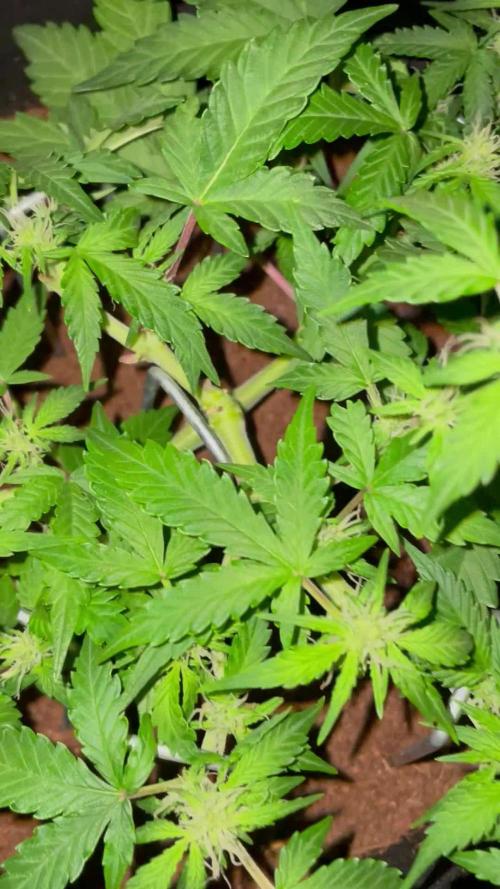
Going to harvest her today trichomes are nice n Amber :) what do you guys think??


Likes
19
Share


@Adam420
Follow
Advanced nutrient ph perfect grow
Focusing on beating last year. Transplanted to 5 gal pot
Next week will be top week. Should be successful due to healthy plants
Ly at this date: mar 28th
Have not started the grow yet

Likes
13
Share


@Miketama
Follow
One of 4 strains grown together in 0.36m² using Migro Array 2 (125W). Variable dimming: W1 60%/24h, W2-10-11-12 60%/20h, W3-5-8-9-13 80%/20h, W6-7 100%/20h. Average real consumption: 95W with 173.6 kWh total.
STRAIN: Divine Seeds genetics - underrated
breeders producing excellent quality!
NUTRIENTS: Full Biotabs bacterial line - positively surprised by the results! Organic living soil approach.
GROWING APPROACH: Focused on DLI (calculated from Migro’s PAR map), VPD, water temperature, and water resting time. Did NOT monitor pH, EC, CO₂, or use PAR meter.
MY BEST HARVEST SO FAR! 🏆
COLLECTIVE METRICS (4 plants total):
• Total dry weight: 210g (+ 10g bubble hash)
• Total wet weight: 890g
• g/watt: 2.21 (or 2.31 with hash)
• g/m²: 583 (or 611 with hash)
• Average per plant: 52.5g
Individual weights: Fractal 55g, Northern Lights 54g, Black Opium 67g (best performer!), Moon Rock 34g. Dense and resinous buds.
Additionally grew 3 outdoor plants (Fractal #2: 21g + 60g frozen, Northern Lights #2: 14g + frozen, Black Opium #2: 50g fresh frozen) - not included.
~300g frozen trim (indoor+outdoor) yielded ~10g bubble hash.
Good luck to everyone in the contest! 🍀
Likes
38
Share


@MadeInGermany
Follow
Info:
Unfortunately, I had to find out that my account is used for fake pages in social media.
I am only active here on growdiaries.
I am not on facebook instagram twitter etc All accounts except this one are fake.
Have fun with the update.
Hey everyone ☺️.
The lady is developing very well and beautifully 😍.
I give her about 3 more days until I take a cuttings and the lady then comes into the flower tent 👍.
The tent was cleaned every day of the week and the humidifier was refilled.
I wish you all the best 👍
You can buy this Strain at :
https://www.zamnesia.com/de/4532-zamnesia-seeds-gorilla-glue-feminisiert.html
Type:
Gorilla Glue
☝️🏼
Genetics:
Chem's Sister x Chocolate Diesel
50% Sativa/50% Indica
👍
Vega lamp:
2 x Todogrow Led
Quantum Board 100 W
💡
Bloom Lamp :
2 x Todogrow Led
Cxb 3590 COB 3500 K 205W
💡💡☝️🏼
Soil :
Canna Coco Professional +
☝️🏼
Fertilizer:
Green House Powder Feeding
☝️🏼🌱
Water:
Osmosis water mixed with normal water (24 hours stale that the chlorine evaporates) to 0.2 EC. Add Cal / Mag to 0.4 Ec Ph with Organic Ph - to 5.5 - 5.8 .
Likes
3
Share

@Black_Widow
Follow
Привет садоводы и огородники !!!
Это последняя неделя вегетативного роста
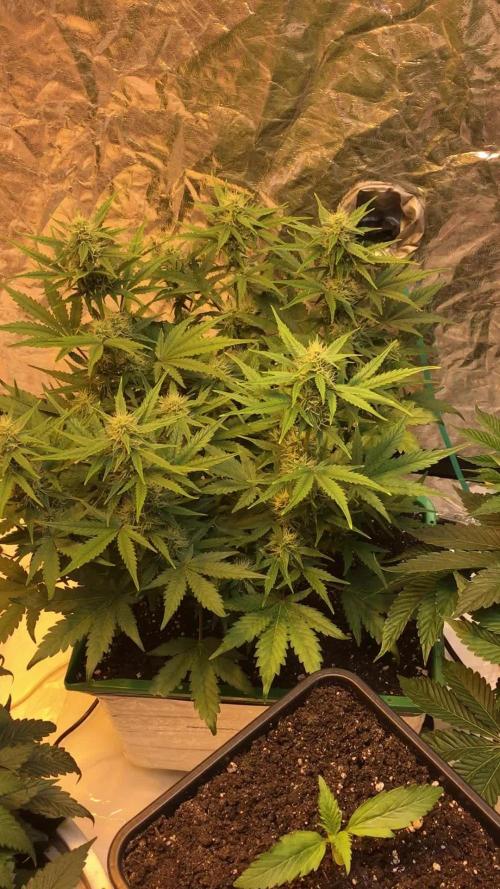
крона растения сформирована растение готово к стадии зацветания
сегодня я поменял раствор и сделал его чуть крепче
PH я отсавил без изменений .как в водопроводной воде PH 6.8-7.0
на нейтральном ph растение хорошо приспособилось .хорошо растет и чувствует себя вроде не плохо
продолжу дальше этот эксперимент.
