Likes
Comments
Share

@billybadass
Follow
QUICK GROW STATS/NOTES THROUGHOUT EACH WEEK:
—————————————————————————
5/15:
Seed germinated on 5/13 via Cannakan.
Planted in Earthbox with BAS 3.0 soil.
Sprouted 5/15.
————
5/18:
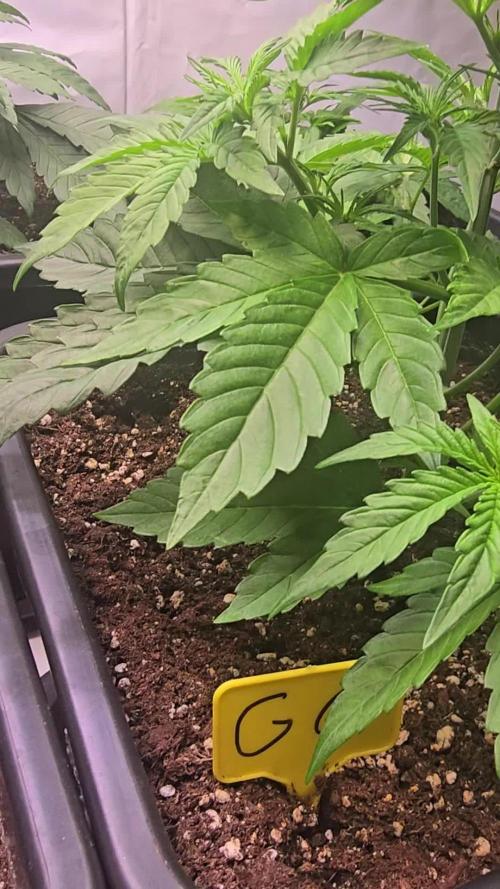
She's grown. A little stretch, I'd say.
I lowered the light closer and checked PPFD using Photone.
Right now, she is on a 20-on/4-off light schedule (will change soon).
With the Evoframe on 3 or 30%, her light condition is as follows:
Light Distance: 2 FT above the seedling
PPFD: 252
DLI: 17.8
Pretty soon, as she develops her first set of seedling leaves (a one-finger pair), I'll take out the infrared thermometer to set the VPD offset.
————
5/19:
She's getting bigger! Not much to see here. Check photos!
—————————————————————————————
CONTEXT ABOUT THE GROW, SETUP, & ANY OTHER INFO I WANT TO SHARE:
I have a 2x4 for veg and a 4x4 for flowering.
I plan to scrog train her in the 4x4, hopefully around 1-2ft above the top of the Earthbox.
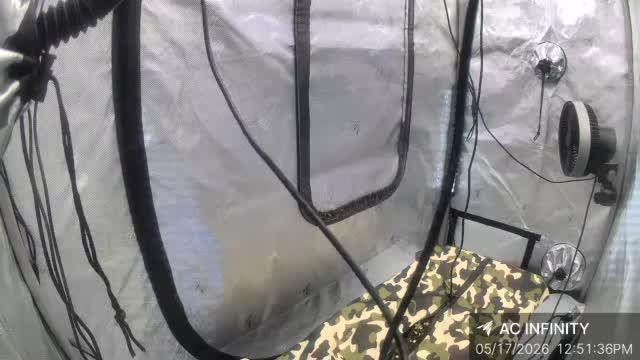
I am also using the new Spectrum AI Camera from AC Infinity! See short clips and photos above.
The AI is pretty sweet. It lets you know when it sees stress, if the tent was left open, and more.
It also provides daily growth estimates based on historical data.
I also use the AC Infinity to get leaf temperature to properly set the VPD offset.
At this stage, she's a bit too small to worry about that.
I focus on keeping temps around 80F during the day and 72F at night.
Also, I keep the humidity around 70-80%.
—————————————————————————————
SOIL PREP, TREATMENT, AND PLAN:
I use Build A Soil 3.0.
For a seedling, this needs NOTHING to begin with.
I used Quillaja during prep for the 10-gallon soil bed in the Earthbox.
Quillaja is a Saponin wetting agent.
I also used WDG3000.
This is used to kill fungus gnats or their larvae, if any exist.
The microbiology in 3.0 soil can carry this seedling weeks into veg without any feeding.
I pre-soaked the soil with 1/2 gallon (5% of the soil's volume) of RO water. No PH.
Around 2 weeks into veg, I'll start organically feeding her based on the BAS Supplemental Feeding chart.
Top dressing and watering (top, not reservoir) will happen once a week from then on.
Shortly after, I'll add 1/2 gal of water to the reservoir and measure how long she takes to drink it.
Over time (a few weeks after veg, week 2), I'll ramp her up to 2 gal of water in the reservoir, refilling only when she goes dry.
Any additional details are covered in the attached images of the feeding and environmental protocol!


Likes
15
Share


@AloeLover
Follow
She's in a small tent, do you think I should flip the switch? Every time I take some bottom leaves off more come back LOL. What do you think?😎

Likes
5
Share


@Bamz84
Follow
No Complaints No Issues Or Problems In The Garden...just being watered PH 6.0 and cal mag for now☺️


Likes
16
Share


@Ieiogrow94
Follow
Eccoci di nuovo qui!!!
Super eccitato per questa nuova collab con Kannabia Seed Company, team davvero al top, che mi ha dato l’opportunità di testare questa nuova genetica e di condividere i progressi con tutti voi!!!
NON HO PAROLE AVETE TIRATO FUORI UNA GENETICA MUST HAVE, TEAM SIETE GRANDIII
Grazie a tutti per il supporto ❤️🍀🔥



Likes
41
Share


@PrairieFrostGrow
Follow
******** Week 3 of flower, Week 12 growth - Oct 3 to 9/20 ***********
It has been less exciting this week with respect to new issues👍😃
Leaves are getting a little darker for my liking this week. It is one of the things I have often struggled with using AN Sensi Grow and Bloom base nutes.,,,,,,keeping the feeding at 1ml.L to maybe 1.5ml at max.....stopped using their CalMag Basie of nitrogen levels as well. Not sure where else to go and will just give her some time for now and stay the course and see what the next two weeks bring.......keep up, increase, the plain water feedings.
Little more detail........
Oct 3/20, Day 15
- 4L watering with CalMag, Rezin @ 2ml, Sensyzime @ 1.5ml
- 450ppm and 5.7pH
- they look to be stretching a bit.
Oct 4/20, Day 16
- 4L feed with Rezin, Terpinator @ 2ml, CalMag, Sensi Bloom, Big Bud, B52, Bud Candy @ 1ml
- 1025ppm and 5.8pH
- left alone for the most part.
- C472 needs some lower branching removed.
Oct 5/20, Day 17
- 3L - Vitathrive, Piranha, Microbial Mass @ 1.5ml = 110ppm and 5.9pH
- 100ppm and 5.9pH
- fair bit of runoff yesterday with 4L so backing down a bit.
Oct 7/20, Day 19
- 4L - Rezin, Terpinator @ 2ml, Rhino, Big Bud, B52 @ 1.5ml, CalMag, Sensi Bloom, Bud Candy @ 1ml
- 1025ppm and 5.9pH
- girls are really frosting up! Bud sites stacking......feeling might be a little slow though????
Oct 9/20, Day 21
- 3L- Rezin @ 2ml, CalMag, B52, Sensi Bloom @ 1ml,
- 500ppm and 5.9pH
Girls are looking good.....slow though?????


Likes
4
Share


@adam_pawloski87
Follow
@twenty20mendocino Ateam R&D Update ~ Let’s Go day 18 of 🌸almost 3 weeks in an we are looking great! Gave em another aggressive trim up some lollipops this week hopefully wasn’t too early but hey it’s we learn as growers, but they are bouncing back super nice, praying a looking happy y’all! Can’t wait to see what these girls do over the next few weeks, y’all have to keep them eyes peeled for next weeks update. Y’all have an amazing productive rest of your day as well as great rest of your week! Hope y’all enjoy, peace love an positive vibes to all y’all Cheers an blaze on 😶🌫️💨💨💨💨

Likes
15
Share


@Mrs_Larimar
Follow
2022-09-03
I planted all 3 Seeds, started one indoors and 2 Outdoors
2 Outdoors were attacked by the Cat- and did not survive
The indoor Girls developed very fast, and after 4 Weeks she went Outdoors too.
There she showed great Performance.
Easy to grow, no big attention needed.
She was pleaded with her light prefertilsed Soilmix, and n eeded only afew Feedings in Stretch
and i think one Bloom Feeding in Flower.
After only 6 full Weeks of Flower, she war ready to Harvest.
harbvesting was very easy here.
Buds are thick, and dense. ( and sticky).
The ratio from leaves to Buds are Phenomenal--- economic Plant---- nearly to no waste
Only some branches, a handfull of leaves, and a big amount of lovely smelling Flowers
The smell yes,,,, she smells like Pink grapefruit, and Peaches......
Stay tuned for smokingreport

Likes
26
Share


@cherokee
Follow
Всем привет 🖖.
На фото чётко видно как листья которые под лампой стали светлее и менее зелёными в сравнении с листьями в углу тента. Лампы хватает на 90х90 см тента, растениям мало света. Горшки очень быстро сохнут, пытаюсь поливать через день.
Я покупаю на 🔴 torogrow.com 🔴 УДОБРЕНИЯ , СЕМЕНА , ОБОРУДОВАНИЕ доставка по всему миру!
________________________________________________________________________________________________________________________________________
Ребята предлагаю всем желающим подписаться на мои социальные сети где я делаю еще больше контента о каннабисе.
Подписывайтесь пожалуйста, буду рад всем 😜 !!!
👽 Instagram - https://www.instagram.com/jedi_genetics/?hl=ru
👻 YouTube - https://www.youtube.com/channel/UCRFN2LzgQ4gxDj-6CIIr82g
________________________________________________________________________________________________________________________________________

Likes
13
Share


@WeedM8
Follow
Hello m8 welcome to this journey with me in this diary will have very interesting strains hope u find something useful
O.G. Kush Titanium
- [ ] 1st week Veg: germinated in substrate lighting very close so it jets medium high humidity after the 3rd day they started sprouting
- [ ] 2nd week Veg: this week my ventilator broke down and as the temperature stayed very warm nothing developed much
- [ ] 3rd week Veg:fortunately this week i had fixed the ventilation and the temperature has go down a bit allowing the little plants to develop and reinforce
- [ ] 4th week:very good developments in this week I already started feeding a bit two times but i didn’t have to…once was enough
- [ ] 5th week Veg:this week they were very strong green i only had to water them good and keep the ventilators going no stop .They have good hight already ,but as i have to strains together. I want to transplant them when the hight of the other one have stretched… I’m thinking to transplant next week if not the next one
- [ ] 6th week Veg: this week it went great fortunatly i dont have pests that eat my buds i’ve givven a fed once the substrate is very rich already the plants streached very well i will transplant today so be ready m8 i cant wait to show you the progress
- [ ] 1st week Fl:they started stretching and looking very healthy just transplanted
- [ ] 2nd week Fl this week I’ve been away i had a friend taking care of them they stretching very well i hope that she starts putting energy into the flo
- [ ] 3rd week Fl:they are streaching very well ..getting the light very well
- [ ] 4th week Fl:there we aree guys the good stage is heree good high hope dosent effect de prod
- [ ] 5th week Fl:pumping very good this week a lot of changes started already being frosty
- [ ] 6th week Fl:this diaries its not daily updated this week its going’s so great we are close to harvest between next week and the other one . Ill harvest them at different time just because they are not all at the same point of flowering
- [ ] 7th week Fl


Processing
Likes
15
Share


@donovanliam
Follow
Going great trying to train to best suit my grow tent. There will be 3 other strains so I need to make sure they all get enough light. The water volume in the plants is less then what I have in the conditions. More like 2L every two days

Likes
36
Share


@MadeInGermany
Follow
Unfortunately, I had to find out that my account is being used for fake social media sites.
I am only active on growdiaries here.
I'm not on Facebook Instagram Twitter etc.
All accounts except this one are fake.
Have fun with the update.
Hey everyone 😀.
The plant develops as it should 😍.
It grows very well and very beautifully. She also coped with the topping very well, so I will top it a few more times before it finally goes to the flower tent 😃.
Until then, I wish eucb a lot of fun until the next update.
Stay healthy and let it grow 🙏🏻
You can buy this Strain at :
https://originalsensible.com/original-sensible-seeds-zkittlez~20503
Type:
Zkittlez
☝️🏼
Genetics:
Afghan Kush Indica x Grandaddy Purple x Grapefruit hybrid
👍
Vega lamp:
2 x Todogrow Led
Quantum Board 100 W
💡
Bloom Lamp :
2 x Todogrow Led
Cxb 3590 COB 3500 K 205W
💡💡☝️🏼
Soil :
Canna Coco Professional +
☝️🏼
Fertilizer:
Green House Powder Feeding
☝️🏼🌱
Water:
Osmosis water mixed with normal water (24 hours stale that the chlorine evaporates) to 0.2 EC. Add Cal / Mag to 0.4 Ec Ph with Organic Ph - to 5.5 - 5.8 .

Likes
7
Share


@Polakush420
Follow
MACK AND CRACK 30 % THC / Hidroponia
(TERPENO A LIMONELO)
Lo mas clave de la Hidroponia es el CLIMA PERFECTO - EL AGUA NO DEBE SUPERAR LOS 24 GRADOS !!
Saludos de Argentina