




Likes
2
Share


Likes
5
Share

@Stork
Follow
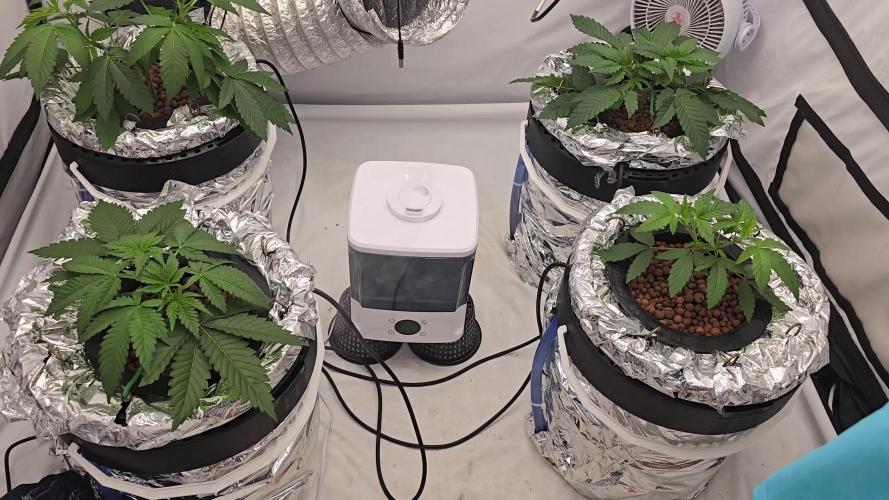
Day 23 Tue
PH 5.8
EC 0.5
DLI 18h
PPFD
Water 24c
Day 26 Sat
Refresh nuts
PH 5.8
EC 0.6
DLI 18h
PPFD
Water 24c

Likes
8
Share

@The_Doctor_Green
Follow
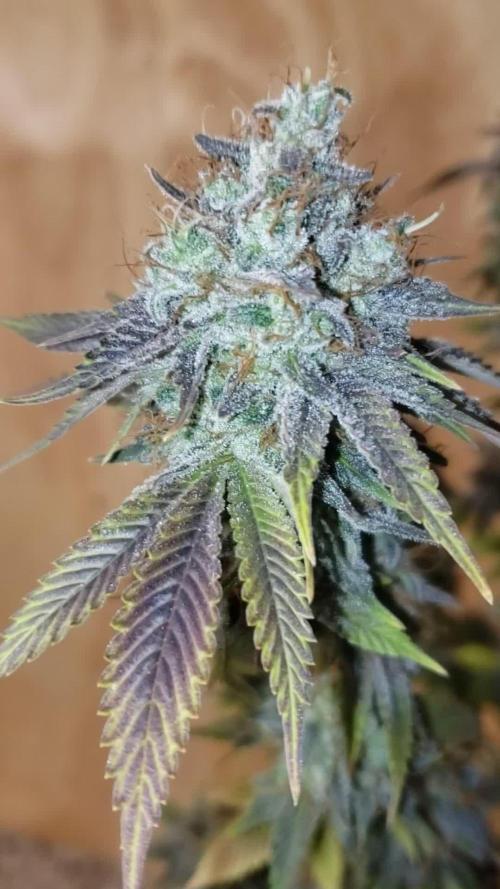
Hola a todos!!
Esta semana he regado solo con agua.
Los tricomas empiezan a ponerse algunos color ambar, todos los tricomas ya están lechoso.
En breve comenzare a manicurar.

Likes
18
Share


@Ktims420
Follow
Struggled with some sort of stress either over watering or light stress then trying to low stress train them before they we’re healthly enough in the previous week but finally recovering, almost fully recovered and looking great! Not very leafy at the top it is a fresh sprout, it has grow multiple centimetres some days, hoping it gets bushier any suggestions?


Likes
14
Share


@artems
Follow
Despite the splendid aroma and delicious profile, the cultivation process of "Blueberry Auto" proved to be less favorable than promised. My expectations collided with reality when the plant remained relatively small, despite all my efforts. The sown seeds exhibited a discouraging germination rate, and even those that sprouted turned into mutants, adding unpredictability to the process. Despite these challenges, it cannot be denied that the scent and taste of this strain are so captivating that they compensate for many cultivation shortcomings. This raises food for thought: in the pursuit of the perfect growing experience, where aroma and plant size become paramount, how does one strike a balance?
Likes
59
Share

@TruTraTri
Follow
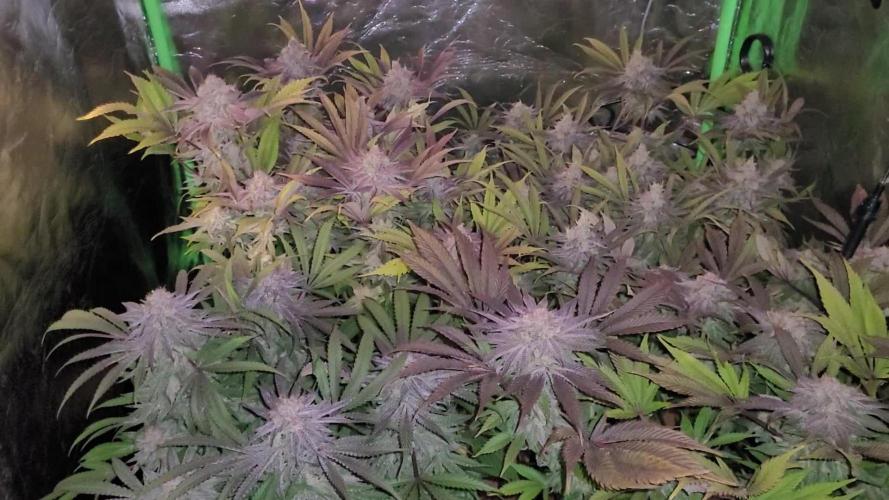
*mumble* missing looks *mumble*.......😹 so sad about this 🤣
Positive .... last two weeks they really fattened and hardened. Didn't expect they have so much juice left. 💪👍
Negative ... too tiny indoor and ScrOG so the beautiful colors are hidden almost all the time, not beautiful with my LED combination and not accessable 😅 - seems like I have to random hate ScrOG if I don't cry about... .... 👽 *mumble*
Already mentioned - but stinky AF and sticky. Early harvest would be possible for all and I think Kai is ready to go.
Nonetheless, harvest is no joy for me. The more smell and sticky stuff (I later enjoy of course😜), the faster I get super annoyed 😂. So I am just trying to harvest sometime in the future but not today... same is true for tommorow😹.
Think nothing good or bad will happen anymore. The leaves are not completely dried out or lush - they must live what is left in the soil and in the leaves.
- Wattage 220W down to 190W
- One week at max till harvest
- hope some people get inspired to watch this exquisite series (Lexx).. 😈
Outlook:
- final week for GD
- harvest + curing
- 3 months - harvest week for gd + smoke report.
“I feel good too, captain - and I will feel even better when I eat that little tiny snack ahead of us.” — Lexx
“Our journey will be long. The chance of mechanical failure over such a period is not insignificant.” — Kai
“Good. Well - I guess this is it.” — Stanley Tweedle
“Well - I wonder if the Dark Zone is ready for us?” — Zev Bellringer


Likes
6
Share


@MissSolasolita
Follow
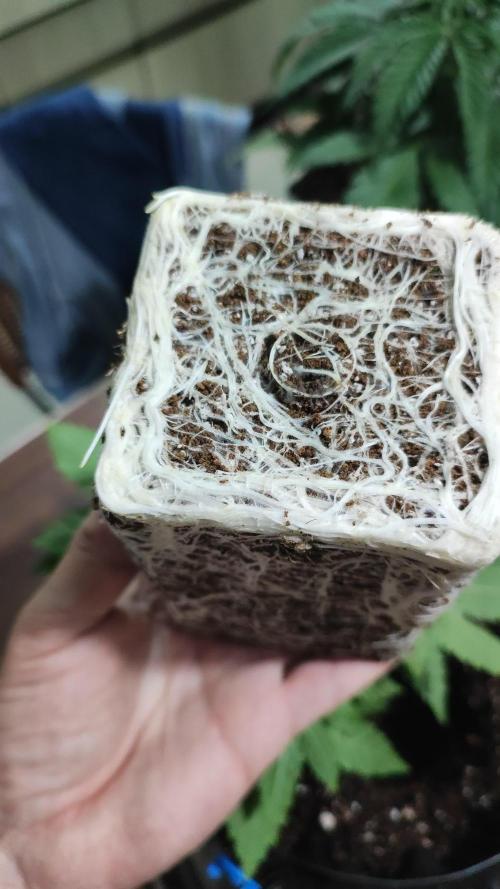
End of week 1 of flower
Started LST today
She is doing very well
The other Bruce Banner in shared pot is in full flower by 1 week and measures 41 cm

Likes
14
Share


Likes
5
Share


@GirlGoneWeed
Follow
Clones got transplanted into my organic recycled soil in solo cups and under the dome.
Under 300w LED QB dimmed at 50%
Watering with tap water. My live soil is packed with nutrient's and minerals so there’s no need to add nutes for now.

Likes
23
Share


@Dabking
Follow
This is my 2nd grow of Runtz Auto by Zamnesia.
It's a fairly compact strain, smells fruity and this go around smells very similar to poison strains (red poison, Durban poison, ect). I believe the terpene is terpinolene. I wish I could test it😅.
Anyways,
She was chopped on day 80
Spent 7 days drying
Yield: 2.02 ounces dry weight
Huge thanks to plagron and Zamnesia. Thanks to the eternity Grow Cup. It was an honor. 🙏

Likes
41
Share


@Mother
Follow
Week 9! We're reaching the home stretch! I defoliated "J", heavily and super cropped her taller tops. She also is the only one to receive nutrients. The crop is still pretty hefty, so we'll water them 🌞 tomorrow.
"J" is happy in her space and is content staying in Veg, indefinitely. I don't have the requirements to flip her into Flower and won't for quite some time, growing Photoperiods was not in the setup or budget.
There is still no smell to speak of, except when you manipulate her, she gives off a citrus, pine aroma.
This grow has been fairly easy going so far, no real issues to report. I'd like to thank 🙇♀️🏾 @WeedSeedsExpress and I look forward to growing their many different strains.
Finally, let me apologize for the quality of my 📸 camera, or lack thereof.
July 29, 2021, Thursday. I watered the crop thoroughly and rotated them. The girls (other than "J") are watered with pH'd tap water, that fluctuates between 6.2 & 6.4.
July 30, 2021, Friday. Girls are chillin'. I'm really having a BLAST! I knew I was going to love cannabis cultivation, but this is something else. I've taken to it, like a 🦆 duck to water. I can't wait to see what more knowledge and experience will reveal.
Anyone that's been on the fence about whether to grow or not, do it. Just go ahead and do it. Only thing I regret, is not being able to afford more 💡 lights and fans.
Or if you want to grow vicariously, you can always sponsor me.
July 31, 2021, Saturday. Everything is peachy.
August 1, 2021, Sunday. I watered the girls today. I moved "J" into the "Veg Desk" and she seems to be adapting to her new environment quite nicely.
Freeman's birthday is just days away! Freeman the person, not the plant. As I mentioned earlier in the diary, this grow has been in secret and is a surprise birthday present. I tell Freeman everything that happens in my life, so keeping this secret was a bit fun.
I look forward to August 5, for the big reveal to Freeman! Stay tuned!
August 2, 2021, Monday. Nothing to report.
August 3, 2021, Tuesday. Watered the ladies thoroughly.

Likes
3
Share


@mquintero7
Follow
Plant looks well. Buds are beautiful. Smell is very good. Some leaves are turning yellow, I believe is normal, maybe a little bit early given that is only week 5 of flowering. But still, the plant looks very healthy.

Processing
Likes
32
Share


@Ganjagrandaddy
Follow
DAY 56 Since flip: well all of these ladies have come past the official harvest dates mow of max 56 days. I am happy to say it is because they all want to continue swelling and pushing new pistils to show off their prowess.
FFT#1 Is starting to brown off nicely all over and will need a loupe soon to determine how close she is to her sweet spot . She smells so much of pineapples now that I think she has to be on that track for her true identity. Nice solid buds , not the biggest but a few around so shouldn't be too shabby on her yield.
FFT#5 Is racing with #7 to the best sized buds I think. She has a couple that are certainly the 2 mains picked to quad from but even the secondary challengers are nice and fat and verybfrity sweet. They are developing a lot of new tricks too and could go another week at least.
FFT#7 Is the heaviest bidder of the whole grow so far. She continues to swell and push plenty of new fresh pistil sets out at a fair pace. Her lower down growth is showing through the canopy all over and does her genetics very proud. She is my favourite of the for growth but #5 is doing amazing too. Let's see what next week brings to the game shall we.
Be sane growmies.

Likes
20
Share


@Boomdrawfyah
Follow
57 dias de vida y 31 dias de trasplante vaya diferencia en solo 10 dias han crecido 50 cm ha augmentado el tamaño exageradamente , hay algun saltamontes comiendo alguna hoja pero nada grave , estan creciendo muy sanas y con unas hojas de 11 foliolos grandísimas la última foto hay una comparación con el culo de una garrafa de 5L

Likes
56
Share


@Aedaone
Follow
The temperatures, humidity, and watering volume(if measured) in grow conditions are all averaged for the week. The pH is soil pH. Any watering done by me is well water which is 7.6 pH and 50° F. Any listed nutrients are ml/gallon of soil to be spread evenly on top of the soil
Day 1 we had a high temperature of 80°F. The skies were partly cloudy with a healthy breeze. I water 2-2.5 gallons today.
Day 2 we had a high temperature of 79 and partly cloudy skies. This cooler weather has been nice. I watered 2-3 gallons each pot once.
Day 3 we had high temperature of 92°F. I watered 3-4 gallons from the hose.
Day 4 we had a high temperature of 85°F. Skies were cloudy to overcast with off and on rain until noon. Then partly cloudy in the afternoon. I added 50ml of blood meal and 50ml of iron spread evenly across the tops of the pots. No watering today.
Day 5 we had a high temperature of 86°F, a short rain shower, with cloudy to partly cloudy skies. Watering done today by the rain.
Day 6 we had high temperature of 81°F skies were cloudy to partly cloudy. We had some intermittent heavy rain so everyone was watered by nature today.
Day 7 we had high temperature of 85° F, with sunny skies. I watered 3-5 gallons each plant from the water hose.
This week was a success. These girls have really added some height. I need to do more work shaping these. They began to run low on nutes. The built of phosphorus from the recycled soil is beginning to play out finally. I added 45ml coop poop and 50ml plant tone spread evenly across the top of the soil. We had our first signs of flower today. I love these fast flowers
Likes
21
Share


@Ultraviolet
Follow
Heyókȟa
I desire naught but the study of nature, to find my way back home.
12x12=144, A dodecahedron is a polyhedron with 12 faces, and in coordination chemistry, it refers to a geometry where ligands surround a central metal atom (in this case, Magnesium) in a specific, 8-coordinate arrangement. Dodecahedrane is a hydrocarbon, meaning it's composed solely of carbon and hydrogen atoms. The carbon atoms are arranged at the corners of a dodecahedron, a 3D shape with 12 pentagonal faces. The water molecules in the dodecahedron form hydrogen bonds that are individually slightly weaker than in either the dimer or the tetramer. However, because three-quarters of the O -H groups in the dodecahedron form hydrogen bonds, it has a more negative energy per molecule than has either the dimer or the tetramer. Magnesium (Mg2+) is the essential, central metal ion in the chlorophyll molecule, crucial for photosynthesis by enabling light absorption and energy transfer. It is chelated by four nitrogen atoms within the porphyrin (or chlorin) ring structure. Chlorophyll appears green because it reflects light in the green region of the visible spectrum, specifically between 490 and 570 nm. The main resonance electronic frequency of a neutral Magnesium (Mg) atom corresponds to the transition from the ground state to the first excited state. Resonance Line Wavelength of Mg2+: 285.1nm (UVB light). The central atom of the chlorophyll molecule is Magnesium (Mg2+), which is coordinated within a porphyrin ring. The electronic "resonance frequency" of this central atom—meaning the frequency at which its electrons absorb energy—is primarily driven by the electronic transitions (ETR) of the surrounding conjugated chlorin ring structure, rather than a discrete atomic transition of the Magnesium atom itself. The resonant electronic frequencies of the chlorophyll porphyrin (technically, a chlorin) ring are determined by the energy required to promote π-electrons within its conjugated system, primarily appearing in the blue and red regions of the visible spectrum.
In standard physics, Chloryphyll b has peak absorption at 460nm (Blue). If we take the peak wavelength 460nm and a UV-B, UVR8 peak absorption wavelength 285nm Tryptophan-285 (W285) Sensing protein. 460/285=1.618 Φ, "natural harmony" and the "structure of light". The cryptochrome photoreceptor (CRY) is a UV-A/blue light receptor that shares this dual sensitivity with several other biological structures and functions, including significant sequence similarity and a common evolutionary ancestor with DNA photolyase enzymes. These are light-activated enzymes that use blue/UV-A light to repair DNA damage caused by UV-B radiation in plants.
Dodecahedrane (C20H20) is a hydrocarbon with a cage-like structure where carbon atoms form 12 pentagonal faces (a regular dodecahedron). It is highly symmetric (icosahedral), contains no delocalized electrons (no aromaticity), and has minimal angle strain, but significant torsional strain. Water Dodecahedron (H2O) forms hydrogen-bonded cages. While individual hydrogen bonds in this structure are weaker than in the linear dimer or tetramer, it has a more negative total energy per molecule. This is because three-quarters (75%) of the groups are involved in hydrogen bonding, creating a very stable, closed-shell configuration. a 3D carbon hydrocarbon (C20H20) to stable water clusters in hydrate, while the Magnesium ion acts as the central activator within a conjugated ring in biological systems, with its electronic absorption dominated by the ring, not the atom itself.
Effective quantum efficiency of photosystem II, often denoted as ΦPSII
In horticultural lighting, adding 730 nm (far-red) LEDs alongside standard red/blue lights has been shown to increase canopy photosynthesis by 20–30% in several crops by acting synergistically with shorter wavelengths. However, the limitation is that excessive, pure IR/Far-red light (without accompanying red light) can trigger the "shade avoidance response," causing plants to grow tall, weak, and spindly rather than robust. Knowing is half the battle however, engineering or utilizing infrared light (specifically the 700-750 nm far-red range) is a viable method to boost photosynthetic efficiency. It acts as a bridge to allow PSII to utilize a broader spectrum of light, breaking the traditional 700 nm barrier.
Extend, then multiply.
UVR8-mediated signaling (often in conjunction with CRY proteins) triggers protective mechanisms that maintain the stability of the photosynthetic apparatus (including LHCII and reaction center proteins), thus ensuring that the efficiency of Photosystem II remains higher in UV-B-exposed plants compared to plants lacking this receptor. ΦPSII indictates the rate of electron transfer from water to plastoquinone, which drives the production of ATP and NADPH. There is a close link between ΦPSII and the true rate of CO2 fixation (Φ*co2), particularly in C4 plants.
Effective quantum efficiency of photosystem II, often denoted as ΦPSII, represents the proportion of light absorbed by Photosystem II (ΦPSII) that is actually used in photosynthetic electron transport. It is a key indicator of how efficiently a plant is using light for photosynthesis, as opposed to losing it as heat or fluorescence. ΦPSII (effective quantum yield of photosystem II) functions primarily as a "multiplier" (a coefficient of efficiency) rather than an additive factor when estimating the overall photosynthetic electron transport rate (ETR). Multipliers are considered far more beneficial than additions because they generate exponential growth, leverage existing resources to their full potential, and create sustainable, self-multiplying capacity, rather than just incremental, linear increases.
Humans, and most other mammals, rely on other mechanisms, such as nucleotide excision repair, to manage and repair UV-induced DNA damage. As such, humans do not have the direct, light-driven repair mechanism that photolyase offers in plants.


