


Likes
Comments
Share

@Krazy_K_Buds
Follow
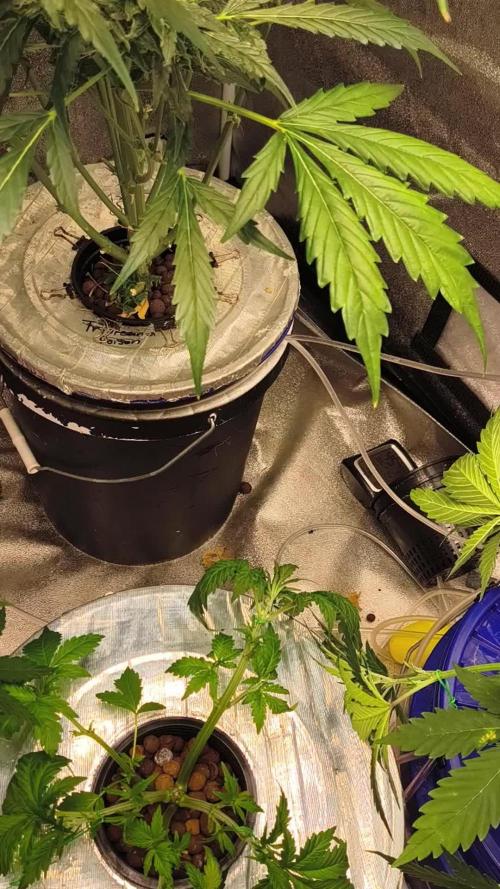
These ladies are stacking up and frosting up and smelling amazing! I can't wait to be able to try these strains.


Likes
177
Share


@DreamIT
Follow
Strong genetics, resistant, fast enough, easy to grow and never pretentious. I will try further training techniques on this strain, while waiting to make more room in the box to plant the Red hot cookie as well. If you like sweet flavors and fragrant plants this is definitely for you! Soon new updates for a cycle of only plants in "monstercropping", to continue my eternal red garden 😁🦄 thanks for following me up to here and leave a comment and suggestions 🦄👍🤘
Likes
12
Share


@CannaDiaries420
Follow
22-01
Already in week 5 and the topping is taking off its results.
*I ended the grow of nr: 3, just bad genes.
but more light for the other 3 plants.
24-01:
Applied another round of LST today. This time to create 4 main coala's and a wide and full deck of leafs.
When the plants start to get more busy i will add an scrogg technique and do a little defoliation at the bottom of them
to take even more profit of the LST.
26-01
I added Mega worm from plagron to the soil to give the plants a big boost so that they are ready for a strong flowering phase.

Processing
Likes
84
Share


@Beans
Follow
Leaf is back in action! Just enjoying life and doing things how I want, when I want. Cant let the everyday grind consume u and forget to have have fun. There will always be work to do but fun comes and goes. Dont let the man hold u down, Be the man that holds it down. Just do what u do and to those who dont like tell em I said F@#$ YOU haha...DAMN IT FEELS GOOD TO PLANTSTA!

Likes
21
Share


@420DeepGrow
Follow
Gracias al equipo de Kannabia Marshydro XpertNutrients y Trolmaster sin ellos esto no sería posible.
💐🍁 Amnesi K - Lemon:
La Amnesi-K Lemon es una semilla formada a partir de un trío de reyes, la Amnesia, la Lemon Skunk y la Jack Herer. Este matrimonio de tres dio lugar a una gran sativa que, con tonos dulces, terrosos y muy cítricos
🌻🚀 Consigue aqui tus semillas:
https://www.kannabia.com/es/semillas-marihuana-feminizadas/amnesi-k-lemon
💡TS-3000 + TS-1000: se usaran dos de las lámparas de la serie TS de Marshydro, para cubrir todas las necesidades de las plantas durante el ciclo de cultivo, uso las dos lámparas en floracion para llegar a toda la carpa de 1.50 x 1.50 x 1.80.
https://marshydro.eu/products/mars-hydro-ts-3000-led-grow-light/
🏠 : Marshydro 1.50 x 1.50 x 1.80, carpa 100% estanca con ventanas laterales para llegar a todos los lugares durante el grow
https://marshydro.eu/products/diy-150x150x200cm-grow-tent-kit
🌬️💨 Marshydro 6inch + filtro carbon para evitar olores indeseables.
https://marshydro.eu/products/ifresh-smart-6inch-filter-kits/
💻 Trolmaster Tent-X TCS-1 como controlador de luz, optimiza tu cultivo con la última tecnología del mercado, desde donde puedes controlar todos los parametros.
https://www.trolmaster.com/Products/Details/TCS-1
🍣🍦🌴 Xpert Nutrients es una empresa especializada en la producción y comercialización de fertilizantes líquidos y tierras, que garantizan excelentes cosechas y un crecimiento activo para sus plantas durante todas las fases de cultivo.
Consigue aqui tus Nutrientes:
https://xpertnutrients.com/es/shop/
📆 Semana 1:
Gran comienzo primaveral después de una germinación excelente. La etapa de plantula se desarrolla con normalidad.
Esta semana aplico tierra de diatomeas espolvoreada en el sustrato para proteger las plantas y las rocio con una solución de cola de caballo para prevenir futuros hongos.
Potencia de la lámpara: 40%

Likes
6
Share


@RhodiesGrow
Follow
Sweet Seeds Speed + Auto Germinated in rapid rooters and AC Infinity propagator. Temp 75º RH 85% +
3rd Generation autoflowering strain. This hybrid is the result of crossing an autoflowering Critical Mass genetic line from the Sweet Seeds®️ R&D Department, chosen for its fast flowering and pleasant intense aroma, with a selected strain of very fast flowering, our Speed Devil #2 Auto®️ (SWS25).
This autoflowering strain has been developed through the search for the genetic traits responsible for very fast flowering. The final result is a strain that is ready to harvest only 7 weeks after germination.
It produces thick buds covered with aromatic resin. Sweet and fruity aromas with hints of yeast and cheese.
Awards
1st Prize - Best Autoflowering Strain - 1st Grow Diaries POTY - Spannabis - Barcelona - 2022
Likes
16
Share


@Nickeluring
Follow
We're getting close to harvest. She is putting on the last bit of weight and adding some trichomes these last days. Her smell is strong and good.
She'll go down later this week...

Likes
21
Share


@uptown4life
Follow
Maintained the LST and Defoliated girls and to me they seemed to be fine with everything done. I also gave them nutrients on 11/12 and plain water 11/16 and both was until runoff. This was the 1st week with UVA lights on for 1 hour at the end of the days light schedule.{ Ladies seem to have no issue with UVA} only issue is #2 seem to be having a rough grow, not sure whats going on with her.Other then that to me with my limited knowledge and this being my 1st grow ever and the mistakes i made they look to be fine to me, but IDK.Either way i'm happy and enjoy growing my own BUD. Thank you all for the responses that i have received from the community on Growdiaries. HAPPY GROWING!!!

Likes
48
Share


@MG2009
Follow
Still on water only. Captains Cake going to mom and clone tent. Alongside sour dream. For future diary's. Switching to Budswell 0-7-0 for flowering next week.😁

Likes
96
Share


@DogDoctorOfficial
Follow
Greetings, fellow cultivators! Today, I'm thrilled to share the grand finale of our journey with the remarkable Big Cheese Auto from Seeds Mafia. At day 81 from seed, she reached the pinnacle of her splendor, and the harvest was nothing short of spectacular.
As I gently snipped each ripe bud, I couldn't help but marvel at the beauty and resilience of our Big Cheese Auto. From the moment she emerged as a seedling, she embodied strength, vigor, and an unwavering determination to flourish. Now, as she hangs upside down to dry for the next two weeks, I'm filled with a profound sense of gratitude for the privilege of witnessing her growth.
Our journey with the Big Cheese Auto has been nothing short of extraordinary. From the excitement of germination to the meticulous care during vegetative growth, from the anticipation of flowering to the aromatic crescendo of the harvest, each phase has been a testament to the plant's resilience and the joy of cultivation.
The journey began with a tiny seed, a promise of potential waiting to be fulfilled. With the nurturing support of the Autopot system and the guidance of Aptus Holland's nutrients, our Big Cheese Auto thrived, transforming into a botanical marvel with each passing week. From the emergence of her first true leaves to the explosion of trichome-rich buds, she captivated us at every turn.
A heartfelt thank you to Seeds Mafia for providing the genetics that sparked this incredible journey. Your seeds have not only produced exceptional plants but have also inspired a community of passionate cultivators. Your dedication to quality and innovation is truly commendable, and I am grateful for the opportunity to cultivate such remarkable genetics.
Before the trimming and curing process begins, I took the time to capture the beauty of our Big Cheese Auto in a special photo shoot. Each snapshot is a testament to her magnificence, a visual ode to the journey we've shared together.
To the entire community, both near and far, thank you for accompanying me on this horticultural odyssey. Your support, encouragement, and shared passion for cultivation have made this journey all the more rewarding. Let's continue to cultivate greatness together!
Thank you for being a part of this incredible journey! Wishing you all abundant harvests and joyful cultivation endeavors ahead!
Genetics -Seeds Mafia Big Cheese Automatic
Light - LUMATEK ZEUS 465 COMPACT PRO
Food - APTUS HOLLAND
All info and full product details can be find in can find @
https://seedsmafia.com
https://aptus-holland.com/
https://lumatek-lighting.com/
As always, thank you all for joining me on this journey, for your love, and for it all. My horticultural odyssey would never be the same without you. Your love and support are cherished, and I feel both honored and blessed to have you in my life

Likes
32
Share


Likes
51
Share


@Hashy
Follow
Week 14 (week 7 flower)
Light settings
12/12 on at 9.00am off at 9.00pm
Viparspectra
Light power= 63% 150w
VPD aim 1.0-1.6
DLI aim 35-40
Extractor settings
temperature 24c with 0c steps
Humidity 45% with 0% steps
Max speed 10
Min speed 4
Monday 19/6/23 Day 92 (day 46 flower)
Been warm again but a good few thunderstorms. VPD has been better.
Tuesday 20/6/23 Day 93 (day 47 flower)
Moved light more over the test strains at the front.
#1 DLI=34.5
Wednesday 21/6/23 Day 94 (day 48 flower)
💧 Starts Autofeed at 10.00am-12.05pm, 8 runs (5,5,10,10,15,15,15,15 total 90 mins) 5 minute gaps.
12L
30 drops ph d
Feed Ec=1.33 Ph=6.5
1.7L left
Roughly 2L each
Combined runoff 1.5L Ec=2.1ph=6.2💧
Defoliation.
Thursday 22/6/23 Day 95 (day 49 flower)
Friday 23/6/23 Day 96 (day 50 flower)
Been less of a battle controlling VPD today.
Saturday 24/6/23 Day 97 (day 51 flower)
Adjust drippers.
💧 Starts Autofeed at 10.00am-12.05pm, 8 runs (5,5,10,10,15,15,15,15 total 90 mins) 5 minute gaps.
13L
35 drops ph d
Feed Ec=1.31 Ph=6.2/6.5
1.25L left
Roughly 2.35L each
Combined runoff 3L Ec=2.4 ph=6.0💧
Sunday 25/6/23 Day 98 (day 52 flower)
#1 Height= 65CM Dist= 38CM DLI=34.0
The weather has caused another tough week for controlling environment. The grow is showing signs of heat stress but nothing to worry about.
This tester is coming along nice. Becoming very frosty, I'm not sure how much more the flowers will bulk out but she is looking nice.
Likes
14
Share


@Esoteric_growing
Follow
Did a final defoliation and now should see some decent swelling of the buds over the next couple of weeks
Likes
19
Share

@PavementPunk
Follow
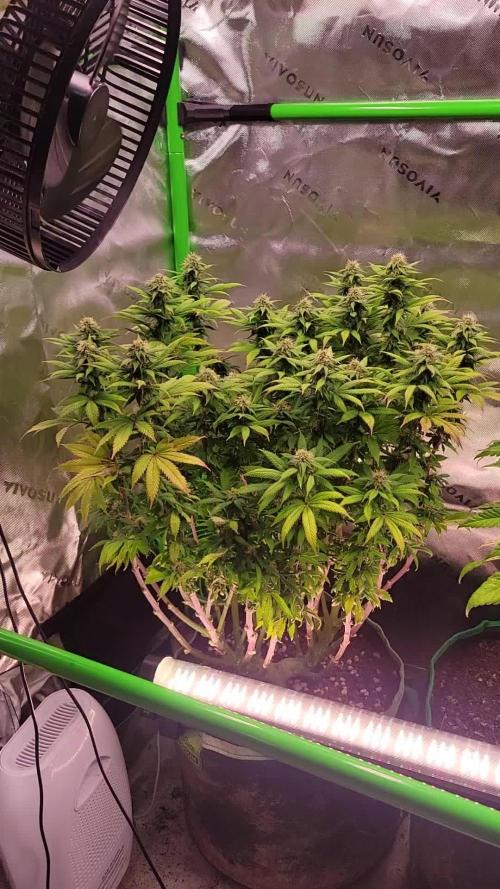
7/8/26 this poor baby was another caterpillar victim. Besides the stunting damage she shook it off ok. Not the biggest and probably not gonna produce a ton but shes doing her thing and looking pretty healthy. Happy growing friends ✌️
Likes
13
Share


@Dunk_Junk
Follow
She's starting to get frosty!!!!!!!
Pistils just turning flame orange 😍
One she goes!


Likes
Comments
Share

@Raul2021
Follow
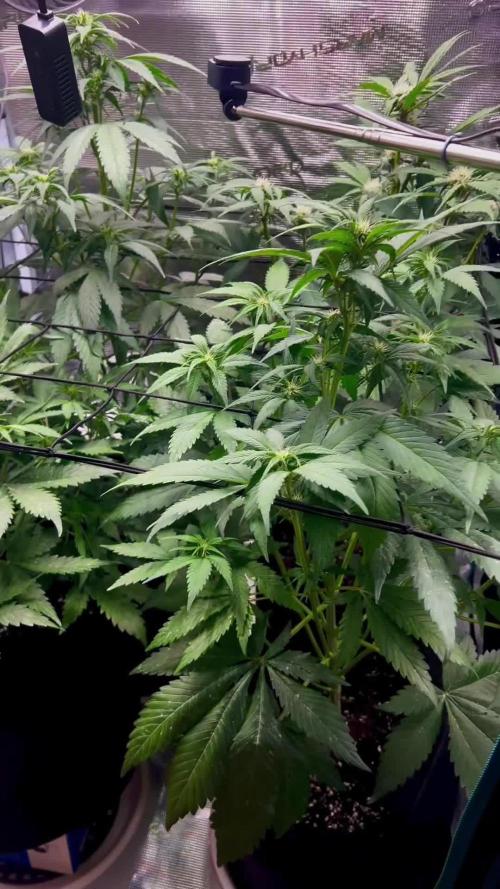
Día 42 de vida de las plantas, estas semanas se ha producido un crecimiento explosivo, se ha regado con unos 1,5 litros por planta con un PH de 6,1 y una EC de 0,82. Se han añadido suplementos al riego para favorecer la floración aun sin utilizar ningún fertilizante. Una de las plantas tiene unos pistilos impresionantes mientras que a la mas pequeña le sigue costando estirarse, ya ha conseguido mostrar las puntas de las hojas. Se ha echo poda de bajos eliminando las ramas con menor exposición a la luz, solo queremos cogollos grandes y compactos. He colocado un intractor de aire y he recolocado el sensor de temperatura y humedad para obtener unos valores mas reales, tenemos ciertos problemas de humedad que aun estoy intentado resolver, por las noches sube a más de 70% y no consigo bajar de 65%. No he aplicado preventivos y aun menos aplicar foliar para que no suba la humedad, con el diatomeas de la semana pasada parece que no existe ninguna plaga en el cultivo.
Por otro lado he apreciado una pequeña deficiencia en las hojas de las plantas, según la IA lo más probable es deficiencia de calcio o magnesio, he aplicado 1 ml/l de Calmag a ver como progresa estas semanas.
Estas son las condiciones de esta semana:
Ventilación: nivel 50% oscilación 90 grados
Extractor: 45%
Humidificador: Off
Luz: 85% con altura de 30 cm
Ppfd: 550 umol/m2/s
Periodo: 18-6
Humedad: 65% a 75%
Temperatura: Día 24 C - Noche 20 C
Vpd: 0,51 a 1,12 kpa
Co2: 329 a 760 ppm
Temperatura del sustrato: mínima 20,4 C máxima 23 C
Humedad del sustrato: mínima 8,5% máxima 33,8%
Productos y Marcas usadas:
Indoor: MARSHYDRO 80x80x160
Led: MARSHYDRO FC 1500 EVO SAMSUNG
Ventilacion y extracción: MARSHYDRO
Controlador: IHUB PRO MARSHYDRO + Kit Sensores
Medidor PH: Milwaukee PH 600
Medidor EC: Milwaukee C66
Sustrato: COMPOSANA Semilleros / LIGHT MIX BIOBIZZ
Ph: BIOBIZZ UP / DOWN
-Fertilizantes-
BAC: GROW, BLOOM, PK, CALMAG
ADVANCED NUTRIENTS: VODOO JUICE, BUD CANDY, TASTY TERPENES, BIG BUD, OVERDRIVE, BUD IGNITOR.
Likes
179
Share


@StarLorr
Follow
Welcome to my Øpium diary.
In this diary:
Seeds: sponsored by Ðivine Șeeds
Media: Promix HP
Nutrients: Advanced Nutrients, Diablo Nutrients.
Light and Weather: Şun☀️and Mother Earth.🌎
___________________________
Feeding:
Mon 03Jun: 2L water not pH'd in bottom saucer only.
Tue 04Jun: 2L water not pH'd in bottom saucer only.
Wed 05Jun: 4L nutrients pH'd 6.5
Fri 07Jun: 2L water not pH'd in bottom saucer only.
Mon 10Jun: 2 L water not pH'd in bottom saucer only.
___________________________
We had very warm weather and by the end of the week rain pouring.
Did spray the girls with Safers insecticide after sunset for good measure after discovering spider mites nests on june 3rd.
___________________________
Thanks for stopping by, likes and comments are appreciated!👊🏻😎
Keep on growin!
Keep on tokin!!!
😙💨💨💨💨💨

Likes
65
Share


@Dendegrow
Follow
So the net is installed, lets wait until it is full covered and then going into bloom. I make this time a trial only to feed the Organe sherbet with Melass yeast buddermilk and sugar in vegetation. The yeast will produce the whole grow enough co2 to keep it up about 800 ppm only thing you have to do is to put some sugar in the feeding solution.
