Processing
Likes
Comments
Share
@
Follow
Processing
Likes
1
Share
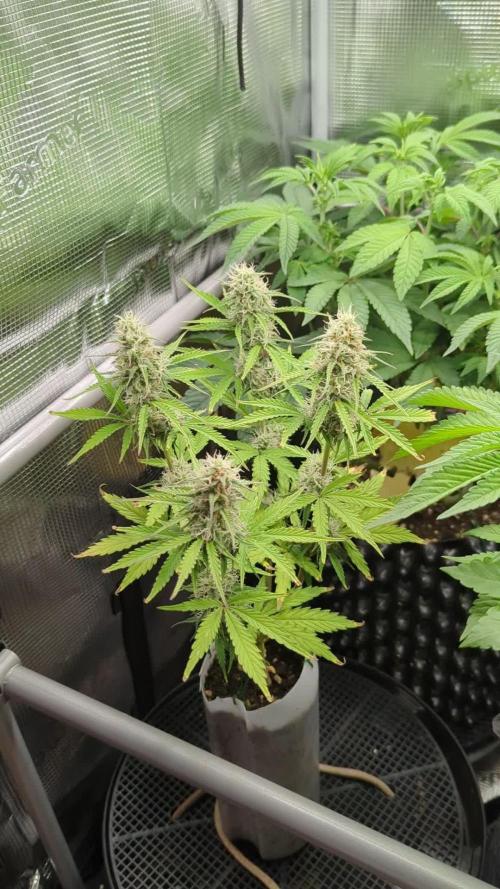
week 5 when the thrips first showed themselves. I noticed them cuz some silver stains started appearing on some leaves. you can see them better under LED light. So, I sprayed Neem Oil all over the plant. I could notice that if you don't do it well, spraying and rubbing the leaves with a piece of cloth, the oil will also create some stains. 2nd topping. killed some thrips this week, they're cute and didn't seem to harm the plant seriously. Neem oil worked fine to control them. No other pests that I could notice + Defoliation + LST Flowermind (4ml + 0.5g)
Likes
6
Share
Legend Timestamp: 📅 EC - pH: ⚗️ Temp - Hum: 🌡️ Water: 🌊 Food: 🍗 pH Correction: 💧 Actions: 💼 Thoughts: 🧠 Events: 🚀 Media: 🎬 D: DAY, G: GERMINATION, V: VEGETATIVE, B: BLOOMING, R: RIPENING, D: DRYING, C: CURING ______________ 📅 D29/V25 - 14/05/24 ⚗️ EC: 1.0 pH: 5.2 🌡️ T: 20°C H: 50% 🌊 🍗 💧 💼 🧠 🚀 Back Home 🎬 ______________ 📅 D30/V26 - 15/05/24 ⚗️ EC: 1.0 pH: 5.0 🌡️ T: 20°C H: 50% 🌊 🍗 💧 💼 🧠 🚀 🎬 1 TL video ______________ 📅 D31/V27 - 16/05/24 ⚗️ EC: 1.2 pH: 5.0 🌡️ T: 20°C H: 60% 🌊 🍗 💧 💼 🧠 🚀 🎬 1 TL video very short + 1 TL video of LST ______________ 📅 D32/V28 - 17/05/24 ⚗️ EC: 1.2 pH: 5.0 🌡️ T: 20°C H: 60% 🌊 🍗 💧 💼 🧠 🚀 🎬 1 TL video ______________ 📅 D33/V29 - 18/05/24 ⚗️ EC: 1.2 pH: 5.0 🌡️ T: 20°C H: 60% 🌊 🍗 💧 💼 🧠 🚀 🎬 1 TL video ______________ 📅 D34/V30 - 19/05/24 ⚗️ EC: 1.0 pH: 5.0 🌡️ T: 20°C H: 60% 🌊 🍗 💧 💼 Big work to prepare her new home 🧠 🚀 🎬 ______________ 📅 D35/V31 - 20/05/24 ⚗️ EC: 1.0 pH: 6.0 🌡️ T: 20°C H: 70% 🌊 16 L 🍗 CalMag - Grow A-B, B-52, Bud Candy, Rhino Skin, Hydroguard 💧 💼 🧠 🚀 The new home for Rey in now ready 🎬
Likes
28
Share
@BudVision
Follow
Hello growers, I harvested because she had completely consumed everything in her pot, so there was nothing left to wait for. The aroma is sweet and spicy, hard to describe but very pleasant. The bud is dense and beautifully colored. Peace and happy growing! ✌️
Likes
13
Share
already harvested the big headbud, because its very wet outside in the moment and i dont want my headbuds to rot. The deeper flowers of the plant look like they need a little bid longer. they are smaller, so the chance of bud rot is lower. to dry them the box is standing in the cellar with around 20 degrees, but definitely to wet there as well :D sorry for the bad pics, got a problem with my cam. Update: after 5 more days I harvested the rest. I am curious to see how much it will be after drying Summary: ztrawberriez and zkittelz were a blast for our 1st time outdoor grow, about 25g each dried and trimmed. Gorilla Punch had a problem with bud rot because she only produced one big cola. So there were only about 10g from that purple gorilla punch
Likes
14
Share
Que pasa familia, vamos con la tercera semana de floración de estas Mental Rainbow F1 de Sweetseeds. Vamos al lío, las plantas se trasplantaron a macetas de 7 litros. El ph se controla en 6.5, la temperatura la tenemos entre 24/21 grados y la humedad ronda el 50%. El ciclo de crecimiento puse 12h de luz, el foco está al 70% de potencia. Me gustaría estar más encima este cultivo pero la salud me está impidiendo un poco este 100% con el proyecto. Con suerte la semana que viene andaré mejor. - os dejo por aquí un CÓDIGO: Eldruida Descuento para la tienda de MARS HYDRO. https://www.mars-hydro.com Hasta aquí todo, Buenos humos 💨💨💨
Likes
6
Share
Likes
3
Share
prima settimana, germinata il 17 dicembre temperature: 22 gradi 60% rh luci accese 15 gradi 60% rh luci spente
Likes
4
Share
Jour 55 sur 65 Plus la fin approche et plus elle est jolie .J'aime la cultiver elle sens très fort les agrumes
Likes
2
Share
The plants have been sitting in a homemade dome for a few days now. Today I decided to move them back to the ziploc dome so I could move my light a little closer. I was scared it would burn them but they seem fine so far, and they stretching a little too much imo. I think next time I pop seeds or run clones I need to get a small fluorescent to keep a few inches away from the plants so they dont stretch as much. Either way, they look good. I even broke the machine elves putting the dome on. I had some duct tape and a paper clip handy so I did some first aid and its kept growing. It was almost broke off completely so I'm not sure if itll make it in the long run. Cool to see how plants can survive something like that tho. It's not only looking fine, but it's the tallest too. I think my new humidifier is gonna be here Wednesday so until then I'll keep the domes on. I'm trying to make some taller domes too so I might not even need the humidifier yet. For now I've connected the veg tent to the flower tent with some ducting. It seems to be keeping it around 50% RH. I might keep this connected until I need to connect my filter. I'm hoping to have these ready to move to my flower tent in 4-5 weeks. Ideally I'm planning to have a perpetual harvest going that will let me harvest every 4-5 weeks.
Likes
148
Share
Boom! Touchdown! I let her dry for 13 days before the trim. The humidity in the grow tent was maybe a bit lower than what I usually prefer, but I wanted to be extra cautious against budrot in the other plant drying in the same tent. It was a breeze to trim her and the final result was 84.4 grams of pure flower with no larf at all. In fact, I didn't even bother keeping the trim as there wasn't all that much of it.
Likes
9
Share
Processing
Likes
103
Share
@CaliGrown
Follow
DAY 65- started to back off the nutrients a bit. Smells like oranges more and more each day. Swelling up nicely now and stacking those triches. Yippie this one is going to be a grower and a show-er 😉
Likes
2
Share
Remember that, however you are played, or by whom, your soul is in your keeping alone. Even though those who presume to play you be kings or men of power, when you stand before God, you cannot say, 'But I was told by others to do thus,' or that virtue was not convenient at the time. This will not suffice. Remember that. Day:18 84°F and 65% RH (VPD) for the vegetative stage. Approximately 1.15kPa(assuming leaf temperature is about 2°F cooler than the air), which falls right into the ideal vegetative sweet spot (0.8kPa to 1.2kPa). At 1.15kPa, plants can draw water and nutrients efficiently without risking stress or wilting. It keeps the leaf pores (stomata) open, allowing for ideal carbon dioxide intake and maximizing vegetative growth. VPD is determined by the leaf's temperature, not just the ambient air. Because leaves usually run 1° to 3°F cooler than room air under bright grow lights, my actual VPD will be slightly lower, closer to the 1.0kPa mark. As she transitions from vegetative growth to flowering, one can gradually lower the humidity (to around 45–60%) and drop temperatures slightly to prevent disease from settling inside dense buds when they appear. Night:6 At 70°F and 60% relative humidity, Vapor Pressure Deficit (VPD) is 0.86 kPa. This is right on the cusp of whats optimal for the vegetative stage. During the nighttime, plants generally close their stomata and undergo cellular respiration rather than photosynthesis. Transpiration slows to a near stop, making VPD less critical at night than during the day. However, maintaining a nighttime VPD between 0.8 and 1.0 kPa is highly beneficial in that it ensures the air is dry enough to prevent powdery mildew or bud rot, but moist enough to keep the plant from undergoing unnecessary stress. This range keeps the environment comfortable for cellular processes and prevents large atmospheric swings. Keeping it all flowing. (Not pushing them yet, these are photoperiods) The optimal soil (root zone) temperature for cellular root respiration and nutrient uptake in cannabis is between 68F & 72F This narrow range balances biological energy production (cellular respiration) with the dissolved oxygen levels in the soil, maximizing plant growth and health. Warmer soils hold significantly less dissolved oxygen. When soil temperature exceeds 74F oxygen depletion occurs, inhibiting cellular respiration almost entirely, At 68-72F root cells generate optimal adenosine triphosphate (ATP) via respiration to power root-tip elongation and the active transport of water and nutrients. Too Hot (Above 78F) Root respiration increases, demanding more oxygen, while the water's oxygen-carrying capacity drops. This creates a prime environment for anaerobic pathogens and Pythium (root rot). Too Cold (Below 60F) Root metabolism and cellular respiration slow to a crawl. This severely impairs nutrient and water absorption, leading to yellowing, wilting, and phosphorus deficiencies. A lot depends on whether it's automatic or photoperiod; with photoperiod, there is not as much of a need to push "hard" as the real countdown only begins once the flower is initiated. Automatics, on the other hand, the chronological "clock" begins ticking the moment the seed germinates. It is of critical importance that the seedling growth gets off to the races, understanding that early growth is like compound interest, which will pay off come harvest. This reality is why getting autoflowers "off to the races" early on yields such exponential benefits. The "compound interest" is directly related to the surface area of the leaves. Larger, faster-growing seedlings process more light and build bigger root networks early on, which translates into an explosion of vertical and lateral growth during their short vegetative window. The margins for error are so thin with autoflowers; this early-stage momentum depends on several critical practices. Seedlings exposed to increased atmospheric CO2 levels early in life will develop at an increased rate. To effectively "extend" or optimize the capacity of Photosystem II (PSII) for increased photosynthetic efficiency. In standard oxygenic photosynthesis, Photosystem II (PSII) is naturally limited to the red-light spectrum, peaking at 680nm. Extending its light-harvesting capacity past 700nm into the far-red region requires bypassing the natural limits of standard chlorophyll a. Adding 730 nm (far-red) LEDs alongside standard red/blue lights has been shown to increase canopy photosynthesis by 20–30% in several crops by acting synergistically with shorter wavelengths. However, the limitation is that excessive, pure IR/Far-red light (without accompanying red light) can trigger the "shade avoidance response," causing plants to grow tall, weak, and spindly rather than robust. Utilizing infrared light (specifically the 700-750 nm far-red range) is a viable method to boost photosynthetic efficiency. It acts as a bridge to allow PSII to utilize a broader spectrum of light, breaking the traditional 700 nm barrier. UVR8-mediated signaling (often in conjunction with CRY proteins) triggers protective mechanisms that maintain the stability of the photosynthetic apparatus (including LHCII and reaction center proteins), thus ensuring that the efficiency of Photosystem II remains higher in UV-B-exposed plants compared to plants lacking this receptor. ΦPSII indictates the rate of electron transfer from water to plastoquinone, which drives the production of ATP and NADPH. There is a close link between ΦPSII and the true rate of CO2 fixation (Φ*co2). ETR stands for Electron Transport Rate. It measures the speed at which electrons are moved through the thylakoid membranes in a plant's chloroplasts during the light-dependent reactions of photosynthesis. Infrared light (particularly Near-Infrared or NIR) improves cellular energy by interacting directly with the electron transport chain (ETC) in mitochondria. This process boosts adenosine triphosphate production, which acts as a metabolic coefficient multiplier by accelerating enzyme activity dramatically. Extend then multiply. Far-Red photons interact with plant photoreceptors to accelerate the plant’s biological "clock" or trigger a shade-avoidance response. Autoflowers don't use the plant's biological clock, although the IR will initiate a shade avoidance and make them stretchy. You can just add equal measures of 660nm-680nm to negate the shade avoidance effect. Replacing nights' "darkness" with a combination of IR+ and 660nm. Because autoflowers don't require a dark period to flower, many growers just blast them with light. 18/6 24/0. However, this ignores the plant's metabolic rhythms, where daytime photosynthesis (light reactions) must be perfectly balanced with nighttime carbon fixation and assimilation (Calvin cycle) to avoid bottlenecking plant development. Cellular respiration is a 24/7 process, but it can only function while the plant has the free oxidative capacity to do so. A 100% photosynthetically active leaf cannot perform cellular respiration. The viral trend of defoliation of every leaf that isn't "getting enough light" is of great detriment overall, putting 100% of the cellular respiratory "workload" and responsibility on the 0/4/6 hours of darkness in sub-optimal conditions for enzymatic activity. Photosynthesis captures nearly 100% of the initial energy as carbon, while cellular respiration is the process that unlocks 90% of that captured energy into usable ATP so the plant can use it. Respiration is considered only roughly 30% to 40% efficient. It captures enough of the potential energy in glucose to synthesize around 30 to 38 ATP molecules per glucose molecule. The remaining 60% to 70% of the energy in the sugar is not captured in ATP; instead, it naturally escapes into the environment as heat, which helps regulate plant temperature. In plants, the primary enzymes of the Electron Transport Chain (ETC) and the ATP synthase complexes are typically adapted to function optimally in warmer temperatures (roughly 77°F to 95°F, depending on the specific plant strain). As temperatures rise within this physiological range, molecular collisions increase, speeding up respiration and ATP production. The cannabis plant has a branched respiratory pathway. During heat or cold stress, plants activate Alternative Oxidase (AOX). AOX burns sugars to dissipate energy as heat rather than coupling it to ATP production. This pathway actually functions optimally at elevated temperatures to help protect the cell from the damaging build-up of Reactive Oxygen Species (ROS) during heat stress. Enzyme activity generally scales with heat; there is a strict biological limit. If canopy temperatures in a grow room exceed 104°F, the enzymes and their supporting lipid membranes lose stability. Not saying you need to go crazy, just optimize nights the same as we optimize days. Phosphorus is the driving force behind early seedling development. It acts as the "energy hub" of the plant, directly driving cell division, robust root growth, and the creation of DNA. Without an adequate, easily accessible supply early on, the plant's overall growth potential and final yield can suffer permanently.
Likes
69
Share
5/12/21 Week 1 of flower 10 of life. Checked fluids 6.01ph, and 390tds. Plant seems ok were I split stem. Will give dose of recharge later this evening. Now on a 12/12 cycle. The watering volume per hour is not letting me go over 2.6 gallons per day. My pump is recirculating water at 200 gallons/hr it runs 15 minutes 2x day. So 50 gallons 2x day or 100 gallons per day. 5/13/21 will start foliar feeding tonight at lights out. Using TPS Canopy boost. Will use for 3 weeks every 3-4 days. Changed water to bloom nutrients. Ph 6.01 tds 710. 5/15/21 ph 6.18 tds 570. Will get dose of recharge this evening. Plants leaves are almost touching side to side in tent. 5/16/21 added water (4 gallons) can't believe she went through that much in 3 days. Ph 5.85 tds 689. Will get a foliar feeding tonight at lights out. 5/18/21 changed nutrients water. PH 5.96 TDS 680. Leaves of plant are now touching all 4 walls of 4x4 tent.
Likes
8
Share
@artems
Follow
Scrooge is feeling fantastic, packing on mass and starting to emit a sweet candy aroma. It's thriving with vigor, promising a delightful harvest ahead. 😊🍬
Likes
8
Share
Day 43 : Watering with co2 tab / 5L. Also added food again because i think they need it. Increased ppm to 850. Maybe the next one will be pure water. Ventilation works all the time when lights are on. Temp and humi are stable and this is good for the girls. She has a lot of burns and i dont know why. Dont want to flush or something. I will let her take her way. Patience is the key always. Also removed some burned leaves from all ladies. She took 4cm in 3 days, so i guess stretching finished and start bud production. Edit (Day 47) : Watering with co2 tab every 5L. DsD drank pure water because of burns. She has lost a lot of leaves from bottom. I dont know what to do. I will keep watering her with pure water to see if burns stabilized.
Likes
28
Share
What's up growmies 🤟🏽 Week number 4 is in the books🙌🏾 Today marks the official start of week 5 and just like my previous grows all my autos are starting to preflower. Like clockwork it starts around week 5 so it lets me know these are right on schedule. I am really focusing on keeping the main cola ties down to keep the canopy as even as possibly. Typically in the past I would stop tying them down during flowering and the main cola would outgrow the rest and dominate. This grow I am continuously tying the main cola down. They all are pretty even except for Caramelicious, her main cola is just a stud and won't bend to 180 w/o me snapping the main stalk. She still is my favorite though and it's my 7th time growing her (I plant at least 1 Caramelicious each grow) The nutrient schedule remains the same. I am feeding them General Hydroponics Flora series. (Floragro, FloraMacro, FloraBloom) I am mixing what the manufacturer recommends for 1 gallon into 3 gallons, so I'm giving roughly 1/3rd what's recommended and it seems to be the sweet spot for my set up and environment. All the plants are doing well and are not showing any signs of stress, deficiency, or toxicity at this point. The weather here in VA has been pretty cold which makes it perfect humidity wise for my indoor grow, without having to blast my Cloud intake system, or even turn on the dehumidifier which won't last long because they are starting to flower and will take up more volume increasing humidity so I expect to have to use them both in the next few weeks. It appears a spider has made it's home in my tent (I see webbing in one corner of the tent) I figured it'll take care of pests for me and is not harmful so I am leaving it be for now. All in all everything is going well so far, fingers crossed. That is it for now, until next time, Happy Growing and like always May the grow goddesses bless you all with a bountiful harvest!
Likes
Comments
Share
Lento desarrollo seguimos con fuertes lluvias saludos