


Processing
Likes
Comments
Share


Likes
9
Share


@Kushizlez
Follow
Day 60F
The PM on the cheese has gotten significantly worse in the last few days. I think it may have something to do with the constant humidity spikes every time I water. I haven’t been running my humidifier at all in flower so maybe it’s having trouble keeping the RH up during lights on. Just another reason to follow a daily watering schedule. The cheese and slurricane look fucking disgusting and I’m starting to doubt that a peroxide wash can totally fix it. It worked well for my outdoor crop so it should be fine but this time there is probably 3x the amount. I’ll make sure to really soak the buds and rinse them off good.
Bbb#1 is flopping over like crazy from the weight. Too late to stake it up now so hopefully it holds until next week. Starting to foxtail a bit but nothing too bad. It is now 100% done and ready for chop.
Bbb#2 is just getting frostier and frostier by the day. The purple fade is really coming along nicely too. Might reveg. It is now 100% done and ready for harvest.
Black garlic #1 is finally filling out! I can’t believe it. Never heard of a plant packing weight on like that in week 8. The breeder did mention that it packs on weight later but I’m stunned. Taking her to 9.5 weeks.
Black garlic #2 is looking very average. Average color, average size buds, average frost, average smell, probably an average yield. And it’s starting to get a bit of PM. Overall not happy. Will be taking her to 9.5 weeks.
Zkittlez #1 has pleasantly surprised me. It was a bushy runt in veg but came through. It’s the third frostiest in the tent, super dense, stacked tight, smells great and looks great. It’s already got a nice amount of amber so it’s 100% ready for chop.
Slurricane #4 looks insanely frosty even under all that PM. If I can’t wash it off it’s going in the trash. I want to chop this asap but have to cut everything at once unfortunately. It’s 100% ready for harvest.
Badazz OG cheese is looking like a decent yielder but doesn’t have much else going for it. I think it still has some filling out to do. I can’t even smell the final profile change yet. The leaves are rotting off very quickly. Taking her 9.5 weeks.
I don’t mind harvesting a bit later rather than early. From my outdoor experience, when a plant is picked early it smells like hay and wet grass clippings until it’s been curing for 3 weeks. When I harvest late or at 30-50% amber trichomes it smells like same scent profile it had when growing. Just my experience.
I’ve read that the tobacco industry adds calcium and potassium carbonate to their crops to help promote fire holding capacity and to increase the whiteness of ash. Turns out some of the organic amendments I bought last week contain exactly that. I’m going to give each plant a light top dress to see if the tobacco industry is onto something.

Likes
21
Share


@NSABND
Follow
Hi there start of week 11 today 😏
today (Day 78) the weather is cold and very high humidity because of rain 😲😩😕
Day 79 same shit weather then yesterday with very high humidity and rain 😵😲😵😲😵
Day 80 autumn has arrived 😱😨😰 cold with rain and high humidity 😲😵😭
Day 82 there are no Updates sorry 😵


Likes
17
Share


@Chubbs
Follow
Weekly update on these three. They'll be getting the chop this week as they're super close to being finished. I'm looking for mostly cloudy trichs on them. Over all Happy Growing


Processing
Likes
8
Share


@Weedganja420
Follow
Esta cepa ha doblado su tamaño en poco mas de una semana!
En unos dias la pondre a 12/12 horas de luz para empezar a ver sus llamativas flores :)

Likes
2
Share


@EyeMKing
Follow
In less than 48 hrs of being in a room temp water bottle in a dark area tap roots already started coming out.

Likes
17
Share


@FlavoursUk
Follow
Day 9 for this girl and roots are touching the water, good growth so far and germinated in less than 24hrs. Pleased with this girl so far as she appears to be strong and stable from the start. Good sign. Can't wait to get her going.
Its been a good week, nice healthy growth.. rather vigorous but im not complaining. Might let her go natural this run with no training but we will see.
Stay tuned. FlavoursUK

Likes
18
Share


@Masterchief
Follow
Week 5 :
What an exiting moment, the buds started to appear.
Apparently the the topped master KUSH is doing well, was shocked for a day but has a nice canopy promising a sufficient yield I assume?
LST still going on. Will end this week, propably Wednesday 🤔
Please let me know what you think!
28/10 update : identified CALMAG deficiency will ad curating dose.
+ bought new pH meter for more accurate testing...

Likes
19
Share


@gottagrowsometime
Follow
Really happy with my yield. 70 grams doesn't look it. But adding up 14 plants i nearly push 1400g.. so overall I'm a happy chappy..
Love MSNL. I've lots to hit on their list.
I've another GDP auto going
Thc bomb auto & Purple haze auto. (I've like 6 hazes going atm so I'll run this later)
Likes
83
Share


@420DeepGrow
Follow
Gracias al equipo de Fast Buds 420 por la donación de las semillas y poder inscribirme en el concurso del año.
Creada a partir de la genética de la Girl Scout Cookies y la Gorilla Glue #4, seleccionadas a mano y en combinación con nuestra famosa Gorilla Cookies Auto, esta variedad lleva todos los mejores atributos de sus padres al más alto nivel. Este híbrido maravillosamente equilibrado prospera en el interior y en el exterior, y en todo tipo de climas, a la vez que es superresistente a los bichos y las plagas. Es una productora masiva que ofrece a los cultivadores de todos los niveles rendimientos de hasta 650 g/m² de cogollos de primera calidad que no decepcionan en absoluto. Siendo una de las versiones más potentes de esta genética, la Gorilla Cookies FF (Fastflowering) presume de un enorme porcentaje de 29 % de THC que se traduce en montones de resina y terps sabrosos que hacen las mejores extracciones. Es la elección perfecta para los cultivadores de hachís que buscan cepas de gran potencia que produzcan sabores y aromas excepcionales.
Consigue aquí tus semillas 😁🌻🚀:
https://2fast4buds.com/es/seeds/gorilla-cookies-fast-flowering
📆 Semana 7 de floración:
La planta mas grande y con mas resina de todas las que tengo, esta aceptando muy bien los nutrientes.
Los cogollos comienzan a formarse y continúa cargandose de resina.
Likes
20
Share


@GrowmieDeLaStreet
Follow
Pas de nutriments cette semaine, le sol continue de s'acidifier donc on laisse la plante utiliser les nutriments du sol. J'ai par contre donner du cal-mag en petite quantité car elle en manque définitivement, du Boo-bloom en foliar feed et des enzymes.
Je vois du mauve qui commence à apparaître sur les sugar leaves et les stems sont rouge pétant ce qui est bizzare car je ne crois pas que ce soit un trait normal de cette strain. J'ai même contacté Q.C.S par rapport à ça mais aucune réponse.
À chaque jour j'enlève des feuilles jaunes.
Je me suis aussi débarassé des clones, c'était trop de travail en plus pour 3g. Les racines ont poussées et c'est tout ce que je voulais voir.

Likes
14
Share

@CannaArchive
Follow
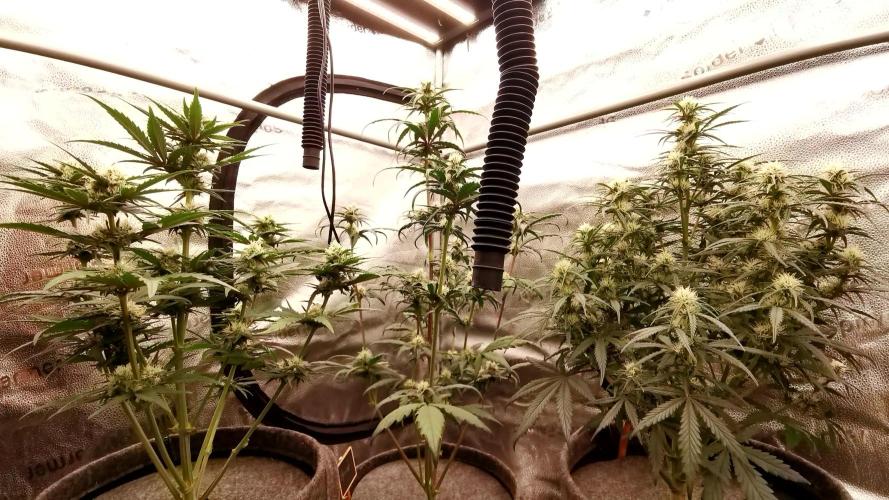
Week 8 showed strong bud development and a noticeable increase in trichome production.
Both plants are now clearly entering the later stages of flowering. ✨
Light intensity stayed around ~1100 PPFD. Environment remained stable at ~24°C and ~50% RH.
Both plants continued to be watered every 2–3 days with RO water + CalMag, based on pot weight. 💧
During this week Apricot #2 developed rust-colored / yellow spots on the small leaves near the buds, which suggested a possible nutrient imbalance or early lockout. To be safe, both plants were flushed twice with water + CalMag. After the second flush the issue did not worsen, although the damaged leaves remained visible.
Despite this, overall flower development progressed very well. 🌸
Apricot #1 looks very healthy and stable with a compact structure and now produces buds just as thick as #2.
Apricot #2 remains the slightly darker phenotype and still shows the previously observed leaf tip droop, but overall development stayed stable after the flush.
Trichome coverage increased significantly this week and the smell became noticeably stronger, developing into a sweet, fruity, tropical aroma.
The plants are relatively small compared to some previous runs, but the bud quality and resin production look very promising so far. 💪🌿


Likes
141
Share


@Ju_Bps
Follow
Hello growmies 👩🌾👨🌾🌲🌲,
👋 The end is close now, Buds keep bumping and frosty, I've started the flush this end week,
Harvest in few days, look delicious 😋.
💧Give water each 2 or 3 days
1,5l Water + Nutri NPK Bloom Boost
1,5l Water + Flash Cleaner
PH @6
- Nutri NPK
Bloom boost
1/4 tsp for 1 gal.
💡Mars Hydro - SP 3000
100% 54 cm.
🔥 Thanks community for follow, likes, comments, always a pleasure 👩🌾👨🌾💚🌲.
Mars Hydro - SP 3000 💡💡
https://www.mars-hydro.com/sp-3000-samsung-lm301b-greenhouse-led-grow-light
NUTRI NPK 💥🔥
https://www.nutrinpk.com/product/npk-mix-pak-for-4-to-5-plants-cannabis-fertilizer/
SweetSeeds - Sweet Mandarine Zkittlez XL Auto🌲🌲
https://sweetseeds.es/en/autoflowering-seeds/3233-sweet-mandarine-zkittlez-xl-auto.html

Likes
5
Share

@Jardineiro_Br
Follow
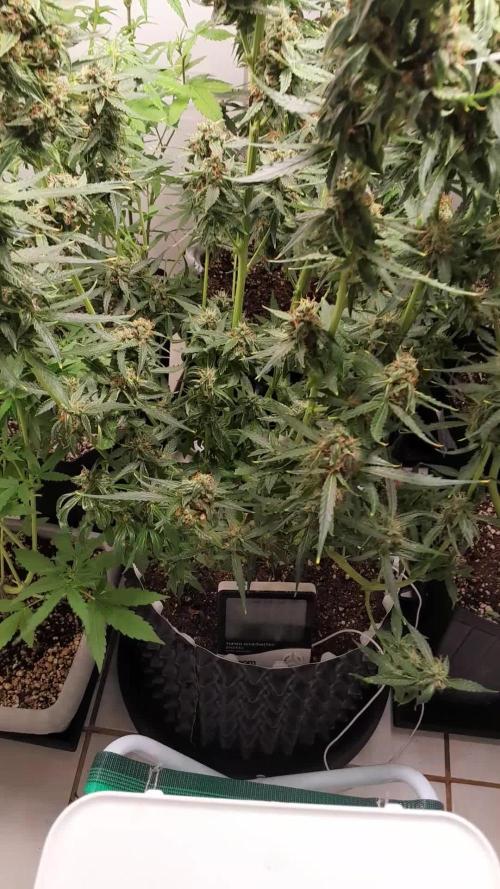
Agora é so aguardar os tricomas ficarem mais um pouco âmbar e partir para colheita. Falta pouco , mas o perigo do mofo esta cada vez maior pois os botões estão densos ena umidade é mais que 65 por cento.
Likes
10
Share


@Cocogrow1234
Follow
Week 5 flower : upped the a&b to 2.5ml litre and steered the pk at 1.2ml per litre
Blue cheese : they have completely outgrown the sunset sherbet . I’ve raised the light as the buds at the back of the tent were literally 1” away it didn’t do much harm although the leaves on them buds started to curl a little so I thought best to raise it now before it causes any stress . I’m still watering everyday to run off . I removed a few fan leaves but I am considering doing a bigger defoliation in a few days as the fan leaves have taken over . They are really starting to smell very sweet and filling out .I was worried about these seeds as I have grown Buddha blue cheese about 10 years ago and now they have changed the name to blueberry cheese and I was told they will be different from 10 years ago . So far I don’t think so as they look the same and smell the same at this point I can’t see any difference which I’m happy about as I haven’t had any good blue cheese for many many years .although they smell the filter is definitely controlling the smell outside the tent .
Sunset sherbet : although it hasn’t grow very big it’s very frosty and starting to smell .
I will carry on the pk for another 3-7 days and will start the flush about 6 1/2 weeks in for 2 weeks with plain water
I will also defoliate about in a few days

Likes
26
Share


@BudBoutique
Follow
! this is my current status, gonna upload my last veg weeks within the next week - got a bit busy around Spannabis - thank you for your understanding! 💚
Welcome to Bud Boutique Grow Diary - really appreciate all your love and support :)
Dont forget to check out my other current grows!
🗓️ This Week:
- Day 17: Transition moving on pretty good
- Day 20: overloaded - its time for another Defo
- Day 20: started K - Boost
- Day 21: strong (last) Defoliation after lollipopping before in last week of veg. Ive got rid of the lower bud sights (popcorn buds) and focusing on Mainbuds only.
Thank you for still staying with me 💚
___________________________________________
--- 🌱 Strain (Sponsor) ---
🏷️ Blue Cinderella 99 FF by MSNL
https://www.marijuana-seeds.nl/blue-cinderella-99-fast-flowering
--- 🥗 Nutrients and Feeding (sponsored by APTUS: APTUS Ambassador) ---
🍸 APTUS: full nutrient schedule extreme
-- Regulator, N-Boost, P-Boost, CaMg-Boost, K-Boost, Allin1 Liquid, Startbooster, Topbooster, Enzym+ every feeding
-- Fulvic-Blast, NutriSpray as Foliar each once a week
🔗 https://aptus-holland.com/
--- ♻️ Grow Control (Sponsor) ---
TROLMASTER: TENT-X + LM14 Light Adapter to dim/sunrise/sunset lights + Temp & rH Sensor all remote on App
🔗 https://www.trolmaster.eu/
--- 🏭 Grow Setup ---
💡LUMATEK Zeus Pro 600
* 🏠🌿 Indoor: Homebox 120x120x200cm (4x4)
* 📐🌀 PrimaKlima exhausting Fan 1180m3/h (running on 60-80%)
* 🌀 Can Light Filter 800m3/h & 1x Fanbox 1x Dyson fan for Air circulation
🔗 https://lumatek-lighting.com/zeus-600w-pro-29/
🔗 https://primaklima.com/de/shop/ventilatoren-de/ec-ventilatoren/pk160ec-tc/
🔗 https://canfilters.com/products/filters/
All Likes and comments are highly appreciated!!!
👨🌾 don't forget to check out my Instagram for daily educational content: budboutiquee
- Bud Boutique