

Likes
Comments
Share
Likes
23
Share
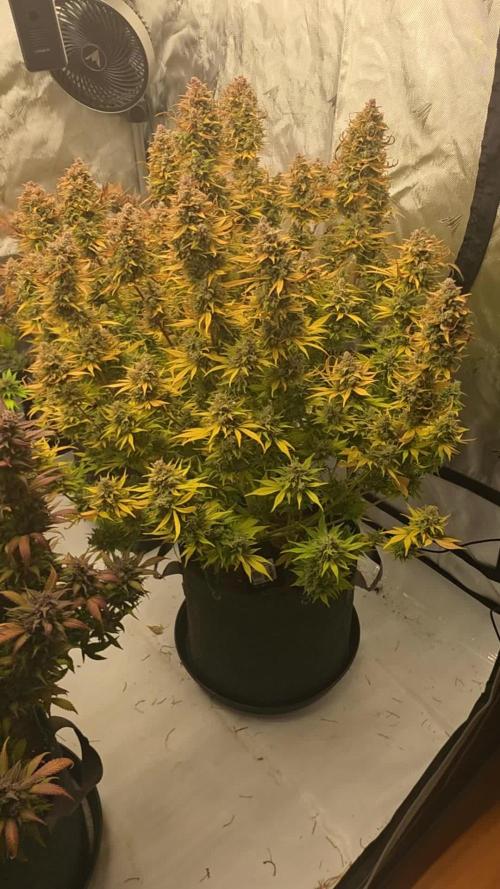
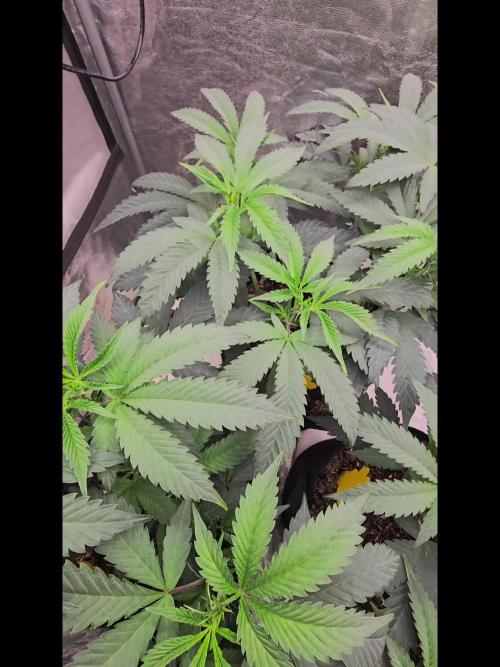
Hey everyone 🤗. This week they both continued to develop very well. Flowering day 35 Today the tent was cleaned, the humidifier refilled and the plants sprayed with Canna Cure :-). Flowering day 36 The plant was watered today with 1.2 L 🙂. They were also checked for their health and pests 👍. Everything looks great 🙏🏻. Flowering day 37 Again the tent was cleaned and fresh osmosis water was filled into canisters. Flowering day 38 Today 1.5 l per pot was poured so that some drainage comes out again. therefor two days are not poured 😋. Flowering day 39 The tent was cleaned, the humidifier was filled, the plant was checked for vitality and the entire electronics were checked for functionality. Flowering day 40 Today she was sprayed again with Canna Cure and checked. Flowering day 41 We got to the last day of this week and 1.2 L were poured again and the tent was cleaned 👍. I hope you have a lot of fun with the new update, and let it grow 🍀🙏🏻 You can buy this Strain at https://thecaliconnection.com/seeds/girls-scout-cookies-34.html You can buy the fertilizer at https://www.greenbuzzliquids.com/ Type: Girls Scout Cookies ☝️🏼 Genetics: GSC Tint Mint 👍 Vega lamp: 2 x Todogrow Led Quantum Board 100 W 💡 Bloom Lamp : 2 x Todogrow Led Cxb 3590 COB 3500 K 205W 💡💡☝️🏼 Soil : Canna Coco Professional + ☝️🏼 Fertilizer: Green Buzz Liquids : Organic Grow Liquid Organic Bloom Liquid Organic more PK More Roots Fast Buds Humic Acid Plus Growzyme Big Fruits Clean Fruits Cal / Mag Organic Ph - Pulver ☝️🏼🌱 Water: Osmosis water mixed with normal water (24 hours stale that the chlorine evaporates) to 0.2 - 0.4 EC. Add Cal / Mag 2 ml per l water every 2 waterings . Ph with Organic Ph - Pulver to 5.8 .
Likes
14
Share
La défoliation a fait du bien . Elle a une Belle couleur et sa croi
Likes
38
Share
@Aedaone
Follow
Early morning day 1 we got a good rain. The girls loved it. This week has cooler night time Temps, storms, and low 90s upper 80s f day time Temps. Plants are getting into the super soil and out of the safe zone of plain organic soil. Next time I'll use a stronger mix of liquid feed for the safe zone. The plants didn't get enough nutes to grow fast. I'm still dialing in super soil/organic so there's a learning curb. I'm a little worried about topping these as I got a late start outdoors. I topped the biggest this week. The smallest got ravaged by an insect so I'll just let it grow out naturally.
Likes
14
Share
@MagooYFZ
Follow
Another week has gone by and I like were this is going !! I hope to be able to flip in 2 weeks. The tripple cheese #2 is developing indica like leaves. I included a video showing a water dripper that I tought was cool.
Likes
8
Share
Now Milky Dreams is starting to fade as well even though it looks like a deficiency might play into it as well imo but I'm not quite sure. At this point I can only repeat myself when saying that they look amazing
Likes
2
Share
Welcome back, brothers of cultivation, here is the moment long awaited by me and this little jewel of mine, the large tent has given us the right space for flowering....we will see beautiful things
Likes
24
Share
The ladies light schedule was changed to 12/12 on Oct.30!❤️ The girls were doing great about 1 week after their big defoliation and SCROG being put in, I decided to flip to flower. I had been tucking and bending and had achieved about 80-90% canopy coverage, the last bit should fill in this week as they begin to stretch. During the 1st week of flower transition, I continued to tuck and bend where I could, trying to maintain an even canopy of tops, as well as fill in as many of the squares, as evenly as I can. It becomes a morning and night routine, I check on my humidifier, say good morning, and tuck away for about 5 minutes or so, it doesn’t take much at this point. Once the first week of stretch is through, I stop tucking branches and allow the tops to continue to grow upwards. I find that by using a SCROG method, there isn’t really a whole lot to do…I don’t defoliate until week 3, so it’s just feeding every 3-4 days and filling my humidifier! When I water is when I like to get under the canopy and check the stems and leaves for anything that shouldn’t be… and typically once a week after watering I’ll wipe down the tent and sanitize any surface I can. There is no reason to get lazy, that’s how you get Pests, Mold, and PM. Happy Gardening 🇨🇦👊❤️
Likes
14
Share
@BudXs
Follow
Never. Give. Up 3 weeks strong and will start to flower soon
Likes
Comments
Share
Vamos familia, actualizamos la segunda semana de floración de estas Fruit cake de Seedstockers, salieron las 3 de 3, 100% ratio éxito. Aplicamos varios productos de Agrobeta, que son increíbles para aportar una buena alimentación a las plantas. Temperatura y humedad dentro de los rangos correctos dentro de la etapa de floración. La tierra utilizada es al mix top crop, por cambiar. De 3 ejemplares seleccioné los 2 mejores para completar el indoor, también cambié el fotoperiodo a 12/12 y apliqué una buena poda de bajos, se ven bien sanas las plantas, tienen un buen color y progresan a muy buen tanto que se me fueron de altura un poco, la solución fue doblar un poco las plantas, también empezaron a formarse las flores. Agrobeta: https://www.agrobeta.com/agrobetatiendaonline/36-abonos-canamo Hasta aquí todo, Buenos humos 💨💨💨
Likes
2
Share
@Vet4weed
Follow
Getting closer to harvest every day. In fact, had to start early with Grace, as all of her leaves turned yellow and the trichomes are starting to cloud up. Decided to try the top bud harvest method and allow the smaller buds on the lower portions of the plant to develop more. Read somewhere that it'll allow me to reap an additional 25-50% more flower.
Likes
2
Share
Likes
143
Share
👉Well my friends , as I've said this is the third time e I've grown this beautiful plant , she's a keeper for sure 👈 The smoke is kinda dank, but then sweet and earthy , and maybe a little dirty 😜 Shes Extremely potent facts , super strong 💪 Would definitely recommend 👌 Soil by Promix Nutrients by Cronks Lights by MarsHydro & Vivosun 🙃 Thanks to all my growmies out there for stopping by its much appreciated 👈 👉Happy Growing👈
Likes
43
Share
I made a few big mistakes. most notably not flipping early enough. I vegged til 13 inches hoping theyd stretch to 26-30 inches and have adequate space away from light, well I underestimate them way too much! despite stretching a ton, these girls were both amazing to grow. bounced back to every training, with a lot of lst and topping and defol, they never stayed down long. they eat a lot, and once i got my feed dialed in they grew healthy and strong thru harvest. i chopped at all milky trichs, decided to harvest all in one go. so lowers have a tiny clear trich but mostly milky, tops are fully milky and after dry have a tiny touch of yellow or amber at tips. effects are ranging from 70-30 sativa (on lowers with clearer trichs) its high energy. very distinct feeling of relaxation all thru body from neck down feel loose in joints and relaxed. in mind i feel very sharp, focused and productive. at the same time i noticed i was more creative. i teach tennis classes and i was better able to describe what I was trying to convey to my student who is a teen, creativity helps. both our games improved, definitely a nice productive smoke, tastey as hell in vape or bowl. grinds up and smells like blueberries soaked in gasoline, topped with a big squeeze of lemon and dash of spicey red chili peppers! ooooh eeee! this stuff is amazing, and the bubble hash i spun looks like its going to be top quality once it dries! will post more pictures of buds once they cure up a bit more. should mention as a hash / rso maker, i also pulled over 1,000 grams of wet fan leaf, and a few hundred grams of trim which yields great medicine not accounted for in harvest #s00
Likes
24
Share
Las 4 nenas del scrog iniciaron con el ciclo 12/12 el día 05/11/2021: están siendo alimentadas con advanced nutrients(dosis indicadas en la foto de la tabla) -micro -blom -grow -b52 -rhino skin -big bue -bud ignitor -bud candy -sensi cal mag xtra Las 2 nenas en macetas de 30LT 18/6: por el momento están siendo alimentadas con advanced nutrients(dosis indicadas en la foto de la tabla) -micro -grow -blom -b52
Likes
17
Share
UPDATE GUYS!!!!! So the girls are doing great I got some new genetics also I'll be doing for my next grows and so forth, but yea just watering as necessary, I really really feel that this process is a learning curve for me lol, mainly because I've learned from the past that everything comes with progress trial and error, so I'm learning which I accept so its okay its okay haha but things are progressing and ill stay up to date with this for you guys thanks!!!!
Likes
1
Share
Here we go week 3 underway stretch has finish now so last night shes been cleaned lolipopped not too heavy thou ,looking good so far its the tallest from all ,she drinks around 1.5l a day now ,very stucker flowers this will have
Likes
2
Share
We become aware at such times of man's wonderful ability to bring seemingly unrelated elements into harmonic balance, and receive a glimpse into a world where everything exists in conscious sympathetic attunement to everything else. When we listen to a piece of music that seems to strike a beautiful chord somewhere inside us, or view a painting that simply glows with harmonic awareness well executed, we probably do not spare much time to contemplate the wonderfully intricate combination of vibrations that our sensors make it possible for us to perceive. We tend to appreciate the relationship between the parts of something by an awareness of the harmony or dissonance of the whole. This ability enables us to say "what a beautiful house!" instead of "analysis has proven that this collection of building materials exhibits certain elements of harmonic proportion." While this ability to instinctively appreciate the beauty of true harmony has an important role to play in evolution, a more analytical understanding of the laws involved can be most useful. This is especially so if we wish to create works of art where each part exists in true harmony, not only with the other part of that particular whole, but with the universe within which the creator and the created exist. Everything vibrates. From the most dense matter to the most subtle cosmic rays, everything which our senses allow our thoughts to become aware of, can be specified in terms of wavelength or frequency of vibration. These two terms define the same thing, but from different points of view. The following are the approximate wavelengths of various energy carriers: Cosmic rays 0.000,000,001 mm Gamma rays 0.000,000,1 mm X rays 0.000,500 mm Ultraviolet rays 0.003 mm Visible light 0.006 mm Infrared 0.01 mm Sound waves 1 meter Radio waves 300 meters Violet light 400 nm to 450 nm Blue light 450 nm to 500 nm Green light 500 nm to 570 nm Yellow light 570 nm to 590 nm Orange light 590 nm to 610 nm Red light 610 to 700 nm 1 nanometer (nm) = 0.000,000,1 cm = 1/10,000,000 cm If a guitar string is plucked and we hear a sound, it is not too difficult for the human mind to associate this sound with the vibration of the guitar string. With color it is quite different. It is difficult for us to conceive that the color of a substance is not an inherent property of the substance itself, but an indication picked up by our senses of that substance's ability to absorb or reflect the light which happens to be shining on it at that moment. Neither the matter nor the light is colored. What happens is that the brain learns to differentiate between the frequencies reflected or transmitted by the substance the eyes are focused on. The same thing happens with sound. When we say "Oh! Listen, they're playing my favorite song," what we really mean is: "My brain has stored within it a particular pattern of frequencies. I have compared the new information being received with this stored pattern and have deduced the answer that the two patterns are similar within certain specified tolerances." The 'pleasure' involved could have something to do with our running the pre-recorded pattern at the same time, in 'sympathy' with the new pattern as it is received. The word sympathy describes very well our ability to appreciate color and sound. It also describes the reason behind certain elements of harmony. For instance, if a substance vibrating at 100 cycles per second (tone 1) is in the proximity of another substance vibrating at 200 cycles per second (tone 2), we could perceive, if we had the right equipment, a certain sympathetic relationship between the two. We will see from this that there is a uniform doubling of the first tone seen in the second. At various points along the waves, the two are the same in amplitude. At other points, they are at opposite poles to each other. This doubled frequency has more points of similarity to the original than any other frequency except the original itself. If the equipment we had available for measuring these two frequencies was a soundboard amplifier and a pair of ears, then we would hear what would sound to us like one tone. If we had the opportunity to hear one at a time, we would hear that although they sound the same, one is higher in pitch than the other. This characteristic of 'the same but different in pitch', musicians have called the octave. Any two tones produced where one has exactly doubled the frequency of the other is called an octave. Speaking in ratios, an octave would appear then as the ratio 2:1 or 1:2, depending on whether we are talking of an octave up or down. A single note produced by almost any instrument will contain more than one wavelength or frequency. It will have a dominant frequency, the wavelength of which we would call the note's 'fundamental' or 1st harmonic. It will also have a varying number of upper harmonics, gradually fading in intensity into infinity or silence. Natural harmonics always have the same pattern of intervals between them. The interval between the 1st and 2nd harmonic is a perfect octave; between the 2nd and 3rd a perfect fifth; between the 3rd and 4th a perfect 4th; and so on, the intervals becoming smaller and smaller until they lose any relationship with the western 12 tone scale as it exists at the moment. Just as an octave has certain elements of sympathy with its fundamental, so some intervals have been noted to be more perfectly in sympathy with the fundamental than others. The ratio of the 'perfect 5th' or interval of 7 semitones, as it occurs in the harmonic series, is 3:2 or 2:3, while that of the 'perfect fourth" is 4:3 or 3:4. All the tones in the western 12 tone scale can be expressed in terms of the ratio between the upper tone and its fundamental. This would seem to be an ideal way of generating a scale from any given fundamental and several attempts have been made to do this, the Pythagorean system being probably the most well known. Although when working with a single tone instrument playing on its own, the Pythagorean formula works wonderfully well, if we had several instruments tuned this way together and asked them to play almost any western music, we would find that at times they sounded quite out of tune to each other. The lack of flexibility of the various scale systems based on the harmonic series has led to what is known as the 'tempered' scale. This uses as its primary unit of interval the ratio of the octave or 2:1. It then proceeds to divide the interval between any fundamental and its upper octave into 12 smaller intervals by applying the ratio: two to the one-twelfth power, to one (21/12:1). This equals 1.059463094, so by multiplying any frequency by this number, we will obtain the tempered semitone next up from our fundamental. We will also find that any tone twelve semitones up from any other tone, in a scale generated in this way, will have exactly double the frequency. If we took the note middle C on a piano and halved the wavelength, we would have the note C one octave above. If we halved this, we would have the C above, and so on. However, within about 6 octaves, we would find that although a 'sound' was being produced, no human ear could perceive it. If we kept on going, halving and producing upper octaves of our fundamental C, we would proceed through the infrared band, into the visible light spectrum. If we happened to be outside during the day, we would, for one octave only, see the note C with our eyes. The next octave above would already be in the ultraviolet band, and outside the eye's sensitivity range. If we can think of color as being an indication of a substance's vibratory rate or wavelength, we may begin to see a relationship that could exist between the color and sound spectrums. The logical extension of what has so far been said is that there exists a scale in the color spectrum that corresponds exactly to the scale in the sound spectrum, each color tone being an octave of the equivalent note in the sound range. This is not the end of the story but only the beginning. If we can for the moment accept that any wavelength in one band has upper and lower octave stretching out to infinity, then the next question is 'fine, but what shall we use as our fundamental? A particular color? A particular sound frequency?' The musicians among us will probably say 'A 440'. This means that the note A should vibrate at 440 Hertz, or 440 times per second. They would tell us that this is standard pitch has been adopted by most orchestras around the world; pianos are tuned to it, instruments are constructed to formulas based on it, and so to them it would probably seem the most appropriate place to begin. Some of these musicians may know of the battle that is still raging with regards to this being the standard, but few would know why A = 440 Hz was chosen except that it worked when it was set to be a suitable compromise between the many different pitches in use at the time. 432 Hz is said to be mathematically consistent with the patterns of the universe. Studies reveal that 432 Hz tuning vibrates with the universe’s golden mean PHI and unifies the properties of light, time, space, matter, gravity, and magnetism with biology, the DNA code, and consciousness. When our atoms and DNA start to resonate in harmony with the spiraling pattern of nature, our sense of connection to nature is said to be magnified. Another interesting factor to consider is that the A=432 Hz tuning correlates with the color spectrum, while the A=440 Hz is off. Audiophiles have also stated that A = 432 Hz music seems to be non-local and can fill an entire room, whereas A=440 Hz can be perceived as directional or linear in sound propagation. Once you adopt the idea that sound (or vibration in general) can have an equalizing and harmonizing effect (as well as a disturbing effect), the science of harmony can be applied to bring greater harmony into one's life or tune to specific energies. There is a form of absolute and relative harmony. Absolute harmony can, for example, be determined by the tuning of an instrument. The ancients tuned their instruments at an A of 432 Hz instead of 440 Hz - and for a good reason. There are plenty of music examples on the internet that you can listen to in order to establish the difference for yourself. Attuning the instrument to 432 Hz results in a more relaxing sound, while 440 Hz slightly tenses up the body. This is because 440 Hz is out of tune with both macro and micro cosmos. On the contrary, 432 Hz is in tune. To give an example of how this is manifested microcosmically: our breath (0,3 Hz) and our pulse (1,2 Hz) relate to the frequency of the lower octave of an A of 432 Hz (108 Hz) as 1:360 and 1:90. It is interesting to note that 432 Hz was the standard pitch of many old instruments and that it was only recently (19th and 20th century) the standard pitch was increased. This was done in order to be able to play for bigger audiences. Bigger audiences (more bodies) absorb more of the lower frequencies, so the higher pitch was more likely to “cut through”. One of the oldest instruments of the world is the bell ensemble of Yi Zeng (dated 423 BC), tuned to a standard F4 of 345 Hz, which gives an A= 432 Hz. The frequency of 345 Hz is that of the platonic year! Similarly, many old organs are tuned in A=432 as well; for example, St. Peter’s Capella Gregoriana, St. Peter’s Capella Giulia, S. Maria Maggiore in Rome. Maria Renold’s book “Intervals Scales Tones and the Concert Pitch C=128 Hz” claims conclusive evidence that 440 Hz and raising concert pitch above scientific “C” Prime=128 Hz (Concert A=432 Hz) disassociates the connection of consciousness to the body and creates anti-social conditions in humanity. The difference between concert pitch A=440 Hz and Concert A=432 Hz is only 8 cycles per second, but it is a perceptible difference of awareness in the human consciousness experience of the dream we share called existence.
Likes
7
Share
A mais belas é mais vigorosa planta, Desenvolvimento super rápido e ótima aparência! Começando a mostrar traços de indica ‘ 9º dias na iluminação, vaso de 750ml Top underground 1,0 ml e top veg 0,3 ml
Likes
28
Share
The weather was sunny and hot this week and the plants grew pretty well even if they have long and thin stems. The roots reached the bottom of the pot for most of them. The Gorilla Punch and the Pound Cake have developped some tiny lateral branches. The Gorilla Punch already have some pistils. So far, the most developped plants are Gorilla Punch and Pound Cake, followed by Orange Sherbet and Apricot. The Apricot stem is thinner than the other ones. Maybe due to its tougher start. Parameters : ------------------------------------------- Humidity range : 30-65% depending on the sun Temperature range : 20-30°C depending on the sun SUN Average : sunny Plants heights at the end of the week : ------------------------------------------- Apricot : 16.5 cm Gorilla Punch : 17 cm Orange Sherbet : 15.5 cm Pound Cake : 18.5 cm