


Likes
Comments
Share
@GasoGrow
Follow
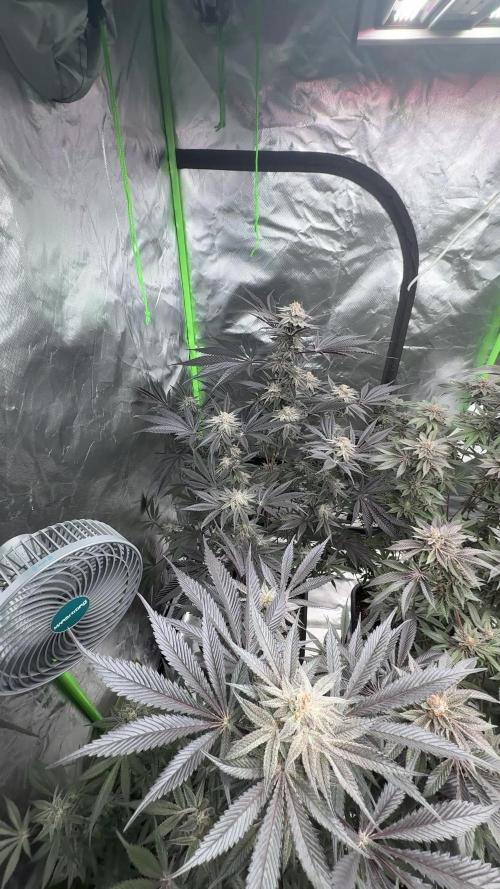
The buds are swelling and gaining more color and the UV setting is being extended by 15 minutes


Likes
24
Share


@MadeInGermany
Follow
Hi everyone 🤗.
Welcome to a new diary.
Cuttings were cut and rooted last week 🙂.
Today they were placed in 11 pots in Canna Coco Proffesional +.
Green Buzz Liquids is used for the fertilizer 😀👍.
Made in Germany 🤗.
I looked at the compositions of the individual elements and I am very impressed and excited about him 😎.
Greetings go out to Green Buzz Liqudis, and a big thank you for the support 🙏🏻👍.
Which training methods I will use will be decided spontaneously each day 😃.
I wish you a lot of fun with the diary, stay healthy l and let it grow 🌱.
You can buy this Strain at
https://www.amsterdamgenetics.com/product/kosher-tangie-kush/
You can buy this Nutrients at
https://greenbuzzliquids.com/
Type:
Kosher Tangie Kush
☝️🏼
Genetics:
Kosher Kush
X
Tangie
👍
Vega lamp:
2 x Todogrow Led
Quantum Board 100 W
💡
Bloom Lamp :
2 x Todogrow Led
Cxb 3590 COB 3500 K 205W
💡💡☝️🏼
Soil :
Canna Coco Professional +
☝️🏼
Fertilizer:
Green Buzz Liquids :
Organic Grow Liquid
Organic Bloom Liquid
Organic more PK
More Roots
Fast Buds
Humic Acid Plus
Growzyme Big Fruits
Clean Fruits
Cal / Mag
Organic Ph - Pulver
☝️🏼🌱
Water:
Osmosis water mixed with normal water (24 hours stale that the chlorine evaporates) to 0.2 - 0.4 EC. Add Cal / Mag 2 ml per l water every 2 waterings . Ph with Organic Ph - Pulver to 5.8 .

Likes
28
Share


@CannaCrew420
Follow
Hey howsit guys
Another week gone and one more closer and closer. These ladies are absolutely reeking and all 3 uniquely different . Ran into a bit of maintenance issues (dehumidifier fan seizing ) luckily I’m a bit of a hands on person and managed to save it. Can’t wait till they ready,I’m like a kid in a candy store 🍭. Btw can someone help me with that weird looking fan leaf? Will highly appreciate the enlightenment ⭐️
That’s it for this week guys happy growing all✌️

Likes
9
Share


@Justrite
Follow
The flush begins ,
Using final flush with water at 21.oC
And some defoliating to get light down .
Managing to keep temps stable at 23-25 oC with both lights
Also added in a mars hydro light
Last week and seems to be working well and shown good response from the plants under it

Processing
Likes
37
Share


@MG2009
Follow
All looking healthy beside some insect damage it is acceptable in organics gardens the good bugs keep them in check, healthy soil food web and all😎 To all a good week happy growing😎
07/06/2018
Mid week update #1 is 32.75" tall a as averaged not gonna measure each top.
Started doing stem rubs for smell,so I'll include that to see if it relates to the end product tastes,smell. Forgot to rub #1 update latter. run
On with #2 34. 5 orangie,lite minty. #3 26.25 straight minty chlorophyll. #4 is less stinkt .... #5 18.25
and she is Stinky brought her into it because I had extra and smells crazy stinky when I walked by it. Which is why I decided to do stem rubs.
Likes
39
Share


@BudsBanditUK
Follow
Only watering now. She is so close, just waiting for a few more ambers. No purple colours like last time but smells the same for sure. So many crystals on here.

Likes
24
Share


@Grnhead
Follow
This was a great grow and only my second one so far. I am starting to figure out more about my setup and just keep learning things. My final harvest weights were more than I expected and I couldn't be happier!


Processing
Likes
41
Share


@Wicked_Stix
Follow
Been wanting to try out this auto ghost og from original sensible seeds for a while and finally got the opportunity to get one wet.
I originally started this setup to compete in the solo cup challenge, but I needed something that will be minimal maintainence and doesn't require hand watering. So this is what I ended up with. I will not be entering since I know it will bring controversy, but I am going to follow the rules and treat this grow as if I am competing.
I didn't want to use regular solo cups because last time I had a lot of algae growing in the root zone when I harvested. I opted to use a black light proof cup. These cups were 27 oz originally so I filled them with 16 oz of water, marked the level, then cut them down to 16 oz. I set the drain pipes about an inch from the bottom so they have a little reserve if I have pump or power issues. I know people will see the drains as a way for roots to grow out of the cup but in reality I have to keep the entire pipe free of roots or it will clog and overflow. So I am actually losing a little volume due to this.
I filled the bottom inch or so of the cups with river gravel to stop the perlite from washing into the reservoir.
I am running a 5 gallon reservoir with a small air pump and the plants will be getting irritated 24 hours a day from an aquarium power head pump. I set the system up to be totally self contained and easily portable. It was all built from things I had laying around other than 97¢ for the cups. I will be keeping the feed simple as always feeding maxigro and maxibloom with a couple flower boosters.

Likes
19
Share

@MrGrowDiarie
Follow
Day 42
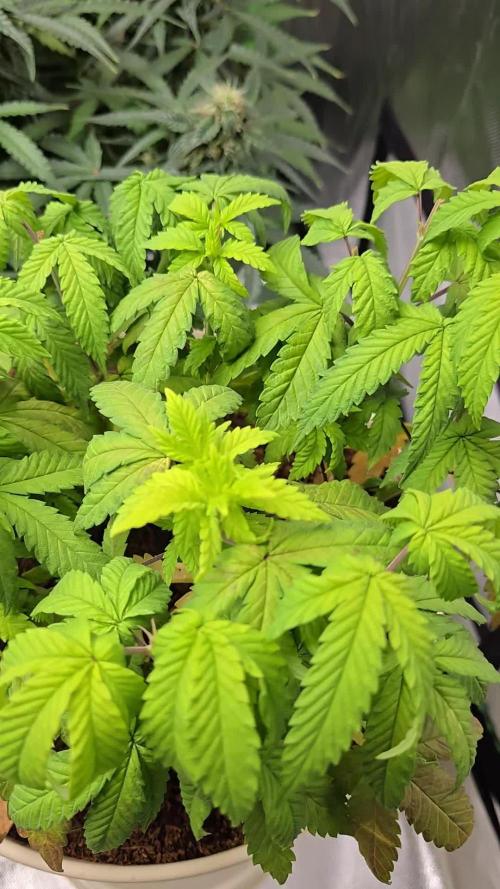
This plant has been topped many times (around 8–12), creating a very wide structure with lots of potential bud sites. However, it is currently in poor condition due to stress from overwatering.
Most of the leaves are drooping heavily, showing a clear lack of vigor. The color has faded from healthy green to a pale light green, with some areas even turning yellowish. This suggests that the roots are still struggling to recover and the plant isn’t able to take up nutrients properly.
Two days ago, I watered again after holding off to let the medium dry out. The plant has not bounced back strongly yet and remains weak. The canopy that once looked promising now looks tired, with leaves hanging down and a general lack of growth.
Given how stressed the plant looks, it may take considerable time to recover — if at all. Because of this, I’ve already started planning to grow a new strain alongside this one. This way I can still move forward with a healthy plant while monitoring this one to see if it pulls through.
At this point, the priority is minimal stress: careful watering, steady conditions, and patience. I’ll give it time, but expectations for this plant are now lower compared to the others.
Likes
7
Share


@Kushma666
Follow
Day 1 beginning of wk 3 flower fed the girls up this morning 4.5 ltr phostrogen to all but bubblegum #1 she gets fed 10ltrs of bud burst they are starting to smell so good 3 strains iv never grown before or even smoked lol exciting stuff 5-6 more weeks to go

Likes
10
Share

@Leprechauns_Garden
Follow
Hallo Grower,
Wochen-Update!
Start der Woche 8.. 🌿
Die Ladys entwickeln sich prächtig 😀
Es sind noch knapp 5 Wochen Blüte vor uns und ich Versuche die Bedingungen so stabil wie möglich zu halten 🤞🤞🤞
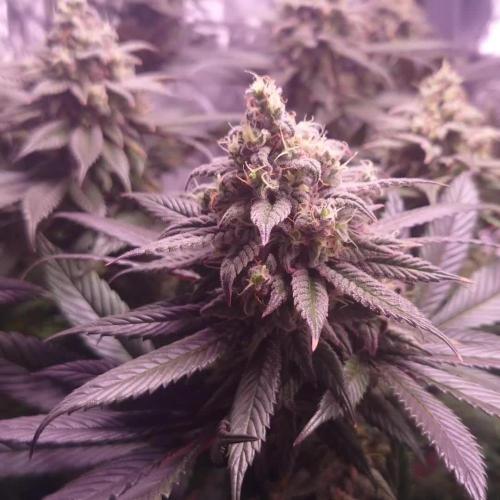
Buds Schwellen gerade ordentlich an und die Pistillen werden allmählich dunkler..
Aktuell keine weiteren Friseur Besuche ✂️🍂 mehr geplant!
Die Ghost Train Haze Dame muss jetzt mit Holzstangen gestützt werden, sie kann ihre Buds leider nicht mehr selbst tragen 😁
ich stecke weiter viel Liebe rein.. dann wird das was 💚
in diesem Sinne
Let IT grow 🌱🌿💚

Likes
33
Share


@Roberts
Follow
Jack Herer auto is on her way out. She has gotten switched to just ph water a few days ago. The next update will ge her harvest in about a week, and a half. She is looking really good and frosty. Good aroma, and nice plant or a 100 watt grow. I should easily get a gram a watt if not 2. She grew great in the Athena blended line nutrition. Everything is looking awesome. Thank you Athena, and ILGM. 🤜🏻🤛🏻💪🏻❄️🌱
Thank you grow diaries community for the 👇likes👇, follows, comments, and subscriptions on my YouTube channel👇. ❄️🌱🍻
Happy Growing 🌱🌱🌱
https://youtube.com/channel/UCAhN7yRzWLpcaRHhMIQ7X4g

Likes
26
Share

@TrickzGrowz
Follow
Servus Moin!
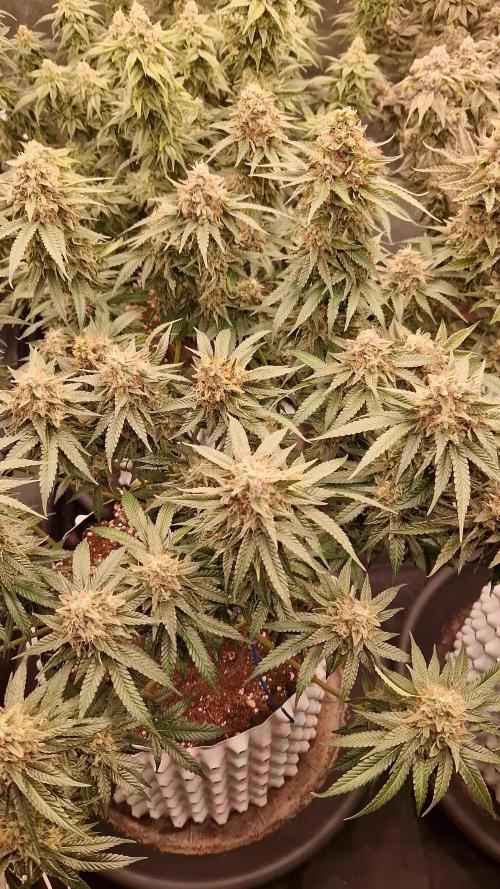
Die Buds entwickeln sich langsam richtig aus. Sie sind aber jetzt schon riesig und richtig fest.
Super klebrig und mega süß im Geruch.

Likes
33
Share


@nbacmprgirl2018
Follow
This was a strain I’ve had my eye on for a very long time and happy to say I have now fully experienced her from seed until harvest ! The ladies were harvested on Day 58 of flower and were hung to dry. Very easy to grow, not sensitive to anything and likes it a bit dryer in her pot. Beautiful plant to look at while in bloom - completely covered in trichomes and lots of beautiful calyxes
While in flower she smells of fresh fruit and and very pungent. After dry she smells of cheese, earthy and peppery. I would love to send her off for some lab results as the effects tell me she is high in thc!
Will definitely grow her again :)00



Likes
8
Share


@Kirsten
Follow
9.1.25:
I have done a large defoliation and readjusted all the LST pegs and removed the wire.
The wire was getting tangled in the plants, so it was easier to just take it off. I may get some thicker, stronger wire when they're too big for the pegs.
PPP1 and PPP2 are by far the best plants in this run so far.
PPP3, however, is the worst of all. She flipped into flower, still having only 3 finger leaves, and there are no five finger leaves at all. I am disappointed, of course! However, for me, the triploid PPP2 absolutely made up for it! 😍
Thanks for checking out my diary 🍃 ✌️

Likes
2
Share


@Dsant
Follow
Explosive growth this week, specially R. Cheese #1 and N. Lights #1.
But both #2’s are also growing strongly and looking great.
Mixed a 15L solution at full strength, will be looking for any deficiencies in the next few days.
Likes
9
Share


@bigolebuds
Follow
Week 8 12/22-29: Getting close to chop day.. planning to start the “flush” soon.. Trichomes looking cloudyyyy
Likes
9
Share


@AlekZombie
Follow
Watering:
06/29 - 1l with 0.5 ml bacteria/mycorrhizae each
07/03 - 1l with 0.5 ml bacteria/mycorrhizae + 1g enmiflora each

Likes
13
Share


@ArtisticGrown
Follow
This week has been great.I'm glad that I was able to pull the plant when I needed to. The weather out here isn't always the best coming towards the end of October. How ever i handle it the best we can. What ive learned to do is wet trim before hang dry. Heres some phots of these glossing nugs. Iknkw ill lose a bitin water weight but im happy none the less. Fire 🔥
This has been a great grow, I learned a lot from Growing out here in new mexico. It was amazing to be able to train these plants 4 into one using training techniques. LST, HST, Defolation & topping all play a roll. It is fun to learn and sharpen my skills.
I hope everyone enjoys my diary.
Thank you so much Divine seeds. I appreciate the free seeds and the friendly community competition 👌
There's a lot of good growers outthere and I wanna learn from all. Much love ❤️ I'll be back with a smoke review soon
