The Grow Awards 2026 🏆
Likes
Comments
Share
@Deli_Weed
Follow
Esta es mi primer planta que cosechó con éxito, y estoy muy feliz con mi resultado final 😄 obtuve una muy buena cantidad de flores premium con alrededor de 15% de thc (desde mi punto de vista claro 😅) Tuve algunos problemas durante el cultivo, principalmente que deje que se estirara mucho, debi hacerle LST a la punta principal para que no siguiera aumentando la altura y tener más flores del mismo tamaño, las flores más bajas quedaron chicas y les faltó madurar un poco, también tuve problemas de sobrefertilizacion aun a pesar de que seguí las instituciones de los fertilizantes y de sus indicaciones que me dieron los de servicio al cliente, incluso ya teniendo en cuenta eso siempre use la menos de la dosis de la base ya hasta que crecieron más le fui aumentando, igual creo que es muy cierto lo que dicen de que “menos es más” a la próxima empezaré usando muy pocos nutrientes, aparte creo que si hubiera usado unos leds más potentes, las plantas hubieran aprovechado más los nutrientes, pero igual me sirvió de experiencia, pienso cultivar de nuevo esta genética y sacarle más provecho. Muy recomendada 👌🏻😁
Likes
47
Share
What's in the soil? What's not in the soil would be an easier question to answer. 16-18 DLI @ the minute. +++ as she grows. Probably not recommended, but to get to where it needs to be, I need to start now. Vegetative @1400ppm 0.8–1.2 kPa 80–86°F (26.7–30°C) 65–75%, LST Day 10, Fim'd Day 11 CEC (Cation Exchange Capacity): This is a measure of a soil's ability to hold and exchange positively charged nutrients, like calcium, magnesium, and potassium. Soils with high CEC (more clay and organic matter) have more negative charges that attract and hold these essential nutrients, preventing them from leaching away. Biochar is highly efficient at increasing cation exchange capacity (CEC) compared to many other amendments. Biochar's high CEC potential stems from its negatively charged functional groups, and studies show it can increase CEC by over 90%. Amendments like compost also increase CEC but are often more prone to rapid biodegradation, which can make biochar's effect more long-lasting. biochar acts as a long-lasting Cation Exchange Capacity (CEC) enhancer because its porous, carbon-rich structure provides sites for nutrients to bind to, effectively improving nutrient retention in soil without relying on the short-term benefits of fresh organic matter like compost or manure. Biochar's stability means these benefits last much longer than those from traditional organic amendments, making it a sustainable way to improve soil fertility, water retention, and structure over time. Needs to be charged first, similar to Coco, or it will immobilize cations, but at a much higher ratio. a high cation exchange capacity (CEC) results in a high buffer protection, meaning the soil can better resist changes in pH and nutrient availability. This is because a high CEC soil has more negatively charged sites to hold onto essential positively charged nutrients, like calcium and magnesium, and to buffer against acid ions, such as hydrogen. EC (Electrical Conductivity): This measures the amount of soluble salts in the soil. High EC levels indicate a high concentration of dissolved salts and can be a sign of potential salinity issues that can harm plants. The stored cations associated with a medium's cation exchange capacity (CEC) do not directly contribute to a real-time electrical conductivity (EC) reading. A real-time EC measurement reflects only the concentration of free, dissolved salt ions in the water solution within the medium. 98% of a plants nutrients comes directly from the water solution. 2% come directly from soil particles. CEC is a mediums storage capacity for cations. These stored cations do not contribute to a mediums EC directly. Electrical Conductivity (EC) does not measure salt ions adsorbed (stored) onto a Cation Exchange Capacity (CEC) site, as EC measures the conductivity of ions in solution within a soil or water sample, not those held on soil particles. A medium releases stored cations to water by ion exchange, where a new, more desirable ion from the water solution temporarily displaces the stored cation from the medium's surface, a process also seen in plants absorbing nutrients via mass flow. For example, in water softeners, sodium ions are released from resin beads to bond with the medium's surface, displacing calcium and magnesium ions which then enter the water. This same principle applies when plants take up nutrients from the soil solution: the cations are released from the soil particles into the water in response to a concentration equilibrium, and then moved to the root surface via mass flow. An example of ion exchange within the context of Cation Exchange Capacity (CEC) is a soil particle with a negative charge attracting and holding positively charged nutrient ions, like potassium (K+) or calcium (Ca2+), and then exchanging them for other positive ions present in the soil solution. For instance, a negatively charged clay particle in soil can hold a K+ ion and later release it to a plant's roots when a different cation, such as calcium (Ca2+), is abundant and replaces the potassium. This process of holding and swapping positively charged ions is fundamental to soil fertility, as it provides plants with essential nutrients. Negative charges on soil particles: Soil particles, particularly clay and organic matter, have negatively charged surfaces due to their chemical structure. Attraction of cations: These negative charges attract and hold positively charged ions, or cations, such as: Potassium (K+) Calcium (Ca2+) Magnesium (Mg2+) Sodium (Na+) Ammonium (NH4+) Plant roots excrete hydrogen ions (H+) through the action of proton pumps embedded in the root cell membranes, which use ATP (energy) to actively transport H+ ions from inside the root cell into the surrounding soil. This process lowers the pH of the soil, which helps to make certain mineral nutrients, such as iron, more available for uptake by the plant. Mechanism of H+ Excretion Proton Pumps: Root cells contain specialized proteins called proton pumps (H+-ATPases) in their cell membranes. Active Transport: These proton pumps use energy from ATP to actively move H+ ions from the cytoplasm of the root cell into the soil, against their concentration gradient. Role in pH Regulation: This active excretion of H+ is a major way plants regulate their internal cytoplasmic pH. Nutrient Availability: The resulting decrease in soil pH makes certain essential mineral nutrients, like iron, more soluble and available for the root cells to absorb. Ion Exchange: The H+ ions also displace positively charged mineral cations from the soil particles, making them available for uptake. Iron Uptake: In response to iron deficiency stress, plants enhance H+ excretion and reductant release to lower the pH and convert Fe3+ to the more available form Fe2+. The altered pH can influence the activity and composition of beneficial microbes in the soil. The H+ gradient created by the proton pumps can also be used for other vital cell functions, such as ATP synthesis and the transport of other solutes. The hydrogen ions (H+) excreted during photosynthesis come from the splitting of water molecules. This splitting, called photolysis, occurs in Photosystem II to replace the electrons used in the light-dependent reactions. The released hydrogen ions are then pumped into the thylakoid lumen, creating a proton gradient that drives ATP synthesis. Plants release hydrogen ions (H+) from their roots into the soil, a process that occurs in conjunction with nutrient uptake and photosynthesis. These H+ ions compete with mineral cations for the negatively charged sites on soil particles, a phenomenon known as cation exchange. By displacing beneficial mineral cations, the excreted H+ ions make these nutrients available for the plant to absorb, which can also lower the soil pH and indirectly affect its Cation Exchange Capacity (CEC) by altering the pool of exchangeable cations in the soil solution. Plants use proton (H+) exudation, driven by the H+-ATPase enzyme, to release H+ ions into the soil, creating a more acidic rhizosphere, which enhances nutrient availability and influences nutrient cycling processes. This acidification mobilizes insoluble nutrients like iron (Fe) by breaking them down, while also facilitating the activity of beneficial microbes involved in the nutrient cycle. Therefore, H+ exudation is a critical plant strategy for nutrient acquisition and management, allowing plants to improve their access to essential elements from the soil. A lack of water splitting during photosynthesis can affect iron uptake because the resulting energy imbalance disrupts the plant's ability to produce ATP and NADPH, which are crucial for overall photosynthetic energy conversion and can trigger a deficiency in iron homeostasis pathways. While photosynthesis uses hydrogen ions produced from water splitting for the Calvin cycle, not to create a hydrogen gas deficiency, the overall process is sensitive to nutrient availability, and iron is essential for chloroplast function. In photosynthesis, water is split to provide electrons to replace those lost in Photosystem II, which is triggered by light absorption. These electrons then travel along a transport chain to generate ATP (energy currency) and NADPH (reducing power). Carbon Fixation: The generated ATP and NADPH are then used to convert carbon dioxide into carbohydrates in the Calvin cycle. Impaired water splitting (via water in or out) breaks the chain reaction of photosynthesis. This leads to an imbalance in ATP and NADPH levels, which disrupts the Calvin cycle and overall energy production in the plant. Plants require a sufficient supply of essential mineral elements like iron for photosynthesis. Iron is vital for chlorophyll formation and plays a crucial role in electron transport within the chloroplasts. The complex relationship between nutrient status and photosynthesis is evident when iron deficiency can be reverted by depleting other micronutrients like manganese. This highlights how nutrient homeostasis influences photosynthetic function. A lack of adequate energy and reducing power from photosynthesis, which is directly linked to water splitting, can trigger complex adaptive responses in the plant's iron uptake and distribution systems. Plants possess receptors called transceptors that can directly detect specific nutrient concentrations in the soil or within the plant's tissues. These receptors trigger signaling pathways, sometimes involving calcium influx or changes in protein complex activity, that then influence nutrient uptake by the roots. Plants use this information to make long-term adjustments, such as Increasing root biomass to explore more soil for nutrients. Modifying metabolic pathways to make better use of available resources. Adjusting the rate of nutrient transport into the roots. That's why I keep a high EC. Abundance resonates Abundance.
Likes
4
Share
Engorde weenooo engoorde real jajajajaja Bueno, pues buenas noticias dado que la población tan bestia de araña roja ha descendido a minimos! Por lo general ni veo ya, pero se que aún queda alguna, por ello, les meteré una limpieza mas con aceite de neem y jabón potásico, pero una sola mas, quizá esta noche o ya mañana. A partir de esta aplicación ya se acabo el uso de estos productos, y el siguiente lavado foliar que le haré será un té de canela, haré un concentrado hirviendo agua y con canela en polvo, filtrándolo para wue no quede residuo. Esto lo haré con intenciones antifungicas y de controlar un poco mas la humedad para mantener los bichos controlados.
Likes
24
Share
Ya tenemos la séptima semana de floración de esta niña bonita (PurpleKush) de Kannabiaseeds. En esta semana solo le estamos echando agua bajada de ph,ya que en nada cortamos y no queremos que nuestras flores huelan y sepan a líquidos 😜
Likes
6
Share
Enfim floração, chegaram bem e saudáveis agora e manter os cuidados aumentar a alimentação e torcer para nao esquentar muito nas próximas semanas .
Likes
11
Share
Just on day 22 now the video taken this morning had few issues very strong through week one, then week 2 I believe nitrogen toxicity as iv done lots and lots of research.... started watering twice in between each feed.. showing pistils now.. plants were tied down day 14.. I am happy with progress overall any tips welcome Pic of individual plant seems to be behind and leaf curling going to give water today and hopefully that will sort it out Day 23 - decided to do some defoliation as the growth since yesterday is very noticeable and starting to see signs of budlets at apex.. going to feed them tomorrow 8th strength grow, 8th strength bloom then by day 30 ish just quarter strength bloom is the plan then continue to up dose until half strength bloom at which point I’ll also add some boost.. any pointers appreciated 👌
Likes
5
Share
@DibbyDab
Follow
Now I have the lights at 100%, and the canopy at about 4’ tall. Water on the weekends mostly, get about 5 days between waterings. Daily checkups on the tent for temps and humidity. Girls are looking happy all around, forming beautiful buds stacked up the stocks. Glad I’ve got more seeds of this strain to play with in the future too after this haul. 🤙
Likes
4
Share
Likes
10
Share
Blüten werden inzwischen sehr Harzig und der Duft nimmt zu. Dem Giesswasser wird täglich 1:10 Jauche zugegen. Zu dem jedes zweite Gießen Pro Sugar von Grow Pro ein Kohlenhydrat Blütedünger(von der Mary Jane ein Tester). Zu dem gibt es ein bis zweimal in der Woche Seafeed Xtra von envii. Die ersten Blätter haben sich unten entfernt daher gebe ich gerade wieder Stickstoff zu den Pflanzen. Auch wenn es nur noch diese Woche war danach nur noch Blütedünger. Zu dem habe ich Basilikum gepflanzt, Dill, Ringelblume und Koriander gesäat am Anfang der Woche und zum Ende noch Lupine und Rot Klee.
Likes
8
Share
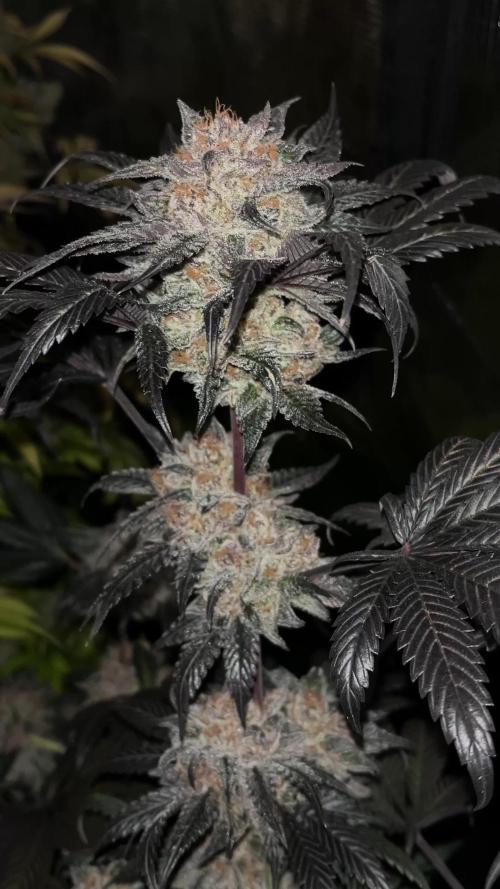
It’s looking fantastic, fam! The top leaves are turning a gorgeous purple now, which—not only stunning to look at—also highlights the massive central cola beautifully. I’ve elevated the left plant to even out the light distribution across the canopy. In hindsight, I probably should’ve done that a bit earlier!
Likes
20
Share
Esta semana creo que fue un poco estresante para ellas ya que dejé que el sustrato se seque por completo para eliminar musgo que apareció sobre el sustrato (por problemas con el timer del humidificador, estuvieron 3 días bordeando 90% de humedad). Pese a ese inconveniente considero que han mantenido un buen crecimiento
Likes
10
Share
@LowzGrowz
Follow
Should Be Finnishing up any Day now Strong Aroma
Likes
18
Share
Well it's finally time to cut her down. It's day 95 post germination for this lady, and she's at maximum potency. All trichomes are cloudy with about 5-10% amber & she's giving out a mixed palet of aromas. I can smell a very distinct mix of lemon, urea, skunk, and spice. It was relatively easy plant to grow. I started in a super soul which ran out of nutrients early and I had to supplement with bottled nutrients. Going forward I'm going to have to put more thought into my initial soil composition. Please note: I'm only estimating the 'Wet Bud Weight'; for the purposes of this diary I estimated 12-16 ounces. Cannabis can loose up to 75% of its mass during the drying phase and based on past experience, I am expecting 4-6 ounces of finished flower. Dry/cure process: 1. Cut entire plant down by main stock 2 hang upside down in a dark room with controlled humidty and temps.... - Temperature should range from 67-72 °F, and my humidity will range between 57-60%. 3. Full trim complete after 8-11 days of drying. 4. Stick in Mason jars indefinitely with 2-way Boveda humidty packs (62%). 4-20. Smoke 2 joints before you smoke 2 joints.. and then you smoke 2 more ☮️ I'll post a thorough smoke report in roughly 3 weeks Thank you growdiaries.com Thank you growmies Thank you Fastbuds
Likes
7
Share
Drying and curing always the biggest challenge for me due too constant climate change in my area, living near the mountains have its flaws too..🧐 Oh well still love growing..✌️
Likes
36
Share
@nonick123
Follow
Día 44 (15/07) Wow! No hay shock de trasplante! 😍💥😁 Todas las ramas se han estirado hacia arriba tras el ajuste de LST y se están formando nuevos nodos rápidamente Esta combinación de nutrientes de Lurpe + substrato de PRO-MIX HP es una maravilla 😍 Día 45 (16/07) Ayer tuvimos ola de calor (37 ºC) y han aguantado muy bien! A última hora de la tarde (cuando ya no había sol directo) les apliqué H2O en spray foliarmente para refrescar los estomas Hoy parece que vuelven las temperaturas estándar para esta época del año: 29 - 30 ºC en las horas centrales del día Riego con 1 litro de H20 pH 6,5 Día 46 (17/07) Pequeños ajustes de LST Hay algunas ramas inferiores que no se han formado / estirado mucho Lo más probable es que haga una buena limpieza este domingo, 7 días después del trasplante, para dejar solo los brotes por encima del 4º nudo Día 47 (18/07) Riego con 0,5 litro de H20 pH 6,5 Este domingo (día 50) haré limpieza de partes bajas y tal vez también de nuevo topping en las 4-6 ramas principales 😁 Día 48 (19/07) Día de muchísimo calor con 37 ºC. A ver como lo llevan! Riego con 0,5 litro de H20 pH 6,5 Día 49 (20/07) Para ayudarles a llevar mejor el calor de las horas centrales del día, coloca una malla de sombreo (70%) sobre el invernadero Lo cierto es que se nota que baja mucho la temperatura debajo de la malla! Van a estar más fresquitas! 😍 Riego con 0,5 litro de H20 pH 6,5 Día 50 (21/07) Training session! Hago limpieza del tercio inferior de la planta, de todas las ramas y nudos que no superan la línea del dosel marcada por el 4º nudo (1er topping) También hago topping (2º) a todas las ramas principales La idea es tener 12 ó 14 colas principales para que no se hagan muy altas De paso saco unos cuantos clones de las ramas inferiores eliminadas 😁💥 Para superar el estrés, hago las siguientes aplicaciones y riego: - Riego con 1 Litro de Té Vegetativo de Lurpe Solutions. Preparación: 24 horas con bomba de aire (oxigenación) con ingredientes: Green Sunrise 8 ml/L + Insect Frass 16 ml/L + Hummus Lombriz 8 ml/L + Melaza 1 ml/L + Kelp Hidrolizado 0,25 g/L - Aplicación foliar Kelp hidrolizado de Lurpe Solutions a 0,25 ml/l 💦Nutrients by Lurpe Solutions - www.lurpenaturalsolutions.com 🌱Substrate PRO-MIX HP BACILLUS + MYCORRHIZAE - www.pthorticulture.com/en/products/pro-mix-hp-biostimulant-plus-mycorrhizae
Likes
100
Share
@AsNoriu
Follow
Day 50. Oh boy .... Most challenging healthy grow I ever had ... Have loads of things covering each other and it's hard to understand, but they constantly unhappy .... Low temps day and nights, different rate of watering, wind damages, too intense lights, understanding feeding with living soil, too high humidity for best VPD and so on .... Loads of challenges !!!! So I decided to harm them more ;))) In the middle of action I was almost regretting it ... But heavy defoliation, SuperCroping and lolitoping session is DONE !!! All 3 Northern Lights are worst in this run. Smallest plant is still in veg or early preflower. All 3 Green Cracks found strength and power and now at least two plants look very decent !! Alaskan Diesel is my love of this run !!! Amazing strain, super fast, super healthy and productive !!! Hope after all that heavy training my humidity will be back to desired 65 , not 70+. Day 52. Long story - short : I am f@ckingly HAPPY, that I did it, plants grew 7 more cm, colas on some and quantity are INSANE !!! Video tells it all ... Day 56. Even if I'll screw up @Seedsman is amazing house ! They just overgrew my setup, I can't crop 25-20 colas on each plant, so tops are burning a bit and yellowing, not best for photos, but amazing for quantity still !!!! ;)))) For this not to be all fun, today I had two hours without electricity, temps dropped to 13 in the night .... All heaters were off ... Happy Growing !!!
Likes
14
Share
I love this strain cant wait till she finished. Never done it by crop king before. Not to familiar with there genetics. Heard there pretty good and have some dank.