Likes
Comments
Share
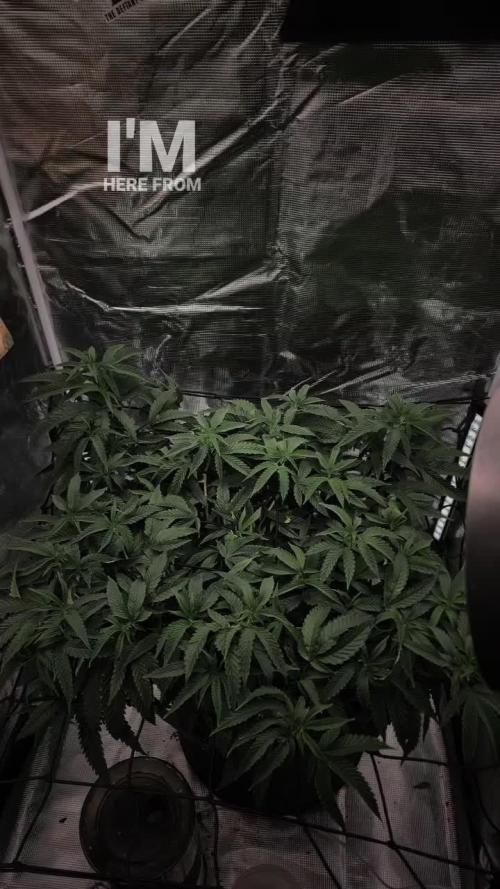
She is just on fire this one looking very happy and she is big too another week and i do clean up so she can pump those top flowers so far without issues at all letals gooooo
Likes
5
Share
@uran7776
Follow
Dokoupil jsem doplňky k hnojivům, překvapilo mě jak jsou drahé, jenom green sensation je 10x dražší jak základní Bloom. Trochu se bojím plísně, protože mám pořád vlhkost 60-65%, snad pomůže když mi v tom malém stanu jede odtah S6 na 7/10 a mám tam 2 oscilátory S6.
Likes
18
Share
@Sti_Cazz
Follow
Using Root booster and carefully spraying once or twice a day, as I see the soil dry... so far so good...
Likes
14
Share
@Terpyboyz
Follow
Alrighty growmies 👌🏻 so I’ve had a bit of a week set back due to issues, but back on track, the heat wave has definitely given a few girls a bit of a hard time not being able to attend but none the less, lifted the light again, trying to get on top of this PH fluctuating I’m having again using these stupid PH drops as my PH pen also keep jumping. Besides that I’ve managed to make a new home for the clones and got them under a couple UFO LEDs so that will house them for a few more weeks and al bring out the 600w HPS for them, but these runtz since being repotted have not taking nicely to it at all even using dynomyco so again hopefully by Friday they should be past that stage if not on flowering either way going to be a bomb scare when these taller plants start to stretch might have to bring out the net for sure 🤣🤙🏻 if all goes wrong at least I have my clones for back ups, keep eyes open for the incoming fire thou 🔥
Likes
2
Share
@Wondrej
Follow
One love, growers 🇯🇲💚 So today we have the first day of Week 4(1.12.25)of vegetation, counting from the first cotyledon leaf. The girls have recovered quite well since Thursday (27.11.25) when they were topped and bent, and we are going strong without flipping from the stress. TBH, try putting other autoflowers through that much stress in the middle of Week 3 compared to Fast Buds without flipping into flower 🤲🏻 BIG UP to their genetics. They are really changing the game. What do yall think of the girls, growmies? Any tips? Btw, the fertrometr finally shows the living soil is OK, it took those little rascals long enough to make it 🐛 2.12.2025 They look so freakin beatifull i needed to shot some random short. Again and again shout out to Fast Buds team. See ya later growmies👽
Likes
2
Share
08/26 - Increased water feeds with increased nitrogen - Prepped using clonex mist and clonex gel for cuttings - Pulled 10 clones on the first gen set 08/30 - New cuttings taken today - 23 in small solo cups for rooting - running high humidity dome - Feeds are as normal.
Likes
1
Share
@InsideAz
Follow
Not much growin on this week just watering and letting them grow. No smell yet Increasing light to 80% Nutrients in previous week and next week
Likes
20
Share
@ThatZimbo
Follow
Start of the grow in a DWC cross Bubbleponics system. Using two clones with the plan to scrog them out and have 5 to 8 strong colas per plant.
Likes
13
Share
📆 Semana 4 La floración continúa avanzando con fuerza mientras el estiramiento llega a su fin. Ambas plantas han desarrollado una estructura equilibrada y una canopia uniforme, permitiendo aprovechar al máximo la iluminación disponible. La planta que demanda más alimento muestra un ritmo de desarrollo superior, requiriendo una nutrición ligeramente más intensa para mantener su crecimiento y formación floral. Ambas mantienen un aspecto saludable y sin signos de carencias. Los cogollos comienzan a ganar tamaño, los pistilos se acumulan en todos los puntos de floración y las primeras capas de resina empiezan a hacerse visibles. ⚡ EC: 1.7 1.8 💧 pH: 6.2 – 6.5 🌡️ Agua: 21°C 🌫️ Humedad: 42–48% 💡 Intensidad: 1000–1100 PPFD 🔥 Nota de cultivo: Con el final del estiramiento, la energía de la planta se concentra cada vez más en la formación y engorde de los cogollos. Mantener una nutrición ajustada a las necesidades de cada ejemplar ayuda a maximizar su potencial productivo. Seguimos creciendo fuerte 💪!
Likes
2
Share
67 days since April 16th, 2026 We become aware at such times of man's wonderful ability to bring seemingly unrelated elements into harmonic balance, and receive a glimpse into a world where everything exists in conscious sympathetic attunement to everything else. When we listen to a piece of music that seems to strike a beautiful chord somewhere inside us, or view a painting that simply glows with harmonic awareness well executed, we probably do not spare much time to contemplate the wonderfully intricate combination of vibrations that our sensors make it possible for us to perceive. We tend to appreciate the relationship between the parts of something by an awareness of the harmony or dissonance of the whole. This ability enables us to say "what a beautiful house!" instead of "analysis has proven that this collection of building materials exhibits certain elements of harmonic proportion." While this ability to instinctively appreciate the beauty of true harmony has an important role to play in evolution, a more analytical understanding of the laws involved can be most useful. This is especially so if we wish to create works of art where each part exists in true harmony, not only with the other part of that particular whole, but with the universe within which the creator and the created exist. Everything vibrates. From the most dense matter to the most subtle cosmic rays, everything which our senses allow our thoughts to become aware of, can be specified in terms of wavelength or frequency of vibration. These two terms define the same thing, but from different points of view. The following are the approximate wavelengths of various energy carriers: Cosmic rays 0.000,000,001 mm Gamma rays 0.000,000,1 mm X rays 0.000,500 mm Ultraviolet rays 0.003 mm Visible light 0.006 mm Infrared 0.01 mm Sound waves 1 meter Radio waves 300 meters Violet light 400 nm to 450 nm Blue light 450 nm to 500 nm Green light 500 nm to 570 nm Yellow light 570 nm to 590 nm Orange light 590 nm to 610 nm Red light 610 to 700 nm 1 nanometer (nm) = 0.000,000,1 cm = 1/10,000,000 cm If a guitar string is plucked and we hear a sound, it is not too difficult for the human mind to associate this sound with the vibration of the guitar string. With color it is quite different. It is difficult for us to conceive that the color of a substance is not an inherent property of the substance itself, but an indication picked up by our senses of that substance's ability to absorb or reflect the light which happens to be shining on it at that moment. Neither the matter nor the light is colored. What happens is that the brain learns to differentiate between the frequencies reflected or transmitted by the substance the eyes are focused on. The same thing happens with sound. When we say "Oh! Listen, they're playing my favorite song," what we really mean is: "My brain has stored within it a particular pattern of frequencies. I have compared the new information being received with this stored pattern and have deduced the answer that the two patterns are similar within certain specified tolerances." The 'pleasure' involved could have something to do with our running the pre-recorded pattern at the same time, in 'sympathy' with the new pattern as it is received. The word sympathy describes very well our ability to appreciate color and sound. It also describes the reason behind certain elements of harmony. For instance, if a substance vibrating at 100 cycles per second (tone 1) is in the proximity of another substance vibrating at 200 cycles per second (tone 2), we could perceive, if we had the right equipment, a certain sympathetic relationship between the two. We will see from this that there is a uniform doubling of the first tone seen in the second. At various points along the waves, the two are the same in amplitude. At other points, they are at opposite poles to each other. This doubled frequency has more points of similarity to the original than any other frequency except the original itself. If the equipment we had available for measuring these two frequencies was a soundboard amplifier and a pair of ears, then we would hear what would sound to us like one tone. If we had the opportunity to hear one at a time, we would hear that although they sound the same, one is higher in pitch than the other. This characteristic of 'the same but different in pitch', musicians have called the octave. Any two tones produced where one has exactly doubled the frequency of the other is called an octave. Speaking in ratios, an octave would appear then as the ratio 2:1 or 1:2, depending on whether we are talking of an octave up or down. A single note produced by almost any instrument will contain more than one wavelength or frequency. It will have a dominant frequency, the wavelength of which we would call the note's 'fundamental' or 1st harmonic. It will also have a varying number of upper harmonics, gradually fading in intensity into infinity or silence. Natural harmonics always have the same pattern of intervals between them. The interval between the 1st and 2nd harmonic is a perfect octave; between the 2nd and 3rd a perfect fifth; between the 3rd and 4th a perfect 4th; and so on, the intervals becoming smaller and smaller until they lose any relationship with the western 12 tone scale as it exists at the moment. Just as an octave has certain elements of sympathy with its fundamental, so some intervals have been noted to be more perfectly in sympathy with the fundamental than others. The ratio of the 'perfect 5th' or interval of 7 semitones, as it occurs in the harmonic series, is 3:2 or 2:3, while that of the 'perfect fourth" is 4:3 or 3:4. All the tones in the western 12 tone scale can be expressed in terms of the ratio between the upper tone and its fundamental. This would seem to be an ideal way of generating a scale from any given fundamental and several attempts have been made to do this, the Pythagorean system being probably the most well known. Although when working with a single tone instrument playing on its own, the Pythagorean formula works wonderfully well, if we had several instruments tuned this way together and asked them to play almost any western music, we would find that at times they sounded quite out of tune to each other. The lack of flexibility of the various scale systems based on the harmonic series has led to what is known as the 'tempered' scale. This uses as its primary unit of interval the ratio of the octave or 2:1. It then proceeds to divide the interval between any fundamental and its upper octave into 12 smaller intervals by applying the ratio: two to the one-twelfth power, to one (21/12:1). This equals 1.059463094, so by multiplying any frequency by this number, we will obtain the tempered semitone next up from our fundamental. We will also find that any tone twelve semitones up from any other tone, in a scale generated in this way, will have exactly double the frequency. If we took the note middle C on a piano and halved the wavelength, we would have the note C one octave above. If we halved this, we would have the C above, and so on. However, within about 6 octaves, we would find that although a 'sound' was being produced, no human ear could perceive it. If we kept on going, halving and producing upper octaves of our fundamental C, we would proceed through the infrared band, into the visible light spectrum. If we happened to be outside during the day, we would, for one octave only, see the note C with our eyes. The next octave above would already be in the ultraviolet band, and outside the eye's sensitivity range. If we can think of color as being an indication of a substance's vibratory rate or wavelength, we may begin to see a relationship that could exist between the color and sound spectrums. The logical extension of what has so far been said is that there exists a scale in the color spectrum that corresponds exactly to the scale in the sound spectrum, each color tone being an octave of the equivalent note in the sound range. This is not the end of the story but only the beginning. If we can for the moment accept that any wavelength in one band has upper and lower octave stretching out to infinity, then the next question is 'fine, but what shall we use as our fundamental? A particular color? A particular sound frequency?' The musicians among us will probably say 'A 440'. This means that the note A should vibrate at 440 Hertz, or 440 times per second. They would tell us that this is standard pitch has been adopted by most orchestras around the world; pianos are tuned to it, instruments are constructed to formulas based on it, and so to them it would probably seem the most appropriate place to begin. Some of these musicians may know of the battle that is still raging with regards to this being the standard, but few would know why A = 440 Hz was chosen except that it worked when it was set to be a suitable compromise between the many different pitches in use at the time. 432 Hz is said to be mathematically consistent with the patterns of the universe. Studies reveal that 432 Hz tuning vibrates with the universe’s golden mean PHI and unifies the properties of light, time, space, matter, gravity, and magnetism with biology, the DNA code, and consciousness. When our atoms and DNA start to resonate in harmony with the spiraling pattern of nature, our sense of connection to nature is said to be magnified. Another interesting factor to consider is that the A=432 Hz tuning correlates with the color spectrum, while the A=440 Hz is off. Audiophiles have also stated that A = 432 Hz music seems to be non-local and can fill an entire room, whereas A=440 Hz can be perceived as directional or linear in sound propagation. Once you adopt the idea that sound (or vibration in general) can have an equalizing and harmonizing effect (as well as a disturbing effect), the science of harmony can be applied to bring greater harmony into one's life or tune to specific energies. There is a form of absolute and relative harmony. Absolute harmony can, for example, be determined by the tuning of an instrument. The ancients tuned their instruments at an A of 432 Hz instead of 440 Hz - and for a good reason. There are plenty of music examples on the internet that you can listen to in order to establish the difference for yourself. Attuning the instrument to 432 Hz results in a more relaxing sound, while 440 Hz slightly tenses up the body. This is because 440 Hz is out of tune with both macro and micro cosmos. On the contrary, 432 Hz is in tune. To give an example of how this is manifested microcosmically: our breath (0,3 Hz) and our pulse (1,2 Hz) relate to the frequency of the lower octave of an A of 432 Hz (108 Hz) as 1:360 and 1:90. It is interesting to note that 432 Hz was the standard pitch of many old instruments and that it was only recently (19th and 20th century) the standard pitch was increased. This was done in order to be able to play for bigger audiences. Bigger audiences (more bodies) absorb more of the lower frequencies, so the higher pitch was more likely to “cut through”. One of the oldest instruments of the world is the bell ensemble of Yi Zeng (dated 423 BC), tuned to a standard F4 of 345 Hz, which gives an A= 432 Hz. The frequency of 345 Hz is that of the platonic year! Similarly, many old organs are tuned in A=432 as well; for example, St. Peter’s Capella Gregoriana, St. Peter’s Capella Giulia, S. Maria Maggiore in Rome. Maria Renold’s book “Intervals Scales Tones and the Concert Pitch C=128 Hz” claims conclusive evidence that 440 Hz and raising concert pitch above scientific “C” Prime=128 Hz (Concert A=432 Hz) disassociates the connection of consciousness to the body and creates anti-social conditions in humanity. The difference between concert pitch A=440 Hz and Concert A=432 Hz is only 8 cycles per second, but it is a perceptible difference of awareness in the human consciousness experience of the dream we share called existence.
Likes
5
Share
These plants have been nothing but a joy to grow, zero signs of pest and mold Giving more nutrients than recommended and they are taking it in strive Taking longer from seed than I expected, may have to harvest early due to going out of town towards end of February Gonna keep it in soil as long as possible
Likes
79
Share
Greetings, fellow cultivators! Welcome to the Week 7 Report on our magnificent Epsilon F1, where the journey of green greatness continues to unfold with each passing day. Prepare yourselves for a detailed and immersive exploration of our botanical wonder as we delve deep into the heart of her flourishing beauty. Let's begin with a momentous decision: the Day 21 Flower Defoliation. With careful consideration and a keen eye for detail, I embarked on this transformative journey, gently removing select fan leaves to allow for increased light penetration and airflow. It's like giving our Epsilon F1 a botanical makeover, revealing her true splendor beneath the foliage canopy. This strategic pruning ensures that every bud site receives the attention it deserves, setting the stage for a bountiful harvest of epic proportions. But that's not all! As we bid farewell to the defoliation process, it's time to release all the bindings and restraints that were used to guide and train our green goddess throughout her growth journey. With a sense of liberation and pride, I untangle each tie, allowing our Epsilon F1 to stretch her leafy limbs and reach for the heavens. It's like setting a bird free from its cage, unleashing her full potential to soar to new heights of botanical glory. Now, let's talk about the environment. The TrolMaster controls have been instrumental in maintaining the perfect climate for our Epsilon F1's growth and development. From temperature and humidity to light and CO2 levels, these precision instruments ensure that our green queen receives the optimal conditions for flourishing. It's like conducting a symphony of growth, orchestrating each element to harmonize in perfect unity. And of course, we cannot forget the nourishment that sustains our botanical masterpiece. The Aptus Holland nutrients continue to be the lifeblood of our grow space, providing a balanced diet of essential macro and micronutrients. From the Micromix Soil to the Substrate Buffer Powder and All-in-One Pellet, each component plays a vital role in nurturing our plant to perfection. But let us not overlook the unsung heroes behind the scenes. Shout-outs to Royal Queen Seeds for bestowing upon us the genetic marvel that is the Epsilon F1, a testament to their dedication to excellence in breeding. To Aptus Holland, our main sponsor, whose unwavering support and innovative nutrients have propelled our grow to new heights of success. To TrolMaster, for providing the tools that empower us to create the optimal growing environment for our plants. And to Grow Diaries, the platform and community that fosters collaboration, knowledge-sharing, and camaraderie among growers worldwide. As we bid adieu to Week 7, let us revel in the glory of our Epsilon F1's progress and look forward with anticipation to the weeks ahead. Happy growing, dear readers, and may your gardens be forever green! Genetics -Epsilon F1 @rqs_esp @royalqueenseedssp @rqsglobal Food - @aptusholland @aptus_world @aptus_es @aptus_portugal @aptusbrasil @aptusplanttechaus @aptus_thailand @aptusplanttechnz @aptususa_official LES @lumatekeu Controls - @trolmaster.eu @trolmaster.agro @trolmaster.support As always thank you all for stopping by, for the love and for it all , this journey of mine wold just not be the same without you guys, the love and support is very much appreciated and i fell honored and blessed with you all in my life With true love comes happiness , Always believe in your self and always do things expecting nothing and with an open heart , be a giver the universe will give back to you in ways you could not even imagine so #aptus #aptusplanttech #aptusgang #aptusfamily #aptustrueplantscience #inbalancewithnature #trueplantscience #rqs #ApoloMission #MoonHarvestAdventure #playwithlego #lego #legotime #legovideo #tothemoonandback More info and complete updates from all my adventures can be found Link in the profile description Friendly reminder all you see here is pure research and for educational purposes only Growers Love To you All
Likes
24
Share
Germination method 🌱 @thecannakan Nutrition @aptusholland 🌿 @aptus_world 🌎 @aptus_es 🌍 @aptusbrasil 🌱 @aptus_thailand 🌿 @aptus_portugal 🌳 @aptususa_official 🍀 @aptusplanttechnz 🌺 @aptusplanttechaus 🍃 Ambient controls🎮 @trolmaster.eu @trolmaster.eu.support @trolmaster.support @trolmaster.agro Soil @promix_growers_eur @promix_cannabis LED - @lumatekeu Watering- @autopot_usa @autopot_global Love and attention- @dogdoctorofficial #aptus #aptusplanttech #aptusgang #aptusfamily #aptustrueplantscience #inbalancewithnature #trolmaster #trolmastereurope #trolmastersecrets #Autopots #GreenJoy As always thank you all for stopping by, for the love and for it all , this journey of mine wold just not be the same without you guys, the love and support is very much appreciated and i fell honored and so joyful with you all in my life 🙏 With true love comes happiness 💚🙏 Always believe in your self and always do things expecting nothing and with an open heart , be a giver and the universe will give back to you in ways you could not even imagine so 💚 More info and complete updates from all my adventures can be found ⬆️ link in the profile description ⬆️ Friendly reminder all you see here is pure research and for educational purposes only 💚Growers Love To you All 💚
Likes
5
Share
[ Information ] For all information on this grow, including strain and room details, please see the first week of veg. [ Updates ] Day 10 - Watered today, 1.2ec feeding of mainly organics (Fulvic/Humic, Kelp, Molasses, Big Bloom) with runoff. 6.8ph. Group one is stretching much harder due to plant density, I will be adding a net soon. Day 13 - Watered today with the nutrients listed for this week. 2.2ec at 6.5ph. 80gals total. Added a small dose of Open Sesame for the first time today as bud sites are starting to form on all plants. Added a net to Group 1 yesterday, I will add the nets for Group 2 in a couple days. Group 1 plants are 38-40 inches, group 2 plants are 32-34 inches. I may adjust net height, this isn't normally how I run a cycle; I'm trying a few different things side-by-side. The "one plant per square foot of canopy" group has consistently shown that even with a short veg period there is far too many wasted growth nodes on the sides of the canopy. The plants around the edge tend to branch out instead of up, as they're naturally trying to find sunlight. My last attempt at using these side branches with heavy topping of the middle nodes resulted in a higher yield, as expected as the light footprint was 5x5 instead of 4x4, which defeats the purpose of "one plant per square foot of canopy" anyways. A better test would have been to stunt the growth of all middle nodes enough to weave the side branches into the main canopy, though this seems to be a waste of time without much gain. I'm much happier with Group 2 which has 1 plant per 2 square feet of canopy space. While it also has side branching, the difference in height at the canopy level of the sides and middles are not nearly as different as Group 1, which means a more even light distribution without the need of a net. As overgrown as the room is getting, they still have 7-8 days before they're defoliated a final time.
Likes
9
Share
@TheNug
Follow
dont know how im feeling about this one , she looks weak and stretchy meeeh???? showing sex though
Likes
8
Share
@Tweak
Follow
These clones are growing really fast. I have them in a tent enriched with CO2. I’ve been transitioning them to flower slowly (30 min shorter each day till I hit 12/12) I’ll be fully into the stretch next week as I hit 12/12 lighting schedule tomorrow. I built my soil with super soil concentrate so I’m only supplementing silica with silicic acid and a foliage misting with kelp extract. Other than that they get plain well water from me. I’m heading out of town for 5 days starting tomorrow so I’m excited to see the growth they put on in my absence.
Likes
6
Share
@OS_Farmz
Follow
Second week of blooming and all goes good. Raised ppm to 950 and added some boosters. First inflorescences started to appear.
Likes
7
Share
Harvest Die erste Hulkberry Auto hängt zum Trocknen 😌 Sie wächst wirklich wunderschön und ich bin gespannt, wie weit sie noch wird. Der zweite Phänotyp braucht noch etwas Zeit, um fertig zu werden, und dann werde ich ein Update mit dem Erntebericht posten 😀 Update 3 Wochen später: Hulkberry Auto Pheno 2 hängt jetzt auch zum Trocknen, bin gespannt, wie sie von der Wirkung wird. Sie hätte vllt noch 1-2 Wochen gebraucht aber egal, fand sie jetzt auch schon Klasse und habe dann heute Morgen den Cut gemacht. Also von dem was dran hängt bin ich wirklich überrascht, wie viel das am Ende wurde. Das wird wohl nur Strawberry Cheesecake Auto Barneys Farm toppen aus dem Durchlauf vom Gesamtergebnis der einzelnen Pflanzen im 6,7L Topf 😊 🦊
Likes
12
Share
Continues to stretch and add more bud sites. Increased maxigro for that final stretch.
Likes
33
Share
Como ya he dicho, siempre ofrece resultados increíbles, la he cultivado tanto en interior como en exterior y siempre sale increíble