


Likes
Comments
Share

@DogDoctorOfficial
Follow
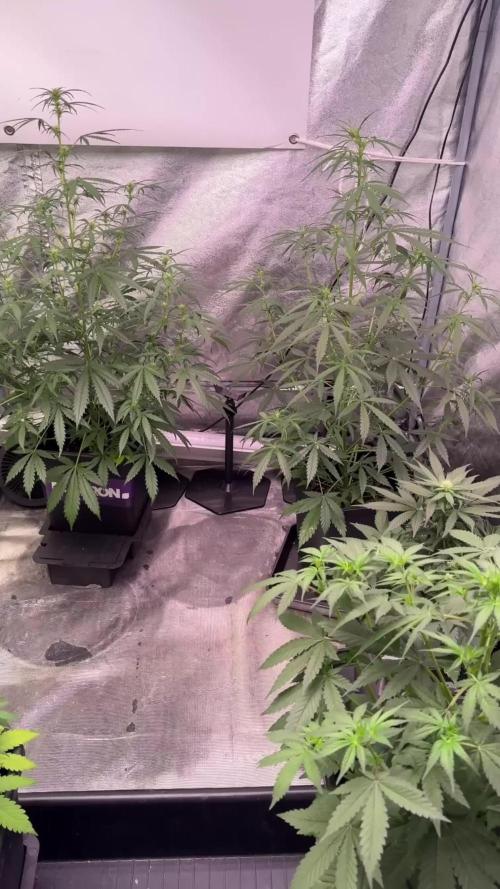
💎 Black Diamond Auto by Zamnesia – Pheno A | Week 1 Flower | A Diamond Beginning to Shine
Every grow has one plant that naturally draws your attention, not because it’s demanding, but because it quietly keeps outperforming expectations. Black Diamond Auto Pheno A is quickly becoming one of those plants.
From the very beginning, she has shown remarkable vigor, stretching confidently while maintaining excellent health, strong branching, and beautiful symmetry. Now, as she officially enters her first flowering week, she’s proving exactly why documenting individual phenotypes is so rewarding.
Although every plant in this project shares the same environment, feeding program, lighting, and training philosophy, every seed expresses its genetics differently. Black Diamond A has chosen height, elegance, and relentless vertical growth, creating what is already becoming one of the tallest structures inside the tent.
This grow continues using my favourite challenge: 12/12 From Seed. Rather than extending the vegetative stage, every plant is flowered from the day it emerges, allowing each phenotype to naturally reveal its own strategy for growth, stretch, and flower production. It creates a unique opportunity to compare genetics while maximizing efficiency inside the grow room.
⸻
🌱 Environment
Just like the rest of the flowering room, Black Diamond A has enjoyed another week of remarkably stable environmental conditions.
🌡️ Day Temperature: 31.1°C
🌙 Night Temperature: 25°C
💧 Relative Humidity: 72%
🥤 Nutrient Solution Temperature: 21.6°C
? Root Zone Temperature: 21°C
☀️ Light Schedule: 12/12
🌬️ CO₂: 639 ppm
Rather than chasing perfect numbers every day, I focus on creating consistency. Stable root temperatures, balanced humidity, continuous airflow, and healthy root-zone oxygenation allow each plant to dedicate its energy toward growth instead of constantly adapting to environmental fluctuations.
⸻
🌿 Training & Canopy Management
Training remains intentionally simple.
Throughout the week I’ve continued using gentle Low Stress Training while regularly tucking large fan leaves behind developing flowering sites whenever needed.
No defoliation has been performed so far.
The goal isn’t removing leaves—it’s allowing them to continue acting as efficient solar panels while simply repositioning them to improve light penetration and airflow. As new flowering sites develop, small adjustments are all that’s needed to expose each future cola without unnecessarily reducing the plant’s photosynthetic capacity.
With such vigorous vertical growth, this approach is producing an open canopy while preserving every bit of energy available for flower production.
Sometimes patience is the best training technique.
⸻
🌾 Feeding Program
As Black Diamond transitions fully into flowering, her feeding schedule continues to bridge vegetative growth and bloom development.
Current feeding includes:
• Plagron Terra Grow — maintaining enough nitrogen to support the final stretch.
• Plagron Terra Bloom — increasing phosphorus and potassium availability as flower production accelerates.
• Plagron Power Roots — keeping the root system active and healthy throughout the transition.
• Plagron Sugar Royal — supporting terpene development from the earliest stages of flowering.
• Plagron Pure Zym — improving nutrient uptake by recycling old organic material around the root zone.
• Plagron Power Buds — encouraging the hormonal transition into full flower while maximizing bud site initiation.
This balanced nutrition allows the plant to continue stretching strongly while simultaneously investing energy into building the foundation for the weeks ahead.
⸻
💎 Phenotype Spotlight
Black Diamond Pheno A has become one of the true standouts inside the room.
Standing at approximately 100 cm, she is among the tallest plants currently growing under this project, displaying a graceful structure with long internodal spacing and exceptionally vigorous vertical development.
The flowering transition is now well underway. Fresh white pistils are emerging across every branch, and bud sites are beginning to stack from the lower nodes all the way to the main apex. Rather than producing isolated flowers, she’s already showing excellent distribution across the entire plant, promising multiple productive colas instead of relying solely on the main top.
What impresses me most is how effortlessly she carries her size. Even with her height, the branches remain well balanced, the stem is thick and healthy, and the overall structure feels surprisingly stable. She has responded beautifully to gentle LST, opening the canopy naturally without ever looking stressed.
There is still plenty of stretch left, but the focus is clearly beginning to shift. Every day more pistils appear, every node becomes more defined, and the framework for what could become a very productive harvest is steadily taking shape.
Sometimes a plant doesn’t demand attention—it simply earns it.
⸻
🔭 Looking Ahead
Over the coming week I expect Black Diamond A to continue stretching while the early flower clusters begin merging into recognizable bud formations.
Leaf tucking will remain the primary form of canopy management, helping maintain even light distribution without removing healthy foliage. Nutritionally, the transition toward a full flowering program will continue as her appetite increases and flower production accelerates.
If she maintains this pace, there’s every reason to believe she’ll remain one of the dominant plants in the room throughout the remainder of the cycle.
The structure is there.
The health is there.
Now it’s time to watch those flowers begin to fill every branch.
⸻
A huge thank you once again to Zamnesia for providing the genetics that make projects like this possible, and to Plagron for supplying the outstanding nutrient line that continues supporting these plants through every stage of development.
Finally, thank you to the incredible GrowDiaries community for following this journey week after week. Your comments, questions, encouragement, and shared passion for growing are what make documenting every phenotype such a rewarding experience. I hope these individual journals help demonstrate just how unique each plant can be—even when they’re raised side by side under exactly the same conditions.
Until next week…
Growers love and happy Growing! 🌱💚



Likes
19
Share


@Earthsower
Follow
She’s suffered too much light penetration but handled it well. The N13 has stopped growing and using all her energy to bud up. Her pistol’s are turning brown. All’s she will receive from now on is pure phd water.


Processing
Likes
31
Share


@Endriu
Follow
Hi Bros&Sis! CIAO! :D
I've almost missed this week, this time, but don't worry, here we are!
Let's talk about the girls, they are fine, except for Pink Doc CBD (see photo) I don't know what happened, but she's born this way, anyhow, I've already put another bean, just to be sure.
This is the TOP/FIM week for my babies (almost all of them), also made a video, let me know what you think, I'm still learning things about growing
As usual, ciao and stop to say something, mates! 😉


Likes
4
Share


@cannabisisland420
Follow
Plants are developing great root structures. Plant A has roots coming out of the bottom of the pot. Will get ready to transplant soon, possibly at the end of the week.
8/23 transplanted to 5 GL pot
8/24 full day after transplant and plant looks great.
8/25 Full feeding 70F 5.8 PH 698PPM
Likes
6
Share

@OS_Farmz
Follow
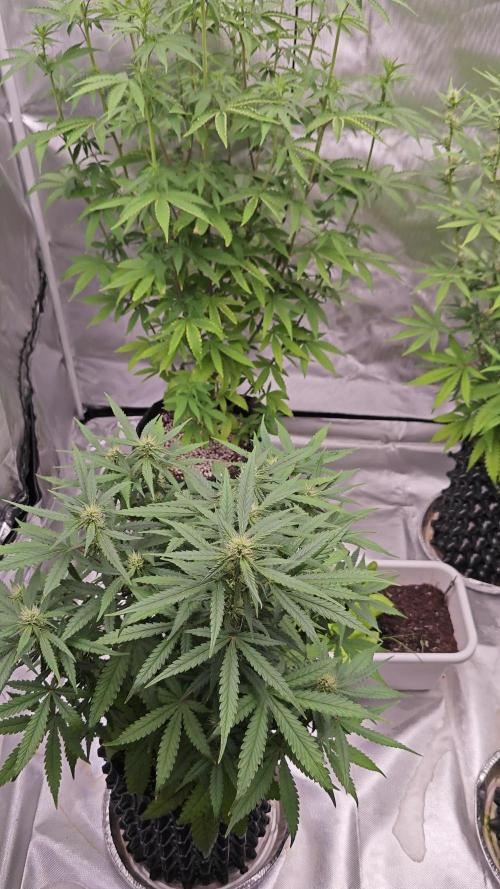
Second week of blooming and all goes good. Raised ppm to 950 and added some boosters. First inflorescences started to appear.

Likes
77
Share


@DogDoctorOfficial
Follow
Week 10 Flower — The Beauty Before the Finish
This week marks a very special chapter in the Eternity Grow Cup. As we approach harvest, the garden is simply glowing with beauty. Every corner, every canopy, every branch tells a story — and this week, I’ve taken the time to slow down and capture that story as best I can through the lens of my camera.
All the photos you’ll see in this update were taken with care and intention. I use my Sony camera in full manual focus mode, and I don’t just snap and go — I spend time with each plant, each angle, waiting for that perfect moment when everything aligns. These are not just photos to document — they’re my attempt to reflect the feeling of the room, the energy of the grow, and the soul of each plant.
Just like with the videos, I don’t shoot randomly and decide later. I record what matters, and what I record, I use. It keeps me focused, organized, and deeply connected to the process — and I believe it helps me tell the story more clearly, whether through stills or moving pictures.
All five Runtz phenos are finishing beautifully. Each one expressing unique traits, but all carrying the same stunning quality — dense, clean, colorful, resin-rich flowers that fill the room with pride. This garden is finishing spotless, and I couldn’t be happier.
This week’s YouTube episode will reflect that beauty. If you’re seeing this here on GrowDiaries, I highly recommend checking it out in full 4K once it’s live — there are moments that simply can’t be translated in photos alone, even though I try my best. But for those who love the details, the full spread of pictures is right here, as always.
t this point in flower, the girls are not eating — they’re just drinking clean water with nothing but System Clean in the reservoir, at a rate of 0.25 ml per liter. This is part of a gentle, prolonged flush phase I like to implement, giving the plants a chance to metabolize and fade naturally. The goal is to promote clean, vibrant flowers that finish with optimal expression, without rushing the process. No forced flush, just time and care.
Lighting-wise, the spectrum has been tuned with precision — we’re currently running 40% on the whites, with reds and UVs at 100% to drive trichome development, resin production, and color expression in these final days. The plants are loving it — they’re soaking in the deeper wavelengths that signal the end of their life cycle and responding with a final push of energy.
And yes — we’ve been running 11 hours of light and 13 hours of darkness from the very start of flower. It’s not the usual 12/12, and it comes with its pros and cons. On the upside, it helps speed up ripening slightly, encourages more compact flower formation, and mimics the natural seasonal decline in daylight. On the flip side, it slightly reduces the overall DLI (daily light integral), so you need to ensure your PPFD and spectrum are dialed in just right to avoid sacrificing yield. For me, the trade-off is worth it — the plants are expressing themselves beautifully, finishing strong, and packing on the final magic.
Now it’s your turn — I’d love to hear from you. Which phenotype is standing out the most to you in this garden? Which one is catching your eye with its colors, its fade, its structure, or just that vibe that speaks to your soul? Is it the frost? The density? The posture? Each of these girls has her own personality, and I know many of you have been following closely — so drop a comment, let me know: which one is your favorite? Which one would you take home?
This run has officially earned the Dog Doctor Official Wax-Sealed Stamp of Approval. These genetics are beautiful — expressive, vibrant, clean. It’s been a joy to grow them, and an even greater joy to share this journey with all of you. Of course, we still have the final word coming after harvest, drying, and curing — that’s when the full picture reveals itself. But until then, based on everything we’ve seen and lived in this grow… this is the real deal.
To everyone following the journey — thank you. To the sponsors, the community, the silent observers, the passionate growers, the haters, the lovers — I see you all, and I appreciate every bit of energy you send.
This cup has been about more than just growing. It’s been about sharing. Connecting. Creating something beautiful together. And we’re almost there.
Next stop: harvest? provably yes lets see !
Growers love always 🌿❤️
DD
Genetics - Runtz https://www.zamnesia.com/6000-zamnesia-seeds-runtz-feminized.html
Nutrients - Plagron https://plagron.com/en/hobby
- Aptus Holland https://aptus-holland.com/
Controls - Trol Master https://www.trolmaster.eu/
LED - https://www.futureofgrow.com/en
LED - https://www.thinkgrowled.com
Soil - https://www.promixgardening.com/en
Germination - Cannakan https://cannakan.com/?srsltid=AfmBOopXr-inLXajXu3QFgKXCXXos4F1oEvScjMKIB5MR5dk8-GJ-F49
DOGDOCTOR 15% off
Smoking Papers - https://ziggioriginal.com/
Terpene saver - https://grovebags.com/
As always thank you all for stopping by, for the love and for it all , this journey of mine wold just not be the same without you guys, the love and support is very much appreciloved and i fell honored with you all in my life
With true love comes happiness Always believe in your self and always do things expecting nothing and with an open heart , be a giver and the universe will give back to you in ways you could not even imagine so
As always, this is shared for educational purposes, aiming to spread understanding and appreciation for this plant. The journey with nature is one of discovery, creativity, and respect. Let’s celebrate it responsibly and continue to learn and grow together!
Growers Love To you All 💚
#EternityGrowCup #RuntzHunt #GrowersLove #CannabisCommunity #AptusHolland #ProMixSoil #TrolMaster #Zamnesia #Plagron #ZiggiPapers #Grovebags

Likes
12
Share


@Cris1982
Follow
3 semana en flora ya mostrando varios brazos con flores así que contento con mi primera siembra, floración anticipada y tamaño adeudado para mi espacio..

Likes
90
Share


@AsNoriu
Follow
Day 50. Had big plans, but postponed them to monday/tuesday. Will strip and heavy bend/lst girls, give them 5 days and i think they will be ready for flower.
Increased light power output from 50% to 70%. Girls got water with 0.5 ml/l Fish Mix.
Overtimes and all weekend at work stops me a bit, but work is work ...
Day 54. Girls got heavy training, started it even too late, leaves were too droopy. All went good, while last one was done, first were somewhere "happy" ;)))
Pure water.
Think to send them to flower this weekend.
Day 55. And like nothing happend ;))) All girls are happy and bushy, one or two days, darkness and FLOWER TIME ! ;)
Happy Growing !

Likes
7
Share


@weedrevolution
Follow
Plants are happy and coming up really nice.
They were defoliated and given a good dose of S.W.A. Organic Compost Tea.
See you soon for another update. 😁
Likes
44
Share


@Roberts
Follow
Casey's Rollex OG grew well. She finished in 7 weeks of flowering. Which was super fast. I fid run a little longer as it never looked ripe then, but started fox tailing as well. So it was a confusing finish the bud has a good citrus and earthy aroma. Really frosty. I have a feeling this will be a strong couch lock experience once done. Thanks again Spider Farmer, and DutchFem Seeds. 🤜🏻🤛🏻🌱🌱🌱
Thank you grow diaries community for the 👇likes👇, follows, comments, and subscriptions on my YouTube channel👇.
Thank you Happy Growing 🌱🌱🌱
https://youtube.com/channel/UCAhN7yRzWLpcaRHhMIQ7X4g


Likes
9
Share


@Chubbs
Follow
420Fastbuds
FBT2308/Week2
Weekly update for these 2. I started seeing some rust spots so I decided to add a little General Hydroponics Calimagic at 0.25tsp/gal to my feed. So far seems to stop. I also decided to start a very light dose of nutes General Hydroponics 3 part flora series at the same 0.25tsp/gal to every other feed to see how they'll respond. All in all Happy Growing.
Likes
4
Share


@TommyBVRSA75
Follow
Como siempre y siempre en la mitad de ciclo de grow, os regalo un vídeo para que sigáis mi evolución.
Es un privilegio tener tantísimos amigos (más que seguidores tan solo)
4:20 Siempre y que el Dios Jah nos guarde siempre.
All you need is Love ( CANSerbero VIVE)....!!!

Likes
4
Share


@Growin_Ish
Follow
Somehow I miscalculated the days and started week 6 prematurely. I will just continue here thru to week 7
Day 32 From Seed
NYD#2
Started LST. Pot was light, watered at 6.3 including Fish Sh!t.
NYD#3
The pony tail backfired. The main is mangled. Despite small nodes, I started LST and watered at 6.3 including Fish Sh!t.
Day 33 From Seed
Did some research and found out the ponytail should only be used during the light cycle and removed for the dark period. I left it on, which caused the ugly. Lesson learned!
Day34
Adjusted and added LST. Watered #2 at 6.5. #3 was still heavy, no water needed.
Day 37
Watered, adjusted LST
Day 39 From Seed
Watered, adjusted LST. Found a bug that isn't a fungus gnats (NYD#3). Inspected both plants for more. Did a neem oil top drench and added Vicks Vapor Rub to the pot rims (bug deterrent). So raised light roughly 4 inches.
Day 41
Light watering, adjusted LST ties, top drenched with Neem Oil. Added a few ounces of peroxide to the humidifier. They'll both need a top dress soon.
Likes
3
Share


@Unculti_responsable
Follow
Esta semana la dejamos más tranquila a la Jack solo le hicimos un trasplante a 5 litros quedo bien , la dejamos recuperar unos días y después le hacemos las últimas podas y ya va a estar lista para florecer

Likes
3
Share


@Canadian_Bud
Follow
3-11-2019
This Northern is slowly bouncing back but the damage has been done, she is producing but not how I would like it. Hopefully she will produce some tight buds.
5-11-2019
Pump Quit- Not much I can do at this point other than go it as Deep Water Culture. Root mass is to well established to attempt a removal.
Likes
6
Share


@Efflorescent11
Follow
Almost done, 3 seeds by Paradise seeds should be done with a 65 day flowering time

Likes
49
Share

@Roberts
Follow
FBT 2401 is going good. She has gotten acclimated, and found the solution. 🤞🏻 it isn't too strong. Hopefully she takes it well, and explodes in growth. She is under the Medic Grow Mini Sun-2, in the Athena blended line nutrition. She is ready for another week. Thank you Medic Grow, Athena, and Fast Buds. 🤜🏻🤛🏻🌱🌱🌱
Thank you grow diaries community for the 👇likes👇, follows, comments, and subscriptions on my YouTube channel👇. ❄️🌱🍻
Happy Growing 🌱🌱🌱
https://youtube.com/channel/UCAhN7yRzWLpcaRHhMIQ7X4g
If anyone needs to purchase fastbuds here is a link for my affiliate program
https://myfastbuds.com/?a_aid=60910eaff2419
Likes
2
Share


@eldruida_lamota
Follow
Que pasa familia, vamos con la cuarta semana de floracion de estas Gorilla Melon feminizadas de fastbuds.
Vamos al lío, de las 3 plantas, me quede con 2 por espacio, siempre pongo alguna semilla de más por si no abriese alguna por no perder ese hueco del indoor.
Y ya superaron el shock provocado por el mismo trasplante.
El ph se controla en 6.2 , la temperatura la tenemos entre 20/22 grados y la humedad ronda el 50%.
Ya empiezan a formarse las flores y progresan a buen ritmo.
Hasta aquí todo, Buenos humos 💨💨💨