


Likes
Comments
Share

@birdmountain
Follow
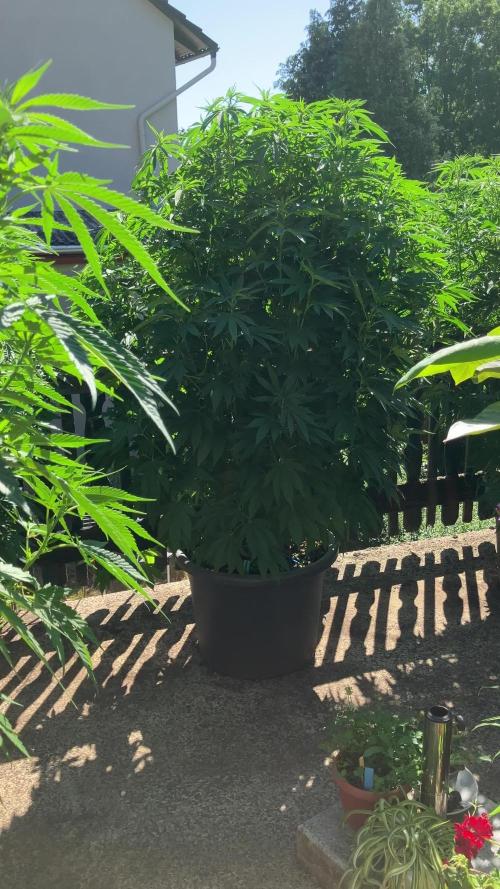
Blueberry wächst völlig problemlos in die Höhe weiter und bildet dabei noch viele Seitentriebe aus.
Eine angenehme Woche, die gegen Ende immer wärmer wurde, die nächste Hitzewoche naht.
Das zeigt sich auch im täglichen Wasserverbrauch,. zur Zeit sind es ca. 10 l. mit zweimaligem gießen.
Die Flüssigdüngung erfolgt nur morgens. Die Blätter haben einen kraftigen, dunklen Grünton ohne Krallenbildung.
Viel Erfolg in der kommenden Grow-Woche!

Likes
14
Share


@Snickelfritters
Follow
11/5 -- They now have 2 weeks of 12/12 under their belts and it's truly been a tale of 3 plants for the past week and a half.
GZ2- This one has the opportunity to meet its full potential. It has stretched to give me this beautiful canopy and very few signs of over feed or stress in it. Hopefully she stays this way.
Moby- look like it may have been developing some deficiencies. I fed it a few days ago and it seemed to respond well. Some leaves have gotten yellow but the plant is do thick and dense I'm not worried about a few falling off. All in all, it's been steady eddy for Moby Dick that I now believe is also a Barney's Farm Freebie(the seed is now listed where I buy mine from) I'm not going to change it but if you're keeping track, this is most likely a tent full of Barney's Farm.
Gz1- and now the music gets a little more serious. I really started recognizing problems with her right at flip. She has lost a lot of fan leaves due to yellowing,, dark stems and I can tell her branching has suffered because of it. Growth at the bottom looks weak and even wrinkled in some spots. She has burn spots and signs of deficiency galore. But also VERY dark fan leaves. I've just come to the conclusion that flushing was probably my best move.
She can still have a week of solid growing. If I can get it corrected now, this plant will still be respectable but the trend is disturbing and alarming to someone who knows how fast they can decline.
So in conclusion, things are getting a little hairy. Flowering always brings on a new set of challenges and I'm still learning every single time. Wish me luck this week, I'll need it.
11/6 Updated pic on old friend banana daddy that they shared the veg tent with.





Likes
35
Share


@Mz876
Follow
We are in week 4 of flower and she is just getting denser and frostier . The leaves are looking kind funky though smh. But the buds are beautiful 😍. Almost time.


Likes
20
Share


@NONSENSE
Follow
Hello everybody! :)
The 4th week of growth.
I continue to train the growth, try bending it every day.
I water the plant every day: 1 day fertilization / 1 day water.
Fertilizers from the RQS COMBO package works perfectly.
I add additional root stimulator from GHE and Diamond nectar.
I will give one more week to VEG growth, then I will down to12 hours of light to provoke flowering.
Also next week a grid will be installed to adequately control the tent area.
In the photo you can see the result of FIM cropping. now the baby will have 4 heads instead of 1.
I removed all the large leaves for better air circulation and for better light penetration.
Please see also this week's short video.
Merry Christmas!!!

Likes
14
Share


@TOMI08
Follow
47.nap
A elkezdtem finomat adni nekik
Hesi tnt 10ml 10l víz
Hesi supervit 2csep 10l víz
Plagorn alga bloom 2.5ml 10l víz
Ph 5.8
Mint este esövizzel premezem őket imádják!
Ezek a tápok hihetetlenül működnek kis mértékben is!
2hetente fogom 0.7ml növelti a tápanyagokat
Holnap kapnak neem olajat permetezve 2ml 0.5l víz

Likes
11
Share


@Nookandplant42o
Follow
Hello, thanks for the , wait for a busy week but always paying attention, I bought new batteries for the ph and ppm devices despite being simple, it was since last season with the same battery, with oscillation. But everything was calm, it was resolved We have this amnesia, taken a mini wool cube to a big grodan, with roots already formed, it is inside a 5-liter , great performance with a non-spaced watering, but without much watering, Nutrition ph ppm in the daily, air humidity at 50% 23°C, foliar application after lights close at 200ppm foliage, not much runoff to hold a safe zone.

Processing
Likes
94
Share


@Master_weeda
Follow
Good morning all
Day 63 and everything goes wonderfully I think for most that feels the end.
Some begin senescence including my gorilla glue from fastbuds and northen light auto from RQS
I start rinsing all of my 5 plants except the bubblegum which has not started to flower after 63 days
I specify that in terms of performance the blueberry auto of pev seeds and the most prolific it is beautiful. 😍
The gorilla glue from fast_buds is smaller but is not left behind because it is loaded with nitroglycerine 😋
We are no longer far from the harvest I am doing a final defolliation in order to let the light reach the lower heads
I think that within a week for some to two weeks for others they will all be harvested
What a pleasure for this run even if the weather is long approaching the harvest ... patience is the mother of all the virtues 😉
May the strength be with me 💪
And in french langage
Bonjour a tous
Jour 63 et tout ce passe à merveille je pense que pour la plupart cela sent la fin .
Certaines commencent la senescence notamment ma gorilla glue de chez fastbuds ainsi que la northen light auto de chez RQS
Je commence le rinçage de la totalité de mes 5 plants hormis la bubblegum qui n'a toujours pas commencée à fleurir après 63jours
Je précise que en terme de rendement la blueberry auto de pev seeds et la plus prolifique elle est magnifique. 😍
La gorilla glue de chez fast_buds est plus petite mais n'est pas en reste car chargée à la nitroglycérine 😋
Nous sommes plus très loin de la récolte j'effectue une dernière defolliation en vue de laisser la lumière atteindre les têtes du bas
Je pense que d'ici une semaine pour certaines à deux semaines pour d'autres elles seront toutes récoltées
Quel plaisir pour ce run même si le temps ce fais long à l'approche de la récolte... la patience est mère de toute les vertus 😉
Que la force soit avec moi 💪


Likes
107
Share


@Tropicannibis_Todd
Follow
💩Holy Crap Growmies We Are Back💩
Entire grow has been stunted by the soil/medium
Code Name FBT2309
Well growmies we are at 63 days in and everything is going as good as possible 👌
👉 Well folks shes been a busy girl , making a ton of bud , just hope she chunks up 👌
Lights being readjusted and chart updated .........👍Even with early major issues due to the soil/medium she's come a long way 👈
👉I used NutriNPK for nutrients for my grows and welcome anyone to give them a try .👈
👉 www.nutrinpk.com 👈
NutriNPK Cal MAG 14-0-14
NutriNPK Grow 28-14-14
NutriNPK Bloom 8-20-30
NutriNPK Bloom Booster 0-52-34
I GOT MULTIPLE DIARIES ON THE GO 😱 please check them out 😎
👉THANKS FOR TAKING THE TIME TO GO OVER MY DIARIES 👈
Likes
15
Share


@PiusWaxis
Follow
Flowering has finally arrived, the structure is fantastic, each branch has its own space, and the light manages to penetrate inside.
With the help of the fantastic tent-x I can keep everything under control, humidity and temperature are now no longer a difficulty to overcome, and thanks to the LED module I can also control the switching on and off of the LED light.
The best thing ever is being able to use the statistics that the device retrieves, calculating the VPD and with a table I can understand if the plant is breathing well.
I thank TROLMASTER immensely for giving me the opportunity to test their product! 👽


Likes
7
Share


@OceanGrownLoc
Follow
Lovely weeks weather. Nice growth and lots of bud points. hit 13 hours lights today also which is nice
Likes
10
Share


@BombBuds
Follow
Looking good so far!
- started to really tuck the branches under the net
- on day 31 i did defoliation
- probably will go into flower after day 34


Likes
7
Share

@Chubbs
Follow
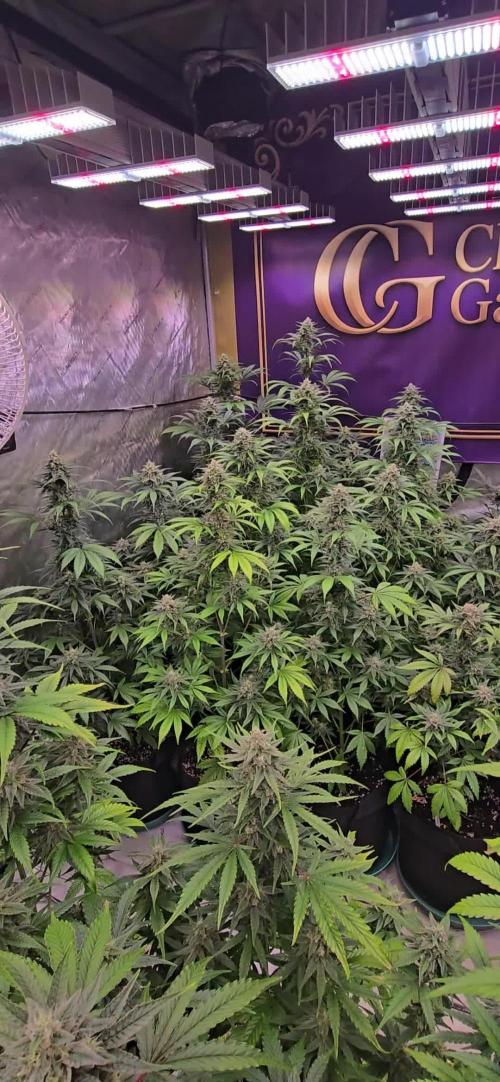
What up fam, weekly update on these ladies. So far they've dealt with the heat like champs. Thankfully I got my AC fixed and it's back up and running. So thank God as we're having a heat wave still with day temps in the high 90's. They're getting fed 16oz of fed daily. It's looking like maybe another week or two before they'll get harvested. All in all Happy Growing.
Likes
9
Share


@Rock_n_Roll_Randy
Follow
All the photos are in the 8x8 now just a few autos in here now
FOR EVERYTHING MARS HYDRO VISIT:
www.mars-hydro.com
www.marshydroled.ca
PROMO CODE: rocknroll
VISIT THE ALIEXPRESS STORE:
@marshydro_aliexpress
Instagram: @marshydropenny
Thanks for taking the time to read and check out my diary🤜🤛
TS3000 FEATURES:
WIDEBAND SUNLIGHT FULL SPECTRUM LED GROW, Infinite close to natural sun light, suit for all plants whole stages indoor growing, rapid plant response from seed to flower, achieve maximum quality and quantity, much better than traditional HPS grow systems.
HIGH REFLECTIVE & NOISE FREE-Fanless LIGHT BOARDS design will make your growing life easy and quiet, quickly heat dispersing material aluminum reducing light lost to aisles and walls, increase the light intensity up to 20%, allowing your plants receive more energy and without burning your plants for maximum headroom.
HIGH EFFICIENCY ENERGY SAVING PLANT LIGHT, high-power NEW LED grow, Compares to traditional 3000 watt HPS lamp and other brand led grow light while only 450 watts true output with 1016 LEDs, more scientifically and energy-efficient! Perfect for 5' x 5' veg stage, 4' x 4' bloom stage, higher intensity in a MARS HYDRO grow tent, reflective area, or by crossing over using multiple TS3000.
BOOM YIELD LARGE GROW LIGHT, NEWEST SMD LED technology provide highest PAR/LUMEN output(1095.6umol/), makes you get 30% higher yield compare OLD led lights, can get max yield at 2.5g/watt, less pay but get more yield, bring a amazing grow trip to any home grower as it beams huge amounts of light energy to plants below.
COMMERCIAL LED GROW LIGHT, Updated easy dimming & daisy chain function, main light controlled, especially come with two waterproof and dimmable Mean Well Drivers, auto sensing power supply works on both 120VAC and 240VAC and 277VAC, suit for Large Rooms and Commercial Setups.
Low Energy-Consuming LED Grow Light: Consuming 300w and also mounted with 1016 chips, TS3000 has the ability to replace a 450w HPS light while reducing 40% power intake.
High Efficiency LED Grow Light: With overall light output PPF 343umol/S as well as amazing PPE 2.3 umol/j, it's 50% even more photon efficient and can assure a 30% more return than the old HPS/MH lights.
Patent Highly-Reflective Hood Shape: The reflector design on TS3000 is patented, which can effectively gather the light dispersed in all directions to enhance its light intensity as well as assist plants in absorbing more light.
Full Spectrum Plants Favorite Spectra: By the unique mix of spectra that makes most light in the 400-700nm waveband, incredibly conducive to plant photosynthesis. Adequate IR(730-740nm) is additionally consisted of in the range to generate larger buds.
Dimming And Daisy Chain Feature Available: Upon an independent dimming button on the external driver, backing 0-100% settings adaptation and up to 30 LEDs daisy-chained in a group, it supplies different light levels for various plant stages meanwhile saving energy.
Safety Certifications And Service Warranty: CE, ETL, RoHS, UKCA security certifications accepted, 50,000 hours durability, 5-year service warranty, and local after-sales repair
5x5 GROW TENT:
LOCK ALL LIGHT INSIDE MARS HYDRO Indoor Grow Tent interior is made of diamond mylar which is highly reflective. (Other brand's mylar and reflective rate is as low as 50%, won't provide efficient light. )MARS HYDRO 1680D canvas, being double stitched, it is tear proof and has perfect light locking. Mars Hydro's grow tent keeps 100% lighting beams inside and helps your plant absorb more lights. EXTRA-THICK --No light leaks or rips at all
DURABILITY GROW TENT Stable metal corner adapters and poles are the trustful supporters of the tent, standing sturdy, neither rusting nor paint-falling, quick easy tool-free installation. Mars Hydro's heavy-duty metal zippers, with double layer black lining, are the best on the market which create a light-proof seal
EASY OBSERVATION FOR YOUR PLANTS. Special observation windows are made by double layers of cloth. Observe the growing conditions of your plants without opening the tent and avoid disturbing plants. The observation window also serves to dissipate heat and ventilate air
AUTOMATIC 6 INCH EXHAUST FAN KIT W/ CONTROLLER:
Mars Hydro 6'' Inline Fan uses a mixed-flow design to maintain peak performance in a high static pressure environment.
GROW TENT FAN: MARS HYDRO inline fans are designed to ventilate hydroponic grow rooms, transfer heating/cooling, cool AV closets, and exhaust odors.
EFFECTIVE VENTILATION: Variable speed controller for easy fan speed adjustment. Optimal ventilation for your planting.
LOW NOISE LEVEL: Durable plastic fan housing and blades for extremely low noise(32dB-A); create a truly quiet growth environment.
EASY INSTALLATION: Removable duct ends with locking tabs for quick removal and easy maintenance and a cord length of 4.9 feet for hassle-free setup. This grows tent fan with a controller for easy fan speed adjustment.
BASIC PARAMETERS: Ventilation exhaust fan size: 6” | Dimensions: 315mm*225mm*210mm. | Weight: 2.7. | Airflow: 402CFM | Noise: 32dB-A | Bearings: Dual Ball.
Likes
68
Share


@MiyaguiOkPolilla
Follow
Hola amigo!
Arrancamos un nuevo proyecto, esta hermosa sativa The Ethiopian de @TERPYZ
Semillas regulares, genética landrace pura de Etiopía, grande, gran poder sativa, larga floración y resistente a clima húmedo y cálido.
La marca recomienda sembrar directamente al sustrato, aquí, en suelo vivo funcionó perfectamente. 4 de 4 germinadas.
Los brotes tardaron 3 a 4 días en aparecer entre el húmedo ambiente inicial.
Se mantendrán en el tupper hasta que se vea estabilidad y tamaño apto
Saludos a todos y éxitos, este proyecto viene cargado de una gran aventura

Likes
12
Share


@yd_grows
Follow
Plantas transplantadas para potes de 1 L. A planta que está no pote maior vai ficar de mãe.
No transplante foi regada com Forth Enraizador 10ml/L até saturar.
Além disso foi feito o Topping nas 3 plantas.
Likes
8
Share


@MG2009
Follow
02/01/2022
Girls looking good potting up this weekend I hope.
I wish I labeled them better but I'll be surprised at harvest I think tallest one is jillybean we will see.
