


Likes
Comments
Share

@DogDoctorOfficial
Follow
🍮 Chem Brûlée – Pheno A
Week 6 | Building Sweet Foundations
Welcome back to another chapter of the 8×8 Adventure!
One of the greatest rewards of growing multiple phenotypes side by side is watching each one reveal her own personality.
Some race into flower.
Others take their time.
Some grow broad, powerful leaves.
Others reach for the sky with elegant spacing between every node.
Chem Brûlée Pheno A continues to prove that she's a lady who likes to do things her own way.
Still growing under the 12/12 From Seed method, she has now settled comfortably into early flowering. The explosive stretch is beginning to slow, and all that energy is gradually being redirected toward what matters most now...
Building flowers.
Every day her structure becomes a little more defined, and every new pistil reminds us that this beautiful lady is only just getting started.
⸻
🌼 Early Flowers Becoming Real Bud Sites
One of the biggest changes this week isn't dramatic at first glance, but it's incredibly exciting once you know what you're looking for.
Last week we celebrated the appearance of the first white pistils.
This week those tiny flowers have begun gathering together, forming the first recognizable bud sites across the entire plant.
The main cola is starting to establish itself, while every branch is producing neat little clusters that will eventually connect into long, resin-coated flowers.
It's one of my favourite stages of any grow.
Everything is still delicate and full of promise, but you can already begin to imagine what she'll look like a few weeks from now.
The blueprint has been drawn.
Now the construction begins.
⸻
🍃 Those Beautiful Giant Leaves
If there is one feature that continues stealing the spotlight, it's those incredible fan leaves.
They're still enormous.
Wide, elegant and working around the clock as natural solar panels, capturing every available photon and converting it into energy for flower production.
This week I also noticed some of the older lower leaves becoming a lighter shade of green.
I'm not concerned.
During the transition into flowering it's common for vigorous plants to increase their nutrient demand while redirecting energy toward rapid growth and bud formation.
Rather than chasing perfection, I prefer listening carefully to what the plant is telling me.
We'll continue monitoring her closely, making small adjustments only when they're truly needed.
Healthy growing is about observation, not overreaction.
And overall...
This beautiful lady still looks full of life and determination.
⸻
🌱 AutoPot Doing Its Job
Chem Brûlée Pheno A continues thriving in the AutoPot system.
By allowing the plant to decide when she drinks, the root zone remains consistently supplied without the repeated wet-and-dry cycles of traditional watering.
One of the things I appreciate most about this system is how quietly it does its work.
There's no timer deciding when the plant should eat.
The plant makes that decision herself.
As her flowers continue developing and daily water consumption increases, the AutoPot will simply keep following her rhythm.
It's a partnership more than a watering system.
⸻
🍽️ Feeding This Week
This week's nutrient program continued supporting the transition deeper into flowering while maintaining enough nutrition for the final stages of the stretch.
The feeding schedule included:
• Terra Bloom – 1.9 ml/L
• Green Sensation – 1 ml/L
• Sugar Royal – 1 ml/L
• Power Buds – 1 ml/L
• pH adjustments using Lemon Kick when required
The focus now shifts gradually away from vegetative growth and toward flower production.
As always, changes are made carefully and based on the plant's response rather than following a fixed calendar.
Every phenotype speaks a slightly different language.
Learning to understand that language is one of the most enjoyable parts of growing.
⸻
🌡️ Room Conditions
The environment remained stable throughout the week, providing ideal conditions for continued flower development.
• Day temperature: 29°C
• Night temperature: 25°C
• Relative humidity: 60%
• Nutrient solution: 22°C
• Root zone: 21°C
• CO₂: 639 ppm
With the stretch beginning to slow, humidity has started coming down compared to earlier weeks.
Lower humidity encourages healthy flower development while maintaining excellent transpiration and reducing future risks as the buds become denser.
A stable environment allows the plants to focus their energy where we want it most—building flowers.
⸻
📸 Watching the Story Unfold
This week's photographs capture a plant that is quietly entering a new chapter.
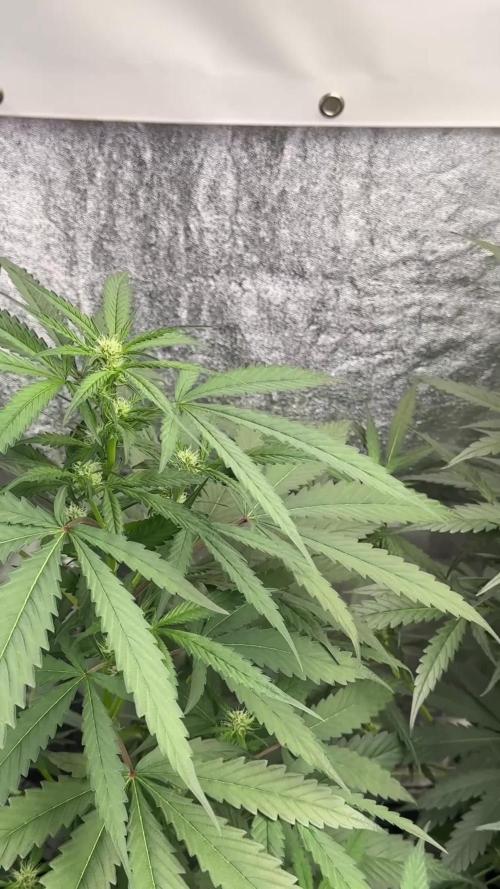
The towering fan leaves still dominate the canopy, but now they're sharing the stage with dozens of fresh flower sites emerging from every branch.
Looking back through previous weeks makes the transformation even more impressive.
What started as a young seedling has become a strong, elegant plant preparing for the busiest weeks of her life.
That's exactly why I enjoy documenting every stage.
These photos aren't just memories.
They're milestones.
⸻
🔮 Looking Ahead
Over the coming week I expect the flowers to become noticeably larger as more pistils emerge and the first signs of stacking begin.
The stretch should gradually come to an end, allowing the plant to invest more and more energy into flower production.
We'll continue watching the lighter lower leaves, making gentle adjustments if necessary while allowing the rest of the plant to keep doing what she's already doing so well.
Sometimes the healthiest gardens aren't the ones where we intervene the most.
They're the ones where we learn when to simply observe.
Chem Brûlée Pheno A seems determined to remind me of exactly that.
⸻
💚 Thank You
A huge thank you to everyone following this 8×8 Adventure.
Whether you're here to learn, compare phenotypes, improve your own garden, or simply enjoy watching these incredible plants grow, I'm truly grateful to have you along for the journey.
Special thanks to:
💚 GrowDiaries for creating a home where growers from around the world can share knowledge, experiences, successes, and lessons learned.
Zamnesia for providing the beautiful genetics that make this phenotype hunt possible.
🌱 Plagron for supplying the nutrition supporting every stage of this grow.
💡 Future of Grow LED for delivering powerful, consistent lighting throughout the entire cycle.
🌿 TrolMaster for helping maintain a stable environment day and night.
And finally...
Thank you to every grower, follower, supporter, silent reader, friend, and even those who challenge me to keep improving. Every interaction helps make these diaries far more meaningful than they would ever be on their own.
I'll see you all next week, where Chem Brûlée Pheno A will continue turning those giant leaves into the energy needed to build what already promises to be something very special.
Until then...
Growers Love and happy growing, everyone. 🌱🍮💚

Likes
20
Share


@ukterpdoc
Follow
Hey my friends and teachers I have had some minor light bleaching so I have raised the led lights as high as they go please tell me if that's cool or if I need to do more thanks guys

Likes
43
Share

@Growbody
Follow
Hallo und herzlich willkommen zu meinem Growbericht Outdoor 2025 mit den Sorten Power Flower Feminized, Royal Medic Feminized und Special Kush #1 Feminized, alle 3 von Royal Queen Seeds. Es ist das erste Mal, das ich Töpfe für den Outdoor grow verwende, bisher waren alle Gorilla grows und direkt in die Erde gepflanzt.
Die URL der Power Flower Feminized: https://www.royalqueenseeds.de/feminisierte-hanfsamen/120-power-flower.html
Die URL der Royal Medic Feminized: https://www.royalqueenseeds.de/cbd-samen/148-royal-medic.html
Die URL der Special Kush #1 Feminized: https://www.royalqueenseeds.de/feminisierte-hanfsamen/138-special-kush-1.html
Die Planung für den Grow ist, die Samen in easyplug Anzuchtwürfeln keimen zu lassen und danach in 0,6L und 2,2L Plastiktöpfen, dann letztlich in die neuen komplett doppellagigen ROOTIES 15 Liter Wide Version Stofftöpfe umzutopfen. Sobald die Witterung es zuläßt, sollen die Pflanzen an die frische Luft.
Es ist schon eine Weile her, das der Grow losging, die Bilder sind jetzt aktuell.
Tag 218: Die Power Flower fem. und die Special Kush #1 fem. bekommen seit Sonntag kein Wasser mehr. Hab heute wieder eine ganze Menge Laub weggenommen. Die Royal Medic fem. bekommt noch weiter ihren Cocktail, sie wird noch nicht geerntet, da ist einfach noch zu wenig dran.
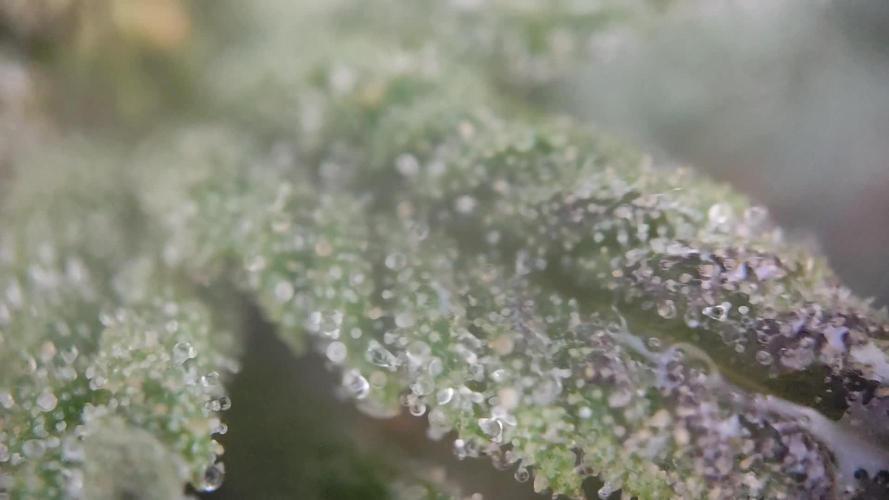
Tag 220: Heute ist wieder Mondhöchststand, nur 5 Tage nach Vollmond, Blütetag, letzter Erntetag und erster Aussaattag, ideal zum Ernten. Dieses Mal habe ich von jeder Dame einen Film der Trichome gemacht, deutlich zu sehen sind die vielen trüben Trichome und einige Bernsteinfarbene. Passt. Von der Power Flower fem. und von der Special Kush #1 fem. habe ich jeweils die 3 stärksten Äste geholt. Ich bin sehr froh, nur eine Teilernte gemacht zu haben, sonst würde ich noch den Rest der Woche schnibbeln. Es gibt Budtrimmmaschinen, vielleicht werde ich mir nächstes Jahr eine Zulegen, mal sehen. Bisher habe ich immer die ganze Pflanze geerntet und zum trocknen aufgehängt und dann trocken getrimmt. Dieses Mal verwende ich die DryFerm Bags, somit wurde zum ersten Mal Nass getrimmt. Das Ergebnis war eine Punklandung, 256 g bei der Power Flower und 257 g bei der Kush, nach dem Trimmen. Die Royal Medic bleibt wie sie ist. Jetzt bin ich neugierig, wie sich die Power und die Kush noch entwickeln.
Wenn's dir gefallen hat, schau wieder vorbei ✌️😎

Likes
13
Share


@TiRobotProds
Follow
Passage 12/12 le 15/11 léger défoliation . Elle ce développe a une vitesse incroyable. Consomme pas beaucoup de nutriments attendons quelques semaines..

Likes
29
Share


@Lazuli
Follow
She put on so much weight this week
I flushed her and now feed with ripen untill next week
Mid week 11: still cloudy trichomes
Maybe i let her go a few more days after the ripen scedule

Likes
92
Share


@Hou_Stone
Follow
it grows so fast. The lower leaves are shaded and away from the light. So I cut them as the plant gets taller
I really don't have a good setup to be able to clean my roots. I tried this week anyway. I watered each pot with 2L (not enough I think :/) of water at 450PPM PH: 7 then after I gave 1L of water at 900PM PH: 5.5.
There was a big puddle in the room afterwards. But it wasn't that hard to clean up after all. In 5 minutes with a rag and a bucket
------------------------------------------------
-Daytime temperature: 24-29°C
-Night temperature: 22-27°C
-Humidity: 50-75% ( Too high but it's hard to lower it... I need advice please contact me if you have :) )
-Lamp: Mars Hydro FC3000. intensity 80% at 40cm from the top leaves
-Room: Mars Hydro 100x100x180cm
-Extractor: Mars hydro 402 CFM Max. power 3/10
-Substrate : 70% coco, 25% perlite, 5% vermiculite.
My instagram : https://www.instagram.com/p/CuMhQ_BsjRP/?utm_source=ig_web_copy_link&igshid=MzRlODBiNWFlZA==

Likes
61
Share

@Hou_Stone
Follow
Superb variety that I discovered, very tasty with sweet smell cheese and productive. I place it in my favorites, To be redone in a future culture
Instagram :
https://www.instagram.com/hou_stone420/
Very nice and simple grinder that i reccomand :
https://shop.greenhouseseeds.nl/merchandise/hemp-grinder/
Likes
Comments
Share

@gr3g4l
Follow
Esta semana añadimos el humidificador para mantener una humedad mas alta.
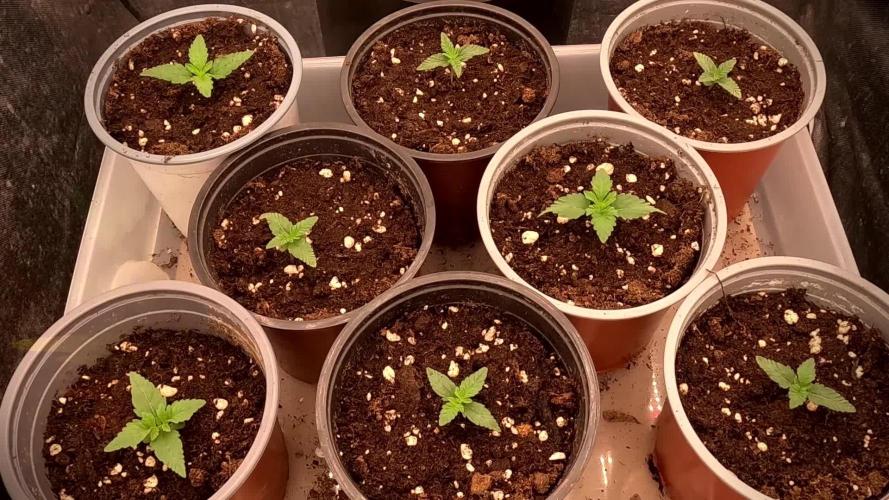
con 14 dias asomaron las raices y las trasplanté en la maceta definitiva de 6L. y aumenté la potencia W a 220. De 150 a 220W.
Processing
Likes
6
Share


@Flydope21
Follow
Last week showed the most progress. Lowered my light to about 22-24” and it just took off from there. The one that was not doing so well has started to show a lot more life this week.

Likes
22
Share

@Marijuanaut
Follow
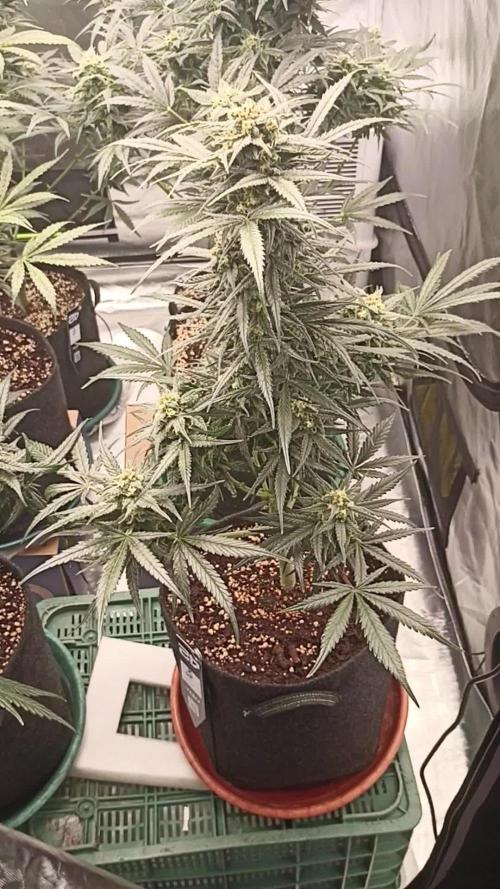
Almost there! 😍
The shorty is going first... the other two might need a couple weeks. 😋
Some signs of Cal deficiency specially on the Banana one 😎
💚💛❤️
Likes
24
Share

@Chucky324
Follow
Hello This is the final look at these fine girls before harvest.
The buds are heavy and are leaning towards the floor.
Found 1 bud with bud rot and it was cut out and tossed


Likes
8
Share


@GarciasGarden
Follow
All in all this was an amazing harvest I usually have around 8-10 plants and harvest anywhere from 24-36 ozs per harvest with the 8 plants I had this harvest including the biscotti mintz and cookies USA I ended up with 898g total dry weight with all top quality flower. I’ve learned some things with all my previous runs when it comes to dialing in my quality and yield and definitely watching for those herms because I like to push my plants to the max when it comes to training !
GMO PUnch -Greenpoint
I’m giving this a total score of 7-10!
Biscotti Mintz- Barney’s farm
Total score 10-10
Cookies USA score
7-10

Likes
15
Share


@bagofbunnys
Follow
This is the last week of flowering in the next couple days I will begin chopping. I cut the blue dream and the Dinafem amnesia cbd auto flowers today since they finished first. Stay tuned for the harvest and weigh in.


Likes
10
Share


@FriendlyNeighbor
Follow
This Cookie had 2 translplants and more than enaught time to veg its the biggest plant I have grown so far leets see what this girl can do!!!
Sadly at the end of my last grow my living situation changed rapidly...
So I wasnt able to keep up the Diary cause I had to moove but I have a new flat now and things are going their way again!
Now that I have a time again new diaries will come!
So happy to be back
youre Friendly Neighbor
Likes
52
Share


@Ultraviolet
Follow
Lacewings seemed to have mostly killed themselves by flying into hot light fixtures. I may have left the UV on which was smart of me :) Done very little to combat if anything but make a sea of carcasses, on the bright side its good nutrition for the soil.
Made a concoction of ethanol 70%, equal parts water, and cayenne pepper with a couple of squirts of dish soap.
Took around an hour of good scrubbing the entire canopy.
Worked a lot more effectively and way cheaper.
Scorched earth right now, but it seems to have wiped them out almost entirely very pleased.
Attempted a "Fudge I Missed" for the topping. So just time to wait and see how it goes.
Question?
If I attached a plant to two separate pots but it was connected by rootzone, one has a pH of 7.5 ish the other has 4.5. Would the Intelligence of the plant able to dictate each pot separately to uptake the nutrients best suited to pH or would it still try to draw nitrogen from a pot with a pH where nitrogen struggles to uptake?
Food for stoner thought experiments!
Another was on my mind.
What happens when a plant gets too much light?
Well, it burns and curls up leaves.
That's the heat radiation, let's remove excess heat, now what?
I've always read it's just bad, or not good, but when I look for an explanation on a deeper level it's just bad and you shouldn't do it.
So I did.
How much can a cannabis plant absorb, 40 moles in a day, ok I'll give it 60 moles. 80 nothing bad ever happened.
The answer, finally. Oh great........more questions........
Reactive oxygen species (ROS) are molecules capable of independent existence, containing at least one oxygen atom and one or more unpaired electrons.
"Sunlight is the essential source of energy for most photosynthetic organisms, yet sunlight in excess of the organism’s photosynthetic capacity can generate reactive oxygen species (ROS) that lead to cellular damage. To avoid damage, plants respond to high light (HL) by activating photophysical pathways that safely convert excess energy to heat, which is known as nonphotochemical quenching (NPQ) (Rochaix, 2014). While NPQ allows for healthy growth, it also limits the overall photosynthetic efficiency under many conditions. If NPQ were optimized for biomass, yields would improve dramatically, potentially by up to 30% (Kromdijk et al., 2016; Zhu et al., 2010). However, critical information to guide optimization is still lacking, including the molecular origin of NPQ and the mechanism of regulation."
What I found most interesting was research pointing out that pH is linked to this defense mechanism. The organism can better facilitate "quenching" when oversaturated with light in a low pH. Now I Know during photosynthesis plants naturally produce exudates (chemicals that are secreted through their roots). Do they have the ability to alter pH themselves using these excretions? Or is that done by the beneficial bacteria?
If I can prevent reactive oxygen species from causing damage by "too much light".
The extra water needed to keep this level of burn cooled though, I must learn to crawl before I can run.
Reactive oxygen species (ROS) are key signaling molecules that enable cells to rapidly respond to different stimuli. In plants, ROS plays a crucial role in abiotic and biotic stress sensing, integration of different environmental signals, and activation of stress-response networks, thus contributing to the establishment of defense mechanisms and plant resilience. Recent advances in the study of ROS signaling in plants include the identification of ROS receptors and key regulatory hubs that connect ROS signaling with other important stress-response signal transduction pathways and hormones, as well as new roles for ROS in organelle-to-organelle and cell-to-cell signaling. Our understanding of how ROS are regulated in cells by balancing production, scavenging, and transport has also increased. In this Review, we discuss these promising developments and how they might be used to increase plant resilience to environmental stress.
Temperature stress is one of the major abiotic stresses that adversely affect agricultural productivity worldwide. Temperatures beyond a plant's physiological optimum can trigger significant physiological and biochemical perturbations, reducing plant growth and tolerance to stress. Improving a plant's tolerance to these temperature fluctuations requires a deep understanding of its responses to environmental change. To adapt to temperature fluctuations, plants tailor their acclimatory signal transduction events, specifically, cellular redox state, that are governed by plant hormones, reactive oxygen species (ROS) regulatory systems, and other molecular components. The role of ROS in plants as important signaling molecules during stress acclimation has recently been established. Here, hormone-triggered ROS produced by NADPH oxidases, feedback regulation, and integrated signaling events during temperature stress activate stress-response pathways and induce acclimation or defense mechanisms. At the other extreme, excess ROS accumulation, following temperature-induced oxidative stress, can have negative consequences on plant growth and stress acclimation. The excessive ROS is regulated by the ROS scavenging system, which subsequently promotes plant tolerance. All these signaling events, including crosstalk between hormones and ROS, modify the plant's transcriptomic, metabolomic, and biochemical states and promote plant acclimation, tolerance, and survival. Here, we provide a comprehensive review of the ROS, hormones, and their joint role in shaping a plant's responses to high and low temperatures, and we conclude by outlining hormone/ROS-regulated plant-responsive strategies for developing stress-tolerant crops to combat temperature changes.
Onward upward for now.
Next!
Adenosine triphosphate
(ATP) is an energy-carrying molecule known as "the energy currency of life" or "the fuel of life," because it's the universal energy source for all living cells.1
Every living organism consists of cells that rely on ATP for their energy needs. ATP is made by converting the food we eat into energy. It's an essential building block for all life forms. Without ATP, cells wouldn't have the fuel or power to perform functions necessary to stay alive, and they would eventually die. All forms of life rely on ATP to do the things they must do to survive.2
ATP is made of a nitrogen base (adenine) and a sugar molecule (ribose), which create adenosine, plus three phosphate molecules. If adenosine only has one phosphate molecule, it’s called adenosine monophosphate (AMP). If it has two phosphates, it’s called adenosine diphosphate (ADP).
Although adenosine is a fundamental part of ATP, when it comes to providing energy to a cell and fueling cellular processes, the phosphate molecules are what really matter. The most energy-loaded composition for adenosine is ATP, which has three phosphates.3
ATP was first discovered in the 1920s. In 1929, Karl Lohmann—a German chemist studying muscle contractions—isolated what we now call adenosine triphosphate in a laboratory. At the time, Lohmann called ATP by a different name. It wasn't until a decade later, in 1939, that Nobel Prize–-winner Fritz Lipmann established that ATP is the universal carrier of energy in all living cells and coined the term "energy-rich phosphate bonds."45
Lipmann focused on phosphate bonds as the key to ATP being the universal energy source for all living cells, because adenosine triphosphate releases energy when one of its three phosphate bonds breaks off to form ADP. ATP is a high-energy molecule with three phosphate bonds; ADP is low-energy with only two phosphate bonds.
The Twos and Threes of ATP and ADP
Adenosine triphosphate (ATP) becomes adenosine diphosphate (ADP) when one of its three phosphate molecules breaks free and releases energy (“tri” means “three,” while “di” means “two”). Conversely, ADP becomes ATP when a phosphate molecule is added. As part of an ongoing energy cycle, ADP is constantly recycled back into ATP.3
Much like a rechargeable battery with a fluctuating state of charge, ATP represents a fully charged battery, and ADP represents a "low-power mode." Every time a fully charged ATP molecule loses a phosphate bond, it becomes ADP; energy is released via the process of ATP becoming ADP.
On the flip side, when a phosphate bond is added, ADP becomes ATP. When ADP becomes ATP, what was previously a low-charged energy adenosine molecule (ADP) becomes fully charged ATP. This energy-creation and energy-depletion cycle happens time and time again, much like your smartphone battery can be recharged countless times during its lifespan.
The human body uses molecules held in the fats, proteins, and carbohydrates we eat or drink as sources of energy to make ATP. This happens through a process called hydrolysis
.
After food is digested, it's synthesized into glucose, which is a form of sugar. Glucose is the main source of fuel that our cells' mitochondria
use to convert caloric energy from food into ATP, which is an energy form that can be used by cells.
ATP is made via a process called cellular respiration that occurs in the mitochondria of a cell. Mitochondria are tiny subunits within a cell that specialize in extracting energy from the foods we eat and converting it into ATP.
Mitochondria can convert glucose into ATP via two different types of cellular respiration:
Aerobic (with oxygen)
Anaerobic (without oxygen)
Aerobic cellular respiration transforms glucose into ATP in a three-step process, as follows:
Step 1: Glycolysis
Step 2: The Krebs cycle (also called the citric acid cycle)
Step 3: Electron transport chain
During glycolysis, glucose (i.e., sugar) from food sources is broken down into pyruvate
molecules. This is followed by the Krebs cycle, which is an aerobic process that uses oxygen to finish breaking down sugar and harnesses energy into electron carriers that fuel the synthesis of ATP. Lastly, the electron transport chain (ETC) pumps positively charged protons that drive ATP production throughout the mitochondria’s inner membrane.2
ATP can also be produced without oxygen (i.e., anaerobic), which is something plants, algae, and some bacteria do by converting the energy held in sunlight into energy that can be used by a cell via photosynthesis.
Anaerobic exercise means that your body is working out "without oxygen." Anaerobic glycolysis occurs in human cells when there isn't enough oxygen available during an anaerobic workout. If no oxygen is present during cellular respiration, pyruvate can't enter the Krebs cycle and is oxidized into lactic acid. In the absence of oxygen, lactic acid fermentation makes ATP anaerobically.
The burning sensation you feel in your muscles when you're huffing and puffing during anaerobic high-intensity interval training (HIIT) that maxes out your aerobic capacity or during a strenuous weight-lifting workout is lactic acid, which is used to make ATP via anaerobic glycolysis.
During aerobic exercise, mitochondria have enough oxygen to make ATP aerobically. However, when you're out of breath and your cells don’t have enough oxygen to perform cellular respiration aerobically, the process can still happen anaerobically, but it creates a temporary burning sensation in your skeletal muscles.
Why ATP Is So Important?
ATP is essential for life and makes it possible for us to do the things we do. Without ATP, cells wouldn't be able to use the energy held in food to fuel cellular processes, and an organism couldn't stay alive.
As a real-world example, when a car runs out of gas and is parked on the side of the road, the only thing that will make the car drivable again is putting some gasoline back in the tank. For all living cells, ATP is like the gas in a car's fuel tank. Without ATP, cells wouldn't have a source of usable energy, and the organism would die.
Eating a well-balanced diet and staying hydrated should give your body all the resources it needs to produce plenty of ATP. Although some athletes may slightly improve their performance by taking supplements or ergonomic aids designed to increase ATP production, it's debatable that oral adenosine triphosphate supplementation actually increases energy.
An average cell in the human body uses about 10 million ATP molecules per second and can recycle all of its ATP in less than a minute. Over 24 hours, the human body turns over its weight in ATP.
You can last weeks without food.
You can last days without water.
You can last minutes without oxygen.
You can last 16 seconds at most without ATP.
Food amounts to one-third of ATP production within the human body.

Likes
8
Share


@HoddleKing
Follow
Trying to keep the humidity to 50% is a task right now . Swapped up the fan and carbon filter for a Spider Farmer 6 inch complete kit as the budget one from Growell was immensely loud . Serves me right for going for a deal on 4/20 weekend . Never go too cheap on vital equipment
Anyway , first week of flower done , the runt is trying its best lol , the other two are doing great . Although the Peanut Butter cookie is now the daddy of the bunch . Looking forward to the flowering fun
Managed to grab a dehumidifier for 30 notes from a local retailer . Taken it down to 44 from high 50’s . Every little helps :)



Likes
2
Share


@Elguacho420
Follow
Buenas a tod@s....🏻♂️ Bueno esta fue la última semana de gestación para las critical, están bastante bien, las veo parejas, fuertes, uniformes al crecimiento prácticamente, más alla de alguna hojita media fea en aspecto van muy bien, controlando mucho la temperatura en esta época del año q hace más frío, lo demás van muy bien... Ahora cambio de siclo y vemos a ver q tal van... Buen fin de para tod@s y buenos humos... 💨💨😎👍🏻 🇦🇷🤝🏻🇪🇦


Likes
56
Share


@Prilyfe13
Follow
February 15, 2024
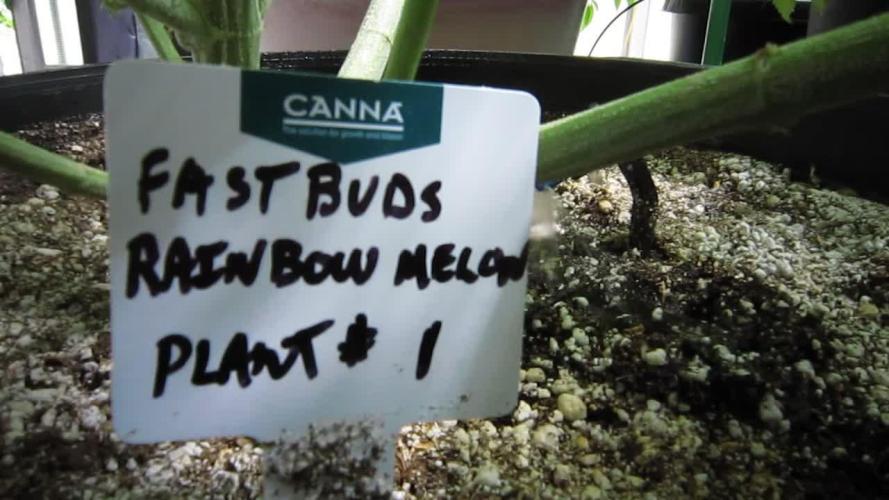
Welcome to the next installment of my grow world. This run will be a pair of Banana Purple Punch by FastBuds.
Happily, I won these in a contest and will take great pleasure in growing them. So let's get into it.
I'm running a 3x3 AC Infinity Grow System.
It has a 4" exhaust fan and carbon filter.
2 circular fans with one oscillating. I may end up with a second oscillating fan in a couple weeks. We shall see about that.
The Germination Center is also AC Infinity with the 12" supplemental lighting for the seedlings and a heat mat. I also have a small 4" computer fan, also from AC Infinity, to help regulate the air exchange in the Center.
For the grow itself, I'll be using 3 gallon fabric pots and the AC Infinity bottom feed watering basins. I have used these for a few runs with these and I love them. Technically it's a hydroponics setup, but with soil for a medium. Speaking of soil, I'll be reusing my Sohum Living Soil. The last run had used soil and I ended up with 21.25 oz from a single plant.
A few more things to mention about the expectations of this grow.
I'll be implementing LST and SCroG if needed. I don't want to top them as I feel it slows down the grow and extends the time it takes to grow.
As it stands, I have about 10 weeks until a contest I'm running in and this is an 8 week strain. Hopefully it doesn't take any longer that 9 weeks. If not, I'm kind of in trouble.
Anyway, along with training, I'll be running a weekly dose of recharge and advanced nutrients 3 part base. This is living soil so it shouldn't need much for nutrients. However, 8 do have a regimen that I have ready to go if I need it.
I'll also be using root riot plugs for the seedling stage. With the light at around 250 PPFD, I'll run the light at 18/6 from the start.
That's all for now. See you tomorrow.
February 16, 2024
Day 1:
Both ladies popped last night and had little tap roots ready to go this morning. So they were planted in the root riot plugs. I don't expect them to be in the Germination Center for more than a few days. I prefer to plant in the final pot before the roots start to show through the plug. So like 2 days.
Currently I'm warming up my soil from being out in the cold garage. I'll be filling up the pots probably tomorrow and have them in the tent for a day to acclimate and get some water before planting the plugs.
Germination Center Environment:
Temp: 77.6°
RH: 82.9%
VPD: 0.55 kPa
February 17, 2024
Both ladies are showing some green coming out of the plugs. I feel like they will pop the surface later today. I'm having a bit of an issue keeping the temp above 75°. I'm sure it will adjust once the lights go on, but for now it's just below 75°. The humidity is a bit bouncy as I can't find the correct spot for the "exhaust fan" yet. It won't really matter until the lights go on and both ladies have popped.
I didn't end up filling the pots up yet. I have to wash the basins out first. I'll do that today and prep the pots tomorrow.
Quick Update: I turned the light on now that I'm seeing green but not quite popped yet. It should help with keeping the heat up.
Germination Center Environment:
Temp: 76.5°
RH: 82.1%
VPD: 0.56 kPa
February 18, 2024
Both ladies popped their plugs last night. Perfectly green and healthy little stalks. Honestly, it's only been a total of 2 days and they have already popped surface? I don't think they will be in the Germination Center for too long. At this rate, they'll be in their final pots by tomorrow. I'll try to not let the roots grow out too much.
Speaking of final pots, I have filled my 3 gallon AC Infinity fabric containers with reused Sohum Living Soil. So they are all ready to go. It's nice and clean and still perfectly moistened and fee of roots. I've also decided not to use humidity domes when I plant them. I will be using a humidifier and the light lower and dimmer to keep the RH in place. At least for a couple of days. I do plan on raising the light significantly and increasing the power. I genuinely feel that the perfect foot print for this setup is about 24" at 90% power. Any higher and light may be lost even at 100%. This is just my experience so far. But I wouldn't pay too much heed to it. I haven't been able to really test my theory out yet. My last couple grows had plants that were much too tall.
Hopefully I can keep them short and wide this time around.
Anyway, the supplemental light is currently at 60% power. The intensity is around 250 PPFD. I'll be running the light at 18/6 for the entire grow starting last night. I normally run seedlings at 24/0 and switch to 18/6 when the dome comes off. But this time I feel like trying a full 18/6 from day 1. It'll be interesting even if nothing happens. At least something to note.
Quick Update: I decided to drop the light power down to 30%. I'll increase it to 40% tomorrow and so on until I hit 350 PPFD. Because this strain is super fast, I'm going to need to get up to 350 in a matter of days. Then the big light goes on.
Germination Center Environment:
Temp: 76.5°
RH: 76.5%
VPD: 0.74 kPa
February 19, 2024
Today is a new day and a new stage.
Both ladies were planted in their final containers. I watered them in with 250 ml of plain water PHed to 6.2. I didn't concentrate all of the water at the base. I made sure to start with 100 ml around the base and the rest covering the whole top soil.
Their tap roots were poking out from the plugs already. I was kind of hoping for one more day in the Germination Center, but then I would have had to set up the nursery bags and that wasn't the plan for this run. Hopefully my calculations are correct with the 250 ml.
I'm using the 3.4 gallon fabric pots from AC Infinity I already mentioned. They are also used from 2 runs ago and washed thoroughly.
Domes were added and the main grow light is now on at 20% power. The light height is around 30" and the intensity is at 290 PPFD. It's a bit high, but the domes block out a bit of the light, dropping the intensity down to 200 PPFD.
The tent isn't all that warm currently due to cold weather, but I'm hoping the heat of the main grow light will increase the temp in the domes. Currently the tent temp is 72° and the temp under the domes is around 68°. I'm hoping over the next few hours, the temp will raise up and the environment will stabilize.
I can't keep the domes off either as the RH is hovering at 43% in the tent itself. I have a humidifier, but that dropped the temp down even more, hence the domes. Kind of a pickle I'm in. I'll keep trying different things until I get it right. I hope it won't take me more than a day or 2. If not the next few hours.
Grow System Environment:
Temp: 68°
RH: 80%
VPD: 0.49 kPa
February 20, 2024
It's day 4 since seeds and these ladies are doing perfectly fine. Right on cue as well. I expect them both to hit the Veg stage in just a few days. Should be by the end of this first week. Maybe a day or 2 after.
The domes are doing their job perfectly. Just a little bit of dew and the temps are finally leveling out at a reasonable number. 75° by the end of the morning, the environment should be spot on.
That's all for the day. No watering. I'll water tomorrow another 250 ml for each baby.
Grow System Environment:
Temp: 75°
RH: 75%
VPD: ? (I'm taking readings from 2 different hydrometers. One of the main tent for temp and the one for the Germination Center for RH)
February 21, 2024
Both ladies got another 250 ml of filtered water PHed to 5.8, spread around the entire pot surface. I was thinking about doing another 250 ml around the outside of the pot. It may be a good idea to start moistening the rest of the soil. So when they start the veg stage, they can take off immediately. I'll probably wait until this afternoon and then decide. I did notice that A had drier soil than B. B is in the front and A is in the rear. I wonder why that is.
They look absolutely wonderful. Slightly praying and they both have really nice steady growth. The leaves are a beautiful dark green. So healthy and ready to go. The baby fan leaves have some really pronounced, serrated edges.
As for lighting, I've been paying attention over the past day and I think the domes will come off tomorrow or the next day. The light may also need to be lowered when the domes come off. Currently the intensity is 200 PPFD. I think 300 PPFD should be a good starting point starting week 2. I've also been researching and I think I have a good light schedule for the whole grow.
At 18/6
Week 1: 200 PPFD DLI: 13
Week 2: 250 PPFD DLI: 16.2
Week 3: 350 PPFD DLI: 22.7
Week 4: 500 PPFD DLI: 32.4
Week 5: 700 PPFD DLI: 45.4
Week 6: 700 PPFD DLI: 45.4
Week 7: 700 PPFD DLI: 45.4
Week 8: 550 PPFD DLI: 35.6
Week 9: 500 PPFD DLI: 32.4
This is based on a 3 week veg time and 5 week flower time.
Update: Domes Removed. I was researching as to when to remove a humidity dome from a seedling and everything I've read is to remove them a day or 2 after sprouting. So I removed them. The tent has been sitting nicely around 68% and 77°. So everything should be fine. I'll have to keep an eye on the light. Without the domes, they are getting the full intensity. However, I'm not all that worried. They are both praying, so a bit more light won't hurt.
Grow System Environment:
Temp: 73.6° too low
RH: 77.5% spot on
VPD: 0.95 kPa estimate
February 22, 2024
Not much to do today. I filled the humidifier, cranked the heat and spritzed the babies with a mist of PHed water. Took some photos and that's all. No adjustments needed. Both plants look absolutely perfect. Their leaves are flat, so I know the light is right where it needs to be.
Grow System Environment:
Temp: 75.9°
RH: 80.9%
VPD: 0.93 kPa