Likes
Comments
Share
Hallo zusammen šŸ¤™. Habe sie heute geerntet. Wir sehen uns in 3 Wochen mit dem Erntebericht
Likes
50
Share
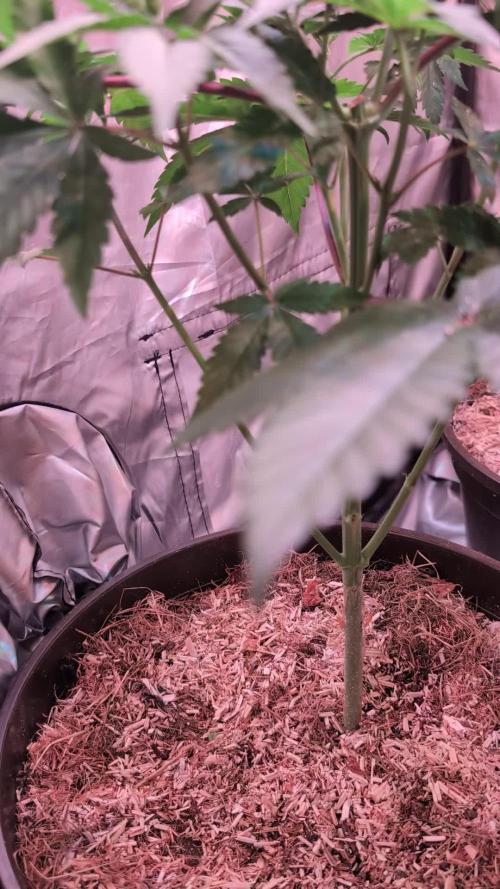
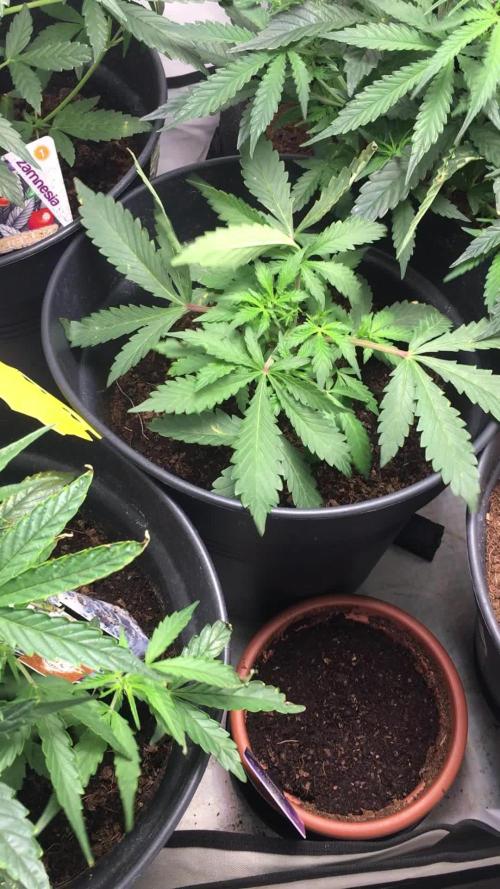
🌱 Eternity Grow Cup: Week 1 Report – The Journey Begins 🌟 First and foremost, a huge thank you to Grow Diaries, the incredible community, and all the amazing sponsors that make this journey possible. Big shoutouts to my core supporters: Aptus Holland, Pro-Mix Soil, TrolMaster, ThinkGrow LED, Future of Grow LED, and CannaKan. And for this special Eternity Grow Cup run, I’m deeply grateful to have Zamnesia and Plagron on board, providing seeds and the game-changing Green Sensation. Your support inspires me to put my all into this grow! šŸ’š 🌿 Week 1 Highlights: Slow but Steady Progress This week has been all about resilience and careful nurturing. Despite colder-than-ideal temperatures, the Zamnesia Runtz seedlings are showing their strength and determination. Here’s how things are looking: Environment Stats • Daytime Temps: ~18°C • Nighttime Temps: ~14°C • Humidity (RH): ~60% • Root Support: Heating mat keeping the root zone warmer, ensuring the seedlings stay cozy even when ambient temps drop. Growth Update • All five phenos (labeled Runtz #1–5) have sprouted and are now showing their first leaves. • Growth is slow due to the low temperatures, but the Pro-Mix HP with Biofungicide and Mycorrhizae is proving to be an amazing medium—supporting healthy roots and steady development. • No nutrients yet, just plain water, allowing the seedlings to establish themselves naturally in this excellent soil. Faith in the Pheno Hunt I’m holding onto the dream of finding that special passion-fruit pheno I adored in the past. It’s still early days, but I believe in the magic of this strain and the promise each seed holds. Educational Focus: Germination to Week 1 Care The Importance of Root Warmth in Cold Conditions Maintaining a consistent root-zone temperature is crucial when growing in a cold environment. Here’s how I’ve adapted: • Using a heating mat under the pots to keep the roots warm while the surrounding air remains cooler. • Ensuring the soil stays evenly moist, as dry conditions can amplify the impact of cold. Minimal Feeding Philosophy For the first week, I stick to plain water—letting the soil and its microbial life do the heavy lifting. This allows the seedlings to establish strong roots without risk of overfeeding or salt buildup. Patience is Key Early growth may seem slow, especially in cooler climates, but this is the foundation stage. Each small leaf and root is setting the stage for explosive growth in the weeks to come. Visual Storytelling: A Peek Behind the Scenes This week, I’ve documented every detail through photos and videos to share the full story: • Photos: Close-ups of all five phenos, capturing their early beauty. • Videos: A general end-of-week overview and a behind-the-scenes look at my process, shot with my Sony A6000 on a tripod. • These visuals not only highlight the progress but also offer a deeper look into the tools and techniques I’m using. Looking Ahead: Building Momentum As the journey continues, I’m confident these seedlings will pick up momentum. Next week, I’ll be keeping an eye on root development and early veg growth while maintaining the same environment and feeding approach. Community Love & Thanks I want to thank Grow Diaries and this incredible community for making this journey so rewarding. To all the participants: good luck, and let’s keep learning and growing together! Let’s make this cup one for the history books. Stay tuned for Week 2, where we’ll dive deeper into the evolution of these amazing plants. Until then, keep growing, keep dreaming, and let’s make magic happen! 🌟 Genetics - Runtz https://www.zamnesia.com/6000-zamnesia-seeds-runtz-feminized.html Nutrients - Plagron https://plagron.com/en/hobby - Aptus Holland https://aptus-holland.com/ Controls - Trol MAster https://www.trolmaster.eu/ LED - https://www.futureofgrow.com/en LED - https://www.thinkgrowled.com Soil - https://www.promixgardening.com/en Germination - Cannakan https://cannakan.com/?srsltid=AfmBOopXr-inLXajXu3QFgKXCXXos4F1oEvScjMKIB5MR5dk8-GJ-F49 DOGDOCTOR 15% off As always thank you all for stopping by, for the love and for it all , this journey of mine wold just not be the same without you guys, the love and support is very much appreciloved and i fell honored with you all in my life With true love comes happiness Always believe in your self and always do things expecting nothing and with an open heart , be a giver and the universe will give back to you in ways you could not even imagine so As always, this is shared for educational purposes, aiming to spread understanding and appreciation for this plant. The journey with nature is one of discovery, creativity, and respect. Let’s celebrate it responsibly and continue to learn and grow together! Growers Love To you All šŸ’š
Likes
8
Share
It was not a sight I was expecting so soon lol…rain fell last night her buds got soaked and the wind picks up you already know what happened after.
Processing
Likes
7
Share
@rainman
Follow
Week 4 in da house. Plant is short but bushy. Leaves look very strange. I will start LST in coming days. Day 23 - LST done right after watering 2L with nutrients. Day 28 - End of week 4. Great progress, plant is getting bushy, a lot of side branches. But its growing unevenly, with some strange leaves. Peace.
Likes
13
Share
@NSABND
Follow
Day 50 and a new week... the summer comes back to germany and "Hilde 2.0" goes well šŸ™šŸ˜€ Day 51 ... the summer is back in germany ... sun and heat šŸ˜ŽšŸ‘... good for the Buds šŸ˜‰šŸ™ Day 52 summer sun and warm weather....šŸ˜ŽšŸ™ŒšŸ™šŸ‘ Day53 hell yeah....sun and hot weather šŸ˜ŽšŸ™šŸ‘ Day54 summer sun and heat sounds like fun again šŸ˜ŽšŸ™šŸ‘ Day55 sun sun sun and hot weather šŸ˜ŽšŸ‘
Likes
5
Share
@Fefa128
Follow
More plant porn hehe... Not sure if that pollination was from the last week or the one before cutting. Either way this was the las week before chopping it down!
Processing
Likes
22
Share
@dutdut
Follow
Smells like new shoes lol I think I made a decent haul off 315 Watts the buds look frosted and I can’t wait to dry some. I knew what to expect in the coming weeks and if I run this again I think I’ll keep the plants shorter like last time. Highly recommend this Indica strain to anymore looking to make dry ice hash or solvent less! I’ll do the weigh in shortly0
Likes
18
Share
Alright! Now she’s starting to show. Picking up speed— little transplant shock, but moving along. They are sitting in fox farms soil— not what I use normally, but they ran out of Mendo mix so it will be a bit until I put them in their final pot. Playing the nutes by ear because of the soil situation. āœŒļøšŸ»šŸ’š
Processing
Likes
20
Share
@BudXs
Follow
Solo cup challenge continues to press along. Not much change, plants are in veg, growing and healthy. Still a few weeks before the flowers start so I hope to get a bit of size going before it does. Having fun and really like looking at the other entries in this contest. Check out WildeWeed, Butterstotch and BeanswithPork, silky, larimar, fireman
Likes
1
Share
Remember that, however you are played, or by whom, your soul is in your keeping alone. Even though those who presume to play you be kings or men of power, when you stand before God, you cannot say, 'But I was told by others to do thus,' or that virtue was not convenient at the time. This will not suffice. Remember that. Day:18 84°F and 65% RH (VPD) for the vegetative stage. Approximately 1.15kPa(assuming leaf temperature is about 2°F cooler than the air), which falls right into the ideal vegetative sweet spot (0.8kPa to 1.2kPa). At 1.15kPa, plants can draw water and nutrients efficiently without risking stress or wilting. It keeps the leaf pores (stomata) open, allowing for ideal carbon dioxide intake and maximizing vegetative growth. VPD is determined by the leaf's temperature, not just the ambient air. Because leaves usually run 1° to 3°F cooler than room air under bright grow lights, my actual VPD will be slightly lower, closer to the 1.0kPa mark. As she transitions from vegetative growth to flowering, one can gradually lower the humidity (to around 45–60%) and drop temperatures slightly to prevent disease from settling inside dense buds when they appear. Night:6 At 70°F and 60% relative humidity, Vapor Pressure Deficit (VPD) is 0.86 kPa. This is right on the cusp of whats optimal for the vegetative stage. During the nighttime, plants generally close their stomata and undergo cellular respiration rather than photosynthesis. Transpiration slows to a near stop, making VPD less critical at night than during the day. However, maintaining a nighttime VPD between 0.8 and 1.0 kPa is highly beneficial in that it ensures the air is dry enough to prevent powdery mildew or bud rot, but moist enough to keep the plant from undergoing unnecessary stress. This range keeps the environment comfortable for cellular processes and prevents large atmospheric swings. Keeping it all flowing. (Not pushing them yet, these are photoperiods) The optimal soil (root zone) temperature for cellular root respiration and nutrient uptake in cannabis is between 68F & 72F This narrow range balances biological energy production (cellular respiration) with the dissolved oxygen levels in the soil, maximizing plant growth and health. Warmer soils hold significantly less dissolved oxygen. When soil temperature exceeds 74F oxygen depletion occurs, inhibiting cellular respiration almost entirely, At 68-72F root cells generate optimal adenosine triphosphate (ATP) via respiration to power root-tip elongation and the active transport of water and nutrients. Too Hot (Above 78F) Root respiration increases, demanding more oxygen, while the water's oxygen-carrying capacity drops. This creates a prime environment for anaerobic pathogens and Pythium (root rot). Too Cold (Below 60F) Root metabolism and cellular respiration slow to a crawl. This severely impairs nutrient and water absorption, leading to yellowing, wilting, and phosphorus deficiencies. A lot depends on whether it's automatic or photoperiod; with photoperiod, there is not as much of a need to push "hard" as the real countdown only begins once the flower is initiated. Automatics, on the other hand, the chronological "clock" begins ticking the moment the seed germinates. It is of critical importance that the seedling growth gets off to the races, understanding that early growth is like compound interest, which will pay off come harvest. This reality is why getting autoflowers "off to the races" early on yields such exponential benefits. The "compound interest" is directly related to the surface area of the leaves. Larger, faster-growing seedlings process more light and build bigger root networks early on, which translates into an explosion of vertical and lateral growth during their short vegetative window. The margins for error are so thin with autoflowers; this early-stage momentum depends on several critical practices. Seedlings exposed to increased atmospheric CO2 levels early in life will develop at an increased rate. To effectively "extend" or optimize the capacity of Photosystem II (PSII) for increased photosynthetic efficiency. In standard oxygenic photosynthesis, Photosystem II (PSII) is naturally limited to the red-light spectrum, peaking at 680nm. Extending its light-harvesting capacity past 700nm into the far-red region requires bypassing the natural limits of standard chlorophyll a. Adding 730 nm (far-red) LEDs alongside standard red/blue lights has been shown to increase canopy photosynthesis by 20–30% in several crops by acting synergistically with shorter wavelengths. However, the limitation is that excessive, pure IR/Far-red light (without accompanying red light) can trigger the "shade avoidance response," causing plants to grow tall, weak, and spindly rather than robust. Utilizing infrared light (specifically the 700-750 nm far-red range) is a viable method to boost photosynthetic efficiency. It acts as a bridge to allow PSII to utilize a broader spectrum of light, breaking the traditional 700 nm barrier. UVR8-mediated signaling (often in conjunction with CRY proteins) triggers protective mechanisms that maintain the stability of the photosynthetic apparatus (including LHCII and reaction center proteins), thus ensuring that the efficiency of Photosystem II remains higher in UV-B-exposed plants compared to plants lacking this receptor. ΦPSII indictates the rate of electron transfer from water to plastoquinone, which drives the production of ATP and NADPH. There is a close link between ΦPSII and the true rate of CO2 fixation (Φ*co2). ETR stands for Electron Transport Rate. It measures the speed at which electrons are moved through the thylakoid membranes in a plant's chloroplasts during the light-dependent reactions of photosynthesis. Infrared light (particularly Near-Infrared or NIR) improves cellular energy by interacting directly with the electron transport chain (ETC) in mitochondria. This process boosts adenosine triphosphate production, which acts as a metabolic coefficient multiplier by accelerating enzyme activity dramatically. Extend then multiply. Far-Red photons interact with plant photoreceptors to accelerate the plant’s biological "clock" or trigger a shade-avoidance response. Autoflowers don't use the plant's biological clock, although the IR will initiate a shade avoidance and make them stretchy. You can just add equal measures of 660nm-680nm to negate the shade avoidance effect. Replacing nights' "darkness" with a combination of IR+ and 660nm. Because autoflowers don't require a dark period to flower, many growers just blast them with light. 18/6 24/0. However, this ignores the plant's metabolic rhythms, where daytime photosynthesis (light reactions) must be perfectly balanced with nighttime carbon fixation and assimilation (Calvin cycle) to avoid bottlenecking plant development. Cellular respiration is a 24/7 process, but it can only function while the plant has the free oxidative capacity to do so. A 100% photosynthetically active leaf cannot perform cellular respiration. The viral trend of defoliation of every leaf that isn't "getting enough light" is of great detriment overall, putting 100% of the cellular respiratory "workload" and responsibility on the 0/4/6 hours of darkness in sub-optimal conditions for enzymatic activity. Photosynthesis captures nearly 100% of the initial energy as carbon, while cellular respiration is the process that unlocks 90% of that captured energy into usable ATP so the plant can use it. Respiration is considered roughly 30% to 40% efficient. It captures enough of the potential energy in glucose to synthesize around 30 to 38 ATP molecules per glucose molecule. The remaining 60% to 70% of the energy in the sugar is not captured in ATP; instead, it naturally escapes into the environment as heat, which helps regulate plant temperature. In plants, the primary enzymes of the Electron Transport Chain (ETC) and the ATP synthase complexes are typically adapted to function optimally in warmer temperatures (roughly 25°C to 35°C depending on the specific plant strain). As temperatures rise within this physiological range, molecular collisions increase, speeding up respiration and ATP production. The cannabis plant has a branched respiratory pathway. During heat or cold stress, plants activate Alternative Oxidase (AOX). AOX burns sugars to dissipate energy as heat rather than coupling it to ATP production. This pathway actually functions optimally at elevated temperatures to help protect the cell from the damaging build-up of Reactive Oxygen Species (ROS) during heat stress. Enzyme activity generally scales with heat; there is a strict biological limit. If canopy temperatures in a grow room exceed 40°C, the enzymes and their supporting lipid membranes lose stability. Not saying you need to go crazy, just optimize nights the same as we optimize days. Phosphorus is the driving force behind early seedling development. It acts as the "energy hub" of the plant, directly driving cell division, robust root growth, and the creation of DNA. Without an adequate, easily accessible supply early on, the plant's overall growth potential and final yield can suffer permanently. E=MC2 looks like a simple multiplication problem; it describes a fundamental physical truth: mass and energy are the same thing. The equation doesn't just calculate a value; it reveals that mass is effectively "congealed" energy. Energy is just numbers. Energy isn't a physical "substance" you can hold or touch. It is essentially an abstract, calculated number that we assign to a system to predict how it will change, interact, or move. A numerical label we attach to matter to track how it behaves. Because the universe runs on laws of symmetry (specifically, that the laws of physics don't change over time), a single global number must be conserved. We call that number "energy". We don't grow; we facilitate energy conversion. How well a seedling grows is essentially down to how much knowledge one can acquire to increase the level of conversion to occur. Applying knowledge effectively requires intuition, which comes from hands-on experience. A seasoned stoner learns to read subtle signs—like a slight change in leaf turgor (stiffness), subtle color shifts, or the specific texture of the soil—before a textbook diagnosis can be made. Ultimately, growing is the application of botanical science blended with active observation. Knowledge dictates your potential, but adaptability and attentiveness to the plant's immediate environment determine your results. 1.618 nature mathematically optimizes quantum energy transfer and light absorption efficiency within the photosynthetic machinery, as it naturally dictates energy scaling hierarchies and resonance dynamics. External vibration or electromagnetic wave that perfectly matches a plant's natural frequency directly influences plant growth. Low-frequency sound waves and targeted electromagnetic fields stimulate cellular processes and boost photosynthetic efficiency Does it produce better yields? How long is a piece of string? As long as you cut it. But isssss the juice worth the squeeze? The quantum framework of the IVM seems to think so. Good enough for the quantum firmware, good enough for the DNA software. Genetics are not dictated; they are expressed; the rate of that expression is dictated by the environment in which growth occurs. Quantum Coherence in Photosynthesis occurs When a photon of sunlight strikes a leaf, the energy it carries must travel to a reaction center to be converted into chemical energy. This process operates at nearly 100% efficiency. If the energy moved in a traditional "bunching" or random hopping manner, a large portion of it would be lost as heat. Instead, plants utilize quantum superposition. The energy particle (exciton) doesn't just take one path; it exists in a wave state and explores multiple pathways simultaneously. It essentially "chooses" the most efficient route to the reaction center simultaneously. Research shows that molecular vibrations and the specific network arrangements of chlorophyll molecules (like the naturally evolved Chlorophyll A & B ratios) actively protect against energy overflow, optimizing light capture across different light intensities. Enzymes are the biological catalysts that speed up chemical reactions within a plant's cells, allowing them to grow, metabolize, and repair. Rather than relying solely on the classical kinetic energy of molecules colliding, plants use quantum tunneling. Subatomic particles like electrons and protons (hydrogen ions) can literally "teleport" through energy barriers that they normally wouldn’t have the energy to climb over. This makes vital metabolic reactions happen far faster than classical physics could ever explain. Chloryphyll b has peak absorption at 460nm (Blue) and at 647nm(Red). If we take the blue peak wavelength 460nm and a UV-B, UVR8 peak absorption wavelength 285nm, Tryptophan-285 (W285) Sensing protein. 460/285=1.618 Φ If we take chlorypyhll b's Red absorption peak 647nm and a UV-A of 400nm, we get 647/400=1.618 Φ. "Structure of light". The cryptochrome photoreceptor (CRY) is a UV-A/blue light receptor that shares this dual sensitivity with several other biological structures and functions, including significant sequence similarity and a common evolutionary ancestor with DNA photolyase enzymes. These are light-activated enzymes that use blue/UV-A light to repair DNA damage caused by UV-B radiation in plants. Synergistic. But Shhh, it's a secret. Effective quantum efficiency of photosystem II, often denoted as ΦPSII, represents the proportion of light absorbed by Photosystem II (ΦPSII) that is actually used in photosynthetic electron transport. It is a key indicator of how efficiently a plant is using light for photosynthesis, as opposed to losing it as heat or fluorescence. ΦPSII (effective quantum yield of photosystem II) functions primarily as a "multiplier" (a coefficient of efficiency) rather than an additive factor when estimating the overall photosynthetic electron transport rate (ETR). Multipliers are considered far more beneficial than additions because they generate exponential growth, leverage existing resources to their full potential, and create sustainable, self-multiplying capacity, rather than just incremental, linear increases. This fascinating observation is rooted in the intersection of subatomic geometry, fractal scaling, and quantum dynamics. In specific molecular arrangements—such as in conjugated polymer networks or biomolecular architectures—the Golden Ratio (PHI) naturally dictates energy scaling hierarchies and resonance dynamics. Mathematically tied to the fine-structure constant, which defines the strength of the electromagnetic interaction. The Golden Ratio can be mapped geometrically as the Golden Angle (137.5 degrees) in atomic structures, linking the charge of the electron to fundamental quantum constants like Planck's constant. Electromagnetic. The Golden Angle (137.5): This angle is derived from the Golden Ratio (1.618). It is the smaller of two angles created when a circle is divided such that the ratio of the arcs equals the Golden Ratio.
Likes
37
Share
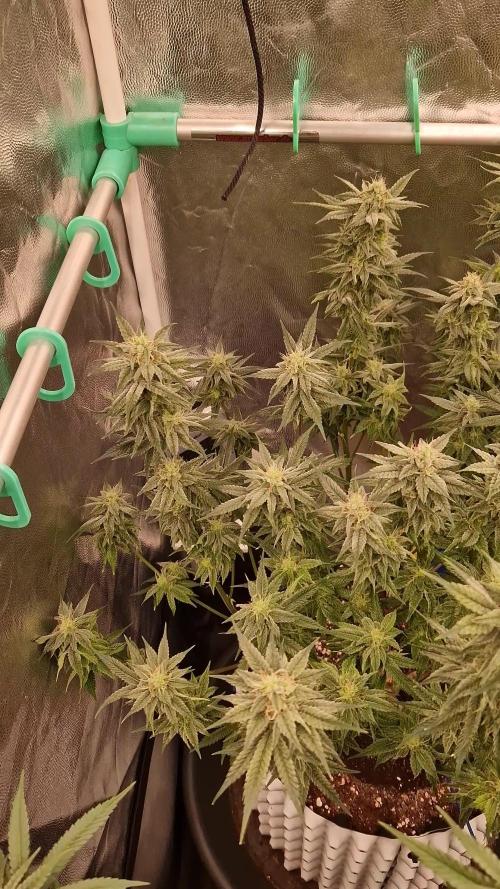
šŸ˜šŸ˜šŸ˜‹ starting to see some trichromes forming and the flowers are starting to smell quite nicely. They are looking quite plump already with tons of time to go so i'm hoping this is a good sign!!!!! have done some trimming almost nightly to keep it cleaned up but still bushier than last couple runs. Will this be the run to set the tent record??? On a side note I grafted two clones from the tent that are now outdoor plants lol i had 2 clones outside. phantom og and liberty haze, so i decided lets try grafting them!!! they both survived!!!! I cut them in half basically and swapped them lol so i'm thinking i'll keep them alive outside until the tent is ready for them in about 5-6 weeks
Likes
15
Share
@Aleks555
Follow
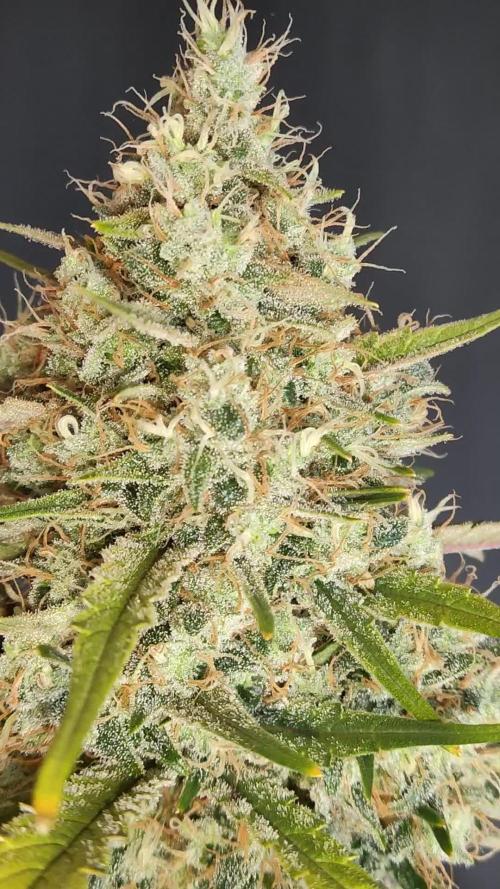
42Fast Buds - Gorilla Zkittlez Auto 🌱 Today marks 70 days, and it's finally time to bring this incredible journey to an end. šŸ’« Honestly, I can hardly bring myself to cut her down, I've grown so attached to her, and she's just so beautiful. But the trichomes have turned a deep amber, and there's no more time to wait. For the last 6 days, we’ve been flushing her roots with ice-cold water, watching as she transformed, her colors changing and becoming even more stunning. It wasn’t just a grow – it was a true process of evolution. I want to give a huge thanks to 42FAST Buds for their amazing genetics and for allowing me to grow such a phenomenal strain. Gorilla Zkittlez Auto is an absolute masterpiece! šŸ’„ Special thanks to Xpert Nutrients for their incredible fertilizers and ongoing support. Without you, we wouldn’t have achieved these remarkable results. You helped grow not just a plant, but a true work of art! 🌟
Likes
1
Share
@Wiffz_CBD
Follow
Grow dots added at beginning of grow. I’d say it’s working great. And it’s simple. Cal-Mag added in reservoir 1tsp/1gal Recharge .5tsp/2.5gal -fed 1L
Likes
35
Share
The start of the week is going well.Did some defoliation. Added a scrog net. I removed the scrog the next day, might use it if the buds need support. There’s no way to add the rabbit poo to the nutrients accurately all I did was top dress the soil with a few scoops and worked it in the soil lightly. Water with distilled water.
Processing
Likes
20
Share
@mikemobes
Follow
8/25 -Plants responded well to the increase on volume of water fed. Im really liking the +50 mLs a feeding (every other day) -Only a few of the oldest leaves have started wilting. This is normal and expected as those leaves have been used and abused the worse. I left them on originally because it seemed the plant was pulling nutrients from those two leaves specifically if there was any kind of deficiency. As I took care of the Ca/Mg/Fe issue a few weeks ago those spots went away. -The canopy is so damn thick defoliation doesn't allow for light penetration down to the coco. šŸ¤·ā€ā™‚ļøšŸ»šŸ¤·ā€ā™‚ļøšŸ» -I really shouldn't complain since these plants are definitely going to harvest big. Very excited -Building 4 separately raisable platforms so I can start growing my Fall plants. Only have 1 light, limited space for my grows but I don't want to waste a month of vegetation. If the platforms work as designed I am very confident ill be able to grow staggered harvests. The goal is to always have weed ready and cured for me to smoke. Buying from dispensaries is getting to be too expensive. -Went back and re red some online forums about growing in coco as I had no experience going in. All the forums said to essentially flood the coco on a daily basis. I have no idea how that is successful--when I tried that I almost killed my plants. Listening to the plant and reading its signals is WAY more efficient for me. The time lapse allows me to look at the plants normal day/night trends. SUCH a good idea plus it makes for a really great video at the end of the grow. 8/26 -NEw nutrient solution made. Same nutrient concentration and strength. -Cheese lowered 1.5 inches on its stilts. Its definitely stretching according to the Time Lapse -Cream Cookies smell is getting stronger and stronger every day. Cheese is the first smell to start developing. -Slight color change starting to occur on Cream Cookies. -Its beginning to become more obvious that Cream Cookies is transitioning focus from maintaining older leaves birthed in early vegetative growth and transitioning to only focusing on bud production. Lower growth is beginning to wilt out. A Natural lollipop if you will. 8/30 -Cream cookie buds are really really really starting to thicken and fill out. Looks like the final buds are going to be quite dense. The smell is really developing on cream cookies. Cant really put my finger on the exact smell but there is a definite strong cheese odor followed by a strong earthy smell. No sweet/citrus smells yet. -Cheese is flowering completely differently from cream cookies. It seems three of the main cola branches are going to yield absolutely huge buds. These main cola bud sites are stretching and small flowering nodes dominate the landscape of the branch all the way from the soil line to the canopy. It seems like the flowers are going to really fill in around the branches. -Lower branches of Cream Cookies starting to become more rigid, taking on rigid character of the main stem. Makes me think that the buds are becoming sufficiently heavy that the plant needs to reinforce some branches to avoid bending over and falling. Love to see it. -Slight signs of stress observed, going to reduce concentration of bloom nutrients to 11 mL/gal. Still should have all the nutrients the plant needs just in a less concentrated solution.
Likes
8
Share
Venga familia que ya viene la cosecha de estas Terp & Tonic de Seedstockers, que ganas que tenia ya de darles machetazo. No veas que ma me dio esta variedad desde principio de floración entre carencias y a mediados una maldita plaga de trips. Las flores aparte, se ven resinosas. a sido una genĆ©tica con la que disfrutĆ© cultivarla, es algo complicada cultivarla pero merece la pena si eres cultivador con experiencia no te serĆ” problema cosechar. Agrobeta: https://www.agrobeta.com/agrobetatiendaonline/36-abonos-canamo Mars hydro: Code discount: Eldruida https://www.mars-hydro.com/ Hasta aquĆ­ es todo , espero que lo disfrutĆ©is, buenos humos šŸ’ØšŸ’Ø.
Processing
Likes
35
Share
@rhodes68
Follow
8/20 D37 Pics : Ceila 22"x21"x15" Side and Top and she is not really much bigger than the rest weight wise Full tent, this is why I just ordered a bigger boat... they just keep growing. I am going to have them on bloom nuets and water until the new tent is set up in a couple of days hopefully. The five gal pots are a real keeper just need a bigger tent for flowering, the 4x4 with sperate seedling and mini veg area will be fine. Tent porn: https://www.amazon.com/gp/product/B07HQRGL6P/ref=ppx_yo_dt_b_asin_title_o00_s00?ie=UTF8&psc=1 8/23 D40 New 4x4 plus 1x4 germ and cloning area tent is setup and plants in the new home. They are looking better not being so jammed up and the light can even be moved up as the side coating is excellent, plenty of light. Climate conditions inside the tent are ridiculously easy to control just from the increased area inside may hold plenty of fans, humidifier, or whatever else is needed. Not to mention being able to stand inside the tent with the plants. The smaller tent is being given veg duties for the next rotation. Fed Rchrg/Bio-bloom-grow just no deficiencies at this point to address, everything seems fine 8/25 D42 End of week First real haircuts for all , leafy strain but easy to work. Tried to get as many sites uncovered completely as possible yet keep the total under 5% so as not stress the plant too much. Worked on the bottoms (heh) of the plants so nothing will restrict air flow or hijack nuets, Will replace these pics with better later, color correction is not as strong as we would wish.