


Likes
Comments
Share


@chamelendo
Follow
Nach unserem „Unfall“ mit der Grow-Lampe und 10 Tage kein Licht, … 🌿 … standen wir vor der Entscheidung „Totalausfall“… 🌿✂️ … oder „Weiter machen und auf das Beste hoffen“… 🌿 Zum Glück konnte ich mich durchsetzen! 🌿 Die ersten Härchen zeigen sich?

Likes
5
Share


@Shivashamboom1
Follow
4 settimana di fioritura.belle piantine mie continuate a fare dei bei fiori grandi e terapeutici 😂🙏😉..........
questa è la settimana che iniziano a gonfiare le cime.che i bei fiori prendono forma e profumo...
adesso gli farò il lavaggio radici per un paio di settimane e via......
Likes
5
Share


@killerjoint
Follow
10-24-2024
ALL THE STRAIN RECOMMEND FLOWERING TIME IS 7-8 WEEKS
TRY TO FINISH WEEK 8
STILL HAS 19 MORE DAYS...
LAST FEED WITH NUTS .BURNED SOME OF TOP FAN LEAVES ......
BUT CHECK OUT QUEEN,DR SLEEP , WULFF ,POWER... CRAZY FROST TOE TO HEAD
SMELLS .............NEED TO RUN FANS WITH HIGHER SPEED FOR SMELL...
NO MORE NUTS....JUST WATER .....STAY IN THE COURSE...
STAY GREEN ....
10-27-2024
-HIT THEM WITH HUMBOLDT COUNTY NUTS
G10 -5ML PER GAL
SNOW STORM -5ML PER GAL
PURPLE MAXX-7ML PER GAL
EVERY TWO DAY NEED TO WATER....


Likes
10
Share


@KinoBudz74
Follow
I think week 8 is when I’m going to chop I already see some amber trichomes🌳

Likes
19
Share


@Chubbs
Follow
420 Fastbuds Week 2 Veg
FBT2306
The two of these are starting off great. The few rust spots stopped and stayed on the couple leafs it showed up on. I feed 500ml of solution every other day. I did start the General Hydroponics 3 part Flora series as well as the Calimagic. On week one I started 1/4tsp per gal ratio every other feed, so far no burn so will probably bump it up this coming week and see how they respond. All in all Happy Growing.
Likes
1
Share


@Captain_Automatic
Follow
LIGHT SCHEDULE CHAGING (12/12) - (DECEMBER, 15) - FIRST PISTIL APPEAR
WATERING
7º - ONLY WATER / 0,5L
8º - FERT/ PH 7,0/ 0.5L
9º ONLY WATER/ 0.5L


Likes
40
Share


@nijuana
Follow
Monster plant ! So much trichomes 🙏😅
Bonus : the hermaphrodite problem was 100% resolved I removed directly passt 2 weeks everything , nothing was re-coming she focus only to do the bigger buds ever 😁🙏 and no one on the canopy was affected it's so great , so the thing is if you see that directly isolate the plant and remove everything , if you wait you're done !
Likes
5
Share

@Badbreath
Follow
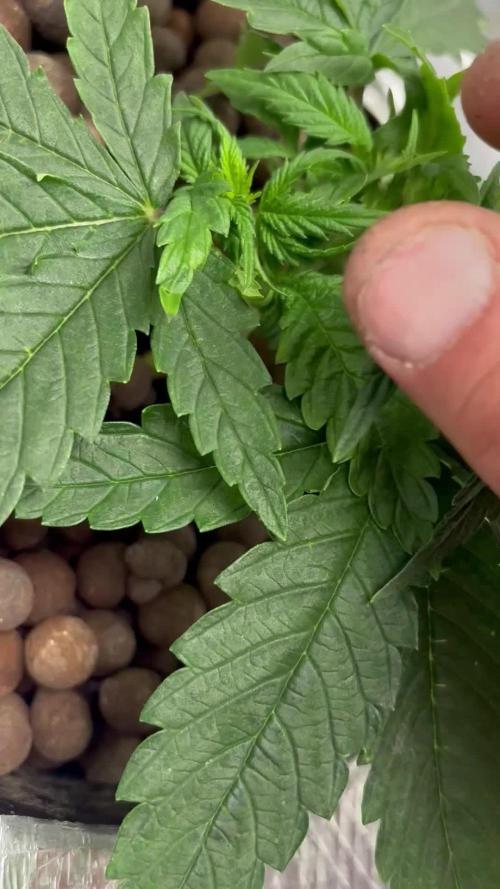
16/9 Denna veckan har jag lärt mig att det finns 2 sätt att odla Hydro/dwc. Med bakterier eller utan, valet för mig med shogun är enkelt, sterilt och rent är det bästa sättet för min del. Jag har för liten behållare för att köra med levande bakterier. Jag får slemmiga rötter alldeles för lätt.
Men tack vare er mina vänner så har jag räddat min royal skywalker. Jag har bytt ut vattnet och tillsatt shoguns serie med näring och även tillsatt silver bullet root!
Detta har räddat mig totalt, säg själva vad ni tycker 😎
PH 5.7
Ec 1.43
Ppfd 560
WT 18/21 Celsius


Likes
6
Share


@CanOli95
Follow
Bud development is really nice. Now you can clearly see purple buds, starting to produce a layer of resin. The purple from spreads from the inside to the sugar leaves, leaving a nice colour. The smell to this point, is not that strong. But she smells like a doughy overripe fruit, very sweet, but not yet like a cherry. I'm excited to see, how it's gonna turn out in the end.
She is not a thirsty plant and is not asking for a lot of nutrients. I just added a small mixture of bloom fertilizer, just to prevent deficiency symptoms. O guess she will take another 5 to 6 weeks, to become fully ripened.
So far the plant is really easy to handle , just don't overfeed her and she is running on her own.


Likes
9
Share


@Dthebudguy
Follow
Over all the plants are slowly growing been feeding smal doses of liquid seaweed and foopcanna veg

Likes
Comments
Share

@ooo111
Follow
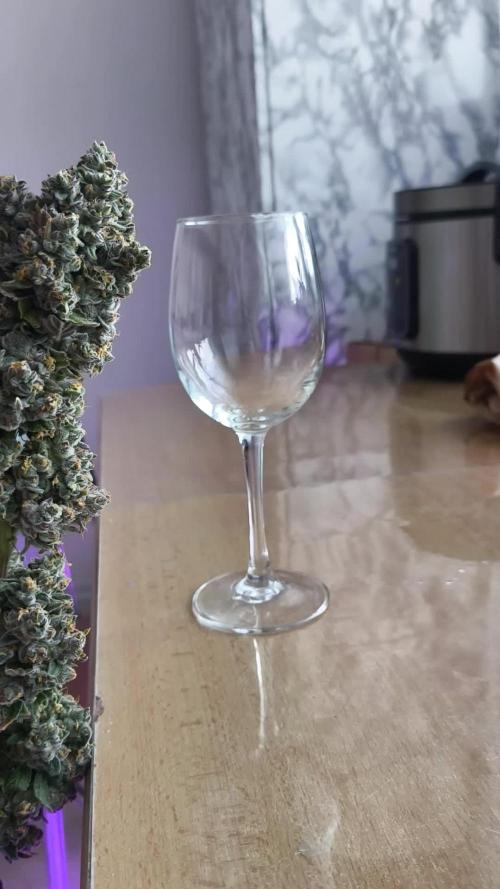
☺️ tak je po dalsi sklizni..vahu napisu az uschne..pocitam do 1 kg.h
jako vzdy. jinak rostli krasne.jako vse id beleaf..jsem rad ze meli vice v sobe BX1. takze tvrdist tam je. chut popisi tez pozdeji a sila je jasna kolem 30 procent.jako vzdy😉


Likes
14
Share


@ClydeGrows
Follow
Very sad looking little friend... Young leaves do look better, but she's gonna stay looking like this because the damage was done! Underwatered and underfed for over a week over new years' plus the tiny metal pot, can't be good for a lil bean just trying to make it in the world. Even the plant of the same cultivar next to it (as you can see in video- but is my housemate's baby so no diary) is still recovering from the same fate. Will spend some time checking out other people's grows of the same bean to see if she's particularly finicky or if we've been particularly neglectful 😂 still fun though!

Likes
22
Share


@Johnny5thesim
Follow
So far, so good! Stretching is almost done I hope. They are starting to stack on the buds.
Still seeing discolouration on the one plant. I’m was going to go full strength. But I think my problem is nutrient lockout from overfeeding. So I did a plain water on day 69.
Likes
29
Share


@gottagrowsometime
Follow
Welcome to my Slurircane Diary sponsored by MSNL & Spider-Farmer
Week 7, early flip and attempt at reveg into early week 8 but decided I liked the look of her cola potential and decided to throw her into flowering. From the reveg attempt I thought a ratio on/off would be best if it leaned more on the off, so a 13-11 off / on was set for early week 8 and till fattening (when the stretch is over, 'pre flower)
This is a bit of a weird one for me, well more a 1st. I'm not 100% sure. But I do remember this getting 3 13.5hr days as did my whole tent. As my cheap timer ran for an extra hrs off when it was meant to be on. So, put it into a flip. And I tried for over a week to reveg, I'm sure if I pushed on. I would of gotten to reveg. (I'm not sure how long it takes, am very pleased though with this spectrum even without the IR that the flip time is quick. So, after a week 7 was finished. I decided to push on to a 13-11 off/on to induce her. I'll increase it to 13-11 on/off in fattening. Sadly has the pre flip and then attempt at reveg make all her nodes very stiff. And near to LST. After pre flower I'll hard defol and attemp to distance the colas. Surprisingly with her been a dom indica her leafs are very Stavia style. Very thin. Would make an ideal candidate for scrog. She is very healthy and been the most responsive with co2/heat. Although growth was stalled from my reveg attempt, I'm sure i cut a good few CM from her Height by reversing it again. I should of looked up how long it takes to reveg 1st. Lessons learnt. I still have an amazing pheno. (I'm a few weeks ahead in Real Time)
Defoliation
So, this was done lots on this girl. As my plans for her were changed due to poor attention. So, start of wk 7, what I thought was still a few weeks out from me flipping. But, after my abandoned attempt of reveggin. She was in limbo and I decided to risk it with a hard defoliation. (Looks like it was done in pre flower, it wasn't, It was just coming back into veg, but would of taken weeks to get it growing fully again, and at looking I'm happy with it so I pushed again with my Defol to get colas. You can find this on grow weed easy "full tutorial for flowering") am gonna leave her now until she's out of pre flower, she's 35cm or so tall. I don't see putting on much height. As my reveg attempt will for sure hanmer her stretch.
Diet
Was planning on taking Alga Grow off for the last 10 days r so off grow. So, I only had a few days off it, and its on Alga Bloom now.
Thanks to my sponsors from MSNL & SPIDER-FARMER. Just harvested the GranDaddyPurple Auto. (BEST AUTO I'VE EVER GROWN SO FAR, TASTE, SMELL & STRENGHT BEATS ALL PAST AUTOS, BUDS DOWN) will be uploading the weeks on that soon. I've too many diaries. I knew this. So, I plan to do 2 wk updates at a time for 70% of my diaries, so pics and info will be added as those it was a weekly update. Also, I don't put up a harvest wk for a month until the cure.
Thanks to my sponsors from MSNL & SPIDER-FARME, look forward to working with your more. And trying a lot more of your products. #convert.
Much appreciation to all ppl who stopped by and did your thing. Look forward to seen your work if I know you dropped by of course. Either way. Thanks for stopping by

Likes
55
Share


@Ultraviolet
Follow
What's in the soil? What's not in the soil would be an easier question to answer. 16-18 DLI @ the minute. +++ as she grows.
Probably not recommended, but to get to where it needs to be, I need to start now.
Vegetative @1400ppm 0.8–1.2 kPa 80–86°F (26.7–30°C) 65–75%, LST Day 10, Fim'd Day 11
CEC (Cation Exchange Capacity):
This is a measure of a soil's ability to hold and exchange positively charged nutrients, like calcium, magnesium, and potassium. Soils with high CEC (more clay and organic matter) have more negative charges that attract and hold these essential nutrients, preventing them from leaching away.
Biochar is highly efficient at increasing cation exchange capacity (CEC) compared to many other amendments. Biochar's high CEC potential stems from its negatively charged functional groups, and studies show it can increase CEC by over 90%. Amendments like compost also increase CEC but are often more prone to rapid biodegradation, which can make biochar's effect more long-lasting. biochar acts as a long-lasting Cation Exchange Capacity (CEC) enhancer because its porous, carbon-rich structure provides sites for nutrients to bind to, effectively improving nutrient retention in soil without relying on the short-term benefits of fresh organic matter like compost or manure. Biochar's stability means these benefits last much longer than those from traditional organic amendments, making it a sustainable way to improve soil fertility, water retention, and structure over time. Needs to be charged first, similar to Coco, or it will immobilize cations, but at a much higher ratio.
a high cation exchange capacity (CEC) results in a high buffer protection, meaning the soil can better resist changes in pH and nutrient availability. This is because a high CEC soil has more negatively charged sites to hold onto essential positively charged nutrients, like calcium and magnesium, and to buffer against acid ions, such as hydrogen.
EC (Electrical Conductivity):
This measures the amount of soluble salts in the soil. High EC levels indicate a high concentration of dissolved salts and can be a sign of potential salinity issues that can harm plants.
The stored cations associated with a medium's cation exchange capacity (CEC) do not directly contribute to a real-time electrical conductivity (EC) reading. A real-time EC measurement reflects only the concentration of free, dissolved salt ions in the water solution within the medium.
98% of a plants nutrients comes directly from the water solution.
2% come directly from soil particles.
CEC is a mediums storage capacity for cations. These stored cations do not contribute to a mediums EC directly.
Electrical Conductivity (EC) does not measure salt ions adsorbed (stored) onto a Cation Exchange Capacity (CEC) site, as EC measures the conductivity of ions in solution within a soil or water sample, not those held on soil particles.
A medium releases stored cations to water by ion exchange, where a new, more desirable ion from the water solution temporarily displaces the stored cation from the medium's surface, a process also seen in plants absorbing nutrients via mass flow. For example, in water softeners, sodium ions are released from resin beads to bond with the medium's surface, displacing calcium and magnesium ions which then enter the water. This same principle applies when plants take up nutrients from the soil solution: the cations are released from the soil particles into the water in response to a concentration equilibrium, and then moved to the root surface via mass flow.
An example of ion exchange within the context of Cation Exchange Capacity (CEC) is a soil particle with a negative charge attracting and holding positively charged nutrient ions, like potassium (K+) or calcium (Ca2+), and then exchanging them for other positive ions present in the soil solution. For instance, a negatively charged clay particle in soil can hold a K+ ion and later release it to a plant's roots when a different cation, such as calcium (Ca2+), is abundant and replaces the potassium. This process of holding and swapping positively charged ions is fundamental to soil fertility, as it provides plants with essential nutrients.
Negative charges on soil particles: Soil particles, particularly clay and organic matter, have negatively charged surfaces due to their chemical structure.
Attraction of cations: These negative charges attract and hold positively charged ions, or cations, such as:
Potassium (K+)
Calcium (Ca2+)
Magnesium (Mg2+)
Sodium (Na+)
Ammonium (NH4+)
Plant roots excrete hydrogen ions (H+) through the action of proton pumps embedded in the root cell membranes, which use ATP (energy) to actively transport H+ ions from inside the root cell into the surrounding soil. This process lowers the pH of the soil, which helps to make certain mineral nutrients, such as iron, more available for uptake by the plant.
Mechanism of H+ Excretion
Proton Pumps: Root cells contain specialized proteins called proton pumps (H+-ATPases) in their cell membranes.
Active Transport: These proton pumps use energy from ATP to actively move H+ ions from the cytoplasm of the root cell into the soil, against their concentration gradient.
Role in pH Regulation: This active excretion of H+ is a major way plants regulate their internal cytoplasmic pH.
Nutrient Availability: The resulting decrease in soil pH makes certain essential mineral nutrients, like iron, more soluble and available for the root cells to absorb.
Ion Exchange: The H+ ions also displace positively charged mineral cations from the soil particles, making them available for uptake.
Iron Uptake: In response to iron deficiency stress, plants enhance H+ excretion and reductant release to lower the pH and convert Fe3+ to the more available form Fe2+. The altered pH can influence the activity and composition of beneficial microbes in the soil. The H+ gradient created by the proton pumps can also be used for other vital cell functions, such as ATP synthesis and the transport of other solutes. The hydrogen ions (H+) excreted during photosynthesis come from the splitting of water molecules. This splitting, called photolysis, occurs in Photosystem II to replace the electrons used in the light-dependent reactions. The released hydrogen ions are then pumped into the thylakoid lumen, creating a proton gradient that drives ATP synthesis.
Plants release hydrogen ions (H+) from their roots into the soil, a process that occurs in conjunction with nutrient uptake and photosynthesis. These H+ ions compete with mineral cations for the negatively charged sites on soil particles, a phenomenon known as cation exchange. By displacing beneficial mineral cations, the excreted H+ ions make these nutrients available for the plant to absorb, which can also lower the soil pH and indirectly affect its Cation Exchange Capacity (CEC) by altering the pool of exchangeable cations in the soil solution.
Plants use proton (H+) exudation, driven by the H+-ATPase enzyme, to release H+ ions into the soil, creating a more acidic rhizosphere, which enhances nutrient availability and influences nutrient cycling processes. This acidification mobilizes insoluble nutrients like iron (Fe) by breaking them down, while also facilitating the activity of beneficial microbes involved in the nutrient cycle. Therefore, H+ exudation is a critical plant strategy for nutrient acquisition and management, allowing plants to improve their access to essential elements from the soil.
A lack of water splitting during photosynthesis can affect iron uptake because the resulting energy imbalance disrupts the plant's ability to produce ATP and NADPH, which are crucial for overall photosynthetic energy conversion and can trigger a deficiency in iron homeostasis pathways. While photosynthesis uses hydrogen ions produced from water splitting for the Calvin cycle, not to create a hydrogen gas deficiency, the overall process is sensitive to nutrient availability, and iron is essential for chloroplast function.
In photosynthesis, water is split to provide electrons to replace those lost in Photosystem II, which is triggered by light absorption. These electrons then travel along a transport chain to generate ATP (energy currency) and NADPH (reducing power). Carbon Fixation: The generated ATP and NADPH are then used to convert carbon dioxide into carbohydrates in the Calvin cycle. Impaired water splitting (via water in or out) breaks the chain reaction of photosynthesis. This leads to an imbalance in ATP and NADPH levels, which disrupts the Calvin cycle and overall energy production in the plant. Plants require a sufficient supply of essential mineral elements like iron for photosynthesis. Iron is vital for chlorophyll formation and plays a crucial role in electron transport within the chloroplasts. The complex relationship between nutrient status and photosynthesis is evident when iron deficiency can be reverted by depleting other micronutrients like manganese. This highlights how nutrient homeostasis influences photosynthetic function. A lack of adequate energy and reducing power from photosynthesis, which is directly linked to water splitting, can trigger complex adaptive responses in the plant's iron uptake and distribution systems.
Plants possess receptors called transceptors that can directly detect specific nutrient concentrations in the soil or within the plant's tissues. These receptors trigger signaling pathways, sometimes involving calcium influx or changes in protein complex activity, that then influence nutrient uptake by the roots. Plants use this information to make long-term adjustments, such as Increasing root biomass to explore more soil for nutrients. Modifying metabolic pathways to make better use of available resources. Adjusting the rate of nutrient transport into the roots. That's why I keep a high EC. Abundance resonates Abundance.
Likes
3
Share


Likes
39
Share


@dancingshrubbery
Follow
Day 2: The plant was strutting again after lifting the lights to 50cm above the plant. There is almost no smell, I'm afraid the heatwave might have killed off the smell and taste of the buds permanently :-(
Day 4: Watered with nutrients.
