Likes
Comments
Share
@Salokin
Follow
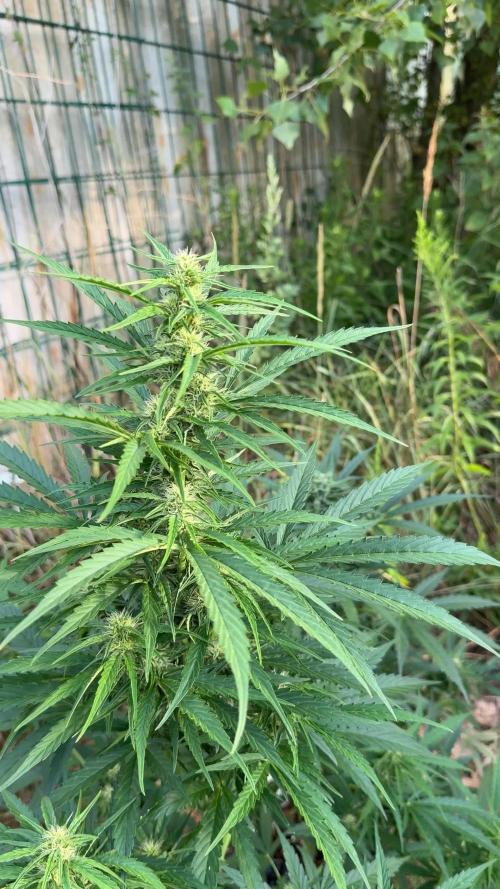
Week 9 | Godfather OG She's the slowest of the outdoor lineup this season, and at this stage that's just how this one's running. Height crept from 100cm to 105cm — vertical growth has effectively stopped and flower development is taking over. Looking at the main cola, bud sites are stacking along the stem with white pistils pushing out on every node, and the lateral branches are following the same pattern. The structure is there, she's just building on her own timeline. Nutrient stack unchanged from last week: CANNA Aqua Flores A+B 3ml/l each, Plagron Green Sensation 0.5ml/l, CalMag Agent 0.9ml/l, Aptus Regulator 0.1ml/l. pH 6.2, EC stepped up slightly to 1.4 mS/cm. Watering holding at 2L per plant per 24h. Still in the 5L pot. Conditions: 25°C day, 18°C night, humidity 60%. Light schedule now down to 16h as summer starts pulling back — the days shortening is doing its job. No deficiencies, no stress signs, just a slow and steady build. She'll get there on her own terms. Updates every Sunday. Stay tuned.
Likes
14
Share
@Lazuli
Follow
Week 15 still white pistils some turn brown cant wait to cut it down Fed ripen for 2 days now
Likes
8
Share
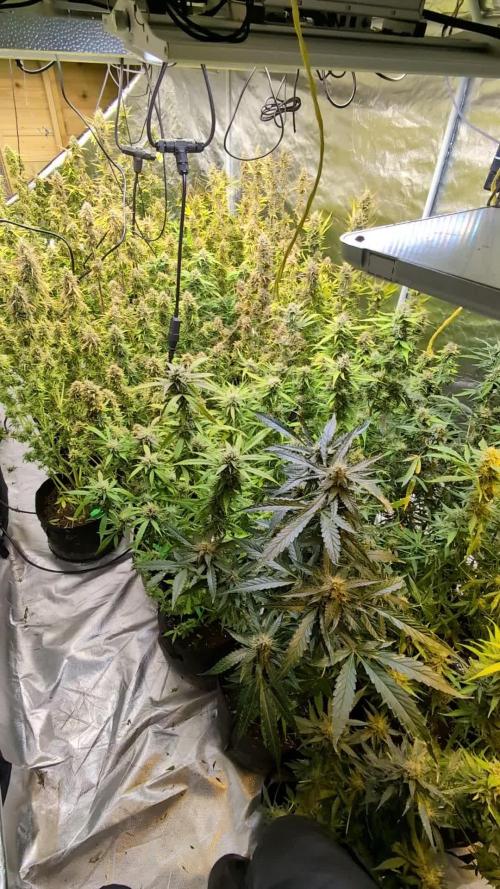
28/04/2021 (Day 43) Se realizo un nuevo cambio de solución, las plantas ya están tirando pelos y los leds están al 80%, se observo un gran crecimiento radicular y las paredes del tallo son increíblemente gruesas y duras. 03/05/2021 (Day 48) Las plantas vienen con un crecimiento optimo pero la flora se está tardando demasiado en hacerse presente, se estima que es debido al estrés que tuvo en semana 3 de vege produjo un retraso de algunos días. Esta semana se incorpora Safe Roots al sistema con la finalidad de que deje la solución lo mas limpia posible. También se realizaron bastantes defoliaciones ya que no existía penetracion de luz teniendo en cuenta el tamaño que están ocupando (85% del espacio de cultivo a 30/35 cm de altura) 05/05/2021 (Day 50) Se realizo un nuevo cambio de solución, esta vez utilizando safe roots para limpiar todo el sistema hidroponico. 600w de Citizen a 30cm en 160x80 y la plantas parecieran que si les doy mas luz van a usarla, es increíble la tolerancia a la alta intensidad de ppfd que tienen, gracias a esto logramos subsanar esa semana de raíces marrones. La temperatura bajo drásticamente y nos dejó el indoor en unos 22 grados, donde todo marcha perfecto.
Likes
44
Share
@Roberts
Follow
Bubba Kush Mintz Autoflower is doing great. I just did the first solution change on her today. I also did some heavy lst training to prepare her. Everything is going great. Hopefully she takes to the blooming nutrition great 🤞🏻. Thank you Aeque Genetics, Spider Farmer, and Athena. 🤜🏻🤛🏻🌱🌱🌱 Thank you grow diaries community for the 👇likes👇, follows, comments, and subscriptions on my YouTube channel👇. ❄️🌱🍻 Happy Growing 🌱🌱🌱 https://youtube.com/channel/UCAhN7yRzWLpcaRHhMIQ7X4g
Likes
38
Share
Gracias al equipo de Anesia Seeds, Marshydro y XpertNutrients sin ellos esto no seria posible. 💐🍁 Purple Lobster: Con un 34% de THC, Purple Lobster no es ninguna broma. Cada calada es una explosión de arándanos, caramelo y sabor afrutado que hará que tus papilas gustativas surfeen sobre las olas del sabor. Es como sumergirse en una piscina de las vibraciones más frías y sabrosas que puedas imaginar. Puede que en Maine se haga bien la langosta, pero en Anesia Seeds hacemos cannabis como nadie. La Blue Lobster ya causó sensación con sus tentadores terpenos y su atractivo en bolsa que se sale de lo común. Ahora, mézclala con el dulce y jugoso aroma afrutado y las notas mentoladas de Planet Red, y tendrás Purple Lobster , una variedad que no sólo se fuma, sino que es toda una experiencia. 🚀 Consigue aqui tus semillas: 💡FC6500: Eficiencia líder en el mercado: la lámpara de cultivo LED FC-E6500, que ostenta un estatus líder en el mercado, es una solución rentable con un PPE de 2,8 µmol/J y un rendimiento máximo de 2,5 g/vatio. Ofrece un PPF alto de 2026 umol/S y es adecuada para una cobertura de vegetación de 1,50 m x 1,50 m y una cobertura de flores de 1,20 m x 1,20 m. Iluminación versátil y uniforme. https://marshydro.eu/products/mars-hydro-fc-e-6500-730w-commercial-led-grow-light/?gad_source=1&gclid=Cj0KCQjw1qO0BhDwARIsANfnkv9IIrYSbmJqz8PqpJOIyWwJfp5bc3SGJgUV68USLQ4tjmXDYwoBuAsaAue3EALw_wcB 🚥 MarsHydro ADLITE UV/IR/RED: Para lograr un crecimiento óptimo de las plantas y maximizar los rendimientos es un arte simple que depende en gran medida de las condiciones ambientales adecuadas. Reconociendo las limitaciones de la iluminación natural y las soluciones de iluminación tradicionales para satisfacer estas necesidades únicas, lanzamos ADLITE. Estas luces especiales UV, IR y roja están diseñadas para llenar áreas del espectro, proporcionando las altas longitudes de onda que las plantas necesitan para un crecimiento y desarrollo óptimos. 🚀 Consigue aqui tu Adlite: https://marshydro.eu/collections/adlite-supplemental-lights/ 🏠 : Marshydro 1.50 x 1.50 x 1.80, carpa 100% estanca con ventanas laterales para llegar a todos los lugares durante el grow https://marshydro.eu/products/diy-150x150x200cm-grow-tent-kit 🌬️💨 Marshydro 6inch + filtro carbon para evitar olores indeseables. https://marshydro.eu/products/ifresh-smart-6inch-filter-kits/ 🍣🍦🌴 Xpert Nutrients es una empresa especializada en la producción y comercialización de fertilizantes líquidos y tierras, que garantizan excelentes cosechas y un crecimiento activo para sus plantas durante todas las fases de cultivo. Consigue aqui tus Nutrientes: https://xpertnutrients.com/es/shop 📆 Semana 14: Última semana de lavado de raices antes de cosechar esta maravilla, ha quedado una planta con unos cogollos escarchados y muy prensados, su dulce aroma te taladra el cerebro .
Likes
16
Share
@Naujas
Follow
I changed the lamp to 50 w :D because my growing box is only 0.16m. it's a really economical grow box, we'll see who gets it:) I think it would be great to reach 40 gr :)
Likes
27
Share
Ladies and Gentlemen we are back!! This project started last Sunday an Germination week was a success for these Purple punch’s an Forbiddin Runtz from Fastbuds 😍! I went with my paper towel method, sprayed down paper towel with pure water, folded it up inside sandwich bag un seeled in a dark cupboard. Checked everyday to make sure paper towel was still moist and on 3rd day we had all 6 pop open! I planted them Wednesday and all 6 popped up in soil on Friday in my Ac Infinity pots using Fox Farms Happy Frog soil! Tomorrow we will give them a small dose of nutrients, will be doing nutes on Monday, Wednesday and Fridays only rest get pure water! Well y’all let’s have another great week , keep them eyes peeled for next weeks photos an pics !!
Likes
7
Share
@Tiozin
Follow
Hi! The plants received a major defoliation on its 21 days from switching to 12/12. This action aim to give more light to the lower buds and focus on bud growing instead of fan leaves production. I also adjusted the scrog net to the canopy after defoliation. The leaves was dropped on the same soil bed (law of return). The light panel was fixed to 60cm far from the canopy and it’s now at its max potency (240W). Providing 900PPFD to the highest point of the canopy, making 38DLI. Temp and humidity remains the same, that’s a risk since humidity is pretty high in my city. 60-70% rH, 27-40°C. Let’s watch some bud grow from now on, I’m not planning big turning points anymore, just letting it grow. That’s it :)
Likes
4
Share
This Week i let them just continue to grow out of the LST. Last Day of the Week i cut down all the lower branches and defuliated the leaves. First Week of Flower and the Plant shows some nice female Flower-pistols. This Week i started with the Flower Feeding, i gave her about 4 tsp Seabird Guano as Topdress Feeding, it got a NPK of 7-4-5 so not idial for Flower but i guess Perfect for Streching-phase. Please Let me Know if you do Lollipop your Autoflowers ?? i was pretty unsure if i should do it but i was afraid that if i didn't do it it would cause problems cause of the ventilation. Hope you like the Grow so far !
Likes
13
Share
Esta semana ha ido muy bien. Su color es muy verde a pesar de la poca cantidad de nitrógeno aportado y lleva un crecimiento muy fuerte a sus flores que ya estan bañándose en tricomas con ese delicioso olor a goma de mascar rosa. Es muy visible el trabajo de Bud Booster sumado a Bud Candy que estan dando un increíble aporte de volumen a sus cogollos. Por suerte no tuve que usar agua de grifo para esta planta que aún está siendo alimentada con agua de lluvia. Irie!
Likes
21
Share
Thank you. Growing cannabis is an art that seems to evolve as you learn it. While it may only take a little knowledge to get started, It seems that this may take a life-time to perfect (doubt I'll ever make that category, but I will certainly try). So thank-you to the community that Shares, Comments, Follows, and Likes. Your efforts in any of these actions make these journals a worth-while and perfect way for us all to learn. I personally appreciate it. Also a huge Thanks has to go out to Grow Diaries for making this community even possible. Your efforts to supply the data storage alone is more than enough, but you the fact that you dont stop there and constantly try to improve the experience even more makes this my favorite community to to share on. And then lastly, but certainly not least, a heartfelt Thank-you to Fast Buds for selecting me as 2nd place in a photo contest and making these seeds available, I'll try my best to honor the gift and opportunity to grow these. Your sponsorship in keeping the community active here is an in-valuable learning tool of its own. And then your branding/research helps give me confidence in knowing that I am working with great genetics before I even start my grow. ---------------------------- Germination Start 2/13/24 to 2/18/24 2/19 to 2/25 Veg Days 1 to 7 Week 0 to 1 Germination took 6 days from dropping in water to transplanting into 1 gallon pots. 29hours in a glass of 6.3ph room temp RO water. Something I would only attempt if they were both floating. They were,so leaving them that long they were able to crack open. I then placed both in paper towels wet with the glass water and pasted to the sides of the glass for 3 days (1 day too long in retrospect). I placed in rapid rooter pods and closed with toothpick tips. They popped out from the pods 1 day later but I gave them 2 days before transplant. Video: Incubator water level is key for rapid rooter pods to wick properly during incubation. Transplant to 1 gal pots: I am using a 50/50, 50%perlite/50%soil with a .5lb of dolomite lime and a .5ml of flora micro added to .5 gallon of RO water (Im mixing 2 gallons of soil total so the water to soil ratio is 1/4 of the total medium volume) to achieve a soil tested ph of 6.4. I am using a 50/50 soil/perlite mix because I plan to use these in auto pots. I also used about 1 cup of the same soil mix water to pour around the plant after transplant; you can see how the perlite rises to the top where I did this. I sprayed two domes and covered - I plan to leave covered for the first week. Feed: I kept them under the domes and sprayed every day that I didnt feed them, to keep humidity up while I let them find water in the soil. By the end of the week I took the domes off and took pictures. Feed this week was another 1 cup of 6.3ph water 5 days after transplant. Feed plan next week will increase the amount to 2 cups of plain-no-nute water with about 4 days between feeds. I want to see the water run through so if I need to use more than 2 cups I will. The idea is to water deep and through, but then make them search for more before the next feed, hopefully spreading the roots out while doing it. Veg Plan: I plan on 8 colas for each plant. So that will be 3 topping days and a total of 7 cuts. I will want to cut the first time on day 21 if I have 5+ nodes. I will transfer to 5 gallon auto pots with-in 1 week of the first topping. Once I have 3 nodes of new growth past the first topping, I will top those two branches to the first node again. (that's 3 cuts total by this point) Then, after 3 new nodes of growth after that, I will do a last topping on the 4 branches. (4 new cuts added to make a total of 7 cuts and 8 colas) I will train the branches using LST/HST with tie downs as soon as I can after the first topping day to help maintain the branches growing where I want them to. I will also introduce an adjustable tomato ring after they have settled into the 5 gallon forever pots to provide support and mobility Hopefully all goes well, and I will have 1 to 2 weeks of growth before flip after week 8. I think it sounds more ambitious than it really is, but if you follow this journal, we will see together.
Likes
1
Share
I start to remove few leaves and I’ll prepare her to training
Likes
9
Share
@Fatnastyz
Follow
2-25 Did a full water with run off. Gave 1/4 nutes made 2 gallons of water. PH 6.2. Ppm 580 Silica 1.5 ml Micro 4 ml went a little under just to be safe. Trees none Flowers 6 ml Frosty Nugs 5 ml Blast off .075 ml Bud Strength 5 ml Run off PH was 5.8 Run off ppm was over 4400 Feel a big fresh water coming 😂😂😂 Sheesh 3-1 1/4 nutes, no trees. Run off ppm 950 ph 6.4 So far so good.
Likes
12
Share
Hypno Seeds knows what rules the world, so we created a strain to let everyone have their chance to try some Juicy Pussy Auto. An autoflowering cannabis cultivar that’s absolutely dripping in trichomes, potency, and flavor. It’s a Sativa-dominant strain due to its Thai Stick cross and is balanced out with some special Indica strains to give it its mellow, yet arousing effects and massive juicy yields of big hard nugs. Take a sip and enjoy! Tech Specs THC 19%-24% CBD 0.50% Flavor Orange Creamsicle, Pungent, Sweet Type 35% Indica / 65% Sativa Flowering 9 Weeks Height 120-160 Cm Effect Calming, Creative, Extra Sensual, Pleasant, Relaxation Genetics Thai Stick X Indica Strains --------------------------------------------------------------------------------------------------------------- Grow Sponsored by MARSHYDRO HIGH EFFICIENCY WHITE LED LIGHT: Newest SMD LED technology provide highest PAR/LUMEN output(743umol@18"), designed to replace a single-ended 250watt HPS; MARS HYDRO TS 1000W Plants Growing lamp makes you get 30% higher yield compare OLD blurple led lights, Max 2.0g yield per wattage (power draw) LOW ENERGY CONSUMPTION GROW LIGHTING : Consuming only 150W with 342 LEDS! It saves up to 50% energy than other led grow lights. Perfect for 2.5x2.5ft,Max coverage 3x3ft. Over 90% light energy can be absorbed by plants; higher intensity and more even coverage in a MARS HYDRO grow tent, reflective area, or by crossing over using multiple TS1000 SUNLIKE FULL SPECTRUM LED INDOOR GROWING: 660-665nm Red IR/3200-4200Knm/5200-6800Knm, infinite close to natural light, best for all plants all stages growing, rapid plant response from seed to flower and increase yield & crop quality‎ HIGH REFLECTIVE & NOISE FREE-Fanless LED GROW SYSTEM design will make your growing life easy and quiet, quickly heat dispersing material aluminum reducing light lost to aisles and walls, increase the light intensity up to 20%, allowing your plants receive more energy and without burning your plants for maximum headroom Get your own at https://www.amazon.de/dp/B07ZVFBR34
Likes
16
Share
@Chubbs
Follow
420 Fastbuds Gelato Auto Week 6 Holy guacamole are these girls ever going to go into flower. It's been six weeks now and generally we'd have flower sites or preflowers by now but so far nothing. It's been super hot with a heat wave going through my area with Temps into the high 90's. I have been still watering 2 liters of straight well water daily. All in all I'll continue to do what I have been and see how long they'll stay into veg and grow.
Likes
2
Share
67 days since April 16th, 2026 We become aware at such times of man's wonderful ability to bring seemingly unrelated elements into harmonic balance, and receive a glimpse into a world where everything exists in conscious sympathetic attunement to everything else. When we listen to a piece of music that seems to strike a beautiful chord somewhere inside us, or view a painting that simply glows with harmonic awareness well executed, we probably do not spare much time to contemplate the wonderfully intricate combination of vibrations that our sensors make it possible for us to perceive. We tend to appreciate the relationship between the parts of something by an awareness of the harmony or dissonance of the whole. This ability enables us to say "what a beautiful house!" instead of "analysis has proven that this collection of building materials exhibits certain elements of harmonic proportion." While this ability to instinctively appreciate the beauty of true harmony has an important role to play in evolution, a more analytical understanding of the laws involved can be most useful. This is especially so if we wish to create works of art where each part exists in true harmony, not only with the other part of that particular whole, but with the universe within which the creator and the created exist. Everything vibrates. From the most dense matter to the most subtle cosmic rays, everything which our senses allow our thoughts to become aware of, can be specified in terms of wavelength or frequency of vibration. These two terms define the same thing, but from different points of view. The following are the approximate wavelengths of various energy carriers: Cosmic rays 0.000,000,001 mm Gamma rays 0.000,000,1 mm X rays 0.000,500 mm Ultraviolet rays 0.003 mm Visible light 0.006 mm Infrared 0.01 mm Sound waves 1 meter Radio waves 300 meters Violet light 400 nm to 450 nm Blue light 450 nm to 500 nm Green light 500 nm to 570 nm Yellow light 570 nm to 590 nm Orange light 590 nm to 610 nm Red light 610 to 700 nm 1 nanometer (nm) = 0.000,000,1 cm = 1/10,000,000 cm If a guitar string is plucked and we hear a sound, it is not too difficult for the human mind to associate this sound with the vibration of the guitar string. With color it is quite different. It is difficult for us to conceive that the color of a substance is not an inherent property of the substance itself, but an indication picked up by our senses of that substance's ability to absorb or reflect the light which happens to be shining on it at that moment. Neither the matter nor the light is colored. What happens is that the brain learns to differentiate between the frequencies reflected or transmitted by the substance the eyes are focused on. The same thing happens with sound. When we say "Oh! Listen, they're playing my favorite song," what we really mean is: "My brain has stored within it a particular pattern of frequencies. I have compared the new information being received with this stored pattern and have deduced the answer that the two patterns are similar within certain specified tolerances." The 'pleasure' involved could have something to do with our running the pre-recorded pattern at the same time, in 'sympathy' with the new pattern as it is received. The word sympathy describes very well our ability to appreciate color and sound. It also describes the reason behind certain elements of harmony. For instance, if a substance vibrating at 100 cycles per second (tone 1) is in the proximity of another substance vibrating at 200 cycles per second (tone 2), we could perceive, if we had the right equipment, a certain sympathetic relationship between the two. We will see from this that there is a uniform doubling of the first tone seen in the second. At various points along the waves, the two are the same in amplitude. At other points, they are at opposite poles to each other. This doubled frequency has more points of similarity to the original than any other frequency except the original itself. If the equipment we had available for measuring these two frequencies was a soundboard amplifier and a pair of ears, then we would hear what would sound to us like one tone. If we had the opportunity to hear one at a time, we would hear that although they sound the same, one is higher in pitch than the other. This characteristic of 'the same but different in pitch', musicians have called the octave. Any two tones produced where one has exactly doubled the frequency of the other is called an octave. Speaking in ratios, an octave would appear then as the ratio 2:1 or 1:2, depending on whether we are talking of an octave up or down. A single note produced by almost any instrument will contain more than one wavelength or frequency. It will have a dominant frequency, the wavelength of which we would call the note's 'fundamental' or 1st harmonic. It will also have a varying number of upper harmonics, gradually fading in intensity into infinity or silence. Natural harmonics always have the same pattern of intervals between them. The interval between the 1st and 2nd harmonic is a perfect octave; between the 2nd and 3rd a perfect fifth; between the 3rd and 4th a perfect 4th; and so on, the intervals becoming smaller and smaller until they lose any relationship with the western 12 tone scale as it exists at the moment. Just as an octave has certain elements of sympathy with its fundamental, so some intervals have been noted to be more perfectly in sympathy with the fundamental than others. The ratio of the 'perfect 5th' or interval of 7 semitones, as it occurs in the harmonic series, is 3:2 or 2:3, while that of the 'perfect fourth" is 4:3 or 3:4. All the tones in the western 12 tone scale can be expressed in terms of the ratio between the upper tone and its fundamental. This would seem to be an ideal way of generating a scale from any given fundamental and several attempts have been made to do this, the Pythagorean system being probably the most well known. Although when working with a single tone instrument playing on its own, the Pythagorean formula works wonderfully well, if we had several instruments tuned this way together and asked them to play almost any western music, we would find that at times they sounded quite out of tune to each other. The lack of flexibility of the various scale systems based on the harmonic series has led to what is known as the 'tempered' scale. This uses as its primary unit of interval the ratio of the octave or 2:1. It then proceeds to divide the interval between any fundamental and its upper octave into 12 smaller intervals by applying the ratio: two to the one-twelfth power, to one (21/12:1). This equals 1.059463094, so by multiplying any frequency by this number, we will obtain the tempered semitone next up from our fundamental. We will also find that any tone twelve semitones up from any other tone, in a scale generated in this way, will have exactly double the frequency. If we took the note middle C on a piano and halved the wavelength, we would have the note C one octave above. If we halved this, we would have the C above, and so on. However, within about 6 octaves, we would find that although a 'sound' was being produced, no human ear could perceive it. If we kept on going, halving and producing upper octaves of our fundamental C, we would proceed through the infrared band, into the visible light spectrum. If we happened to be outside during the day, we would, for one octave only, see the note C with our eyes. The next octave above would already be in the ultraviolet band, and outside the eye's sensitivity range. If we can think of color as being an indication of a substance's vibratory rate or wavelength, we may begin to see a relationship that could exist between the color and sound spectrums. The logical extension of what has so far been said is that there exists a scale in the color spectrum that corresponds exactly to the scale in the sound spectrum, each color tone being an octave of the equivalent note in the sound range. This is not the end of the story but only the beginning. If we can for the moment accept that any wavelength in one band has upper and lower octave stretching out to infinity, then the next question is 'fine, but what shall we use as our fundamental? A particular color? A particular sound frequency?' The musicians among us will probably say 'A 440'. This means that the note A should vibrate at 440 Hertz, or 440 times per second. They would tell us that this is standard pitch has been adopted by most orchestras around the world; pianos are tuned to it, instruments are constructed to formulas based on it, and so to them it would probably seem the most appropriate place to begin. Some of these musicians may know of the battle that is still raging with regards to this being the standard, but few would know why A = 440 Hz was chosen except that it worked when it was set to be a suitable compromise between the many different pitches in use at the time. 432 Hz is said to be mathematically consistent with the patterns of the universe. Studies reveal that 432 Hz tuning vibrates with the universe’s golden mean PHI and unifies the properties of light, time, space, matter, gravity, and magnetism with biology, the DNA code, and consciousness. When our atoms and DNA start to resonate in harmony with the spiraling pattern of nature, our sense of connection to nature is said to be magnified. Another interesting factor to consider is that the A=432 Hz tuning correlates with the color spectrum, while the A=440 Hz is off. Audiophiles have also stated that A = 432 Hz music seems to be non-local and can fill an entire room, whereas A=440 Hz can be perceived as directional or linear in sound propagation. Once you adopt the idea that sound (or vibration in general) can have an equalizing and harmonizing effect (as well as a disturbing effect), the science of harmony can be applied to bring greater harmony into one's life or tune to specific energies. There is a form of absolute and relative harmony. Absolute harmony can, for example, be determined by the tuning of an instrument. The ancients tuned their instruments at an A of 432 Hz instead of 440 Hz - and for a good reason. There are plenty of music examples on the internet that you can listen to in order to establish the difference for yourself. Attuning the instrument to 432 Hz results in a more relaxing sound, while 440 Hz slightly tenses up the body. This is because 440 Hz is out of tune with both macro and micro cosmos. On the contrary, 432 Hz is in tune. To give an example of how this is manifested microcosmically: our breath (0,3 Hz) and our pulse (1,2 Hz) relate to the frequency of the lower octave of an A of 432 Hz (108 Hz) as 1:360 and 1:90. It is interesting to note that 432 Hz was the standard pitch of many old instruments and that it was only recently (19th and 20th century) the standard pitch was increased. This was done in order to be able to play for bigger audiences. Bigger audiences (more bodies) absorb more of the lower frequencies, so the higher pitch was more likely to “cut through”. One of the oldest instruments of the world is the bell ensemble of Yi Zeng (dated 423 BC), tuned to a standard F4 of 345 Hz, which gives an A= 432 Hz. The frequency of 345 Hz is that of the platonic year! Similarly, many old organs are tuned in A=432 as well; for example, St. Peter’s Capella Gregoriana, St. Peter’s Capella Giulia, S. Maria Maggiore in Rome. Maria Renold’s book “Intervals Scales Tones and the Concert Pitch C=128 Hz” claims conclusive evidence that 440 Hz and raising concert pitch above scientific “C” Prime=128 Hz (Concert A=432 Hz) disassociates the connection of consciousness to the body and creates anti-social conditions in humanity. The difference between concert pitch A=440 Hz and Concert A=432 Hz is only 8 cycles per second, but it is a perceptible difference of awareness in the human consciousness experience of the dream we share called existence.
Likes
10
Share
Diese Woche ist die letzte Vegi Wochwe, denn jetzt geht es in die Blüte. Die Pflanze ist weit gjut gewachsen und die Löcher, die der abgebrochene Trieb verursacht hat, sind nahezu dicht. Die ganze Vegi Phase hägtte ohne diese Rückschläge 2 Wochen kürzer sein können. Näheres dazu in meinen Vegi Woche 7 Video auf Youtube: https://youtu.be/iN1EFI8zq6s Link zur Lampe (Mars Hydro FC3000-Evo: https://marshydro.eu/products/mars-hydro-smart-fc-3000-evo/?ref=docgreenthumb Gutscheincode für Mars Hydro (3% Rabatt): docgreenthumb
Likes
8
Share
@Drtomb
Follow
Start of Week 3 There was 5 inches of growth over the last 7 days. It is a total of 25inches now, when I started flower it was 16 inches. My guess is that it will get to around 32" I have two sections of plants growing from the same feeding resivour. For the first time ever I've decided to do a mid grow flush. I ran through 1-2gal of water on each 5 gal bucket. I use only perlite as medium so I figured that I wouldn't need much to flush. It all drained back to the main resivour and I disposed of it. I ran a 24hr cycle of straight PHed tallboy filtered tap water (160ppm) and then drained that again (340ppm). I refilled the resivour with fresh nutes and PHed again (1100ppm)
Likes
57
Share
Hey all 🤗. This week they both continued to develop very well. The Small is sooooo good 😃. I Love Pheno 1 . Flowering day 35 Today the tent was cleaned, the humidifier refilled and both plants sprayed with Canna Cure :-). Flowering day 36 Both were poured today with 1.2 L per pot 🙂. Both were also checked for their health and pests 👍. Everything looks great 🙏🏻. Flowering day 37 Again the tent was cleaned and fresh osmosis water was filled into canisters. Flowering day 38 Today 1.5 l per pot was poured so that some drainage comes out again. therefor two days are not poured 😋. Flowering day 39 The tent was cleaned, the humidifier was filled, both plants were checked for vitality and the entire electronics were checked for functionality. Flowering day 40 Today both were sprayed again with Canna Cure and checked. Flowering day 41 We have reached the last day of this week and again 1.2 L were poured per pot and the tent was cleaned 👍. I hope you have a lot of fun with the new update, and let it grow 🍀🙏🏻 You can buy this Strain at : https://sweetseeds.es/de/red-mandarine-f1-fast-version/ Type: Red Mandarine F1 Fast Version ☝️🏼 Genetics: Red Poison Auto®️ (SWS39) X Tangie (California Orange x Hybrid Skunk) 👍 Vega lamp: 2 x Todogrow Led Quantum Board 100 W 💡 Bloom Lamp : 2 x Todogrow Led Cxb 3590 COB 3500 K 205W 💡💡☝️🏼 Soil : Canna Coco Professional + ☝️🏼 Fertilizer: Green House Powder Feeding ☝️🏼🌱 Water: Osmosis water mixed with normal water (24 hours stale that the chlorine evaporates) to 0.2 EC. Add Cal / Mag to 0.4 Ec Ph with Organic Ph - to 5.5 - 5.8 .