Likes
Comments
Share
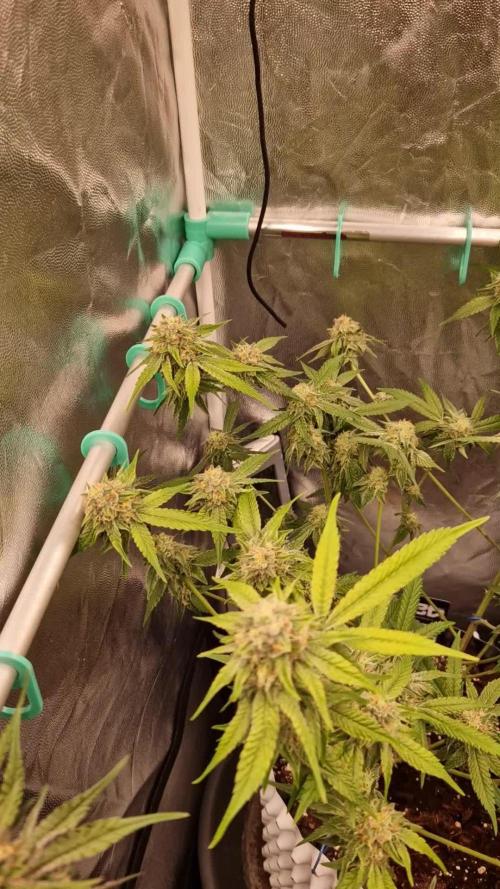
Servus Moin! Die Bluzcotti Vaders Cut riecht wieder extrem BlueSherb-Soapy, Citrus, Gassy... einfach genial. Die Buds werden langsam auch deutlich härter und fangen an Richtung Ausreifung zu gehen. Man sieht sogar wie sie langsam grau-bläulich werden. Sie wurde das letzte mal jetzt entlaubt und ist bereit für die letzten 3-4 Wochen.
Likes
59
Share
@Rap_a_cap
Follow
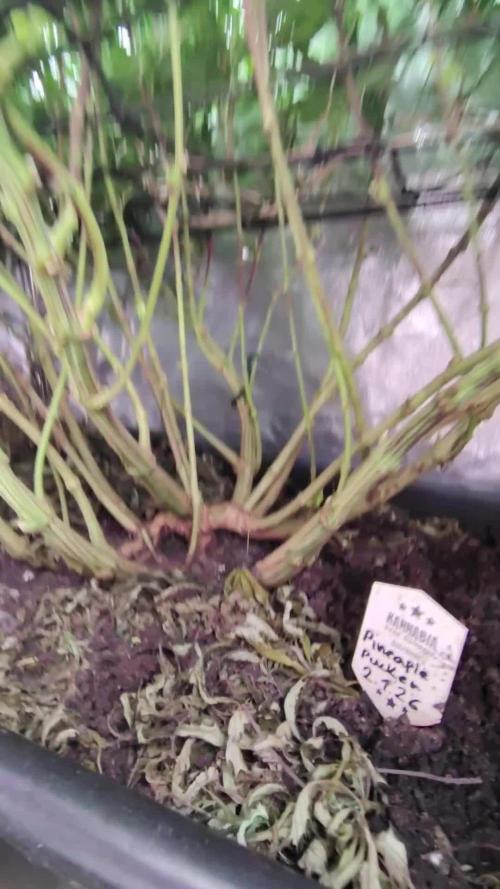
16.2 inches/week Usual summer week here in the south, every day above 86 ° F (max 100 ° F) Pineapple is beast, can tolerate everything and is grown almost 2 inches per day drinking 2 gallons per day of spring water showing only few signs of heat stress. She's in full stretch and had fill every spaces with her thick branches . I fed her half the recommended dose of Biobizz Grow 'cause is too hot and don't want to burn her. I think we are 10-14 days before flowering. I covered her with a PVC net in order to give her a little shield from the sun and give me more privacy ;-)
Likes
8
Share
Good week of growth. Bud sites are starting to come together. Brooke is still really close to light, will see what happens. Bent branches are doing well. 10-2 Buds are starting to look like buds. Got first good photos of forming colas.
Likes
32
Share
@Chucky324
Follow
Its supper time I'll be back. Hello. This week went smooth. It's powdery mildew season outside, my zucchini, squash, cucumbers and pumpkin, all have it. I spray everything with half an ounce of apple cider vinegar to1 quart of water. I've been trying to keep the humidity down and be proactive about it. Treat the root zone with cal mag. Spray something on the leaves (not fungicide). The buds are fattening up. Still a few weeks to go. I flower for 10 weeks, and flush for the last 14 days. I'll add more later. Have Fun and Chuckles! I mentioned in week 3 I had the chance to take some clones from 3 stressed plants. Barneys Farm Pink Kush made it through, but the Godfather Kush OG and the Tom Ford Pink Kush didn't. Luckily when I phoned him he said " Yea come over, I want to get your opinion of my plants anyway". So I'll keep ya updated. Chuck. Wow, he gave me a small plant of Tom Ford Pink Kush. A bit of welling and dealing. And I got 1 cutting of the Godfather Kush OG. So one more try at that one. It was a hot and windy day here 29 c. in the greenhouse. Chuck. It's monday and I change my nutriant water, and put time into the plants. Pruning, trimming and training. With experance you can see what needs to be done to get what you want. Chuck.
Likes
65
Share
@Dendegrow
Follow
The colors of autumn are in full display 🍂 – deep purples, fiery reds, golden yellows, and even shades of black. The garden is alive with vibrant beauty, a final burst of energy as the cycle nears its end 🌿✨. The plants are absolutely stunning, their buds sparkling with trichomes, and the aroma is mesmerizing – a sweet and fruity scent reminiscent of ripe cherries filling the air 🌺🍒. Week 7 is behind us, and while I managed to increase the nutrients again, it came a bit too late. The result? Potency is reaching its peak, but the potential for quantity has passed. Still, the plants stand proud, exuding beauty, sweetness, and character in every bud. As the holidays approach, so does the conclusion of this grow 🎄🌺. By the end of the week, it’ll be time to bring this chapter to a close – a moment to celebrate the journey, admire the elegance of these plants, and look forward to the harvest. Wishing you all a wonderful holiday season and a fantastic start to the new year 🎉✨. Stay tuned for the final updates and the results of this colorful and aromatic adventure 🌿📸. --- Die Farben des Herbstes zeigen sich in voller Pracht 🍂 – tiefes Lila, feuriges Rot, goldenes Gelb und sogar Schwarz. Der Garten leuchtet in seiner ganzen Schönheit, ein letzter Energieschub, bevor der Zyklus zu Ende geht 🌿✨. Die Pflanzen sind einfach atemberaubend – ihre Buds glitzern vor Trichomen, und der Duft ist unwiderstehlich: ein süß-fruchtiges Aroma, das an reife Kirschen erinnert und die Luft erfüllt 🌺🍒. Woche 7 liegt hinter uns, und ich konnte die Nährstoffe wieder anpassen, aber leider ein bisschen zu spät. Das Ergebnis? Die Potenz erreicht ihren Höhepunkt, aber die Menge ist nicht mehr zu steigern. Trotzdem stehen die Pflanzen majestätisch da und verzaubern mit ihrer Schönheit, ihrem süßen Duft und ihrem Charakter in jeder Blüte. Mit den Feiertagen vor der Tür nähert sich auch dieser Grow seinem Ende 🎄🌺. Am Ende der Woche ist es soweit – Zeit, dieses Kapitel abzuschließen, die Eleganz dieser Pflanzen zu bewundern und sich auf die Ernte zu freuen. Ich wünsche euch allen eine wunderschöne Weihnachtszeit und einen großartigen Start ins neue Jahr 🎉✨. Bleibt dran für die letzten Updates und das Ergebnis dieser farbenfrohen und aromatischen Reise 🌿📸.
Likes
10
Share
@TeesTrees
Follow
Day 71 - I watered her with nutrients, PH was at 5.3. Plant looks very healthy. I think i need to get some stucks to support stem. Day 72 - Checked in the morning properly, the plants looks fine checked for hermies couldn't see anything. Day 73 - I checked her today again nothing that can ruin the whole crop. She was watered with nutrients today at PH 5.9. I got new lights today spider farmer sf2000, this looks amazing inside there. We have also done a bit of light Defoliating so the buds have more nutrients. Day 74 - The plant is fine but the temperature is very high after getting new lights its on 34°c I've order a new fan so i can have inlet and outlet to try cool it down. Day 75 - The plant looks a bit sore thats because i should have watered her earlier. I've given the plant 5.5PH water with nutrients. Day 76 - So once again i didn't take a picture today.  I was very busy and didn't have time. I checked the plants as soon as i woke up and they looked well and healthy. Day 77 - Plants looks well would like it o look like its gonna give me a half decent yield but i don't know let's see how it goes. I also watered her today with nutrients and the water Ph was at 5.5.
Likes
6
Share
@Ninjabuds
Follow
It's a nice change of pace to have these warmer temperatures, even if it's not quite spring yet. Low 40s during the day is a lot more comfortable than what we've been dealing with lately. Hopefully, this is a sign that spring's around the corner. It's crazy how much my permanent marker plants have grown! They've really taken off. One's got these super cool purple stems, and the other's covered in buds – it's gonna be beautiful when they bloom.
Likes
4
Share
Las puntas de varias hojas de la rainbow se han enrolado hacia arriba levemente, esta semana he regado con agua solamente, mañana pondré la mitad de la dosis de fertilizante. Gorilla ghost va increíblemente bien, los pistilos empezaron a madurar, esperando con ansias el día de la cosecha, pero sin apurarme!
Likes
2
Share
Seit 2 tagen gibt es nur noch Wasser aus dem Wasser Hahn Ohne Chlor aber mit Sauerstoff mit PH 7,8 Wasser aus Rohr Leitungen enthält weniger Sauerstoff als beispielsweise Regenwasser. Ich habe den Ph wert aber seit 3 Wochen nicht gemessen Weil ich vermutlich einen zu niedrigen PH Wert hatte durch meine Dünger Mischung BioBiZz wie oben angegeben. Ich habe noch nie PH up benutzt oder benötigt bis jetzt.
Likes
61
Share
Welcome to the start of week 5 for Queen Citronella. She has developed a thick stem and really short internodal spacing. She responds willfully to LST. Day 29.5: Repotted. Look at those roots!! This is a special plant. Day 30: There was brief transplant shock as I forgot to flush the medium to correct PH... she's bounced back today. Queen Citronella has almost outgrown Karen who is 2 weeks older. Day 31: Happy one month birthday your majesty! Swelling in every direction. Starting to gain height. Day 32: I've noted a sudden uptick in thirst. In an unrelated note I have added a little 15w LED above her at about 10cm. I doubt it'll make any noticable difference but it's in there anyway as I use it for photos, so it may as well be on. Day 32.5: Have removed approx 20 fan leaves and performed further LST. Day 33: Look how fast Queen Citronella responds to LST and defoliation. She has gained 1cm in the last 24 hours and now stands at 25cm. Day 34: 26cm. Day 34.5: Fertigated. Added pot risers and adjusted pot. Performed further LST on lower nodes. Performed HST on some higher nodes just for practice. Day 34.75: Fertigated 4l Day 35: She didn't gain any height at all that I can tell, but she has put on a lot of leaf growth in the last 24h. So here we are at the end of week 5, and Queen Citronella is starting to take her regal form. Slightly alarmed by the yellowing new growth but her growth rate has stepped up again so it may be just normal. I'll keep an eye on it. Once I can take enough clones I'll cut her back a lot. For now she can grow as much as she wants. Citronella now smells citrusy, if you brush against her it's quite strong. Defoliated approx 6 fan leaves.
Likes
4
Share
Big week this week! Fed the plants about 40gal of compost (5gal worm casting and 35gal lobster compost) plus all the amendments listed above in those rough ratios. I cut down all the cover crop and removed my straw mulch layer. I then added about 2.5gal of my feed to each of my pots. Covered in the cut down cover crop and straw and watered everything in very well. I'm guessing it'll take only 3 weeks for the plants roots to completely take over what I added. Additionally this is the first week I sprayed BT. The OG kush are finishing up their second week of flower and the stretch has diminished but the buds are setting in! Time to spray these girls down! The early lemon berry and grandpas stash are close behind. I'd say they are about 1 week behind the kushes so they're just starting the second week. The stretch for the early lemon berry is very strong. It's all tied up in the trellis net by now so it has been diminished somewhat The grandpas stash is barely stretching....gonna be some massive fat buds. Hopefully they don't mold!
Likes
3
Share
Easy to grow. Only issue I ran into was the other strain being a male. If I grew this strain alone I would’ve filled out the tent with just this strain the yield would’ve reflected that. Keep in mind if the other plant didn’t get the chop this yield would be almost double. I will grow this cut again.
Likes
6
Share
WE OUT HERE DOIN DRUGS
Likes
14
Share
@Canna96
Follow
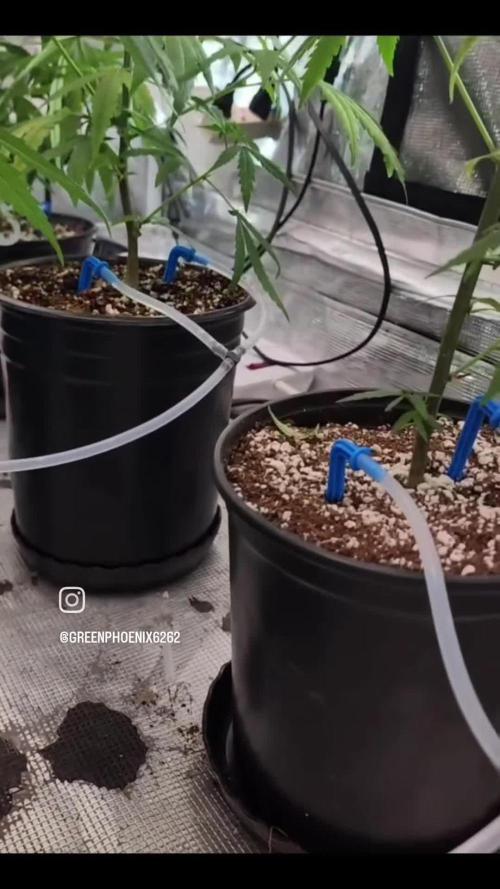
Hey now, hope everyone has been well. Super excited football season is finally here so things are about to get busy. I went out of town for 4 days and the plants struggled a little bit with the PH getting slightly too high before I returned. I also came back to see that some type of insect was munching away on the lower leaves of my Sundae Driver which I sprayed the plant and coco with neem oil, but hopefully they didnt do much damage before I can get them under control I have never experienced insect problems indoors, likely because I grow in Coco and not Soil. However, I left a 5 gallon airpot full of coco from a previous grow outside for a couple weeks by mistake, and pretty sure bugs got into. I wont make that rookie mistake again. Anyways the rest of the ladies are looking pretty good, They are almost getting what I consider a full dose of nutrients, even though it half of the manufacturers recommended dosage. I am feeding all Gen Hydro cal mag, Armor Si, and maxi grow. I also add some food grade hydrogen peroxide to keep the reservoir fresh for around 10 days or so but I clean it once a week. I did get all the ladies transplanted from solo cups to airpots on day 16, and it took 24 hours or so for them to recover from the transplant and start growing again. I am running 3 of the 3.4 gallon, and 2 of the 5.4 gallon just because that is what I had available. I hopefully top them all sometime this week for the first time, as soon as the roots are a little stronger. I let them grow to 7 nodes or so before I top them and make sure they're growing fast. Hopefully I can still mainline the Sundae Driver, she looks healthy other than those two leaves chomped off. All the plants are on their 5th nodes, except for the Green Crack 2.0 which is only on her 4th node. We got another heat wave coming through my region that I am not too excited about but at least its earlly in the game and I dont need to crank this light up yet. I am only running it at 30% and its putting off plenty to keep this ladies happy. Hoping to get a topping done this week, then another one next week, and be ready to flip to flower by week 7 or so. Thanks for stopping by, Stay Safe and Blaze On!!! 💪 Website: https://medicgrow.com/ https://growdiaries.com/grower/medicgrowled
Likes
33
Share
@DrDuhboto
Follow
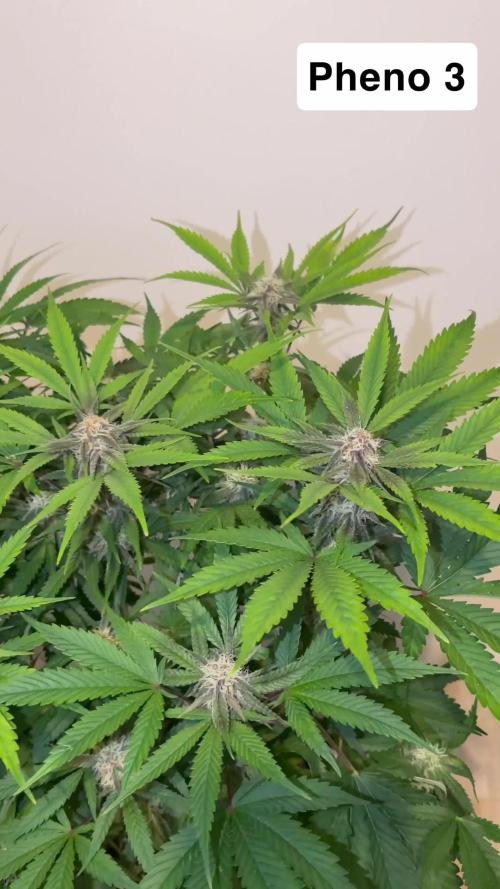
Plants are all doing well and growing fast. The lights are still a bit strong for these guys so I moved them lights up a bit. Fed with fairly strong veg mix, thena supplement and water only feed once they had dried, and then a strongv eg feed again at the end of the week. The plants are burning through Nitrogen very fast. The canopy is almost completely filled in. Once every hole has a node or two I will begin the flip into preflower. I defoliated heavily to increase the amount of light getting to the center nodes. By two days later the plants had bushed out quite a bit. I think one more week before Flip should suffice. The Maui clone has quite a bit more nodes than the seeds. But the seed plants have much sturdier and healthier looking structures. I am excited to see if any other phenos express themselves. The Maui clone has been a great version in previous grows,
Likes
52
Share
Its time to prepare for war. *Blows bagpipe* FISH SH!T THE ORGANIC SOIL CONDITIONER (used twice before and always noticed instantly) Fish Shit is a living product! It provides a complex Microbial profile that includes thousands of different species of bacteria, fungi, and protozoa. This profile is closer to a natural ecosystem than anything you will find on the market. Fish Shit helps release essential oils and terpenes which contribute to the building of a myriad of flavonoids. Flavanoids play a key role in the development of the most potent aromas and tasteful flavors of a plant and its fruit. Fish Shit contains beneficial microorganisms that help plants maximize nutrient uptake. It does this by transforming nutrients into more usable forms and keeping these nutrients in the soil longer. During photosynthesis plants naturally produce exudates (chemicals that are secreted through their roots). Through these exudates, plants can attract the types of good bacteria that are beneficial to them at different points in their growing cycle. These good bacteria cover the roots and act as a barrier to the invasion of disease-causing organisms that may harm the plant. What Are Enzymes? Before we dive headfirst into how, exactly, enzymes can benefit cannabis plants, it helps to understand a little about what these microscopic proteins do. Essentially, enzymes facilitate chemical reactions. They do so by binding with a substrate and forming or breaking molecular bonds. In this context, the substrate is the molecule upon which an enzyme acts to boost the efficiency of a reaction. •substrate /sŭb′strāt″/ •noun •The material or substance on which an enzyme acts. A surface on which an organism grows or is attached. An underlying layer; a substratum. Enzymes are proteins with complex 3D shapes that feature regions called active sites. When the substrate binds to these active sites, it forms an enzyme-substrate complex that causes a chemical reaction to take place, temporarily changing the structure of the enzyme and ultimately causing molecules to either come together or break apart. As a result, molecular products are released, and the enzyme returns to its original shape. Specific enzymes are capable of binding with certain substrates, as the substrate fits into the active site more or less via a lock-and-key principle. Although, new research suggests a more accurate theory of "induced fit", in which enzymes and substrates undergo structural changes to facilitate the reaction. If you take the human body as an example, we have an abundance of enzymes in our saliva and digestive system. These molecules bind with substrates in these regions (food particles), working to break down the food we eat into usable parts before converting them to energy. Enzymes in cannabis work in a similar way to the example highlighted above. Typically, enzymes occur in soil naturally, but if your soil mix is lacking organic material, or you're growing hydroponically, then adding enzymes directly to the substrate is crucial. By using them in cannabis growing, enzymes not only help break down essential nutrients into smaller, more readily available pieces, but they also support the digestion of dead root cells, clearing a direct path for nutrients. Overall, enzymes make it easier for your cannabis plants to absorb all the elements they need to reach their full potential. For growers, a plant that reaches its full potential means a bucketload of juicy buds come harvest. This is essential if you want to reuse a pot with old systems left over like mine. Common plant enzymes include: •Cellulase •Xylanase •Beta-glucosidase •Hemicellulase •Amidase Amino acids are a crucial, yet basic unit of protein, and they contain an amino group and a carboxylic group. They play an extensive role in the gene expression process, which includes an adjustment of protein functions that facilitate messenger RNA Nitrogen, phosphorus, and potassium are the three main pillars of nutrient solutions and fertilizers, but there are countless other nutrients that your cannabis plants need to produce the best possible harvest. Amino acids are one of them. You may have noticed that amino acids get a lot of attention from bodybuilders and other athletes. That’s because they play a key role in the synthesis of protein, which, as you probably know, is super important for sports recovery and muscle growth. Amino acids are the building blocks of protein and the foundation of both plant and animal life. But what do amino acids do for cannabis? WHY IS PROTEIN IMPORTANT FOR CANNABIS? Just like proteins are important for the human body, they are equally important for the growth and development of plants. For example, proteins help plants: •Facilitate the growth of intracellular plant structures •Promote energy generation •Stimulate metabolic processes •Facilitate the absorption and transportation of nutrients So, where do plants get these vital proteins from? Well, unlike humans, plants can’t source proteins or amino acids from other organisms. Instead, they need to create their own amino acids, and then use these to build protein. That's why gardeners, much like athletes, go wild for amino acid supplements. Amino acids help plants by… • Increasing their production of chlorophyll, which ultimately improves their ability to photosynthesize • Serving as an easily absorbable form of nitrogen • Stimulating the synthesis of key vitamins • Improving their resistance to pests and diseases • Boosting the strength of their cells Amino acids also serve as the precursors to auxins, a group of plant hormones produced in the meristems—the apex of the stems where new leaves and stems are born. Auxins play a key role in the plant, activating genes for plant growth and development by triggering a multitude of vital plant functions. In other words, they determine what its size and architecture will look like. Auxins influence the development of branches, flowers, and roots, and even help to regulate the photoperiod response of the plant. Some amino acids, like cysteine, also work together with antioxidants like glutathione to help cannabis plants deal with oxidative stress, which can be caused by high-intensity lighting, some nutrient solutions, and high levels of CO₂. Unlike humans, plants can synthesize all the amino acids they need to survive and develop properly. Unfortunately, however, amino acid synthesis is a really high-energy process, and plants may struggle to produce enough amino acids when exposed to stress. WHAT FACTORS AFFECT A PLANT’S ABILITY TO SYNTHESISE AMINO ACIDS? Any kind of stress can affect a plant’s ability to produce enough amino acids. This includes: • Drought • Temperature extremes • Poor soil health • Pests • Diseases • Poor lighting • Lack of space • Poor root health WHAT DOES ALL OF THIS MEAN FOR WEED PLANTS? If you want to push your plants to their extreme in terms of floral growth and resin production, you should look into amino acid fertilizers. By making amino acids readily available to your plants, they’ll be able to use crucial energy to grow and bloom, rather than focusing on synthesizing amino acids themselves. Game of Inches, this is another Plants can absorb amino acids via their roots and leaves. They can also benefit from amino acids during both their vegetative and flowering phases. The fastest way for plants to absorb amino acids is via their leaves. The foliar application of amino acids is believed to improve the transportation of nutrients, increase transpiration, and boost photosynthesis. Hence, I recommend feeding your plants with foliar amino acid fertilizers. When doing so, however, carefully measure the amount of fertilizer you use, as—like with any nutrient—overfeeding can damage your plants. FOLIAR FEED AND SOIL SOAK • 1 crushed queen anne carrot • Add 2 tbsp of NPK Raw powdered water-soluble cane molasses • 20ml h2o2 • 1 crushed radish • 0.25 tsp NPK Enzymes • 0.25 tsp NPK Amino Acids • 50ml coconut water ( nature's own amniotic fluid packed with amino, enzymes ) + The sound of songbirds. Onto the predators 1250 -Green Lacewings Lacewings are extremely voracious predatory insects that feed on several pests. In adulthood, it feeds on pollen and nectar. In the larval stage, it feeds on aphids, thrips, and mealybugs at all stages of growth. It can also attack spider mites in moderate quantities. It is initially an aphid predator, but very effectively controls thrips and mealybugs infestations. It is so voracious that in the absence of prey, it will feed on its congeners. Lacewings are cannibalistic if there is no food available for them. It is therefore important to introduce them into an infestation situation, and not just preventively. •congener /kŏn′jə-nər/ •noun •A member of the same kind, class, or group. •An organism belonging to the same taxonomic genus as another organism. •A thing of the same kind as. or nearly allied to, another; specifically, in botany and zoology, a plant or an animal belonging to the same genus as another or to one nearly allied. Ideal temperature 20°C – 26°C Ideal humidity 60% – 70% Predatory stage life cycle 21 days Introduction rate 4 weeks Storage Refrigerator Use Immediately Are there any specific instructions on how to use this predator? Lacewings are available on small paper cards that you can hang to plant stems. On the cards are dozens of eggs ready to hatch. There are also sterile eggs they can feed on once they have hatched before they are ready to disperse in the foliage. It is important to use them quickly upon receipt to avoid cannibalism. If you don't use them right away, you can store the cards in the refrigerator for 24 to 48 hours to prevent the eggs from hatching too quickly. Avoid storing them for longer than this or you risk losing eggs. 1250 eggs are divided into 7.5 cards, 2500 eggs on 15 cards, and 5000 on 30 cards. The application rate is one card per square meter of growing surface. Is this predator best used for preventive or curative treatments? Lacewings are used as a curative solution. Anything else I should know? Lacewing eggs hatch approximately 24-72 hours after the cards are exposed to room temperature. When they emerge, the lacewings are just 1.5-2 mm long. They are very small so they are difficult to see. Once hatched, they will stay on the cards for a few hours and then disperse in the foliage. You quickly lose sight of them if you have not witnessed the hatching. They then live in the foliage for about 3 weeks. Often, you will see them towards the end of their larval cycle. After feeding for 3 weeks, they will triple and even quadruple in size. At that point, they are easier to see. But they remain very discreet insects, it is not abnormal not to see them. Egg carcasses left behind on the cards do not disappear after the hatching has happened. It's normal to see eggs still on the cards. Visually it is very similar before and after hatching. Also, on the boxes, there are sterile ephestia eggs which are used to feed the lacewings once hatched. Not all lacewing eggs are viable either. Only a certain percentage of lacewing eggs will hatch. Once hatched, the eggs are white. You can observe this using a magnifying glass. With, 5000 Stratiolaelaps Scimitus It is used to prevent or control thrips pupae, fungus gnats larvae, and root mealybugs in the soil. It can also be used for red mites in bird farms or hen houses. The adult is about 1 mm long and is medium brown with a beige triangle on its back. Another fun fact about them is they can survive without prey. They can eat algae and plant debris. This is why they can reproduce and stay in plants for long periods. Ideal temperature 15°C – 23°C Predatory stage life cycle 18 days Introduction rate 2 weeks Storage Room temperature Use Within one week Are there any specific instructions on how to use this predator? Sprinkle directly on the growing media. They can live in all types of substrates like potting soil, coconut fiber, rock wool, cedar mulch, etc. Stratiolaelaps establish easily so they are permanently fighting pests. One introduction is generally enough unless you have an infestation. In this case, introduce them at least twice at a 2-week interval for best results. If you grow your plants in a 100% mineral substrate, it will have to be released more often since there is less organic matter than in traditional soil. Do I need to take any specific precautions? Stratiolaelaps breed in the top layer of the soil. So it is important not to disturb them in the first days following their introduction. They don't like temperatures below 8 ° C. So be sure not to introduce them in a water-saturated or cold environment. Release them 24-48 hours after your last watering. They are very sensitive to chemical acaricides and diatomaceous earth. These methods are incompatible with their use.