


Likes
11
Share


@Budders
Follow
12/01/2021
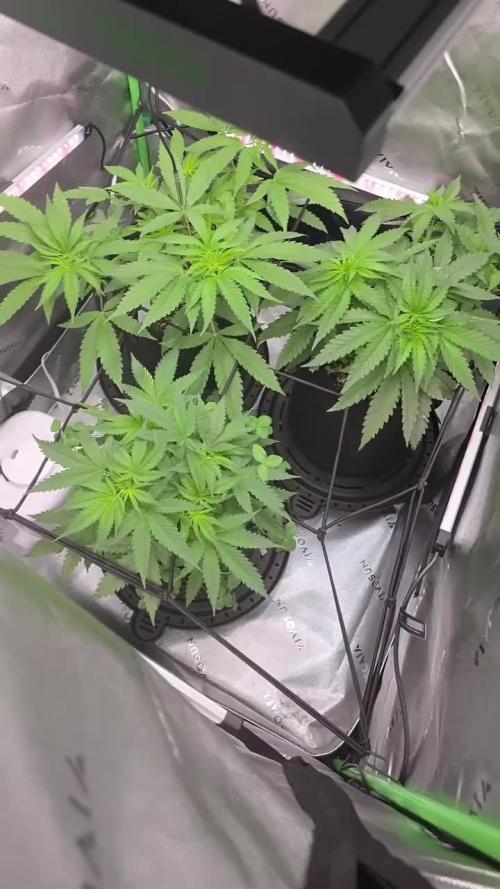
FIMed all plants a second time, and also FIMed the tips of the other main branches of all plants. They will get another dose of Recharge with their next feeding tomorrow. I will give them exactly one week to recover from this FIMing, and will flip these plants to a 12/12 light flowering schedule. These girls are supposed to have a flower period of about 45 days, but I am expecting to have to run them about 50 days or so. My goal is to get over 8 ounces of nice bud on this run.
12/02/2021
I fed two gallons of water with the nutrients listed above.
12/05/2021
I gave all the girls a second major defoliation. I plan to switch to 12/12 flower cycle this Tuesday evening.
12/06/2021
I removed a few leaves and fed two gallons of water with the nutrients listed above. These girls are doing excellent. They have responded very well to the major defoliation that they received. I will flip them to the 12/12 flower cycle in a day or two I believe.
I uploaded a couple of pictures of the strains I plan to grow in the future, which is mostly Humboldt Seed Company genetics

Likes
8
Share


@Mon_monde_onirique
Follow
Les branches de Purple shine sont assez épaisse même un peu trop, le LST est vraiment galère à faire pour l'instant je vais encore attendre un peu qu'elle se développe plus et j'envisage peu être de supercropped les 4 branches principal une fois plus développé afin de former la base(a voir les prochain jours 🤔)
Le 1/05 rempotage de Purple Shine, elle a bien colonisé son air pot 1l passage en 4L géotextile dans un supersoil composé de (lombricompost,guano verre, sang et corne de boeuf sèché, phosphate naturel, zéolite, sel Epsom+ mycorhizines) et terreau covercrop
Le 3/5 début du LST , pose de clip lst pour former les 4 branches principal, petit accident lors de la pose des clips un apex c'est bien cassé et ne tien que sur 1mm. Je fait une tentative pour essayer de le sauver mais je doute de résultat 😥.
Le 4/5 perte de l'apex accidenté 😮💨😥 ce matin la branche avait les feuilles flétrie et la tige recroqueviller, fini pour elle le sauvetage a été un échec😥.
Le 5/5 on se relève de cette déception et envisage quelques changements dans le programme pour que cette connerie deviennent profitable😉.
Nouvelle taille des apex, on passe à 6 pousse maintenant je laisse un temps de repos à purple shine avant une nouvelle taille je prévoyais 8 apex et au final j'en aurai 12😉🔥.
PS: même s'il t'arrive une couille, baisse pas les bras et relève toi, arrange toi pour que cette galère te soit profitable😉🔥
Likes
64
Share


@MadeInGermany
Follow
Hey everyone 😀.
The bush is getting heavier and heavier 😅.
Despite the bamboo sticks, they don't get a proper hold 😊.
This week the nutrients started to be reduced so that she slowly begins to use up her remaining energy before she flushes.
Until then, however, it will still take some time, and I wish you all a nice week, stay healthy 🙏🏻 and let it grow☘️
You can buy this Strain at :
https://www.barneysfarm.com
Strain :
Blue gelato 41 clone from mother (Barney's Farm)
☝️
Genetics:
Blueberry x Thin Mint Girl Scout Cookies x Sunset Sherbert
👍
Vega lamp:
2 x
Todogrow LED HLG Quantum Board 100 W ( 200 W )
💡
Flower lamp:
2x Todogrow LED CXB3590 205 W = ( 410 W )
💡 ☝️
Soil : Canna Terra Professional +
☝️
Fertilizer:
Canna Terra Vega , Canna Terra Flores , Rizotonic, Cannazym, CANNA Boost, Pk 13/14, Canna Cal / Mag, Canna Ph - Grow, Canna Ph-Bloom
☝️🌱
Water:
Osmosis water mixed with normal water (24 hours stale that the chlorine evaporates) to 0.2 EG. Add Cal / Mag to 0.4 Ec Ph with Ph - to 6.0 - 6.3
💦 💧

Likes
19
Share


@AutoDevilHQ
Follow
Just a phenomenal plant from start to finish.
For a first grow yielding 160g is just mind blowing.
Very easy to grow long veg period so windows of LST are large enough to have room for error. Lots of Defoliation needed and at its peak was drinking 6 Litres of water a day.

Processing
Likes
142
Share

@MadeInGermany
Follow
Hey everyone :-).
The last plants were also placed in the bloom chamber kammer.
Everyone has made great progress this week 🙏🏻.
There is not much to say about this week, I think videos and pictures say more like words 🙈😎.
I wish you all a good start into the week :-) Stay healthy and let it grow 🙏🏻👍


Likes
8
Share


@Lazuli
Follow
Start flower: june 6 2023
The nutrients are
1ml/L calmag
1.3 grams/L drypart bloom
Both from T.A.
Ph around 6-6.4


Likes
93
Share


@MrJones
Follow
🔹🔹🔹🔹🔹🔹WEEKLY GOALS🔹🔹🔹🔹🔹🔹
🌞Environment - 75/80℉ and 65/75% Humidity
💧 Feeding - Using "Super Coco" amended soil. compost teas, Dechlorinated H20 PH/6.5 Fish Fertilizer, about 4 ounces of water per day.
🍃Training /
🕷️ IPM - Will be using Green Cleaner" 1 OZ per Gallon, and CannControl from Mammoth alternating between product each month for Integrated Pest Management.
💡Mars Hydro FC 4800 / 480W Led Grow Light - "Instagram: MarsHydro_Aliexpress"💡
🔹🔹🔹🔹🔹🔹🔹🔹🔹🔹🔹🔹🔹🔹🔹🔹🔹🔹
Rambling - So far these Shockwave F2 Cultivars are doing just fine and starting to stretch up and grow out, these are my first regular seeds, so I have decided to let them go until they are about 5 inches high and flower them right in these 1-gallon pots, sex them and remove the males and see what I can get out of them, I have more seeds that I want to get going so I am going to rush this grow, so let's see what I can push out of these lady's!
🔹🔹🔹🔹🔹🔹🔹🔹🔹🔹🔹🔹🔹🔹🔹🔹🔹🔹
▶️Sunday 11.15.20 / Watered with Dechlorinated H20 PH/6.5 (Dead Easy Soil!), these plants are growing fast and furious can't wait until I can find the males and move on!
▶️Monday 11.16.20 / Watered with Dechlorinated H20 PH/6.5
▶️Tuesday 11.17.20 / Watered with Dechlorinated H20 PH/6.5, hard to believe that on Sunday I stripped all the fan leaves of these plants, and 2 days later they look bushier and just amazing! I still need to sex these plants just not sure how or when!
▶️Wednesday 11.18.20 / Today I decided not to water the pots feel nice and wet, tomorrow I will do a recharge feeding, these girls are just bushing out nicely!
▶️Thursday 11.19.20 / Watered with Dechlorinated H20 PH/6.5
▶️Friday 11.20.20 / Watered with Dechlorinated H20 PH/6.5
▶️Saturday 11.21.20 / Watered with Dechlorinated H20 PH/6.5


Likes
4
Share

@GothBotanical
Follow
This week focused on recovery and light nutrition support before flipping to flower. On Sept 17, all three photoperiods were top-dressed with worm castings, kelp, and fish bone meal to help correct lingering deficiencies and strengthen root development. Oracle OG continued showing pale foliage through most of the week, with only minor signs of improvement toward the end. She’s still in recovery, but new growth remains consistent and the structure is holding up well. Blue Bitch stayed vigorous and dark green, showing no stress and maintaining excellent leaf tone. Strawberry Cola Sherbet remained slightly lighter in color but stable overall, showing a healthy rate of new growth. Watering was light since the soil retained moisture after the top-dress, and no major training adjustments were made. Temperatures held around 77–82°F with 55–60% RH. This was a steady week focused on letting the amendments settle and giving the plants time to rebuild strength before the transition to flower.
Likes
42
Share


@KrautFabrik
Follow
Day 69: flush 💦
Day 75: water (no flush)💦 & changed place🔚
Pictures are taken on day 77📸
--------------------------------------------------
She is getting a nice purple 🍇😁
I will chop her next weekend ⚔️

Likes
2
Share


@Khalico20
Follow
Hoy es el primer día a 12/12
La e nutrido con estimulante de flor
Antes de dejarla a oscuras la he trasplantado a la maceta definitiva de 18L
Se va a hacer hermosa muy contento con los resultados no le he dado un cuidado muy excesivo es muy agradecida pedía ya está última sena el trasplante la maceta de 7L al mes y medio se le quedaba pequeña
Un saludo buenos humos!
Processing
Likes
6
Share


@Gordy
Follow
Bloom week 1:
I don’t really have too many pictures of this plant in veg. I didn’t plan to bloom her, but after some training she just looked pretty good. This plant is huge compared to my other 2. She’s about 6 months old.
I’ve only fed this plant about 3 times. I fed her yesterday for the first time in probably about 2 months. The plant looks good considering I’ve give her such little love. Hopefully with regular feeding she will blow up… but not too big for my tent I hope.
Likes
141
Share


@Tropicannibis_Todd
Follow
💩Holy Crap Growmies We Are Back💩
Well growmies we are at 28 days in and everything is going great 👌
👉 Shes a short chunky little plant 👈 We got some very pretty colors😍 👌 She's got some odd colors kinda like tiger leafing,😉
Lights being readjusted and chart updated .........👍rain water to be used entire growth👈
👉I used NutriNPK for nutrients for my grows and welcome anyone to give them a try .👈
👉 www.nutrinpk.com 👈
NutriNPK Cal MAG 14-0-14
NutriNPK Grow 28-14-14
NutriNPK Bloom 8-20-30
NutriNPK Bloom Booster 0-52-34
I GOT MULTIPLE DIARIES ON THE GO 😱 please check them out 😎
👉THANKS FOR TAKING THE TIME TO GO OVER MY DIARIES 👈
Likes
10
Share


@QualitySeeker
Follow
End of the week 5 of flowering
I have little bit problems with humidity 60-70% and i found something that doesnt look like good thing in bud :( but only in one lady
Overall ladies look good only one have something going, should i start flushing?
week 6 of flowering starts today


Likes
1
Share


@GrowPassionItalyChris
Follow
Piante molto compatte con come ed infiorescenze molto dure,pesanti ed appiccicose e colorate! Facile da essiccare e resistente a muffe e parassite, buonissima al massimo tra le varietà kush penso sia la migliore! Effetto molto rilassante e duraturo. È semplicemente bellissima e colorata e buonissima, credo che ogni coltivatore deve avere questa perla colorata sempre!

Likes
21
Share


@Felloffthegrid420
Follow
put a heater in the room and hit 100 degrees just now getting back was very close to losing them vary sad plants im going let these veg for 3 mouths at least hope no stress like that happenings no more i really want 10 15 clone off one them for this summer

Likes
3
Share


@GardenxManxJames
Follow
Was doing main folding this whole time thinking it was LST but did it to encourage more equal canopy and chance for other bud site to become more dominant. Also it feeds about .8 gallon every 24of solution mix and some times water


Likes
35
Share


@GODSGIFT_2005_JM
Follow
🍼Greenhouse Feeding BioGrow & Bio Bloom
⛺️MARSHYDRO
The ⛺️ has a small door 🚪 on the sides which is useful for mid section groom room work. 🤩
☀️ by VIPARSPECTRA (models: P2000 & XS 2000)
