Likes
Comments
Share


@gr3g4l
Follow
Semana de recuperación , sin estres.
La nº3 pero si que sufrió un par de accidentes , uno pasó al cortar el apical que sin querer corté una de las ramitas que estaban creciendo y luego se partió una de las ramas al poner los dobladores , no me di cuenta hasta pasados dos dias . Terminé cortando esa rama y a seguir.

Likes
5
Share


@Cogollo_eu
Follow
From/Desde: 28/07/18 || To/Hasta: 03/08/18
From day/Desde día: 58 || To day/Hasta día: 64
-----WEEK SUMMARY-----
Flora time has come!!!!, the Lemon's Colas are awesome at time, it's internodal distances are excelent to form giant ARMS, an she will do it. I don't have too much photos of the Lemon from now on, i'm sorry for that.
The last day of this week (August 3rd) i will harvest the GlueBerry A & B shown in photo 5, and some days after i will harvest the Dinafem Critical + 2.0 Auto, also shown in that photo.
-----SUMARIO SEMANAL-----
Ha comenzado la floración, las colas que ya ha formado la Lemon son increíbles. Tienen una distancia internodal excelente para formar enormes brazos y así lo harán. No tengo muchas fotos de la Lemon de aquí en adelante (estoy intentado recuperar las fotos que envié por whatsapp, pero no hay muchas).
El último día de de esta semana (3 de agosto) cortaré las Glueberry A y B que se observan en la foto 5. 😱y unos días después la Critical 2.0 Auto de Dinafem que también se ve en esa foto.

Likes
19
Share


@GuerillaSweed
Follow
De really took flight from last week, should be starting flowering theese days coming.
Just watering them with normal water and some tomatonutrition every now and then.
Im happy they look so well in this type of scandinavian climate.

Likes
26
Share


@Ukfarmer420
Follow
So I am entering week 2 of the 12/12 flip, the ladys are showing sex so hopefully later in the week I will get actual pistils so I can start counting down flower days.
Day 9 seen pistils but I had to perform a major defoliation as under the canopy was bad and I didnt want powdery mildew due to leafs sweating ect.
Day 10 24 hours after defoliation, you could not tell I done a thing to them, im hoping its just a odd leaf now and then thru the rest of the flowering period.
Any advice is welcome guys 🙏
I will be adding more fans for airflow.
Day 12 of the flip and the girls are on there way to becoming ladys lol I think there's going to be a few nice kolas in there when done, ordered the new box fan for the floor to create more airflow to reduce the risk of pm and mold.
I need to top up soil as roots are showing so under the net I go again. Wish me luck.

Likes
4
Share

@Mrdub
Follow
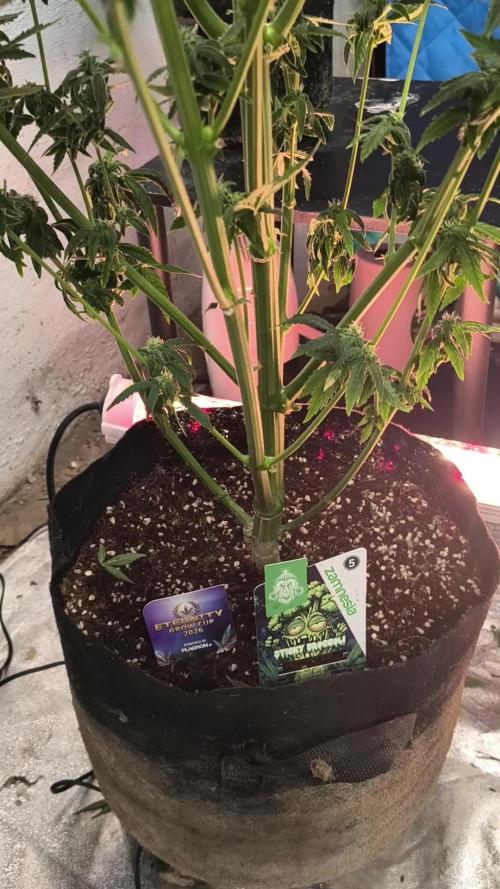
This girl is getting huge colas stacking trichome coverage getting really thick starting to get that sweet smell doesn't have a lot of pistols but the ones pointing out the calaxes she's got nice little crown on her top she jus got a big defoliation to open everything up under canopy lighting rocking you def see it on the lowers running 6.2 pH around 2000 ppm and haven't seen nothing but good results so far upped the calmag cause I noticed that plants in the 5 gallon suck up some calmag when there bulking them flowers out and adding the green sensation is helping alot so far I have some strong branches and a strong stalk cause she's holding herself up really good thanks to the silica running lights at 100 percent rocking a 2 day 24 hr light cycle and then she's off for 8 hrs jus added another fan to bring in some more airflow still adding recharge and bloom city maybe one or two more doses of them then I'll cut them out hit her with a carboload after the microbes and she responds really well she sucks down a gallon of water every couple of days so here's to another week of growing lfg

Likes
25
Share


@rockbo47
Follow
SUMMARY: Switched to late bloom nutes on day 73. She's starting to fade prematurely and I don't know why. I was thinking it was the molasses clogging her up as she was draining very slow and so I just fed her pH'd water over the weekend but I should have flushed her properly.
DAY 71
-----------
Tuesday 9th March 10:45
I fed the Amnesia 300ml of mid bloom nutes which produced 160ml runoff (53%).
I made 5L of mid bloom nutes with tap water and molasses at a pH of 5.8. I made 5L of late bloom nutes with tap water and molasses at a pH of 5.8.
Tuesday 9th March 18:00
I fed the Amnesia 150ml of mid bloom nutes which produced 15ml runoff (10%). [25°C/51%]
DAY 72
-----------
Wednesday 10th March 11:30
I fed the Amnesia 300ml of mid bloom nutes which produced 160ml runoff (53%).
Wednesday 10th March 18:00
I fed the Amnesia 200ml of mid bloom nutes which produced 40ml runoff (20%).
[27°C/54%]
DAY 73
-----------
Thursday 11th March 11:00
I fed the Amnesia 300ml of late bloom nutes which produced 110ml runoff (36%).
I made 20L of late bloom nutes with rain water and molasses. 5L at 5.7, 5L at 5.8, 5L at 5.9, and 5L at 6.2.
Thursday 11th March 18:00
I fed the Amnesia 150ml of late bloom nutes which produced 20ml runoff (13%). [26°C/47%]
DAY 74
-----------
Friday 12th March 11:30
I fed the Amnesia 300ml of late bloom nutes which produced 80ml runoff (%).
DAY 75
-----------
Friday 12th March 14:45
I fed the Amnesia a further 220ml as she appears to be dying and so Im thinking this might "flush" any residual build up if that's the issue. I got 80ml runoff (36%).
Friday 12th March 18:00
I fed the Amnesia 200ml of late bloom nutes which produced 110ml runoff (55%).
[26°C/48%]
DAY 76
-----------
Saturday 13th March 12:00
I fed the Amnesia 600ml of rainwater at a pH of 6.2 in an effort to flush her as shes fading for some reason. I collected 400ml runoff (67%).
[26°C/42%]
Saturday 13th March 19:00
I fed the Amnesia a further 300ml of rain water at a pH of 5.8 which produced 100ml runoff (33%). [26°C/48%]
Saturday 13th March 21:30
I fed the Amnesia a further 300ml of rain water at a pH of 5.8 in an effort to flush the medium.
[26°C/48%]
DAY 77
-----------
Sunday 14th March 11:00
I fed the Amnesia another 600ml of rainwater in an effort to flush her. She's draining extremely slow and so I think there is a build up of residue, possibly caused by the molasses. I collected 500ml runoff (84%)...I think she may be dying? Fuck. [26°C/42%]
I made 15L of late bloom nutes with rainwater and molasses. 5L at 5.8, 5L at 6.0, and 5L at 6.2.
Sunday 14th March 16:00
I fed the Amnesia another 300ml of rainwater.
Sunday 14th March 18:30
I fed the Amnesia a further 200ml of rain water at a pH of 5.8 which produced 200ml runoff (100%).
[26°C/48%]
Sunday 14th March 20:30
I fed the Amnesia a further 200ml rainwater which produced 180ml runoff (90%).
DAY 78
-----------
Monday 15th March 11:00
I fed the Amnesia 300ml of late bloom nutes which produced 180ml runoff (60%). She's draining better now and should be flushed enough. [26°C/42%]
I made 5L of late bloom nutes with rainwater and molasses at a pH of 6.3.
Monday 15th March 18:00
I fed the Amnesia a further 300ml of late bloom nutes, though at 150ml a time, 2hours apart. I collected roughly 100ml runoff each time (66%). [26°C/51%]

Likes
1
Share



Likes
18
Share


@Silverback_Guerilla
Follow
10/23:
Fed today with one, signal, sweet & sticky, silica, beastie bloomz, and a little ca/mg.
10/27:
Fed today with one, signal, sweet & sticky, silica, beastie bloomz, kangaroots, and humic acid.
Lowered the lights to no more than a foot from any cola..most are 7-9" away.


Likes
16
Share


@AestheticGenetics
Follow
4/9/25
This plant is beyond frosty. Stacking up super nicely. Seems like she will yeild quite a bit.
My only gripe is that she has like no smell at all.
Using the foil as a soil cover is working quite nicely. the top soil is getting filled with roots quite well.
Top dressed 1tsp of Bloom
1tsp microbe charge
1tsp bloom

Likes
6
Share


@StonedandSteady
Follow
VIVOSUN®️ @vivosun.official VS2000w & VS1000w Grow-Thank You so Much J Bro!!! I'm Honored and Very Grateful of you and your Company for taking me on to your Team/Family! I #FlippedToFlower today Friday 6/24/22 ShoutOut to our Bro @soillife420_2 for Gifting us this VS®️ VS1000w LED Grow Light! Sponsored VS®️ VS2000w LED Grow Light with Samsung LM301 Diodes & Sosen Brand Driver, Dimmable Lights, Sunlike Full Spectrum with Grow Room Glasses for Seedling Veg & Bloom Plant Growing Lamps for 4x2 Veg & 3x3 Flower Grow Tent or Grow space! Lower Cost & High Efficiency: VS®️ VS2000w LED grow lights use the latest LED plant light technology including Samsung LM301 Diodes, high-energy efficiency with 2.9μmol/J; Extremely high output but consumes only 200W of electricity, making it more efficient than traditional HID lamps and other plant lamps on the market! It comes equipped with 3000k Warm white Diodes that Boosts Bloom, 5000k Cool white lights that Promotes Germination and 660nm Red lights for Higher Yields! Thier attached to a Durable, Waterproof Aluminum Heat Sink with Low Noise and only weights 9.03lbs. with a 5 year Warranty! SuperCropped3rdTime #TransPlanted into 3GallonPots from 1GallonPots #Lollipopped ToppedThe3rdTime #LeafTucked Transferred into our 6×5ft. #ChronicCave BasementFlowerArea and Growing under our Brilliantly Bright VIVOSUN®️ VS2000w-VS1000w with the 12/12 lighting schedule, Dimmed⬇️=50% around 35-40" Over Canopy's We Love to use Team @tnbnaturals @tnb_naturals #TNBNaturals #TheEnhancer #Co2DispersalCanister for Vigorous and Great Growth for our Grows! ShoutOut to Bro @dr._weedman I'm Growing from Team @ilovegrowingmarijuana_strains #HeroMixpack #ILGM #SkywalkerOG-Fem #BruceBanner-Fem #BlackWidow-Fem and started Up a New phenoz of those, my Team @nirvana_seeds nirvanashop.com #Zkittlez-Fem and a New pheno of that! Thanks Again Everyone!!! #BudBrothers4-L Happy Growing! Cheers Famz!!! Much Props and Much Pars!💯VS®️💡's+⛺'s=🏆's
#LoveWhatYouGrow
#BringGreenToYourLife
#vivosun #vs1000 #vivosungrowlight #vivosungrowtent #vs2000 #vs3000 #vs4000 #vs1000e #vsf4300 #hcf1600 #hcf3200
https://linktr.ee/vivosun.official
https://www.linkedin.com/uas/login?session_redirect=%2Fcompany%2F77743591%2F
https://youtube.com/c/VIVOSUN
https://instagram.com/vivosun.official?igshid=YmMyMTA2M2Y=
https://www.facebook.com/198734887125319/posts/1724749361190523/?extid=a&mibextid=baczqb
https://mobile.twitter.com/VIVOSUN/header_photo
https://pin.it/2uORZDs
https://www.tiktok.com/@vivosunglobal?lang=en&is_from_webapp=1&sender_device=mobile&sender_web_id=7110614037704197678
https://www.amazon.com/stores/page/A2F7F49B-7130-4423-BF67-59CE3EC5A44F?maas=maas_adg_01A961034EF443FE5006848DB5A6C70B_afap_abs&ref_=aa_maas&tag=maas&ingress=3&visitId=3e0468ed-290c-4c15-9d06-7a22afdff345&mc_cid=e5417eb03f&mc_eid=69bad0aef8
https://www.amazon.com/stores/page/3EDD8CEC-742A-44F6-90C4-0930E78DD730?ingress=2&visitId=6cfb6992-f86f-4c85-a5ad-4cb5d1c06d07&ref_=ast_bln
Limited-time deal: VIVOSUN 6-Pair 1/8 Inch Adjustable Grow Light Hanger, Heavy Duty Rope Hanger with Reinforced Metal Gears, 8-Ft Long and 150 lbs Weight Capacity Rope Rachet for Grow Light, Inline Fan https://a.co/d/1WezHcI

Likes
21
Share


@JeyGanesha
Follow
Iniziò seconda settimana di fioritura... Questa papaia cookie mi sta sorprendendo...bella davvero,sta iniziando a profumare bene e sopratutto buono😂😉💪💚💛
Likes
2
Share


@Drtomb
Follow
The girls are starting their 2 week flush. The fade will set in quickly. Can't wait to see how these turn out.
Can't wait to sample these sticky buds. Thanks again BOG for all your contributions to the Marijuana community. Rip a good breeder.


Likes
27
Share


@adam_pawloski87
Follow
Let’s go day 43!!!! Week went real well , girls started preflower so sometime this week I will be switching up the nutrients for flowering! We are stable and looking super healthy! Can’t wait to see what these ladies do this week! Hope you all enjoy !
Likes
141
Share


@bioaccessory
Follow
Приветствую, коллеги! 💚💛❤️
В этот раз я захотел вырастить сативадоминирующий сорт, Strawberry Cream от SumoSeeds как раз подходит:
"Прямо из района Эр-Риф Марокко, эксклюзивный гибрид Goji Haze с Strawberry Haze, знаменитой фруктовой сативой от Арьена из GHS. При курении этой красотки будет замечен приятный сладковатый аромат клубники." Звучит интригующе.😏
Теперь пару слов о проращивании: обычно после замачивания в стакане воды(RO water), я проращиваю семечки во влажных ватных дисках и зип-пакете(так мне легче контролировать нужную влажность). Но при этом способе нужно следить за корнем, есть риск вростания в ватный диск, что и случилось с одной из семечек. В этом случае извлекать семечку нужно предельно аккуратно(см. видео). Видимо в следующий раз я попробую менее рискованный способ проращивания. Ах да, перед стаканом с водой я слегка подпилил семечки по острой грани маникюрной пилочкой.
Итого:
23.01(вечер) поместил в стакан с водой
24.01(утро) поместил в диски
25.01(утро) появились корни
25.01(вечер) корни ≈1см. посадил в кокос
26.01(вечер) взошли
На всякий случай отметим, что чуть позже взошла растишка из правой(на фото) семечки, и она же была заметно крупнее.
Кокос(уже с перлитом, спасибо линейке Plagron) я зарядил слабеньким компотом(A+B-2, B52-1, CalMag - 0.5 pH5.9 ppm514), полетели!
Спасибо, что заглянули, и будьте здоровы! 🙏
Продолжение следует ...😶

Likes
3
Share


@Organic473
Follow
This was a rainy week so not much watering however she took the new 5 gallon pot really well. I am just extending her veg for the best possibly yield.
Likes
14
Share


Likes
19
Share