


Likes
Comments
Share

@DogDoctorOfficial
Follow
🌿 Frosted Guava Auto by Zamnesia | Pheno B | Week 8 (Flower Week 5) 🌿
Small Plant. Big Personality. And Now… A Little Less Green.
There are plants that follow the plan.
And then there are plants that write their own story.
Frosted Guava Pheno B has been doing the latter from the beginning.
She has never been the biggest plant in the room. She hasn't chased height, hasn't tried to dominate the canopy, and hasn't demanded much intervention.
Instead, she has quietly developed her own personality.
Compact.
Elegant.
Beautifully structured.
And increasingly covered in flowers.
Now, entering her fifth week of flowering, she has reached another important moment in her journey.
This week, she joined the group receiving a selective flowering defoliation.
Not because she was struggling.
Not because she was unhealthy.
And certainly not because every plant needs to be defoliated.
Quite the opposite.
She was looking fantastic.
But after looking carefully at her structure, her development, and the way light and airflow were moving through the plant, I felt that removing some unnecessary foliage was the right decision.
So we went in.
We cleaned her up.
And now we're going to see what she does with the extra space.
🌸 Week 5 Flower – Her Own Story
Frosted Guava Pheno B is currently around 108 cm tall.
That still makes her one of the more compact plants in the room.
But honestly?
I don't think she cares.
😂
She has found her own architecture and she's sticking with it.
The flowers continue developing beautifully, with increasingly visible frost and those characteristic white pistils reaching outward from the developing buds.
Her foliage has remained lush and healthy, with that beautiful deep green colour we've been following since the beginning.
The plant looks comfortable.
The flowers are developing.
And now we're starting to see more definition between the different parts of the plant.
This is exactly the kind of moment where stepping back and looking at the whole plant becomes important.
Because sometimes the question isn't:
"Can I remove this leaf?"
The better question is:
"Does this leaf still have a useful job to do here?"
And that's where this week's defoliation came from.
✂️ Defoliation – What We Actually Did
This wasn't a complete strip.
It wasn't a race to make the plant look naked.
And it wasn't about removing leaves simply because they were large.
The approach was selective.
I removed most of the fan leaves carrying their own petioles, particularly where they were contributing to unnecessary shading or creating congestion inside the plant.
I also cleaned the lower and interior portions of the plant where some flowering sites were positioned so far below the productive canopy that I didn't expect them to develop into meaningful flowers.
Those areas are what I would consider the true bottoms on a compact plant like Frosted Guava.
And that's an important distinction.
Because this plant is small.
Her lower sites really are lower.
Even with the Lumiflora under-canopy lighting helping bring additional photons into the lower canopy, the primary productive zone of the plant remains higher up.
So rather than allowing the plant to spend resources maintaining foliage and very low sites that are unlikely to contribute much, I decided to clean those areas selectively.
But I didn't remove everything.
Some lower flowering sites remain.
I want to see what they can actually do.
That's part of the experiment.
🌿 What Is Defoliation?
For anyone new to growing:
Defoliation is the intentional removal of selected leaves from a plant to alter the structure of the canopy.
The goal isn't simply to have fewer leaves.
The goal is to create a better balance between:
light penetration + airflow + canopy structure + productive flowering sites.
Leaves are extremely valuable.
They're the plant's solar panels.
So removing them should never be treated as something automatically beneficial.
Every leaf removed is a piece of photosynthetic machinery removed.
That's why I don't approach defoliation as:
"Flower started. Time to strip the plant."
Instead, I look at the plant in front of me.
Is the canopy becoming too dense?
Are leaves heavily shading developing flowers?
Are there congested areas where airflow is poor?
Are there leaves that are doing very little because they're buried underneath several layers of foliage?
Are there lower sites that realistically have very little opportunity to develop?
If the answer is yes, then selective defoliation can make sense.
If the answer is no...
Leave the plant alone.
🚫 What Defoliation Is NOT
This is probably even more important.
Defoliation is not:
❌ Removing every fan leaf
❌ Trying to expose every single flower to direct light
❌ A substitute for good plant structure
❌ A guaranteed way to increase yield
❌ Something every plant needs at the same time
❌ An excuse to strip a healthy plant simply because you can
The objective isn't to make the plant look clean for the sake of appearance.
The objective is to improve the functional canopy.
And there's a big difference.
A beautiful green leaf isn't a problem simply because it's a beautiful green leaf.
If it's healthy, receiving light, contributing to photosynthesis and helping the plant, I have no reason to remove it.
But when the canopy becomes crowded and certain leaves are contributing more obstruction than productivity, that's when selective removal becomes interesting.
✂️ How I Approach It
My approach is simple:
I observe first.
I don't start with a predetermined number of leaves that must disappear.
I start by looking at the structure.
Then I work from the outside toward the interior and from the top toward the lower portions, looking for unnecessary congestion.
Leaves that are heavily shading productive flowering sites can be candidates.
Leaves buried underneath several other leaves can be candidates.
Leaves occupying congested interior areas can be candidates.
And lower growth that is so far beneath the productive canopy that it has little realistic opportunity to develop can also be considered.
But I always keep the plant's overall health in mind.
The goal is balance, not maximum removal.
That's why Pheno B still has plenty of green.
She's not naked.
She's simply better organized.
💡 The Under-Canopy Question
This is particularly interesting with Frosted Guava Pheno B because we're running Lumiflora under-canopy lighting.
Someone might reasonably ask:
"If you have light underneath, why remove the lower growth?"
That's a very fair question.
And the answer is that under-canopy lighting doesn't magically make every lower flower equal to a top flower.
On a compact plant like this, the very lowest parts are still extremely low relative to the main productive canopy.
The under-canopy lighting is helping reinforce the lower and interior areas, but I still want to observe where the plant naturally allocates its energy.
That's why I deliberately left some lower flowering sites behind.
I don't want to assume.
I want to watch.
Will those remaining lower sites develop?
Will the extra light make a noticeable difference?
Will the upper flowers continue dominating?
That's exactly the kind of question this project allows us to explore.
And the harvest will eventually give us the answer.
☀️ More Light Where It Matters
The Future of Grow Black Series LED continues providing the primary light from above, with approximately 1,000 PPFD across the upper canopy.
Frosted Guava may be compact, but she certainly isn't short on photons.
She's been sitting underneath that light throughout flowering, converting those photons into leaves, flowers, structure and now increasingly visible resin.
And with the selective defoliation, we're changing how some of those photons move through her architecture.
We're not creating more photons.
We're simply trying to make better use of the ones already available.
That's the idea.
Don't waste energy chasing light.
Build a canopy where the available light can actually do its job.
❄️ And The Frost Is Getting Serious
The name Frosted Guava continues becoming more appropriate every week.
The flowers are developing beautifully, and the resin production is becoming increasingly visible.
Those white pistils are still everywhere, creating an incredible contrast against the deep green foliage.
And underneath all those hairs, the flowers are beginning to gain more structure and density.
This is the stage where I love looking at the same plant from week to week.
Because the change isn't always dramatic overnight.
But compare the plant to where she was a few weeks ago...
And suddenly you realize:
She's building.
She's filling out.
She's gaining flower volume.
She's becoming increasingly defined.
She's becoming Frosted Guava.
🌿 Small Plant. Big Character.
I've said this about her before, but this week makes it even more obvious.
Frosted Guava Pheno B doesn't need to be the tallest plant in the room.
She's already found something more interesting.
Character.
Her sister Pheno A has followed a different path.
And that's one of the beautiful things about running phenotypes together.
Same genetics.
Same room.
Same light.
Same nutrition.
Same philosophy.
Different personalities.
Pheno B has chosen to remain compact and elegant.
And now, as flowering progresses, she's showing us exactly what that compact structure can become.
💧 Nutrition & Hand Watering
We're continuing with hand watering throughout the room.
Current feeding remains centered around the Plagron flowering program:
Terra Bloom — 2.2 ml/L
Power Buds — 1 ml/L
Sugar Royal — 1 ml/L
Green Sensation — 1 ml/L
Lemon Kick — 0.03 ml/L
Current recorded parameters are around:
pH: 6.0
EC: approximately 2.0 mS/cm
Solution temperature: 21°C
Root-zone temperature: 21°C
Watering: approximately 1.2 L per 24 hours
Hand watering has also given me another opportunity to observe this plant closely.
Every time I water her, I get another chance to look at the flowers, inspect the leaves, check the structure and notice those tiny changes that are easy to miss when everything is automated.
It takes more work.
But it also brings you closer to the plants.
And sometimes that's where the best observations happen.
🌡️ Environment
The room continues running under stable conditions:
Day temperature: 29°C
Night temperature: 25°C
Relative humidity: approximately 72%
Solution temperature: 21°C
Root-zone temperature: 21°C
CO₂: approximately 639 ppm
With the canopy becoming increasingly dense, airflow and humidity management become even more important.
That's another reason selective defoliation can be useful at this stage.
Not because leaves are inherently bad.
But because a dense flowering canopy can create small pockets where air movement becomes less effective.
Opening selected areas gives the room a little more breathing space.
And that's particularly valuable as the flowers continue developing.
🔭 Looking Ahead
Now comes the interesting part.
We've changed the architecture.
We've removed some unnecessary foliage.
We've cleaned the lower sections.
We've opened some of the interior.
And now...
we wait and observe.
I want to see how quickly she responds.
I want to see how the flowers develop with the improved canopy structure.
I want to see what happens to those lower sites we deliberately left behind.
And most importantly, I want to see how Frosted Guava Pheno B continues writing her own story.
Because she's already made one thing very clear:
She doesn't need to follow anybody else's timetable.
❤️ Final Thoughts – Let Her Shine
Frosted Guava Pheno B has been one of those plants that quietly earns your attention.
She didn't arrive in the room demanding the spotlight.
She didn't become the tallest.
She didn't become the biggest.
She simply kept growing.
And week after week, she became more beautiful.
Now she's entered another chapter.
A little less foliage.
A little more breathing room.
A little more light moving through the canopy.
And plenty of flowers left behind to show us what she's capable of.
The important thing about this week's defoliation isn't how many leaves we removed.
It's why we removed them.
Because good cultivation isn't about following a recipe blindly.
It's about looking at the plant in front of you and making decisions based on what she's actually telling you.
And Frosted Guava Pheno B was telling me:
"I'm ready."
So we listened.
Now let's see what she does.
A huge thank you once again to Zamnesia for these beautiful genetics, Plagron for the nutrition, Future of Grow for the Black Series lighting, Lumiflora for helping illuminate the lower canopy, TrolMaster for environmental control and of course to everyone following this 8×8 Adventure on GrowDiaries.
Every week, every phenotype tells us something different.
And that's exactly why I love this project.
Until next week...
Let her shine. She has earned her spotlight. ✨🌿❄️
Growers love and happy growing! 🌱💚

Likes
252
Share


@Tropicannibis_Todd
Follow
💩Alrighty then Growmies We Are Back At it 💩
Well folks we just finished up the last run and so we are back to do it all over again 😁
So what do you say we have some fun 👈And what we got here folks is a Strawberry Blast 🍓 🍓 🍓 🍓
Strawberry 🍓 Gorilla , Strawberry 🍓 Banana 🍌 and there new release 🍓 Ztrawberriez 🍓 from FastBuds
And we also got Strawberry 🍓 Cola from Exotic Seeds
👉 Well we are now around day 35 and well growmies its been a ruff week 👈
We had a huge storm roll in a little over a week ago and we lost power for 4 days , this is where I had to get creative 😳 and now this weekend I had some ph issues 👍
So 2 out of the 4 are preforming really well into the preflowering , where as the other 2 are taking there time 👈 Plus there stretching pretty good now 😉
So this week I've started her new nutrients regiments 👉 ive moved to a new nutrients brand👌Just need to remind myself to take it easy 🤔
FC4800 from MarsHydro Lights being readjusted and chart updated .........👍I've added a RU45 to the mix 👍
www.marshydro.ca
👉I am using Agrogardens for nutrients for my grows and welcome anyone to give them a try .👈
👉 www.agrogardens.com 👈
Agrogardens Cal MAG
Agrogardens Grow A+B
Agrogardens Bloom A+B
Agrogardens Bud Booster
Agrogardens PK13/14
I GOT MULTIPLE DIARIES ON THE GO 😱 please check them out 😎
👉THANKS FOR TAKING THE TIME TO GO OVER MY DIARIES 👈
Would you like to hang with the growdiary community 👉 https://discord.gg/gr4cHGDpdb 👈


Likes
9
Share


@NanoLeaf
Follow
End of Week 4
Trying to make sure the soil stays nice and moist to keep the microbes happy and letting the top 3 cm of the topsoil dry before each watering.
.
Turned the wattage up on my ballasts to 600W each.
The ladies have gained some strength and they can handle the extra wattage.
I also performed LST by tucking fan leaves and softly pinching and bending some of the bud sites also used some tie downs and topped here and there whilst keeping the stress at a minimal.

Likes
3
Share


@danielsegovia
Follow
Germinación: 24 hs en agua y después las paso a un tupper con papel de cocina.
21 de mayo 2020: abrí el tupper para poner las semillas germinadas en tierra.
23.05.20: todas ya se abrieron.

Likes
8
Share

@RBG
Follow
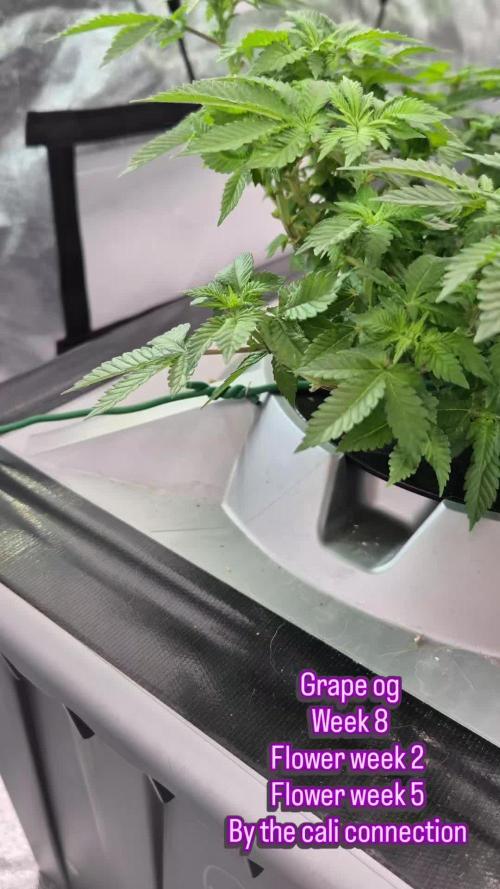
Week 8
Flower week 2
Flower-day 5
26/10/2025
Finally feeling good again!
Kept the same nutrient mix almost the same, have had to use some others just to get by until more rock up 🙃
Floramax Veg 1: 1000ml
Floramax Rezin: 400ml
Floramax Organabud: 400ml
Floramax Flowering Enhancer: 400ml
Cyclo Platinum Silica: 200ml
ISN Cal-Mag: 400ml (still waiting on my main one to be delivered, so using what’s left of this)
Green Planet Massive Bloom: 200ml
Green Planet Bud Booster: 4 scoops (30ml each)
Sleeps with the Fishez: 100ml — used some hydrogen peroxide today while waiting for the next batch to arrive next week
I’ve been looking into a flushing additive called New Millennium Winter Frost for a nice clean finish.
Pistils finally popped up yesterday on a few of the top sites! Should start seeing some solid stretch from Grape og soon, guessing around 30 to 40cm at least.
I’m letting her do her thing and reach up into the net for now. If she starts getting crowded before the end of week 3, I’ll kick off some early defoliation.
Also got two AC Infinity IonBeam S11 lights set up sitting about level with the top colas. I’m aiming the light to hit the middle and lower sections instead of blasting the tops directly, trying to get that nice even coverage.
Still debating whether I even need to scrog this run, but a few people keep telling me to give it a go to see the difference, I guess only one way to tell 🙌

Likes
21
Share


@Bud_Lee
Follow
Full feed el caudillo organic. Esperando a que seque el substrato para cosechar✂️✂️🤪🙏

Likes
39
Share


@Mastr
Follow
Day 50 and they are so healthy and bushy I feed them.with
4ml bloom
4ml heaven
4m acti vera
4ml top max
Been done finally defoliation yesterday guy this time I cut all lower branches and just leave top branches just want see what different coz I been speaking to someone with experience he told me you need do defoliation very very aggressive I know you get low yield but its top shelf bud you get let see its work or no
Day 54 and she is in weeks 5 flowering but still bud wont get fatten up but I know mulost sativa start fatten up week 5 to 7 in flowering let see
Likes
31
Share


@Santica_Garden
Follow
So this is how things are looking at the end of Week 8, not much to update, bud sites forming nicely. Uploaded a video which explains better.

Processing
Likes
11
Share


Likes
43
Share


@420DeepGrow
Follow
Gracias al equipo de Kannabia Seed y XpertNutrients, sin ellos esta magia no seria posible.
🍁💐 Runtz (Auto):
Si esta cepa se ha ganado su popularidad a pulso, esta versión autofloreciente es digna heredera de sus atributos. No es de extrañar que nuestros criadores hayan acertado con su programa de reproducción, al combinar dos de las cepas más fascinantes de la actualidad: Zkittlez y Gelato.
planta resistente y robusta, de cuerpo esbelto y fuerte ramificación lateral, que se puede cultivar prácticamente en cualquier entorno; pero prefiere los veranos largos y cálidos, tal y como quiere la madre naturaleza, donde bañada por el sol se eleva hasta los 120 cm. para producir unos rendimientos muy gratificantes de 100-150 gramos por planta.
En interior, y tras solo 70 días desde la semilla, también recompensará con cosechas abundantes de hasta 500 gr./m²
Inmediatamente después de encontrarte con ella, lo primero que notarás es su aroma descaradamente afrutado, con un toque tropical cortado con reminiscencias terrosas y amaderadas, que se entremezclan de forma agradable para ofrecer un combo que hace salivar las papilas gustativas.
Ofrece un sabor confitado, refrescante y similar a sumergirse en una piscina de frutas cítricas y flores de fragancia intensa. Al inhalar, obtienes la bondad de la dulzura; al exhalar, el humo se convierte en suave y cremoso, dejando suficiente profundidad en cada bocanada para satisfacer a aquellos que buscan los matices más complejos.
⛽ XpertNutrients: es una empresa especializada en la producción y comercialización de fertilizantes líquidos 🍶y sustratos🐛, que garantizan los mejores resultados y cosechas de la más alta calidad. A través de una cuidadosa selección de materias primas y un proceso de producción avanzado, sus productos son sinónimo de resultados confiables.
🛒 Consigue aqui tus fertilizantes:
https://xpertnutrients.com/es/sobre-nosotros/#:~:text=Xpert%20Nutrients%20es%20una%20empresa,de%20la%20m%C3%A1s%20alta%20calidad.
📆 Semana 6:
Parece que el temporal por fin se va a pasar esta semana, todo esto le ha afectado.
Se aprecian las preflores, por lo tanto estamos en plena floración 🔥 😎.
Comienzo a aplicar abonos de floración. Mantendre el Master Grow una semana mas antes de cambiar a Master Bloom.

Likes
43
Share


@OrganicPower
Follow
Week 8 flower and the OG Kush looks like fire 🔥 so frosty and covering everything. I thought this seed was a dud but it is definitely not! Flowers are not huge but that’s ok. Tight, frosty, and the smell very nice and getting stronger. The development is slow and has been since the beginning, might be something I’m doing or did, not to sure? Lights are at 12” and she is responding well. Looks like about two weeks to go. TS 600’s have done well again! Blimburn OG Kush seems to be producing some potent looking flowers. Need to do a better job taking care of the fungus gnats moving forward. Thanks for the view!

Likes
54
Share


@rhodes68
Follow
2/19 Week 8
Controlling the stretch somewhat by keeping strong blue light in the spectrum. Wont start flower under HPS again, will wait till stretch has finished.
The FFt-7 seem to respond most to this, the FFt-5 not as much but still slowed down.
Major day coming Saturday everyone back into one tent and that undergrowth is getting trimmed!
Driving me nuts
Wont need to worry so much over height at that point.
Adding that small amount of PK has really spurred a lot of bud growth, looks like the guys knew what he was talking about.
2/21 Could not wait so... Lower End Defoliation Day!
Cleaned them all up for their last day in Moya (veg tent) before moving to Enterprise (Flower tent) ... heh
Walking nuets up
2/22 in the new digs
Both the 600w HID and 150w LED are now in the tent = 750w
Everybody is on the Enterprise now.
2/23 white tips back dropping back down to 4ml/gal on the CT
2/25 Cutting back PK to 2ml/gal
Pics for Fast Buds on leaf oddity
Raised HID a couple of clicks getting some praying leaves underneath it.

Likes
4
Share


@CannaIGrow
Follow
This plant was the first of the 4 to come up, it also basically exploded out of the shell in the germination process. While she was still in water I could already see green leaves lol. She’s really plugging along. This is a cross made by a friend of mine and is the first time it’s being grown.
Likes
12
Share


@bodonha
Follow
I harvested her 1 week before I did with her mom, and she is definetely stronger! Not as lemony as her mom, and I have no clue why, since they were fed just the same. The high is strong, but keeps me talkative and socializing...
Likes
23
Share


@MistaOC
Follow
*******************************************
11.02. Day 16
*******************************************
13.02. Day 18
*******************************************
16.02. Day 21
*******************************************
Likes
27
Share


@CannbellFarms
Follow
I’m overjoyed with the phenos this strain is producing, strong vibrant purples with some serious flavour profiles!
Scent Profiles we have:
Candy Lemon Sherbet 🍬🍋
Sweet & Piney Diesel 🍭🌲⛽️
Sweet & Tangy Tropical Punch 🏝️🥊
Alongside this, these beauties are the frostiest and the most insanely dense koala looking nugs I’ve ever produced!
Processing
Likes
7
Share


@thephalanx420
Follow
One of my seeds didn't germinate, so I had to plant another. The 2nd one is now in the 64L reservoir and is 6 days behind the one in the 1L reservoir.
Roots are starting to make their way down into the nutrient solution in the 1L bottle.
Likes
4
Share


@HowtoBubatz
Follow
The second week of vegetation is going well! This time, I’ve decided to try the Green House Feeding BioEnhancer instead of BioBizz Root-Juice.
I’ve had issues with the shelf life of Root-Juice in the past, so I’m curious to see how BioEnhancer performs.
The plant is looking healthy now, but it had a bit of a rough start. I initially planted it in soil that was too heavily pre-fertilized, which caused the first leaves to turn yellow.😔
Thankfully, it recovered quickly and seems to be thriving now. 💪
To keep the plant as stress-free as possible during vegetation, I’ve decided not to train it for now.
I want it to focus on strong, natural growth without any added strain.
I’m excited to see how it progresses over the next few weeks—things are looking promising!🌱😊
Likes
Comments
Share

@Firefly
Follow
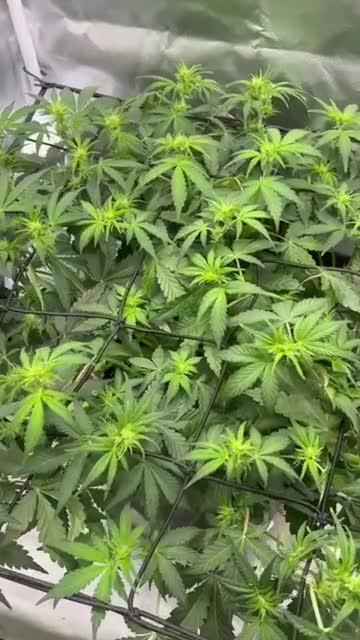
Week 5! End of Veg? Preflower? Flower? Very eventful week. Throughout this week at ever watering the plant got a round of LST+Tucking. At this point I'm trying to maximize the amount of growth sites getting light exposure and also trying to keep the canopy relatively flat/level. Full strength nutrients per normal. About this point I was getting really worried about space, particularly giving the genetics of this plant tend to the larger side. Impulse purchased a net and on 9/17/25 the ScrOG net was installed and I did my best to use it to curate the canopy. ~placed about 8" from the top of the pot and besides that I just gave it my best go, not exactly sure if I did it right or not. Towards the end of this week pistols become pretty apparent on most of the plant! Some very light defoliation was done, just a couple of oversized fan leaves that weren't getting much light anyway. LED was set to 100% (and slightly raised) per manufacture specification towards the end of this week.
Wouldn't be a first grow without a scare of the week. 😵 Last week we had an accidental topping, this week we have roots growing all outside the pot. On 9/16/25 I noticed the root growth out the bottom of the pot. My wildly unintelligent drain pan setup used bows to space the pot up and they collected runoff, leaving the roots with a nice bath of runoff water to grow into. Learning every week, this week I learned about air-pruning. Went ahead and cut these root growths off, purchased a 1$ Lowes runoff pan, and returned three bowls and a nice Pyrex dish back to the kitchen. About the same time of my root issue, within the next 2 days a good amount of leaves had slight yellow tips...

Likes
57
Share


@GreenISR
Follow
First of all the plant is so strong after I have LST her all the way and tops and main line like wtf 🤪🤪
My trim of the buds gose fan leafs in the side and sweet leafs in the side and cut a litel for secend trim ( took me some time around 3 - 4 hours .
P
So I had some issue in the beging becuse I try to grow it in 24 h cycle light in the start it have made the plant dense but it slow down the growing for 2 - 3 weeks .
In the end the results are amazing with the flux method ( I hope I did it right ) .
Grate seed bank !
That color in the end just wow and even the lower buds get a pink color .
Wet wight around 1.2 - 1.5 ( Human scale Lol ..) will update soon with more pic's .
Roots are full its amazing ! And I 0did a good job .
After the dry out ill do so aging .
So came out with 200 grams in the end I have learn that the size is dosent metter 🤣
Becuse of 3 liter pot I made 180 but still it weird becuse in 10 liter I came out 300 .
So the flux project went intresting and my last time im doing this grow flux..
