


Likes
Comments
Share

@DogDoctorOfficial
Follow
🌸 Pink Rosay Auto by Zamnesia | Pheno A | Week 8 (Flower Week 5) 🌱
Small Frame. Big Flowers. An Absolute Beauty.
Some plants need space to become impressive.
Pink Rosay doesn't.
Standing at approximately 111 cm, she remains one of the most compact plants in the entire 8×8 Adventure.
But somehow, when you look at her, she doesn't feel small.
She feels complete.
Dense.
Elegant.
Full.
Every centimetre of her structure seems occupied by flowers, leaves and developing potential.
She's one of those plants that reminds me that size and presence are two completely different things.
And Pink Rosay has presence.
This week, she also joined the group receiving a selective flowering defoliation.
Again, not because there was anything wrong.
Not because she was struggling.
And not because I believe every plant needs to be stripped at a particular point in flower.
She was actually looking fantastic.
But she's a little more advanced than some of the plants around her, and when I looked closely at her structure, I felt that opening her up would benefit both her and the room.
So we made some space.
And now we're going to watch what she does with it.
🌸 Week 5 Flower – Compact Doesn't Mean Small
Pink Rosay has always had her own way of doing things.
She never chased the ceiling.
She never tried to become the biggest plant in the tent.
Instead, she's packed an incredible amount of flowering structure into a remarkably compact frame.
At approximately 111 cm, she's still relatively short for this room.
But look closer.
The branches are carrying substantial flowering sites.
The flowers are stacking.
The calyxes are beginning to swell.
The pistils remain beautifully bright.
And the resin continues becoming more apparent.
This is where I think the word "compact" can sometimes be misleading.
She's compact in height.
She certainly isn't compact in personality.
And she definitely isn't compact in what she's building.
There's a lot happening inside this little plant.
✂️ Defoliation – Making Space, Not Removing Beauty
This week I decided to selectively defoliate Pink Rosay.
And I want to explain the reasoning because defoliation is one of those subjects where growers can have very different approaches.
For me, this wasn't about looking at the plant and thinking:
"There are too many leaves."
Healthy leaves are valuable.
They're photosynthetic machinery, and I don't remove them simply because they're large or because I want the plant to look cleaner.
Instead, I look at the relationship between the leaves, flowers, light and airflow.
Pink Rosay has become quite dense.
Her compact structure means that a lot of foliage and flowering sites are occupying a relatively small vertical space.
As flowering progresses, that density can create areas where leaves overlap heavily, airflow becomes less direct and light has difficulty travelling deeper into the canopy.
So this time, I selectively removed foliage that was contributing to unnecessary congestion.
Not everything.
Not aggressively.
Just enough to open the architecture.
💡 Let The Photons Travel
One of the reasons I like selective defoliation at this stage is that we're not necessarily trying to make every flower receive direct light.
That's not the objective.
We're trying to improve the distribution of the available light through the canopy.
The Future of Grow Black Series is already delivering around 1,000 PPFD across the upper canopy.
There are plenty of photons available.
The question becomes:
How efficiently can the plant's architecture use them?
When several large leaves overlap one another, some of that light is intercepted before it can reach deeper areas.
By selectively removing leaves from congested sections, we can allow more light to penetrate into the canopy and reach leaves and flowering sites that were previously more heavily shaded.
We're not creating more light.
We're simply changing the path it takes through the plant.
And with Pink Rosay being such a compact and dense phenotype, that can be particularly interesting.
🌬️ And Then There's Airflow
Light isn't the only reason for opening a dense canopy.
Air needs space too.
As the plant becomes more compact and the flowers continue developing, airflow through the interior becomes increasingly important.
Removing selected leaves creates little channels through the plant where air can move more freely.
That helps reduce stagnant pockets inside dense foliage and makes the entire canopy easier to manage as flowering progresses.
Again, this isn't about removing leaves because leaves are bad.
It's about managing density.
Sometimes the best thing you can do for a plant isn't giving her something.
It's simply getting out of the way of what she's already doing.
🌿 A Plant With Serious Density
And this is probably what impresses me most about Pink Rosay right now.
She is dense.
Not just in foliage.
The flowering structure itself is becoming increasingly substantial.
The individual flowers are beginning to look less like isolated flowering sites and more like components of developing colas.
The calyxes are swelling.
The pistils are still predominantly white.
And the resin continues building across the flowers and sugar leaves.
She's entering that beautiful transition where you can start seeing the architecture of the eventual harvest forming in front of you.
I don't want to call it "bulking" just yet.
I prefer thinking of it as stacking, swelling and building flower mass.
But whatever word we choose...
She's definitely building.
And she's doing it beautifully.
❄️ Frost Is Becoming Part Of Her Personality
The resin production continues to impress me.
Looking closely at the flowers, there's already a visible layer of trichomes developing across the calyxes and surrounding sugar leaves.
And this is still only Week 5 of flowering.
The bright white pistils make everything even more dramatic.
Against the deep green foliage, those flowers almost look illuminated from within.
It's one of those combinations that makes photography incredibly rewarding.
Dark green.
Bright white pistils.
Developing frost.
And flowers that become more substantial every time I look at them.
Pink Rosay is definitely starting to look like she knows exactly where she's going.
🌱 Why I Didn't Defoliate Everything
This is important.
After a defoliation, it's easy to look at a plant and think:
"Why didn't you remove this leaf too?"
Because more isn't necessarily better.
I want Pink Rosay to retain enough healthy foliage to continue powering photosynthesis and supporting flower development.
The objective was never to expose every flower.
It was to improve the relationship between:
foliage → flowers → light → airflow.
Some leaves are still doing excellent work.
Some flowers are still perfectly positioned beneath them.
And some shading is completely natural.
A plant doesn't need to look like a perfectly arranged artificial canopy.
She's alive.
She's dynamic.
And I'm much more interested in creating a healthy, functional environment than achieving a perfectly clean photograph.
Although...
I have to admit...
She does look pretty damn good after the cleanup. 😍
💡 Lighting From Above & Below
The primary lighting remains the Future of Grow Black Series LED, providing approximately 1,000 PPFD across the upper canopy.
Below, the Lumiflora under-canopy lighting continues adding another dimension to the system.
This combination is particularly interesting with a plant like Pink Rosay.
Her compact structure means that the lower portions of the plant are physically much closer to the upper canopy than they would be on a tall, stretched plant.
At the same time, her density can create additional shading.
The under-canopy lighting gives those lower areas another source of photons while the defoliation helps improve the movement of light through the plant from above.
It's another experiment within the larger experiment.
And, as always...
Harvest will be the judge.
💧 Hand Watering – One Plant At A Time
Pink Rosay continues receiving individual attention through hand watering.
There's something especially useful about hand watering at this stage.
Every time I approach the plant, I have an opportunity to look.
To inspect the flowers.
To check the leaves.
To feel how the plant is progressing.
To notice changes that might otherwise disappear into the background of an automated system.
Current feeding remains:
Terra Bloom — 2.2 ml/L
Power Buds — 1 ml/L
Sugar Royal — 1 ml/L
Green Sensation — 1 ml/L
Lemon Kick — 0.03 ml/L
Current readings:
pH — approximately 6.0
EC — approximately 2.0 mS/cm
Solution temperature — 21°C
Root-zone temperature — 21°C
Watering — approximately 1.4 L per 24 hours
No unnecessary changes.
The plant is responding well.
So we keep giving her consistency.
🌡️ Environment
The environment continues providing the stability this garden has been built around.
Day temperature: 29°C
Night temperature: 25°C
Relative humidity: 60%
Root-zone temperature: 21°C
Solution temperature: 21°C
CO₂: approximately 529 ppm
The room continues relying on natural CO₂ replenishment through ventilation rather than bottled supplementation.
The important thing isn't chasing one individual number.
It's the interaction between temperature, humidity, airflow, irrigation, root-zone conditions and light.
When those pieces work together, the plant gets to concentrate on what she does best.
Growing.
👀 Looking Ahead – Is Something Special Building Here?
I'm becoming increasingly curious about Pink Rosay's final outcome.
Not because I want to predict a number.
Not because I want to call the harvest before she's finished.
But because the structure is promising.
She's compact.
She's healthy.
She's carrying a remarkable number of flowering sites for her size.
She's producing resin.
She's stacking flowers.
And now we've opened the canopy slightly to give her more room to breathe and allow light to travel more effectively through her architecture.
If she continues at this pace, I have a feeling she could surprise us at harvest.
Sometimes the plants that look modest from a distance are the ones that make you raise your eyebrows when the final numbers come in.
And Pink Rosay has exactly that feeling.
❤️ Final Thoughts – Let Her Shine
Pink Rosay Pheno A continues telling one of my favourite stories in this entire 8×8 Adventure.
She reminds me that you don't need to be the tallest plant in the room to make an impression.
You don't need to stretch toward the ceiling.
You don't need to occupy the most space.
Sometimes you can simply take your little corner...
And make it extraordinary.
This week, we gave her a little more room.
A little more airflow.
A little more opportunity for photons to move through her canopy.
And now we're stepping back again.
Because after making a cultivation decision, the most important thing is knowing when to stop touching the plant and let her respond.
That's where the real lesson begins.
Pink Rosay is compact.
She is dense.
She is elegant.
She is increasingly frosty.
And there is an enormous amount of flower packed into that small frame.
I have a feeling this little lady may have something very interesting waiting for us at harvest.
But for now...
We're going to let her keep building.
Keep stacking.
Keep swelling.
Keep shining.
A huge thank you once again to Zamnesia for these beautiful genetics, Plagron for the nutrition, Future of Grow for the incredible Black Series lighting, Lumiflora for bringing light beneath the canopy, TrolMaster for environmental control, and to everyone following this 8×8 Adventure here on GrowDiaries.
Every phenotype has a different story.
Pink Rosay's story is becoming one of elegance, density and quiet strength.
And I absolutely love where she's going.
Until next week...
Small frame. Big personality. Let her shine. 🌸✨
Growers love and happy growing! 🌱💚

Likes
84
Share


@bioaccessory
Follow
Начинаю тренировку растения 💪
Пару дней не заглядывал в бокс, от растяжки надломилась ветка в верхнем междоузлии. Не паникую(мы же на расслабоне гровим 😜), надломил до хруста противоположную ветку, для симметрии, и временно убрал растяжки. Ну вот, планировал не мучать свой автоцвет, но пока не выходит 😈
В конце недели собираюсь делать плановую промывку.
👉Таки доделал досвет низов по периметру, ближе к началу цветения будем тестировать, оставайтесь на связи.
Спасибо, что заглянули, и будьте здоровы! 🙏
Продолжение следует ...😶

Likes
16
Share


@RakonGrow
Follow
Day 71 :
sie bleibt noch im Aufbau !!!
Day 72:
+ 2L Flaschenwasser
++ Dünger mit wenig CalMag
+ final PH 6.35
Etwas sehr interressantes ist mir aufgefallen , deswegen hab ich auch ein Video davon gemacht.
Eine SideCola hat sich oben wie topping verhalten und 2 TopBuds entwickelt . Sieht echt nice aus .
Ausserdem hat sie überall da wo ich etwas abgeschnitten habe einfach neue Triebe mit neuer Blüte gebildet.
Diese Dame hat irgendwie nur ein Sinn , Blüten bilden wo es geht :)) Ich lass es einfach wachsen , dagegen arbeiten wäre eh zuviel stress.
Day 73:
Day 74:
+ 2L Flaschenwasser
++ Dünger mit wenig CalMag
+ final PH 6.10
Day 75:
Day 76:
+ 2L Flaschenwasser
++ Dünger mit wenig CalMag
+ final PH 6.10
Day 77:
Trichome sind noch nicht ganz fertig .

Likes
5
Share


@Tuti_pacha
Follow
Semana 8:
Estamos en su ultima semana de vegetación.
Despues de muchas apicales y desfoliaciones, decidimos probar el producto DELTA 9, el cual lo recomiendo ya que acelera el proceso de nuevos brotes y a la vez ayudará en su período de floración a que los cogollos sean mas resinosos y compactos.
Despues de un lindo y largo trabajo de paciencia , las plantas quedaron con 32 puntas,. a su vez , se le realizó desfoliació de las hojas por debajo de las apicales para favorecer el crecimiento .
En unos dias entran en flora.
Nutrientes: kawsay
Ph:5.9
Ppm: 1000
Semana 8.

Likes
7
Share


@Black_Venom
Follow
Flowering is developing well.
Very resistant genetics to fertilizer overdose, if it accepts it it is because it needs it.
Dosage to monitor depending on the evolution

Likes
6
Share


@GoodBudz
Follow
I LOVE GROWING!!
Purple Kush is growing super fast! It will be finished way before the Moby Dick's.
I was noticing some swollen Calyx on the Purple Kush and since I'm a newbie I was a little concerned thinking that she hermed on me. After talking with many growers I was told it was normal which was a HUGE relief.
I fed 5 out of 7 days this week
Ph between 6 - 6.1
Moby 1 - 9ml 4500ml
Moby 2 - 9ml 4500ml
Purple - 8ml 4000ml
*Screwed up one feed on the Purple and fed 9ml 4000ml and shortly notice nute burn.


Likes
30
Share


@Dunk_Junk
Follow
This week she was transplanted into her forever home. A 38 litre airpot. The timelapse is the whole week except a few hours when I was repotting.

Likes
3
Share


@Cupboardgrowuk
Follow
Blueberryz had lockout problems so flushed now looking better, had alot of problems with her but have learned alot for first auto.
Limoncello been perfect the whole run 2 3 week more max be starting to flush this
Likes
9
Share

@MrGrowDiarie
Follow
Day 49
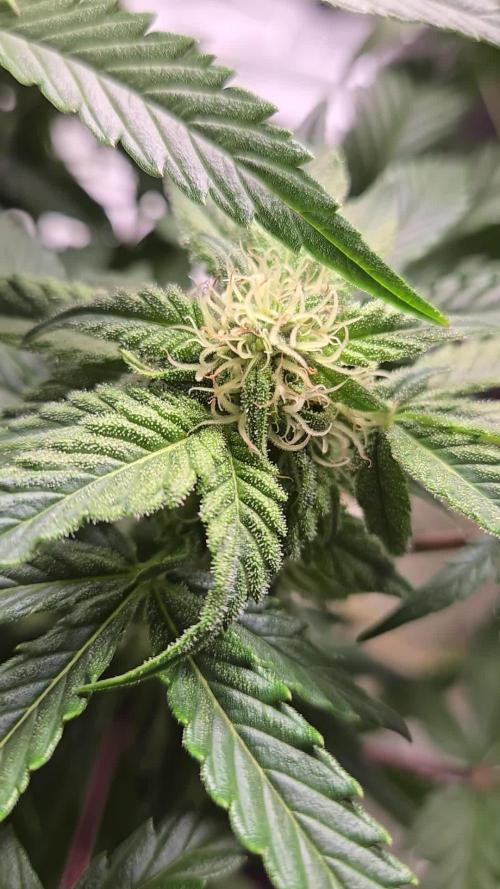
The plants are progressing well into the flowering stage. Bud development is becoming more noticeable, with small clusters starting to form and fill out. The leaves are a healthy green, though some are slightly curling down, possibly due to a bit of overwatering or humidity fluctuations. Overall, the plants look strong and vigorous. Light distance and airflow are being monitored closely to keep conditions stable. Over the next days, the focus will be on maintaining consistent watering, adjusting nutrients for mid-flower needs, and supporting steady bud growth
Likes
7
Share


@Sunstonedgrows
Follow
Well the pas week has been a lot! We had some dehydration issues, did some defolitation, and additional LST to prep for flower. Starting today, this plant has been kicked into the flower tent and will be starting its journey!
Before we went to flower, I gave this guy 1tbsp of Dr. Earth tomato blend. Over the next week or so we'll be switching to Dr. Earth flower girl.
Cheers til next time!
-Dj Sunstone

Likes
36
Share


@Terp_Djiny
Follow
Today I shortened all four plants by fimming. Let's see what will become of them.
Day 32: I think they took it well. The new shoots are growing.
Day 33: Today I actually had to repot. The roots came out from the bottom of the pots. Plant three is struggling as you can see. I hope it comes through well.
Day 35: I think the plagron light mix is too heavily fertilized. The plants give me the impression of being over-fertilized. The purple color of the stems is a hint. Then I will rinse them tomorrow.

Likes
132
Share


@Crashoverite
Follow
Hi all👨🌾👋
Welcome to my another week update
Hope everyone doing well 🧑🌾🤤
Week 3
Feb 16 - Feb 22
It was a very easy week. Both baby girls are growing steady but not in rapid speed yet. 2 waterings of 500 ml each on Feb 17th and Feb 22nd alongside with foliar feedings(100ml water and fish mix) both looking healthy and happy. LST is coming next 😁🧑🌾✨🍀
Wishing you all a wonderful week✨🍀
Much appreciate all your likes, follows and comments. 🙏💚❤️💜
Peace and love brothers and sisters 👨🌾✌️💚
Links
https://2fast4buds.com/seeds/TROPICANA-COOKIES-AUTO
https://www.biobizz.com/
https://fishheadfarms.com/

Likes
27
Share


@Jungle_James_Grows
Follow
They are looking great really really nice now starting to put some weight on and the smell is sweet and stinky.
Might add some bloom booster to help them along as well as molasses. I've got 5 of the same strain and they are all different. The one I topped seems to be doing the best.
30/8 Did a bit of a defoliation and leaf tucking tonight. They are fattening up nicely now.
Likes
49
Share


@LockDownGrow
Follow
Coming along nicely now apart from alittle cock up yesterday where I accidentally topped her while trying too lst but I have managed too tape the stem in place so I am hoping my little cock up will force the lower branches too shoot upwards while the broken stem heals ,
This week I had too change my lighting too 600 true watts of kingbo dual optical LED range due too the temps getting closer too 30c than I would like , and by doing so I have now got a constant temp of 27c lights on and 18c lights out,
Update on day 4 or week 3 ,
My little cock up snapping the main stem while trying to lst the tape seems too have really don't the trick , and although snapping the main stem is not ideal lol ,
It seems I've managed too top this plant and still get too keep the top , the leaves all look fresh and healthy and feed so I will leave the tape on there for two weeks and then try and remove it as all I had too hand was selotape lol
The breakage really do not seemed too affect the top 2 nodes at all apart from trigger the lower plant too stretch out , as this break was bad , like hanging on by a thread bad , so really shocked it took too the repair so easily , and as always I had just been leaching the soil with a single feed that lasts them 7 days , my set up is completely automated and I only go too the grow space once a week but I have a WiFi cam inside the grow space so I can check the temps and how dry the pots are just incase I need too increase the feeding , but too be fair these autos seem too have a mad feed at week 7 and 8 and then drink one feed per week , keeping it simple has helped I think as the plants seem too love it , and I don't need too do anything apart from check the camera ,
And that's just the way I like it , I pay special attention too the temps in my grow space and a calculator in hand for the nutrients ,
Other than that I leave them alone too do what they do ,
I will take some end of week 3 pics over the weekend at some point it's abit of a drive so once a week suits me down too the ground , :)
Update on day 5 of week 3 well as you can see from the photos this week has had a huge raise in production , the breakage I did too the main stem has completely healed it's self and the plant has bushed right out at the bottom and top of the plant where it broke ,
So all in all my little cock up has actually helped the plant grow larger ,
I today gave them a smaller defoliation basically anything covering a branch that could not be tucked under it I removed ,
This is too get as much light too these spots as possible too get them too develop before flowering starts ,
But so far so good , temps are good and no nutrient burns on any of the plants ,
and the results from day one / first feed on green buzz nutrients too this photo today day 5 is dramatic , the photo of all four was before defoliation , but the defoliation has just shown how busy they have this week and the bud sites on this things already is crazy , my next plan this week is too put the net in there and space out all of the branches too give the best spacing between the breaches
Likes
5
Share


@GrowFunMD
Follow
These plants are amazing!!! Sorry been too busy to post the last couple of weeks. I ended up harvesting one of the 5 plants. It was further along than the others (still pulled it too soon, but it came out amazing. Couldn't help but try it. The smell is off the chain (good)). Still have four going; they are taking their time. The second one that is furthest along is going to be the biggest plant by far. It has buds top to bottom. FAT!!!

Likes
34
Share


@Roberts
Follow
She grew really well. She developed some nice big colas. A very fruity and sweet smelling flower. It Looks to be very potent. The Medic Grow mini Sun-2 worked great during the grow. The Agrogardens nutrition also worked great during the grow. Thank you Agrogardens, and Medic Grow. 🤜🏻🤛🏻🌱🌱🌱
Thank you grow diaries community for the 👇likes👇, follows, comments, and subscriptions on my YouTube channel👇. ❄️🌱🍻
Happy Growing 🌱🌱🌱
https://youtube.com/channel/UCAhN7yRzWLpcaRHhMIQ7X4g
If anyone needs to purchase fastbuds here is a link for my affiliate program
https://myfastbuds.com/?a_aid=60910eaff2419
Likes
11
Share


@Ecogeek
Follow
Was facing some difficulty when it came to lighting (what brand, wattage, output range, full spectrum etc.) Did a watering today with a mix of Epsom salt & purified water which was the 1st nutrient mixture since my ladies been in the soil. A couple of changes made since I've joined GD is I changed the distance of lights to plant (was @ 14-18 now 20-24 inches away thanks for that folks) lighting schedule is still on a 18/6hr. Another trick I choose was the water used...it's either rain water or artesian water both help eliminate unwanted pH unbalance. This is my 1st grow and Im going to post more photos of the entire setup. If you guys&gala have any other helpful tips for a better grow lmk. I also wanted to do a LST on my autos but not quite sure when to do, they're currently coming out of week 2 into week 3 vegg mode. Every tip and hint helps so let em fly.

Likes
26
Share


@Hydro_Bins
Follow
Excellent quality and quantity with this harvest! Will look to to control the stretching phase of flowering next grow.
Likes
2
Share

@deseed_uy
Follow
Ahora siiii buenas buenas😃
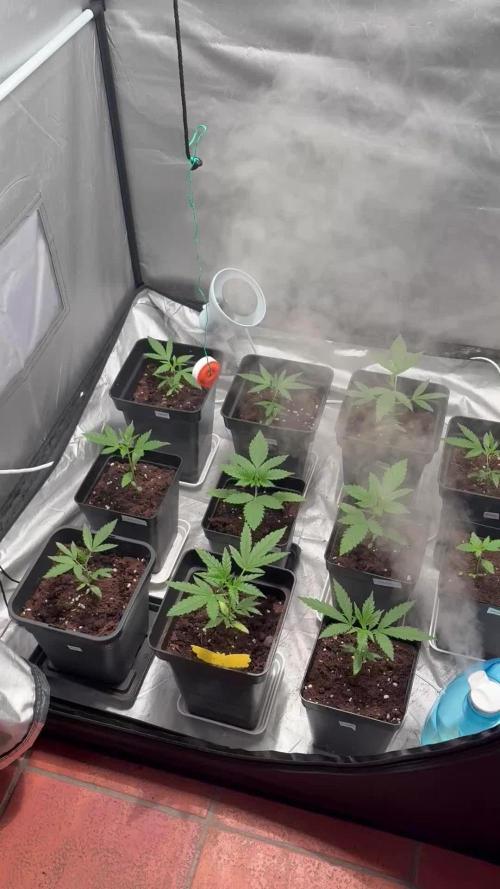
Recuperadisimas entraron en vegetativo a todo ritmo, en estos dias ya les voy a hacer apical y se viene una buena aplicacion de ipw para empezar a prevenir como tiene q ser.

Likes
7
Share


@Budking420
Follow
Shes chugging along like a steam engine! I'm so excited to have this in my arsenal. I'm also very content with the way she handled the LST. I'm sure she would be very tall without the training all of that energy would have went to the main cola. Shes budding quickly at this stage shes very happy with less soil than more as it dries quickly I hope others learn this as well. I've found using less soil is producing my largest autos with fox farm ocean forest. It's not how deep the roots go but rather how wide. Check back next week to see just how fast she buds & remember its 4:20 somewhere!!!!!!
Likes
9
Share


@TrialAndErrorGrows
Follow
Ok week 5 veg. I usually just let the plants grow through the trellis net.
This time I tried a little bit of everything. I did a fairly big trim on leaves. I tied down branches with twist ties and then lowered the trellis net overtop. I may have gone a little overboard. But looking at other peoples diary’s I am seeing a lot of techniques being used so I will giver a shot. Trial and error.
**Update**
Plants growing up through trellis nicely. After tie down and trim.