


Likes
55
Share


@Reyden
Follow
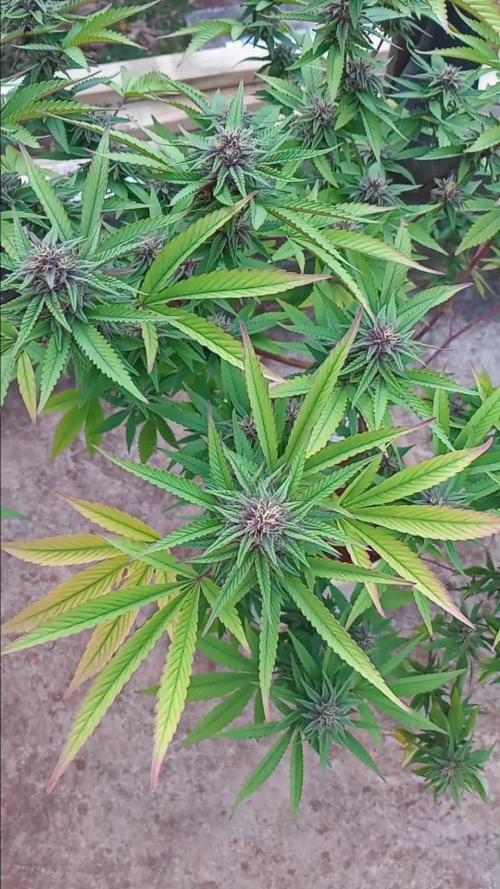
Le Royal Gorilla 🦍 stanno proprio 😌 una meraviglia, avvicinandomi sento un adore floreale meraviglioso e già posso vedere il ghiaccio ❄️ sulle foglie da zucchero, non vedo l’ora di vederle alla fine della 9º settimana come saranno gonfie e gelide 🤞🌬️🚀✨mi piace tanto questa varietà, è la terza volta che la coltivo e sono rimasto sempre soddisfatto, a parte ovviamente gli errori da coltivatore 👨🌾 inesperto ma sicuramente quelle volte ho avuto la fortuna di trovare ottimi fenotipi…cerchiamo di tirare fuori il massimo da ognuna 🤩🙌🦍📸

Likes
13
Share


@cookingwithninja
Follow
Week 5 day 1. I have a favourite for next run. I’m very happy, I haven’t really defoliated at all this grow, just letting it grow. Wish I was going for mains(topping) but still very good. Going to wait around week 9 so seeds will be good for next run. I have decided to do very hard hst next round to show max potential. Very happy with supercropping so will do it very heavy with scrog. I will try to reveg the one I really like but it is difficult having only 1 set of lights and 1 tent. Plants are about 7ft tall, might just run 2 next round in 4x8 or will still continue to go 4 in the 4x8.
Likes
13
Share


@STAYINGONMYMAINCBATORUNTWO
Follow
04/01/21
Amazing colours have came through during cure showing off her red and purple! And she’s frosty all over and tastes like a tropical dream!mango pineapple tones with a side of lime! Would defiantly recomiod
Update; colours are coming through got some amazing hues just uploaded some vids 😍
Got the green pheno on both???! But it’s but either way I love this strain tastes a lot like the black cream auto I’ve done of sweet seeds too. So many colours in the bud and the flavour is immense throughout! Tastes like tropical mango and slight pineapple with a lovely pungent limeish taste it’s so nice and the high sent me to sleep when I tested the result! Just had to lay there and close my eyes and enjoy it and woke up to the end of my film ahahah would defiantly recommend Anyone growing very easy and amazing results!


Likes
5
Share

@FourTwenty_Plants
Follow
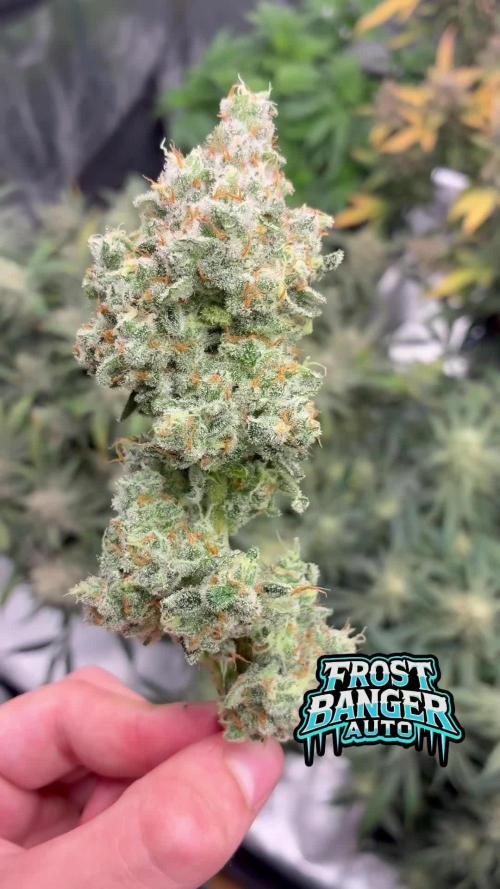
Did a partial harvest on my 1 frostbanger to let her get abit more light to the bottom. And also im prob gone wash the rest thats still on the plant.
Likes
3
Share

@Liberty420blaz
Follow
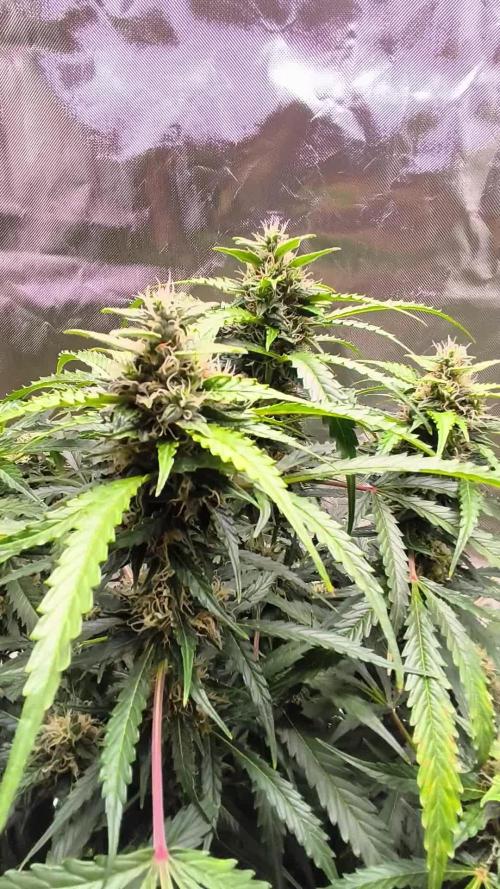
Week 6 flower
Defoliated some leave in the middle central canopy to increase airflow and prevent mold.
25°c day 20°c night 45-50 humidity
Forgot about cal mag,started spotting rust/Brown spots and purple branches, started giving 1ml/l cal mag, Wednesday 7l decholirated water with 7ml cal mag.
Think we just passed peak swell, resin production is increasing, more smell coming out.
Did some light lst on lower branches that where not getting light at all and were growing straight up in the canopy.
All in all this is looking ok, i could have used a net to keep them more spread out. We learn as we go.
30-40% brown pistils
Trichomes very visible on sugar leaves.
SF2000 upgrade went well past week. Increased intensity gradually from 70 to 100% it did increased tent temperature by 2-3 °c, adjusted room temp, + ventilator blowing between light and top of plant vertically to remove direct heat from lamp on cola's.

Processing
Likes
75
Share


@Dedon
Follow
Hi everyone ! 😀
Everything is ok, no disease, no carrency. but 2 ladies don't want to stretch a lot :/ ( the 2 on the corner, bottom left and Top right ) i don't know why. maybe it's the variety. i have 4 Skunk XL and 2 Critical. Maybe these 2 are the critical ( yes i lost them when i plant the seed 😩 ... )
No more pH fluctuation ( i love that )
EC is around 1.9/2.0 and increase to 2.1/2.2 when they drink a lot so i add water with 1.7 ec to decrease it to 1.9/2.0 again
I added 30L of water since i changed the water ( 2 tanks * 20L / i change it the 11/05/18 ) so i'm gonna change the whole solution during the week.
See you next week !


Likes
42
Share


@AsNoriu
Follow
Day 21. I post one day earlier, but its a huge week for them.
Cleared space, install chicken wire fence.
Added worm castings, epsom salt, mono potassium, calcium nitrate , Great White, Biosys and hope they will be ok.
Next visit in two weeks.
Root system was good, couple girls had mini root bound on the bottom, so timing was perfect !
Sherbet was strongest, purple haze weakest, both Apples were ok too.
Happy Growing !!!
Likes
25
Share


@Grower_Of_Persia
Follow
my dry and cure style is this:
4 days of hanging upside down to get water activity lower to around 0.6 in 50% humidity and 26 C temp (i know its a little high but we are in a hot summer right now and i cant get it lower even with air conditioner) and then after 4 days of drying i remove leaves and stalks, trim buds and move them to jar for the rest of their life :D . and in the first 4 days of curing i open the jar door and let hem get some fresh air in the jar for about 5 minutes and close the jar door again, after 4 days of curing like that buds are smokable but they will get better as they getting cured about 1 month.
buds are one of the hardest as fucking rocks type of buds! very dense , compact , sticky , smelly , amazing at every aspect
growing stage was 60 days and flowering stage was 70 days total (harvested tops at day 63th)
the total weight of dry buds was : top buds 174 G + lower buds 55 G = 229 G
my overview of strain with details:
the seeds:
unfortunately i only got 1 seed cracked out of 5 so i will not know how much this genetic can get different but at least i got the chance to grow once of this wonderful strain
the plant :
in every stage you can ensure that you are dealing with a high level plant ,
she will get big so you have to control her height LST and SCROG highly recommended , will grow very well with tick stalks and big fan leaves , has good resistance for stress and will respond very well to stress trainings , she really has gorilla power in herself ,
fresh buds on plant :
buds are very compact and dense even from start , fresh blossoms smells like pineapple and mango , 2 different shades of sweet smells like you hold 2 junks of pineapple and mango in your hand and you smell them together, she is a trichome and resin factory , very very sticky , very oily , strong smell
dried buds:
very compact and dense , hard as rocks , has dark colors with purple hues inside it , it smells sweet
smoke :
very smooth and sweet like lollipop , pineapple , mango like , after 2 minutes it'll kick in and you'll get higher and higher with every breath , has a strange and especial high mind high mostly

Likes
12
Share

@420DeepGrow
Follow
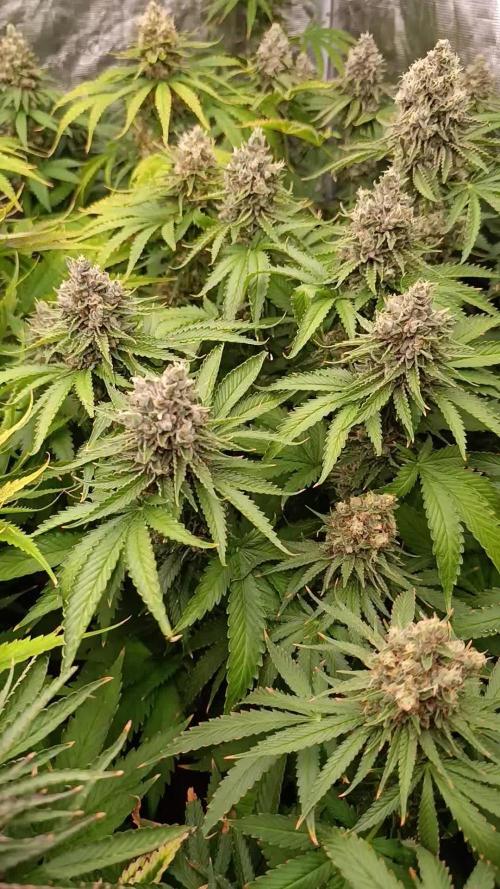
📆 Semana 8
Los cogollos continúan aumentando su densidad y dureza, mientras la producción de resina se mantiene elevada y los aromas ganan intensidad. Los pistilos siguen oscureciéndose y replegándose progresivamente, avanzando hacia la fase final de maduración.
El consumo de nutrientes comienza a reducirse ligeramente y el fade se hace más visible en algunas hojas, mientras la planta concentra sus recursos en completar el desarrollo y maduración de las flores.
⚡ EC: 1.6–1.7
💧 pH: 6.2–6.5
🌡️ Agua: 20–21°C
🌫️ Humedad: 40–45%
💡 Intensidad: 950–1050 PPFD
🔥 Nota de cultivo: Mantén una fertilización moderada y unas condiciones estables, preparando la planta para la fase final y controlando de cerca la evolución de los tricomas.
¡Seguimos creciendo fuerte! 💪!


Likes
105
Share


@StarLorr
Follow
Welcome to my autø Møøn Røck 2 Diary.
In this Diary:
Seeds: Sponsored by Ðivine Seeðs
Media: Pro~Mix HP *•ns
Nutrients: Remo Supercharged Kit *•ns
*•not sponsored
___________________________
Feeding:
Wed 30Oct: 2L Remo/Recharge pH'd 6.5
Sat 02Nov: 2L Remo/Recharge pH'd 6.5
___________________________
Senescence occurring on some lower leaves.
What a cutie with green leaves so green and the buds are coming out nicely😋
___________________________
Thanks for stopping by, likes and comments are appreciated!👊🏻😎
Keep on growin!
Keep on tokin!!!
😙💨💨💨💨💨


Likes
9
Share


@Lazuli
Follow
I think she needs 2 more weeks, she drinks slower and starts to fade on her own theres still nitrogen in the feeding
Likes
1
Share

@HoneyBlunt42
Follow
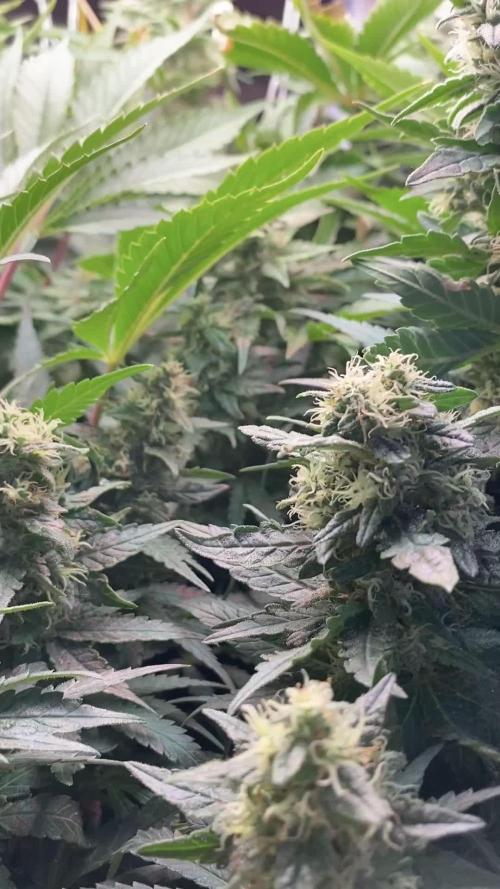
Колы набухают. Кормлю CalMag с базой, убрал PK booster. Иногда поливал не каждый день - увидел красные стебли на лопухах. Поставил на автополив, замешал 2 ml/l порцию для последних 2 недель цветения. Два других куста прошли половину сушки и усохли вполовину
Processing
Likes
2
Share


@Cogollo_eu
Follow
**Encontrarás la traducción a español al final de la descripción**
From/Desde: 30/09/19 || To/Hasta: 06/10/19
From day/Desde día: 29 || To day/Hasta día: 35
BlueBerry Cookies Diary / Diario de las BlueBerry Cookies:
https://growdiaries.com/diaries/38769-dinafem-039-s-blueberry-cookies-at-the-ocean
If you like this week, please hit a like, it costs you nothing! 👊. Thanks in advance 😉!
-----IMAGES & VIDEOS-----
V1: TimeLapse week video, at second 24 I changed the lights to full operation (notice the color change), so since mid week I'm using the full 180W instead the 90W for growing. Also today (Week 11), I purchased the Platinum P450 model to replace the P300 I have. I still don't know if I'm going to place both lights together to end this grow, or if just replace the P300 and use it to grow another plant in my 60x60 tent.
P5: A leave broken on a night photo session (last week dark photos). I'm in really love with Ocean's leaves, they are super beauty, with very bold "fingers", and very textured.
-----WEEK SUMMARY-----
This week I changed the lights to full flora mode as is recommended by the manufacturer for late vegetative grow.
They are still growing at a very good speed more than a cm per day, soon I will perform a full LST on one of them and also I will place the SCROG mesh to try to match the height of the colas. At time the 4 plants (All the cookies) are +/- the same height, but soon the BlueBerries will be bigger than the Oceans.
I see a bit overfeeding in the leaves aspect, it must be due to the guano and volcanic soil I added to Soil mix. In a couple of weeks they will look very beauty and healthy.
-----WATERING CALENDAR-----
05/10/19 DAY 34 - 1 l with all week nutrients @ (1.3 EC | PH 6.2 | 24.9ºc)
*****ESPAÑOL*****
Por favor, si te gusta esta semana dale un like, no te cuesta nada 👊. ¡Gracias por adelantado 😉!
-----IMÁGENES & VÍDEOS-----
V1: Video TimeLapse semanal, en el segundo 24 cambio las luces a full flora (se nota en el cambio de color de la imagen), así que a partir de mitad de semana empezaré a usar los 180W de mi luminaria en vez de los 90W que venía consumiendo en crecimiento. Esta semana (Semana 11) he comprado una mejora de luces, he comprado el modelo P450 de Platinum que reemplazará al P300 que estoy usando. Aún no se si voy a dejar ambas luces juntas para acabar este cultivo, o si simplemente reemplazaré el P300, y este lo usaré para crecer otra cosa en mi armario de 60x60.
P5: una hoja que se me rompió durante una sesión de fotos nocturna. Las hojas de esta genética son especialmente bonitas, con unos dedos gordos gordos y texturizados.
-----SUMARIO SEMANAL-----
Esta semana cambio el modo de la luminaria a flora, pues es lo recomendado por el fabricante para la última etapa de crecimiento.
Siguen creciendo a una velocidad excelente, más de 1 cm por día, pronto pondré la malla de SCROG para intentar ajustar la altura de las cola. Por el momento las 4 plantas (todas las cookies) son más o menos d la misma altura, pero pronto las BlueBerry pasarán en altura a las Ocean.
Puedo ver un poco de sobrealimentación por el aspecto de las hojas, debe ser debido a la tierra volcánica y el guano que le añadí al sustrato. En un par de semanas se verán super sanas y bonitas.
-----CALENDARIO DE RIEGO-----
05/10/19 DÍA 34 - 1 l con todos los nutrientes semanales @ (1,3 EC | PH 6,2 | 24,9ºc)


Likes
45
Share


@masterofsmeagol
Follow
7/3 Hot as fuck today. Japanese beetles were around. I killed a few. I'm going to have to go over and keep an eye on things. It reached 90° today for the majority of the day. I watered around 1pm as I noticed most of the bags were very light. I'm glad I held off on the BT. I've dealt with jpn beetles before so hopfully that won't be an issue. Things are getting big. It won't let me upload any pictures or the video I did. I may upload it to past week. Went back over at night and and plants looked dropy but it was after 7pm and they were just going to sleep.
7/4 Didn't take photos this morning. Found some jpn beetles. That's the damage I've been seeing. I went back over last night to hunt them but I only got two. There weren't any others. No biggie. I'll put some pics up from today after I get back
7/5 Didn't get a chance to check the plants out today. My intuition tingled around 1pm and I had just gotten home and I ran over to check them. They displayed minor signs of heat stress as seen in the pics (due to the super high humidity and 90° weather) and the bags were light. A few were REALLY light. I could see they needed water. I WATERED 4 1/2 GALLONS TO THE GARDEN. DO TO THE HIGH TENPS AND WINDS IVE HAD TO WATER THE LAST THREE DAYS IN A ROW. IVE SLOWLY STRARTED INCREASING VOLUME. I don't want to water until I get a shit ton of run off because I want to keep the nutes in my soil as long as possible. As you can see things are going great. Minor pests but notjing major. They're growing at a very rapid pace. I'll need to add another layer of supports soon and begin to LST some of these girls. I've got one seedling in a 10 gal and I'm pretty sure it's a feminized red runtz but it's in preflower and looks and SHOULD be a female but I haven't seen the white hair yet. Looks like a female preflower though. I do have one auto though in a 5 gallon tjats doing good too. I have a bunch of pics but the internet is too slow. I'll upload tomorrow. Started pouring around 6.
7/6 Poured sheet rain all night. After it had Bern super fucking hot and I watered my plants with 4 1/2 gallons. Oh well. If I didn't water we wouldn't have gotten the rain. The fabric bags makes watering easier. The wind will dry out the medium. We do have some rain in the forecast. A pallet fell over and knocked my 5 gal bucket with tje auto into a 10 gal seedling but it held the pallet up and didn't damage anything. Out of all the ways it coyldve landed it landed just right to not hurt anything. Everything is super healthy. I do have some random pest damage but it's minimal. I'll decide whether to use a spray or not. Didn't take pictures this morning. Was pressed for time.
7/7 Super hot even at 8a.m. Rained the majority of the day yesterday. Plants are getting HUGE. I'm going to have to build a second round of supports and should probably start some LSTing. They seem to like growing natural how they are (besides the original topping and FIMed. You can tell these are ALL very high % indicas. I'm seeing pistols spitting out everywhere. Event horizon and sherb cake seem to be in the lead. The seedlings have realky taken off. The one I put in the 50 has fan leaves the size of my hands.
7/8 Wow it has been extremely hot. It's going to be in the 90's again today. Checked my plants and it seems the GMOs seem to be using more water. Those bags were a little lighter. Seeing how there is no rain in for a few days I had to water. WATERED 3 1/2 GALLONS. LAST SEEDLING FINALLY SHOWED AS A FEMALE.
7/9 Bags are still heavy. Found ONE jpn beetle this morning. Plants seem to be bigger everytime I look.starying the stretch and spitting out some pistols. I took some pics of the pistles. I'll update
7/10 should've started a new week but I didn't. I'll make next week six days. Plants are starting ro stretch. Minor random pest damage but woth the heat they need lots of water. Noticed a couple dead interior leaves so I should probably go through everything and defoliate. I need to add another layer of supports as well.

Processing
Likes
14
Share


@PlantGod
Follow
Day 30 Feb. 18th- I feel like everything is going great
-all plants are now in final 7 gallon containers..have used a lot of soil!
-I have been tying the plants down as much as possible
-March 2nd will be 42 days and I think that is when I will switch to 12/12
-Day 35 Feb. 24th- I need trellis netting soon
I retie branches constantly for inner growth
HULKBERRY and GREEN GELATO are growing similar...LSD and ROYAL GORILLA are growing similar!
-Very interesting!!
* I have color coated the plants like I should have a couple weeks ago
-GREEN GELATO has all green pipe cleaners now...HULKBERRY has all yellow pipe cleaners.
very long branches and small inner growth
LSD is in all purple pipe cleaners. tying it down has done wonders! it has awesome inner growth!
Now the ROYAL GORILLA in all orange pipe cleaners! This plant is a pain in the ass lol. The inner growth and spacing is insanely close!!! so many shoots all tightly together. I have tied down anything I can. Unsure how it will work in budding next week
