


Likes
Comments
Share

@Mannirumpel420
Follow
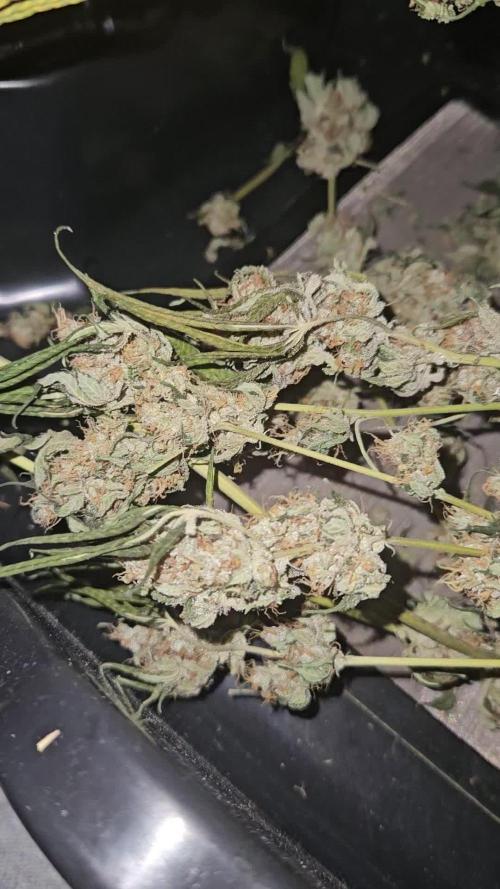
Es hat sehr viel Spaß gemacht dieses Mix Pack anzubauen und die verschiedenen Genetiken zu sehen.Jede Pflanze hatte einzigartige Merkmale.P2 hatte sehr schöne lila Töne.P3 Wurde sehr kompakt und ihre braunen Härchen sind wirklich einzigartig.P4 ist sehr kompakt gewachsen und hat sich fast gar nicht gestreckt.Sie hat auch eine sehr starke trichom Produktion und wurde sehr frostig.Deswegen versuche ich einen Steckling von P4 zu reveggen.Die mutterpflanze habe ich geerntet um die ergebnisse beurteilen zu können.

Likes
12
Share


@BudBrewerz
Follow
Very dense and sticky buds with a little purple in them , she smells very good too, looking forward to her taste


Likes
7
Share


@nedreynolds
Follow
Starting out good... going in the tent soon.
I still have to buy 2 components for ventilation... the inline fan and charcoal canister to cover what I hope will be smellin earthy and stinky and sweet very very soon.
6am 4/1 - Putting the tent up.. might not fit though.

Likes
Comments
Share


@All_about_420
Follow
Diesmal wieder ein paar mehr Bilder.
Hat sich aber auch n bisschen was getan.
So langsam streckt sie sich nach oben und wird größer.
Bisher ein sehr gutes Wachstum,
saftig grüne Blätter und gute Nodien Abstände.
Likes
24
Share


@nonick123
Follow
Semana 18 30-9-24 6-10-24
Día 122 (30/09) Riego con 750 / 1.000 ml H2O de osmosis
Día 123 (01/10) Riego con 750 / 1.000 ml H2O de osmosis
Día 124 (02/10) Riego con 500 / 1.000 ml H2O de osmosis
Hace 35 ºC de temperatura ambiente! Que barbaridad!
Día 125 (03/10) Riego con 750 / 1.000 ml H2O de osmosis
Hoy bajan las temperaturas 25-26 ºC, más normal para estas fechas
Día 126 (04/10) Riego con 750 / 1.000 ml H2O de osmosis
Día 127 (05/10) Riego con 750 / 1.000 ml H2O de osmosis
Las plantas empiezan a doblar sus ramas por el peso de los cogollos! 💪 🚀
Les aporto sujeción con cañas de bambú y cables de sujeción
Día 128 (06/10) Riego con 1 / 1,25 litro H2O pH 6,5 + Kelp Hidrolizado 0,3 g/L
Locura de día con 37 ºC y un aire caliente asfixiante!
💦Nutrients by Lurpe Solutions - www.lurpenaturalsolutions.com
🌱Substrate PRO-MIX HP BACILLUS + MYCORRHIZAE - www.pthorticulture.com/en/products/pro-mix-hp-biostimulant-plus-mycorrhizae

Processing
Likes
10
Share

@CrackinBeans
Follow
The mephisto is has bounced back and pushing hard. All the plants still have a high runoff but has been pushing hard this last week or so. Ph run off has been around 7.6 from around 8.4ph😬😬
I kinda gave up on the freeze berry but I started checking it out and I didnt notice how well the branching is on that plant and how frosty it is.
the freeze berry has been getting set up nicely hoping it fills out nicely because the branching and spacing on that one is not too shabby
I'm not sure wth is going on with the big bomb that one decided to just grow like a bush real fast and has soo many bud sites but is flowering super slow.. I started all the seeds at the same time except the mephisto is about a week or two younger than the rest.
The crystal meth is about ready I'm going to start flushing that here sometime this week when I get my new ph pen.


Likes
7
Share


@The_Doctor_Green
Follow
Hola a todos!😃
Espero que anden bien, les cuento que esta semana he regado con fertilizantes con top veg, 2ml x litro de agua, top bloom 1ml x litro de agua y lo combine con amazonia roots 1gr por litro de agua.
Los demás días he regado solo con agua, la planta se ha comportado bien al trasplante, de hecho ha crecido unos 13 centímetros en una semana.
He doblado algunas ramas hacia los laterales y la verdad que no he notado que se haya estrenado.
También realice una pequeña defoliacion y he quitado las ramas más bajas para hacer esquejes🤪🤭.
Likes
66
Share


@Experimentgreen
Follow
Getting ready for the flowering flip. I'm interested to see what their stretch will be like, this is my first time doing extensive LST....hopefully it helped out. I'm glad to see the plants are at least pretty even in height.
There's roots popping out of every piece of the fabric pots....i really wish i did a 5 gallon...i don't want to try to transplant them cause it's real difficult using a fabric pot or i have to cut the fabric.
Both plants have had more yellow pale bottom leaves so I think they must be some hungry little hippos or possibly the organic nutrients need a slightly heavier dose than recommended.
Happy holidays!

Processing
Likes
7
Share


@Kushizlez
Follow
Day 42-49
(Day 42) Just watered today but couldn’t go until runoff because I didn’t have enough RO. I forgot to add the probiotic too. Nonetheless, everything is starting to recover from those weird deficiencies and is looking super healthy. Plants are really bushing out now too. I had to top the zkittlez and BBB#3 again as they are just getting too big. Nothing is definitively showing sex yet but I’m seeing clues. Shouldn’t be long now. If I get 4 females or less I will use 10gal pots, 5-7 fem 5gal pots and 8-12 3gal pots.
I need to stop overwatering. Even though it doesn’t look too overwatered, it is much better to water a little bit each day at lights on. This will help keep the humidity down as well as deliver optimal oxygen to the roots speeding up plant growth considerably.
(Day 45) Gave an EM1 spray down today. The beneficial bacteria is said to overpopulate surfaces so powdery mildew and septoria can’t form. Something seems to be really working as I haven’t seen any yet.
(Day 47) I sealed up the tent and am running both dehumidifiers and it’s keeping the RH around a safe 70% night and day which is right on track with VPD. Plants are all looking super healthy. Deficiencies have pretty much all cleared up. Cold nights I’m running 600w and warmer nights I’ll run 400w.
I was asking around Instagram about white ash/good burn and a few different people assured me it has to do with mineral content of the soil. I was told the three best products for clean ash is glacial rock dust/basalt, oyster shell flour and langbeinite. I already have langbeinite so I’ll grab the other amendments today and top dress.
I grabbed the amendments and also got some Destiny Organics dark matter super soil, coco and some beneficial nematodes. Top dressed each amendment except langbeinite and mulched in some coco coir.
(Day 48) My shelf came in today and I think it may be to big for the 4x4 tent. Each square is 12”, not the 11.8” advertised. I could wipe down my flower room and set it up in there which would give my plants a good adjustment to the new lights before I flip. Or I could set it up in the veg tent but that seems like a huge hassle as the need to be moved and flipped soon anyway. I wish they would show sex already so I can toss out the plants I’m not keeping.
For flower I am considering starting over fresh with the new Destiny soil and coco mixed with some amendments. I’m concerned that my current mix might be too hot. I could also dilute it with the Destiny/coco mix. Those little bulb mites that came in with the worm castings are a little concerning as well. Some say they are just beneficial composters aka “worm bin mites” and others are telling me they’re predatory bulb mites which destroy crops like garlic. I’m leaning towards beneficial composters but in another grow I watched them devour a seedling before it sprouted. Gotta check the current roots but the plants aren’t quite ready to be transplanted.
(Day 49) Got everything in the flower tent wiped down and sprayed with alcohol then EM1 few hours later. Got the shelf set up and got all my temp controls set up and running. I put the controllers outside the tent this time and will patch any light leaks. Gave a lite compost tea at 830ppm and a velokelp foliar spray at 6ml/L. This will be the last veg feeding before I transplant into their final containers on the 31st.
BCTG#2 is a confirmed male and I pulled him. No one else is showing definitively. Roots looked super healthy with very few mites but I’m not 100% convinced they’re all clean. I saw a few mites on leaves today too.
Saw a bit of droop after the move but they all look happy just a few hours later.
Took a few clones from some sucker branches on a few of the blackberries.
Likes
19
Share


@Master_weeda
Follow
Bonjour à tous les padawans et maîtres jedis
Tout d'abord merci à James de Royal queen seeds de me permettre de faire cette culture
Je rappelle je n'utilise que le strict minimum du matériel nécessaire à une culture correcte au prix le plus bas possible
MATÉRIEL CONFIGURATION
Box 80×80×160
Lampe led greenception GC4 250WATTS
Ventilateur à pince 15 watts
Xiaomi Deerma humidificateurs 5L
Hygrometre thermomètre
Extracteur PROFAN 107 m3/h - 100
Prise programmable électronique ×2
1 pot geotextile noir 10 litres (RQS)
RQS feeding easy boost organic
RQS easy combo tablets
Substrat cellmax bio ligthmix
Fil de fer et pince coupante
Microscope
Petite balance de précision
CULTURE ÉTAPE PAR ÉTAPE
J'ai tout dabord fais germé ma graine avec le easy start de Royal queen seed et je suis agréablement surpris car franchement le taux de réussite est très élevé (9 graines sur 10) simple d'utilisation et très efficace.
Une fois la plantule sortie et d'une hauteur de 2 ou 3 centimètres je la prend délicatement et la place directement dans son pot définitif. Je préconise des pots allant entre 10 litres et 15 litres pour des autofloraisons cultivées en intérieur.
Le pot aura été préalablement préparé (video dans diarie) avec 50 grammes d'engrais RQS easy boost organic, soit l'équivalent de à peu près 5 grammes par litre de substrat.
Je dépose donc la plantule dans son pot définitif je recouvre un peu de avec de terre je tasse légèrement et j'arrose pour garder le substrat humide pas plus
Je place ma lampe led 300watts à environ 90 centimètres de la plantule avec un cycle de lumière de 24/24 pendant une semaine. Au début de la semaine 2 le cycle de lumière passera en 20/4 grace a un programmateur car c'est pour moi le cycle de lumière qui offre le meilleur rendement pour une autofloraison.
Jour1: léger arrosage
Jour2: léger arrosage
Jour5: préparation de 3 litres d'eau ph6.3 à laquelle j'ajoute une tablette grow easy combo RQS ensuite arrosage avec 1,5 litre d'eau ph6.3

Processing
Likes
81
Share


@NugLife420
Follow
I am pretty excited. 🙂. They are coming along nicely. The ladies arms are getting more and more swollen every day. The stretch has stopped. I have done some more defoliation (can't keep my hands away from the damn scissors. Lol). I will update throughout the week. 😎


Likes
1
Share


@Ultraviolet_
Follow
Turned off IR @ nights
Red wigglers (Eisenia fetida) are highly beneficial. They are considered an ideal choice for "no-till" or container-based organic growing because they live in the upper layers of soil, feeding on organic mulch rather than the plant's root system. Red wigglers accelerate the breakdown of organic amendments and produce high-quality, nutrient-dense worm castings directly in the root zone. Clover is another exceptional component of an organic rhizosphere, offering a sustainable, self-sustaining alternative to synthetic nitrogen fertilizers produced via the energy-intensive Haber-Bosch process. By forming a symbiotic relationship with Rhizobia bacteria, clover converts atmospheric nitrogen N2 into ammonium NH4, providing a steady, slow-release nutrient source that enhances soil health and reduces environmental impacts. Red clover offers superior nitrogen fixation and biomass production compared to white or yellow clover, making it the premier choice for maximum soil vitality, particularly for improving soil structure and providing a high-volume nitrogen credit for subsequent crops.
If it is fully functional and efficient soil, the rhizophagy cycle is far superior long-term than any synthetic delivery when it comes to preventing deficiencies, not because it's "better," per se. The medium will require a very high CEC to make it to harvest without re-fertilization. The rhizosphere acts as a dynamic, interactive exchange where plants and soil microbes trade resources based on immediate needs. When a plant lacks a specific nutrient, it changes its physiology and releases specialized chemical cocktails—root exudates—into the surrounding soil. These exudates, which include sugars, amino acids, and organic acids, serve as a "shopping list" to attract specific microorganisms, which in turn return higher levels of desired nutrients. There is nothing in comparison to synthetic delivery, which causes plants to stop producing exudates, effectively "starving" the beneficial soil life, over time turning the soil barren and void of microbial life. Responsible use, applying the right amount at the right time, can minimize these negative effects. Relying solely on synthetic fertilizers without replenishing organic matter is what typically leads to exhausted soil. The use of synthetic fertilizers can utilize the Cation Exchange Capacity (CEC) of the soil, but without a robust rhizosphere and active microorganisms, the efficiency of this process is significantly reduced. This makes synthetic growing more difficult to prevent deficiencies overall compared to an efficient organic living soil with a robust rhizophagy cycle, as there is no "one size, fits all" when it comes to different nutrient profiles of strains/genetics, making it trickier to "guess" and prevent creeping deficiencies.
CEC does not contribute towards EC. Add more CEC using biochar, problem solved. If you keep pH between 6.3 and 6.7, hydrogen is exudated to cycle the medium's CEC for its needs. Keeping the pH between 6.3 and 6.7 creates an environment where plants release H+ to displace positively charged nutrients (like Ca2+, Mg2+, K+ held on soil particles or within artificial media this cycle through nutrients via the medium's Cation Exchange Capacity (CEC)
Microorganisms generate a stable potential of approximately 0.5 V EC. The rhizosphere creates its own food, similarly to chelation, using 1000's of varying combinations to create its own food.
Start to finish, just add water. Eventually, more materials will need to be added at the beginning of each new grow, but very attainable to go from seed to harvest without ever fertilizing, regenerative cultivation.
ATP is king above all else when it comes to biomass accumulation. Cellular root respiration and cellular respiration are essentially the same biological process, the breakdown of glucose to create usable energy (ATP) in the presence of oxygen, just taking place in different parts of the plant. Synthetic (salt-based) grows have significantly lower levels of total rhizosphere respiration, often referred to as root-zone activity, compared to organic living soil grows. While the plant roots themselves may respire in both systems, the surrounding soil ecosystem in a living soil setup is vastly more active, teeming with bacteria, fungi, and beneficial microorganisms.
2 pools of ATP, it won't double in growth buuuut, but improving root respiration by ensuring high oxygen in the soil is crucial. Good aeration ensures roots can fully utilize glucose to generate the ATP necessary for nutrient uptake, leading to healthier and more productive plants, even if growth isn't exactly doubled. The ATP created using root respiration is dedicated to rootzone growth; the ATP created using regular cellular respiration in a synthetic system would have to dedicate a lot of ATP to the roots when there is little or no root respiration. It's true that there is less of an initial ATP cost in breakdown when nutrients are already in their final form (synthetic), but you lose a solid chunk of ATP when the entire plant is reliant on cellular respiration alone; a large portion of ATP is dedicated to root zones for "forced" (active) nutrient uptake. Making it overall less efficient, even if the initial cost of breakdown is higher. If that makes sense. Oxygen is of critical importance when growing in living soil compared to synthetic methods because it supports the metabolic needs of the microbial, fungal, and insect ecosystem, rather than just the root respiration required by the plant itself. While synthetic grows can survive in lower-oxygen environments with precise mineral feeding, living soil systems rely on aerobic microbes to decompose organic matter (microbial mineralization) to create plant-available nutrients, which is an oxygen-intensive process. While a specific fair percentage is difficult to guess, my experience points to a massive, compound difference between the two methods and the amount of oxygen required. All the ATP spared is used on more biomass, not only that, but the extra root respiration can achieve a much higher CO2 compensation point naturally than you could with synthetic and atmospheric CO2 alone.
As a plant grows faster and increases in size, its demand for nutrients to support that growth increases, requiring a higher rate of nutrient uptake. As plants enter phases of rapid vegetative/floral growth, their metabolic demand for nutrients increases exponentially. Without a robust buffer zone—whether in the soil (cation exchange capacity) or in a hydroponic reservoir—deficiencies will occur rapidly because the instantaneous demand for specific nutrients can quickly exceed the rate of supply.
A growing body of evidence suggests that organic living soil provides superior long-term soil health and environmental benefits compared to synthetic fertilizers, which are often criticized for promoting a cycle of dependency and degradation. While synthetic fertilizers offer short-term convenience and high yields, they often come at the expense of long-term soil health, sustainability, and increased corporate control over growers/ farmers. Organic living soil, while slower and requiring more care to establish, creates a sustainable, resilient, and, ultimately, more fertile environment.
We don't grow; we facilitate energy conversions.
Once all water is removed, approximately 95% to 97% of a plant’s dry matter consists of carbon, oxygen, and hydrogen. These three elements form the structural backbone of all plants. Corporate interest sells you the other 3-5% NPK & all the rest in RATIOS! Why not throw the 3-5% in a pot, and focus your energy on the other 95-97%?
Indigenous Amazonians created, or at least significantly enhanced, the fertile, dark soil known as Terra Preta de Índio (Portuguese for "Indian Black Earth") by incorporating biochar and other organic materials into the soil. This anthropogenic (human-made) soil technique, which dates back roughly 2,500 to 8,000 years, allowed ancient civilizations to flourish in regions with naturally poor, acidic, and nutrient-poor tropical soils.


Likes
12
Share


@ELPIRATA
Follow
Todo parece ir bien por estos lados, Lo importante es que las raices estan haciendo una fiesta en el sustrato!!! 😎
Hoy comienza la 4ta SEMANA! Dia 22 de cultivo, y 100% motivado por este mundo maravilloso!
- Se realiza una pequeña poda en las partes bajas de las 4 plantas, por motivos de precaucion a la aparicion de algun agente perverso que pueda estropear lo avanzado.
(Se aplica folear Knactive X3 ML)
*El día de hoy 28/05/2020 se han regado 3 plantas en macetas de 11 litros:
X2 Semillas Auto Lemon Kix= 500 ml [3mlKnactive+3ml/L ATAGrowth-C+2mLTopCrop-TopAuto] PH 6.0 / EC= X Tº=22
X1 Semilla Auto Tutankhamon= 500 ml [3mlKnactive+3ml/L ATAGrowth-C+2mLTopCrop-TopAuto] PH 6.0 / EC= X Tº=22
(Proximo riego se incorporara al parecer Flower-C de ATAMI)
*El día de hoy se han regado 1 planta en macetas de 7 litros:
X1 Semillas Auto Lemon Kix#3 = 350ml [3mlKnactive+3ml/L ATAGrowth-C+2mLTopCrop-TopAuto] PH 6.0 / EC= X Tº=22
*El dia de hoy 29/05/20 se realiza de manera experimental, LST nivel novato, Me gustaría sus consejos. próximamente incorporare Red SCROG de 49 espacios.
*El día de hoy 01/06/2020 se han regado 3 plantas en macetas de 11 litros:
X2 Semillas Auto Lemon Kix= 500 ml [1mlKnactive+3ml/L ATAGrowth-C+3mL ATAFlower-C] PH 6.2 / EC= X Tº=23
X1 Semilla Auto Tutankhamon= 500 ml [1mlKnactive+3ml/L ATAGrowth-C+3mL ATAFlower-C] PH 6.2 / EC= X Tº=23
*El día de hoy se han regado 1 planta en macetas de 7 litros:
X1 Semillas Auto Lemon Kix#3 = 350 ml [1mlKnactive+3ml/L ATAGrowth-C+3mL ATAFlower-C] PH 6.2 / EC= X Tº=23
CONSEJOS ?
BUENOS HUMOS!!!


Likes
92
Share


@DogDoctorOfficial
Follow
Harvest Notes ✂️
• Harvest Timing: Papaya Zoap was harvested at day 63, with select buds taken earlier at day 56 due to mold concerns.
• Drying: After careful trimming, the buds were dried for 12 days. The quality and aroma during drying hinted at the stellar smoke to come.
• Density & Yield: Buds were rock-solid, delivering an excellent yield with perfect density for storage and enjoyment.
Terpene Profile & Aromas 🍋
• Primary Aromas: A tropical explosion with sweet papaya upfront, complemented by creamy, soapy undertones that make her truly unique.
• Complexity: As the buds cure, a hint of citrus zest and exotic fruit emerges, creating a full-bodied terpene profile that’s simply irresistible.
Cultivation Experience 💡
• Highlights: Her uniform growth, heavy trichome production, and response to super cropping made her a delight to grow. She thrived under careful spectrum adjustments and defoliation, showcasing her adaptability and vigor.
• Challenges: The dense bud structure made her more prone to mold, especially in a high-humidity environment. However, proactive monitoring and swift action mitigated the spread.
Verdict: 🌟🌟🌟🌟🌟🌟🌟🌟🌟🌟 (9.8/10)
Papaya Zoap is a strain that commands attention with her beauty, aroma, and unstoppable growth. While her susceptibility to mold required extra care, her overall performance, yield, and quality were nothing short of exceptional. A grower’s dream and a frosty masterpiece!
Stay tuned for their individual harvest reports, smoke reviews, and more as we wrap up this epic series!
Discount Codes so you can save big on your next check out 💚💚💚
Kannabia - DOGDOCTOR 30% off
SeedsmanSeeds - DOGDOCTOR 10% off
CannaKan- DOGDOCTOR 15% off
terpyz.eu - DOCTOR 15% off
The Neutralizer - PORKIT5-DOG 15% off
Fast Buds - DOGDOCT 15% off
As always thank you all for stopping by, for the love and for it all , this journey of mine wold just not be the same without you guys, the love and support is very much appreciated and i fell honored and so joyful with you all in my life 🙏
With true love comes happiness 💚🙏 Always believe in your self and always do things expecting nothing and with an open heart , be a giver and the universe will give back to you in ways you could not even imagine so 💚
Friendly reminder all you see here is pure research and for educational purposes only
Growers Love to you all 💚💚💚


Processing
Likes
4
Share


@Fluffhead
Follow
I've overwatered my plants the past 2 times, so I let them go through the whole drying cycle which took all week. I'm feeding them tomorrow morning. I put up my trellis and trained a couple branches and tops are already evening out. I also battled some fungus gnats this week.

Likes
43
Share


@Sabac
Follow
16 plantitas maravillosas
Dieron un resultado excelente
Aromas y sabores intensos
Plantas de cores sorprendentes.


