


Likes
Comments
Share


Processing
Likes
17
Share


@DudeGrowsWeed
Follow
Alien Vs Triangle growing strong, Nice amount of growth in the past week. I'm thinking of giving her a 90 degree LST bend in about a week since that seemed to work really well with my Mexican Airlines.

Likes
6
Share

Likes
6
Share


@JohnnyBarrel
Follow
Week 15 - Flowering week 7 (November 1 - December 19)
Harvest approach, may be 2 weeks more; depending to the strain.
-CaiFunk will be ready soon, flowers are compact, covered with resin. .
-Green Punch, despite of the damages, this strain seems to have a good flowering potential: resinous and aromatic.
-Royal Gorilla is pretty advanced, pistils are turning brown and buds are meaty but still growing. Strong smell.
-Bubbie Gum healthy, not ready for now, I suspect a sort of stagnation but it’s may the strain.
-Sour Glue need more weeks, correct flowering, subtil aroma.
-AK 47 is attacked by aphids, one more time: the only target of the room. I treated with black soap and hoppe to keep the plant relatively safe till the end.
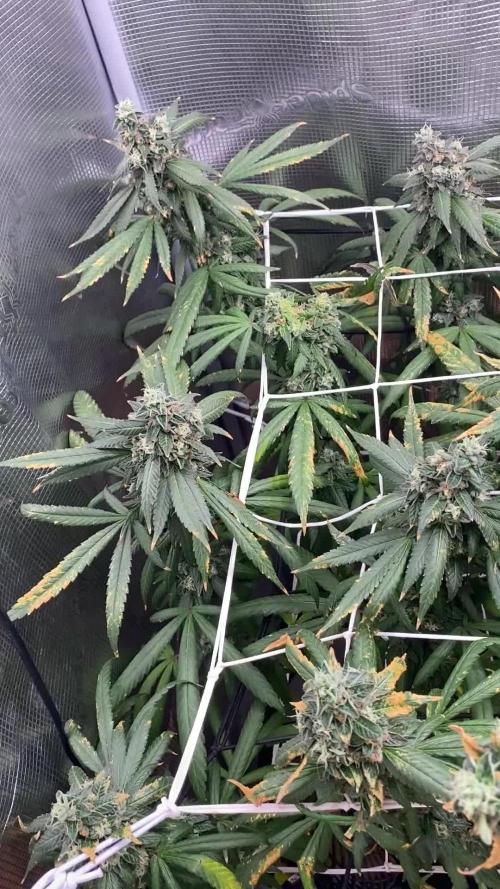
Signs of potassium deficiency on every plants: leaves are turning yellow and brown.I added PK 13/14 and Overdrive (PK boost).
Light Mars Hydro Ts 1000 x 2 - 100%
Watering: 2L/48h
Nutrients:
Week 14: Calmag + Grower Master Flo + Bud XL
Calmag + Grower Master + PK 13/14
Calmag + Overdrive + Pure Zym
Week 15: Calmag + Pure Zym + PK 13/14
Calmag + Pk 13/14 + Bud XL


Likes
10
Share


@jermainemorris2011
Follow
Noticed that four out of the five plants have began to pre-flower at week five so I’m beginning to switch my nutrients from grow to bloom and soon after that I’ll be adding my bloom booster..I’m wondering if I should Switch from my grow nutrients to my bloom nutrients as soon as I seen those pistols or should I give it another week

Likes
110
Share


@FoTwenny
Follow
••••••••••••••••••••••••••
Sept. 26 - Oct. 2
Week 8 of 12/12
••••••••••••••••••••••••••
WEEKLY SUMMARY:
••••••••••••••••••••••••••••••••••••••••••••••••••••••••••••••
🙋♀️Fo' Twenny here!🙋♀️
We're back with another update on our 👴🏽💜 GRANDADDY PURPLE cultivar bred by BLIMBURN SEEDS! It's week 8 and all she is looking great as she progresses deeper into senescence; however, she is still a bit greener than either of her tent mates! She just seems to get frostier ❄️ by the day and her fragrance smells a bit sweeter than last time I ran her. I love her colors, the pink and yellow contrast is just beautiful! I keep checking trichomes, but still not a lot of amber. Maybe another week or more.
Also, I realized my BlueLab Conductivity Meter has the option to switch to EC. Since EC is the most accurate way to measure the nutrient concentration in a solution, I will now be measuring and reporting EC readings rather than PPM.
Any advice, suggestions, or constructive criticisms are always welcome.
Now, for the weekly break down!
••••••••••••••••••••••••••••••••••••••••••••••••••••••••••••••
THIS WEEK'S BREAK DOWN
••••••••••••••••••••••••••••••••••••••••••••••••••••••••••••••
9/26 - Day 50 of Bloom
°°°°°°°°°°°°°°°°°°°°°°°°°°°°°°°°°°°°°°°°°°°°°
- Upgraded from 8k BTU to 14k BTU portable AC unit!
- Light selective defoliation. 🌿
🚿FEED DAY!🚿
- She received approximately 2.5 gallons of nutrient solution. I mixed 8 gallons of solution for all the plants I have in flower. 2.5 gallons of that was then measured and fed to this cultivar. After 10-15 minutes I added additional 12 oz of plain H2O pH to 6.3
👩🔬NUTRIENT SOLUTION👩🔬
⬇️Mixing Rundown⬇️
- The solution starts with 12 gal tap H2O through two kdf filters mixed in a 36 gallon reservoir. The solution is applied via wand sprayer powered by a submersible pump attached to a garden hose. Nutrients and additives are added to the reservoir in the order listed below and thoroughly mixed using a plastic stir spoon. The reservoir is oxygenated by four 4 inch air stones.
Start pH: 7.9
PPM: 630
1.5 tsp/gal - Fox Farm BIG Bloom
1 tsp/gal - Fox Farm Tiger Bloom
1.5 tsp/gal - Fox Farm BEMBÉ
.125 tsp/gal - Fox Farm Cha-Ching
I always make sure pH is in the range of 6.0- 6.6 prior to adding any microbial innocclants.
pH: 5.8
Add 1 tsp/gal General Hydroponics pH UP
pH: 6.2
PPM: 1160
Mammoth P. - 0.6 ML/gal
••••••••••••••••••••••••••••••••••••••••••••••••••••••••••••••
9/30 - Day 54 of BLOOM
°°°°°°°°°°°°°°°°°°°°°°°°°°°°°°°°°°°°°°°°°°°°°
📸 PHOTOSHOOT! 📸
🎥 FILMING! 🎥
••••••••••••••••••••••••••••••••••••••••••••••••••••••••••••••
10/2 - Day 55 of BLOOM
°°°°°°°°°°°°°°°°°°°°°°°°°°°°°°°°°°°°°°°°°°°°°
🚿FEED DAY!🚿
- She received approximately 2 gallons of nutrient solution. I mixed 6 gallons of solution for all the plants I have running in this SOG. 2 gallons of that was then measured and fed to this cultivar. This week I used some gallon bottles filled with water and frozen to lower temps in the reservoir.
👩🔬NUTRIENT SOLUTION👩🔬
⬇️Mixing Rundown⬇️
- The solution starts with 6 gal tap H2O through two kdf filters mixed in a 36 gallon reservoir. The solution is applied via wand sprayer powered by a submersible pump attached to a garden hose. Nutrients and additives are added to the reservoir in the order listed below and thoroughly mixed using a plastic stir spoon. The reservoir is oxygenated by four 4 inch air stones.
Start pH: 7.8
Start EC 1.0
TEMP: 69°F
.75 tsp/gal - Fox Farm BIG Bloom
.5 Tsp/gal - Fox Farm Tiger Bloom
.75 tsp/gal - Fox Farm BEMBÉ
.0625 tsp/gal - Fox Farm Cha-Ching
Our target pH is in the range of 6.0- 6.6 prior to adding any microbial innocclants. pH already in range, no adjustments needed.
pH: 6.5 (No adjustments needed)
EC: 1.5
TEMP: 60 °F
Mammoth P.
.6 ML/gal
••••••••••••••••••••••••••••••••••••••••••••••••••••••••••••••
SUPPLIES & EQUIPMENT
CURRENTLY IN USE:
••••••••••••••••••••••••••••••••••••••••••••••••••••••••••••••
• A/C: Whynter ARC-14S 14,000 BTU Dual Hose Portable Air Conditioner
• TENT: VIVOSUN 48"x24"x60" Mylar Hydroponic Grow Tent with Observation Window & Floor Tray
• POTS: Black 8"tall Active Aqua brand 6" x 6" one gallon square pots/Black 12" tall Active Aqua brand12" x 12" 3.4 gallon square pots
• VEG/AUTOFLOWER INTAKE FAN: None (PASSIVE)
VEG/AUTOFLOWER EXHAUST FAN : VIVOSUN 6 Inch 390 CFM Inline Duct Fan with Variable Speed Controller
• BLOOM INTAKE FAN: VIVOSUN 6 Inch 390 CFM Inline Duct Fan with Variable Speed Controller
• VEG/AUTOFLOWER EXHAUST FAN : VIVOSUN 6 Inch 390 CFM Inline Duct Fan with Variable Speed Controller
• BLOOM EXHAUST FAN: AC Infinity CLOUDLINE T8, Quiet 8” Inline Duct Fan with Temperature Humidity Controller - Ventilation Exhaust Fan
• VEG/AUTOFLOWER AIR MOVEMENT: 6-Inch Lasko FBA 2004W 2-Speed Clip Fan
• BLOOM AIR MOVEMENT: One Honeywell TurboForce Air Circulator Fan Black, HT-900 and Three 6-Inch Lasko FBA 2004W 2-Speed Clip Fans
• Bluelab PENPH pH Pen Fully Waterproof Pocket Tester
• Bluelab PENCON Conductivity Pen Fully Waterproof Pocket Tester
• Kolder Multi-Purpose Liquid and Dry Measuring Cup, 16-Ounce
• Fox Farm Measuring Spoons
• WATER TREATMENT: Tap H2O run through two AQUACREST Garden Hose Water Filters to remove chlorine and chloramine.
– COMING SOON: Hydro-Logic 31023 1000-GPD Evolution RO1000 High Flow RO System, White (HL31023).
• WATER APPLICATION: I use 2 different watering systems. The pump sprayer is typically used in early veg, between feeds, or for lighter feeds. Most feeds are usually run through the pump and reservoir because it's faster and easier when dealing with larger volume feeds.
– 2 GALLON LAWN & GARDEN PUMP PRESURE SPRAYER. * I removed the spray head due to clogs and it's just faster.
– Superior Pump 91250 Utility Pump, 1/4 HP in a heavy duty 27 gallon Tote attatched to a 10 foot garden hose to an Orbit Underground 56246 Green Thumb 9-Pattern Telescoping Wand.
– Aeration of the reservoir is accomplished using a General Hydroponics HGC728040 Dual Diaphragm Air Pump 320 GPH 4 Outlet attached with standard aquarium air hose to four 4-Inch Air Stone Disc Bubble Diffusers.
• VEG/AUTOFLOWER LIGHTING: 320w MosterBoard V4-PLUS powered by a MEANWELL 320H-48AB DRIVER. There are three V4-PLUS boards prewired and mounted on a 935x195x10mm black heatsink. Dimmer, UV Switch, and IR Switch included. Each board contains two hundred fifty two 3000k lm301h diodes + twelve Osram 660nm diodes plus 4 separately switchable LG UV 395nm diodes and 4 separately switchable Osram IR 730nm diodes.
• BLOOM LIGHTING: Two custom mounted lighting units: Each mount has one 480w MEANWELL 480H-48B driver and one 240w MEANWELL 240H-48AB powering 6 KingBright Quantum Boards. Each board contains two hundred fifty two 3500k lm301h diodes + twelve CREE XP-E2 660nm diodes plus four separately switchable CREE XP-E2 730nm diodes and four LG UV 395nm diodes. Hanging between the two mounts are two additional quantum boards with two hundred fifty two 3000k lm301h diodes + twelve 660nm diodes plus four constant power 730nm IR diodes and four 395nm UV diodes. That's a total of 1680 watts of quantum board power in our 96" x 48" bloom tent!
⚠️ ALL DRIVERS MOUNTED REMOTELY IN AN AIR COOLED BOX INSTALLED BETWEEN THE FILTER AND EXHAUST FAN ⚠️
• SLMOTO Universal Oil Drain Pan, 2 Gallon (8 Liter) Capacity ABS Low Profile Oil Drain Pan w/Spout Fit for Motorcycles
• Modified Botanicare Low Tide LT Black Tray - 4' x 4' - Modification: Cutaway at corners and used flex-seal tape to create a new edge that will be soft to fit between tent supports. She is supported by 6 Standard Cored Concrete Blocks (Common: 4-in x 8-in x 16-in; Actual: 3.625-in x 7.625-in x 15.625-in). ⚠️THIS TRAY WILL NOT FIT BETWEEN SUPPORTS IN A 48" x 48" or 48" x 96" TENT WITHOUT MAKING MODIFICATIONS TO THE TRAY!⚠️
• Blue Sticky Pads
• Yellow Sticky Pads
••••••••••••••••••••••••••••••••••••••••••••••••••••••••••••••
SOIL MIX DETAILS:
••••••••••••••••••••••••••••••••••••••••••••••••••••••••••••••
All components were mixed into a 50 gallon tote that is kept in a warm environment to help innocculate to promote a vast and diverse microbial life in the rhizosphere. Once mixed, add 32-64oz water once every 7-14 days as needed. The goal is to keep the soil moisten without oversaturating.
2 Part - Royal Gold Tupur
INGREDIENTS: Coco fiber, aged forest materials, perlite, and basalt
1 Part - Fox Farms Ocean Forest
INGREDIENTS: Aged forest products, sphagnum peat moss, earthworm castings, bat guano, fish emulsion, and crab meal.
1 Part - Roots Organics
INGREDIENTS: Perlite, Coco Fiber, Peat Moss, Composted Forest Material, Pumice, Worm Castings, Bat Guano, Soybean Meal, Alfalfa Meal, Fishbone Meal, Kelp Meal, and Greensand. Also contains beneficial mycorrhizal fungi: Funneliformis mosseae, Rhizophagus intraradices, Septoglomus desertícola
.5 Part - Wiggle Worm Soil Builder Pure Earthworm Castings
.5 Part - Ancient Forest Humus
.5 Part - Coarse Grade Perlite
Inocculated by mixing 1 cup of Extreme Gardening Mycos
Watered with pH 6.5 h2O
1 Tsp/gal Real Grower's Recharge
1 tsp/gal Hi-Brix Molasses
2 tsp/gal Fox Farms Kangaroots
••••••••••••••••••••••••••••••••••••••••••••••••••••••••••••••
Want to see more cultivars I have growing❓
Please, be sure to check out my other diaries & give me a follow! 👍👍
🙏Thank you for stopping by my garden!🙏
Peace, ☮️✌️
Love, 💚🤟
& Frosty Nugs! ❄️🌲
Happy farmin' my friends! ☺️🌱
- Fo' Twenny 👩🌾🏻

Likes
68
Share


@Prototype0181
Follow
The cherry's are doing great and they look phenomenal 👌 With their next transplant to 7gal airpots, i gonna put 1 in plagron bat-mix combined with the bio tabs range for optimal taste👌

Likes
39
Share


@Randyb4
Follow
Day 120 First Day of the week, 46 days of flowering.
Day 123 49 Days of flower
Trichomes look about ready of Plants B and D.
Day 124 50 Days of flower, First day of Week 8 of flower
Chopped plants B and D( had to chop in sections, because of the trellis net), hairs were mostly orange/brown, soil was dry, cut off most of the dead and dying fan leaves. Buds look beautiful. Hang drying at 65°F@50%RH. Plenty of airflow, but not blowing on the plants. Watered Plants A and C with 2 gallons of plain non ph'd water. PH shouldn't matter at this stage in the grow.
Day 126 52 Days of flower
Watered with 2 gal of spring water non ph'd.


Likes
2
Share


Likes
7
Share


@ChitownCannaChica
Follow
Flushing this week. She seems to be pushing more white pistols and will be ready next week. Smells like melon! Really nailed the terps! Just kind of left it alone and easy peezy.
Humidity has been tough to control but running the dehus no stop!
Likes
14
Share


@GoldenWeedGrower
Follow
D92/F48 - 01/07/23 - 👉👉👉 First Havest, I cutted the main buds and left the others for one more week. Now I'm going to put only the timelapse video and then all details in the next week
D93/F49 - 02/07/23 - Secondary grow with flushing
D94/F50 - 03/07/23 - Secondary grow with flushing
D95/F51 - 04/07/23 - Secondary grow with flushing
D96/F52 - 05/07/23 - Secondary grow with flushing
D97/F53 - 06/07/23 - Secondary grow with flushing
D98/F54 - 07/07/23 - Secondary grow with flushing
Likes
3
Share


@cmstacker01
Follow
Good yielder, give them least 9 week flowering.
Can take a good feed, i suggest to cut of N last 2 weeks.
Had 2 pheno. 1 is very bubblegum type of smell and the other is just slight fruity.
Harvested 3 plants.
1 was 56.20 dry at 52%RH
2 was 52.33 grams dry at 52%RH
3 was 80.23
grams dry at 55%rh
Total=188.76 grams for
3 plants
All the plants Peyote critical Orange SHerbert Candy Dawg where flowered under 300W Led
Organic way.
Total sum of grams for all plants 401.32 grams
= 1.3333gram per watt
Will i be growing this for the future? Nope, i'm looking for something more unique for my taste.
Imo pretty generic kind of weed.
Will update later for taste after 4 week cure


Likes
101
Share


@DogDoctorOfficial
Follow
OMG the smells are becoming so intense, from lemon to the sweet caramel mix with chilies and a touch of pine trees, i think i cant put in words what im smelling and were is taking my mind, but i can tel this, what an amazing combination of fragrances that are flying around
The tricomes are shouting up as they become fatter and frostier, all cristal clear so far, i think i still have 3 mb 4 more weeks to harvest, lets see 😜
Just calculate my VPD and it’s 0.98 kPa need to increase this up to 1.2 for now s i’m moving my ligth up a bit and see if it works 🙏🤓🙏
Thank you all for following, comment, like and all 🙏 100 likes 😅🙏 🙌🙌🙌🙌🙌🙌🙌🙌 ❤️❤️❤️❤️
Loving this LED Tec 😍
Girls:
1-BlueBerry
2-Alaskan Purple
3-Poyote Gorilla
4-Hindu Kush
5-Whitw Mango
6-Super Glue
7-Badazz Cookies
8-S.A.D.
tent -8x8 / 2.4x2.4 but i'm only using 1/2 so 4x4 / 1.2x1.2
Led - Lumatek 465w Compact Pro at 100%
All i Grow is medicine for myself,
Stay safe, stay tuned and B Happy
Peace out
D





Likes
10
Share


@DaddyPrime2
Follow
6/19/2024 this plant is short and stinky as fuck even as a cutting. Excited for this next run I'm doing. The last clones from this nursery, were the rs11 and purple octane and those were phenomenal. Let's see where this goes yall
6/25 been staring at her trying to envision how to go about training or topping. She's short and the lower branches are fairly prominent and reaching close to main stem. I will probably Top her after she starts growing regularly and gives me some more to work with.
Likes
21
Share


@CanadianFillmore
Follow
Welcome growfessors 👽 to another episode of growfessor theatre, 4x4 edition. Week 5F begins for the ladies and they are looking good! Frosty trichomes are displaying themselves and bud sites are bulking up!! 🌳💚
Thanks for tuning in growfessors 👽🌳💚, tune in again for another episode!
Likes
11
Share


@Karl_Heinz420
Follow
Tag 10 🌺
Die Ladys befinden sich voll im Stretch. Besonders die Pure Kush von OSS hat in den letzten Tagen ordentlich an Höhe dazugewonnen 🙌🏼 Die Pure Kush wird täglich mit 1,5l Osmosewasser gegossen, die zwei Ladys vorne (Bruce Banner #3 - links und Critical Kush - rechts) fordern lediglich alle zwei Tage 1,5l Osmosewasser.
Tag 12 🌺
Lollipopping 🌳 - 🌿
Tag 13 🌺
Sanlight Evo 3-60 100% (1000-1200 PPFD)
Temperatur: 24-27 grad Celsius
r.Lf.: 50-57%

Likes
14
Share


