


Likes
Comments
Share




Likes
16
Share


@BudsBanditUK
Follow
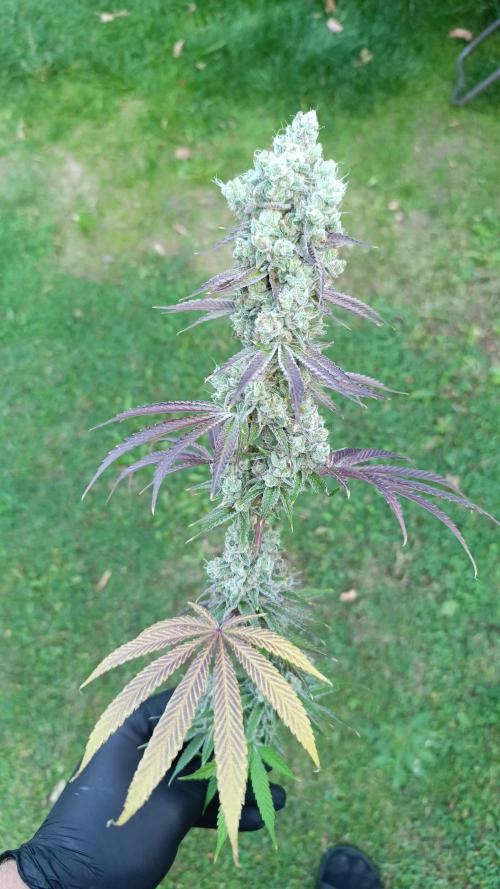
She is coming to the end now. Big fat juicy buds and a crazy sweet smell. I alreadt know this will be a good one. I will chop her this week and then update with a harvest and smoke report in a few weeks.

Likes
4
Share


@Trinidad
Follow
8th.05.25 68
Been so busy I don't even know what day it it. Last night I gave the chem dawg defoliation and add bloom booster and calmag to revervoir. Pumps where out so root rot was developing on all of them, however I think I caught it in time. Smell on tropicana cookies moved from sour citrus to sweet cirtus. Trichomes are clear and starting to trun milky. They are ripening nicely. I don't know how much longer I can hold out. I started counting days as the seeds were placed in water however I should start my count after germination so actually days are less than what I think. Still learning. I must say chem dawg was my least favorite because of longer grow time and less thc which is about 20% compared to other. But after seeing the stucture and how she is shapping up i must say i am quite impressed. No wonder she is a cassic strain. We shall see how things progress.
Likes
14
Share


@MadeInGermany
Follow
Hey guys :-)
This week the lady was watered 3 times with 1 l each time. ( Nutrients see table above )
It is developing well and will soon be in bloom 😃.
Apart from that, everything was cleaned in a controlled manner and osmosis water was treated.
Stay healthy 💚🙏🏻
👇🏼👇🏼👇🏼👇🏼👇🏼👇🏼👇🏼👇🏼👇🏼👇🏼👇🏼👇🏼
You can buy this Nutrients at :
https://greenbuzzliquids.com/en/shop/
With the discount code: Made_in_Germany you get a discount of 15% on all products from an order value of 100 euros.
👇🏼👇🏼👇🏼👇🏼👇🏼👇🏼👇🏼👇🏼👇🏼👇🏼👇🏼👇🏼
You can buy this strain at :
Clearwater Seeds
Water 💧 💧💧
Osmosis water mixed with normal water (24 hours stale that the chlorine evaporates) to 0.2 EC. Add Cal / Mag to 0.4 Ec Ph with Organic Ph - to 5.8 - 6.5
MadeInGermany

Likes
12
Share


@greenAF
Follow
MW6Bar Controller Level 8(520w)
UVA Bars 365-370nm (54w) 10min on 50min off and 10min at the beginning of the night.
IR 730nm (26w) 10min at start of night.
Front Left Koosh The Magic Dragon #4
Front Right Tricho Jordan #5
Back Left Tricho Jordan #5
PPFD 1025-1275
6.5 pH
Feed EC
Tricho 1EC (Fade formula) Taper down to 0 by day 60
KMD 3 Switching to fade around D59
Sub EC
0-3 TJ
5-5.5 KMD
Dryback Target: 60-70%


Likes
2
Share

@RatmanJR
Follow
Hello and welcome to my newest grow! Going to be doing a small pheno hunt for a keeper cut of purple marmalade by Solfire.
Speaking of Solfire, want to shout these guys out. Just purchased from these guys the first time and the seeds I received look perfect. They also sent me 3 free seeds which I’m looking forward to growing next.
Purple Marmalade is something special too me as I actually smoked this strain in Rochester New York around 2021, I would always pick up 3 new strains a week when I stayed here. For me and my girlfriend at the time it was one of our favorites we have ever had. Super spacey and melted away all stress.
Going to be doing a proper hunt where I will keep the rooted seeds as parents and will be taking clones of these for the actual hunt. The clones will be planted in my newest 30 gallon no till bed where they will be flipped semi early to allow all 3 plants to fill the 2x3.
The 30 gallon pot is the same soil I have been no tilling in a 15 gallon for the last year and a half. It had gotten compacted in the 15 so I dumped it out, reammended with 3.0, craft blend, and gnarly barley. Also added a gallon of perlite to help prevent compaction again. Poured it into the 30 and topped it off with about 8 gallons of fresh Elite Soil.
My thought process is the plants will start off in the new top soil as the bottom cooks, so by the time the roots hit the older soil it is ready to go. I also took a soil sample of the old soil and sent it to my local university to see if the amendments I added will be enough or if I should top dress more early on. Today August 23rd I sprinkle a ton of white clover seeds on top of this pot so by the time I transplant the clones in two weeks I will have a cover crop
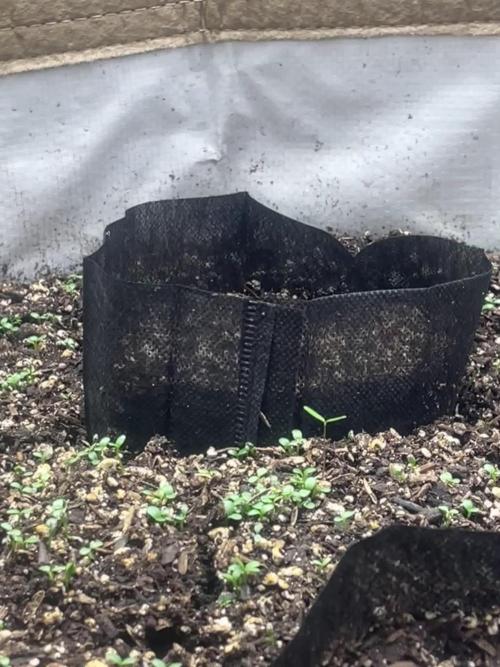
I also planted the seeds today on August 23rd. I filled my small nursery pots with some new Elite Living soil. I soaked the soil heavily to ensure it was wet and tamped. Poked a small one inch hole into each pot. Sprinkled recharge into each hole, dropped the seeds in and covered lightly. I then transferred these to my small parent tent where they will hopefully pop and veg until I am able to take my clones for the main tent.
Germination success is set to 0/3 until they start too pop.
Really looking forward to this grow with you guys! God bless!
Update Day 4, August 28th:
Cover crop growing in well and first seed popped. Good looks for solfire, first time using them. My seeds planted directly in soil almost always consistently pop on day 5. Day early and healthy looking, no helmet head, and can already see true leaves coming in.
Update Day 5, August 30th
Number 2 sprouted
Update Day 6, August 31st
Transplanted both sprouted clones to large container
Likes
9
Share


Likes
20
Share


@MrWolfe
Follow
So this round I just lollipopped and didn’t strip the top at all, with better veg next round it’ll work better but I’m having issues with some plants not quite trellised how I’d like. Everything smells great, BCS,BD and WM are getting fat and PKB is frosty and tight. Watering is more of a chore than I’d like I think I’m just going to use some 5s for the next round . Thanks for following along I hope your buds are fat and frosty.


Likes
1
Share


@Professor_Chaos
Follow
Beginning of week..
So I went ahead and did a late defoliation.. humidity is sitting too high in the tent.. its been around 50 - 55 % RH but it does sometimes get up to 60% RH.. removing some of these leaves should help lower the RH AND lower the chances of getting mold.. these are gonna be some fat colas.. and those are the ones mold can creep up on.. doing my best.. dehumidifier just cant keep up.. but I also dont run it inside the tent due to the heat that thing and it's transformer give off when it runs for over 24 hours or so.. but she shouldn't mold.. I've got 3 fans inside just moving air.. but of course, sometimes that isn't enough.. but we will see how this goes.. may even add another fan.. keep it on the floor of the tent an point it up.. we shall see! But damn she smells so amazing.. i can smell alot of similarities from the Mandarin Cookies in here.. which also has Mandarin Sunset as a mother.. just as this one does.. but you can smell the skunk along with it.. but not as powerful as the citrus.. aw man the citrus.. love that shit.. I even chewed on a trichome covered fan leaf.. very delicious! So glad I have 9 more of this strain and a few others from ETHOS.. next run may be some Aura Genetix.. I've gotta see what fast versions are all about.. I bougt some of the Peach Bellini.. should be pretty epic.. keep an eye out for that diary after this one!
Mid week..
Lower branches are getting plenty of light after the defoliation. The smell is getting intense. My carbon filter has began to smell like shit lol. Not literally.. but it stinks.. maybe like rotten skunk or something.. I've ordered a new one but I took that smelly one off for now.. so the whole block smells like member berries right now till the new filter comes in.. tomorrow. I couldn't figure out what the smell was untill i accidentally got my face into the exhaust fan wind.. smelled like rotten skunky shit.. lol. I guess I forgot things need to be changed out every so often.. just figured "air" running thru it wouldn't make it crap out so fast. Been maybe 8 - 12 months.. something like that. Never used one before this.. but running some ETHOS, it is a must! So citrusy! Purples are slowly coming in. She really reminds me of the Mandarin Cookies I grew.. but I also think the Mandarin Cookies was heavier on the Mandarin Sunset phenotype side.. and this one is pretty similar. Scent, growth, stretch.. but I know I cant say for sure that's what it is.. this is just what I believe is going on. But wow.. such a beautiful plant.. I've had to run a a few twist ties to other branches in order to keep them from flopping over, leaning on eachother and the sides of the tent.. should have scrogged I guess lol.. live and learn tho.. but so far its not too bad.. but this early on shows me what I might have to be dealing with in the next couple of weeks cuz they are beginning to get STACKED! I've said it before, and I'll say it again... ETHOS for the win 🏆
Later that day...
Wow.. going back in again and now she smells just like the Early Lemon Berry! Wth! How is that even possible?! She is doing amazing things! Some calyxes are beginning to turn purple. Some of the top leaves are as well. Tried to get some decent pics of it.. but I guess I cant figure the new phone out.. as you can see, some pics are a little blurry. And sometims the capture is delayed behind the flash and I still get a dark pic as if it didnt even flash.. but whatever.. I can't wait to see what she has to offer! Such a gorgeous girlie! So happy and excited for this one!
End of week..
Nothing left to do now but feed/water for about 1 more week and she will be ready for the 2 week flush!.. I normally like to just water as normal (without nutes, duh) for the entire 2 weeks and still keep checking runoff.. maybe FloraKleen once a week and then just water till harvest! So far, I am starting to see some milky! Still mostly clear, but that means she is getting closer! So excited! This girl really smells just like the Early Lemon Berry I grew! But still with a bit of sweetness to it too! Aw man I can't wait! Anyways... on to the next week!...

Likes
166
Share


@Wicket
Follow
I did get some nasty burns, but as you can see on the last picture they look way better now.
They seem to grow fine. Today on the 22th i watered them for the first time after watering them 11 days ago while putting them in the 2l pots. (500-600ml each plant)
The cripple still is slower but it seems like it also recovered.
On the 22th the Special Queen #1 seed did germinate and on the 23th the root did come out so i did put it in the 2l Pot, but this time without Bio Tabs, i only did use mycotrex (2g), the rest will come with the 11l pot then. I think i over watered it a little bit since the new leaves are hanging a little bit (the first leaves did hang from the beginning so i doubt that is water related with those)
I also noticed today for the first time, when i open my tent it does already smell pretty tasty. Didn't thought it would happen that fast.
Also i already learned a lot. Even tho i tried my best to inform myself from the beginning, i made many mistakes which i will never do again. You can prepare yourself as you want, you will still have some failures and that is fine. So im not ashamed of my little plants by now. I will make them survive and a great final result. Looking forward to the next weeks.
/edit
Last day of the week. There were Roots at the bottom of two pots, so i decided to plant them into the final 11l Pots, i also added biotabs (little bit less since both had some of it from the beginning.
Everything went fine. The next days i will give them slowly more ppfd and next week i think i will top them and also tie them a little bit down.

Likes
13
Share


@ernest_twwg
Follow
May 2nd:
She seems to be growing strong. She's trying to grow vertically!
Just natural well water.
Light intensity is at 75%.
No nutes, yet.


Likes
3
Share


@Kronen
Follow
Montebello Mind Bombx2 (MMB): by Doc Wylder Genetics. 3rd week from seed and MMB #1 is taking off. Very good growth this week. Transplanted to 1 Gal pot for additional nutrients in soil. Also, a stronger soil Sohum Living soil with Wollastonite & Mycorrhizae additive. MMB#2 however is still struggling to grow. Not sure what's going on with it. Gave it a bit of TEA Compost for a kick of nutrients yesterday and Bumped Lighting to 750ppfd, to spur some growth. Could be shocked still from 12/12 lighting a week ago. Roots have yet to make it to bottom of the Cup. Environment: 78-85F, 50-55% RH, 600-650ppm CO2, 750-850ppfd, and watered from bottom 6.0ph Mineral Water along with a Spritzx2 each day. Use Cup weight and reactions of the plant to determine watering and allow for dry period once a week. 👌
Likes
58
Share


@GreenHouseLab
Follow
143gr for the Larger pheno and 97 for the shorter, very respectable yield in total for 3 Wk Veg. Total 240gr even they each had 1.5’x1.5’ of space. Big yielder, buds are 10/10 & very easy to grow . Could be prone to mold in an uncontrolled environment.
Likes
30
Share


@Togoutouseg
Follow
J'ai lancé la floraison le 24 avril !!
J'espère que mes plantes vont faire de belles fleurs 🌱🌴


Likes
64
Share


@DogDoctorOfficial
Follow
Super easy growing, almost no maintenance, she just needs love and attention, and she will shine for you


Processing
Likes
105
Share


@Green_Friends_Inc
Follow
Commencing week 5/Day 29: on Nov 21st
Day 29
All is doing well now and a few more plants have roots in water but tomorrow is going to be well below freezing as well as the humidity has dipped very low
Day 32
Still growing steady the cold temps and low humidity haven't hurt or slowed them down too much
Day 34
Happy to say 6 out of 8 girls have pretty massive root masses developed in past week into bucket.
I have been very lightly foliar feeding every day a slightly acidic low ppm solution.
Lights were put back on timer since the temp and humidity are going back up I don't need the lights for heat.
pH has remained steady for past two days in low to mid 5.8s.
Is this too steady I wonder 🤔
I put on fans today today as well as under lighting LED strip.
D35
Am check-in and all is going well.
All 3 Gorilla Zkittlez are absolutely killing it, way bigger than the rest of the bunch. Although the 818 Headbands and the Raspberry Diesel are not far behind. Unfortunately both the Boss Hoggs seems to be runt-ish. One especially is really funny looking. But I always cheer for the under dog in the fight so who knows 😎
Turned off under lighting. Raised overhead LED Panels up 3-6 inches and re-oriented (angled) towards girls.
*I've decided to break off the barely mentioned personal crosses into their own journal in the next few weeks in case anyone was watching or wondering, it's coming. I'll be editing this journal accordingly when the time comes to be more accurate and useful. Lastly I am adding a new journal today for "🍋🍰" aka Lemon Cake by Moxie. It's terpalicious 👅. super sugary and lemony on the nose. Does anyone from the US or elsewhere know what's "Country-Time" lemonade mix is?? It makes your mouth water and smells almost too much like the sugary lemonade mix. Stay tuned
💚🙏


Likes
19
Share


@Wenz004
Follow
Reifung schreitet voran.
Trichome schau ich mir erst Ende der nächsten Woche an.