


Likes
Comments
Share

@Altitonans_Fulmen
Follow
Tito's Living Soil Blueprint: Why You Can’t Treat Organics Like a Synthetic Hydro System.
When transitioning from synthetic hydroponics to true organic cultivation, many growers bring their old habits with them. It is a common pitfall: pulling out pH pens, measuring runoff, and liquid-feeding heavy doses of organic nutrients as if the medium were sterile coco or rockwool. But living soil operates on an entirely different set of rules.
To achieve the true potential of an organic garden, we must stop treating the soil as a mere holding tank for liquid chemicals and start viewing it as a self-sustaining biological engine. This will be a breakdown of why treating organic soil like a synthetic system fails, and how to shift ones methodology to unlock the true power of the soil food web.
Pouring massive amounts of raw elements into a living system all at once is the biological equivalent of force-feeding a newborn a massive takeout meal and expecting them to digest it instantly. In an optimal system, soil should never be breaking down more than roughly 5% of its total composition as organic matter at any given time. The math is simple: more intense chemical and biological reactions equal more physical heat. If the root zone temperature creeps even remotely over 72°F, oxygen hypoxia sets in, drastically reducing plant growth.
Organic rhizospheres and biological nutrient delivery require significantly more oxygen to maintain efficient parameters for growth—a reality that is drastically different from a pure synthetic approach where a complex rhizosphere is virtually non-existent.
The fundamental blueprint of organic growing relies on Cation Exchange Capacity (CEC). The goal is to build a medium with so much CEC that it can store massive amounts of excess nutrients safely. This provides the necessary buffering capacity to handle large biological reactions, a process typically managed in the time period between grows. Once the soil is fully loaded and stabilized, the rhizosphere maintains its own pH balance, allowing the plant to dynamically feed itself directly from its massive, built-in storage of CEC.
Treating Living Soil Like Coco creates a runoff-runaway trap. Applying a massive overdose of raw organic materials releases too many nutrients at once, leading to completely uncontrolled pH skewing. Running a synthetic-style management setup while simultaneously dumping organic inputs into the container does not make it an "organic" grow. Trying to judge a metric like pH after letting it run completely out of control with multiple simultaneous amendments is an uphill battle. Each input possesses unique chemical properties that drastically alter atomic decay chains and, consequently, pH.
Without an adequate structural buffer, the medium experiences unpredictable swings. Put simply, the sheer volume of inputs rapidly outpaces the soil's built-in buffering capacity.
Constantly reading the pH and Electrical Conductivity (EC) of input and output water in an organic soil is not true organic cultivation; it is just a synthetic indoor environment layout utilizing organic ingredients. This presents a distinct misunderstanding of how these two opposing approaches need to be separated. One cannot simply measure EC and pH to heavy runoff in a soil designed to store cations and expect to keep accurate tabs.
Even when using 100% organic certified ingredients, liquid feeds, and compost teas, the underlying methodology matters most. Measuring runoff pH and EC treats an organic soil system like a synthetic coco or rockwool grow. In a high-CEC organic soil, a runoff reading is highly inaccurate. A soaring runoff reading of 8.0 is often just the water physically washing past raw amendments on its way out of the pot. It does not mean the actual root interface is locked out; it simply indicates that the soil ran out of immediate storage capacity for those heavy inputs.
Synthetic growing relies entirely on direct nutrient delivery. Chemical salts are poured over the root system, the plant absorbs what it needs through basic osmotic pressure, and the excess is flushed away. True organic growing, however, relies on biological cycling. An organic soil should never be watered to heavy runoff, because doing so actively washes away the beneficial microbes, soluble humic acids, and organic buffers that the soil life works so hard to create to protect the root zone.
Applying inputs as an immediate, massive overload of raw elements causes chaotic chemical spikes. Dumping heavy amendments directly into a big pot mid-grow triggers unpredictable reactions. In a true living soil system, amendments are added in tiny, balanced amounts long before the plant ever meets the dirt. This deliberate timeline allows the soil’s Cation Exchange Capacity to naturally "park" and buffer those nutrients. When inputs outpace the soil's ability to buffer them, the system breaks down, and the runoff pH screams.
When faced with a fluctuating pH meter, a common reactive impulse is to throw agricultural sulfur at the problem. This is a classic example of trying to react mechanically to a digital number rather than letting the soil chemistry work. Elemental sulfur does not lower pH on contact. Soil microbes must first digest it and convert it into sulfuric acid.
Because this biological process takes weeks or even months, adding it mid-problem yields no immediate change. This leads to the temptation to add even more. Weeks down the line, the cumulative sulfur will finally convert, causing the pH to crash violently and fry the root system.
As a general rule, avoid using sulfur as a corrective knee-jerk reaction. If it is used at all, it should be applied strictly 2 to 3 weeks prior to flower as a precise, one-off addition to assist with Isopentenyl pyrophosphate synthesis. If a soil matrix is truly experiencing a severe alkaline lockout at a pH of 8.0, the new leaves at the very top of the plant will tell you directly by turning bright yellow while the veins stay dark green—the classic signature of alkaline drift and iron chlorosis. The solution is simple: put the pH meter away. Stop watering to heavy runoff. Only apply enough water to evenly moisten the soil matrix, and let natural inputs do their job to feed the microbes and naturally buffer the root zone.
Electrical Conductivity (EC) dictates plant water and nutrient availability by altering the soil solution's osmotic potential. This potential controls whether a plant can efficiently pull water into its roots or if it will actually lose water to the surrounding soil. If a grower cannot control the rate of what is going in (the rate of nutrient release) and cannot control the rate of what is going out (the plant's dynamic growth), the immediate medium's EC deviates. When EC deviates, osmotic potential goes with it, disrupting bulk flow and the entire vascular transport system of the plant.
Synthetic nutrient delivery relies on precise input measurements and an incredibly tight management of the wet-dry cycle to prevent the constant, violent spiking of EC caused by excess moisture loss.
Reducing EC to a mere measurement of "food in and food out" oversimplifies its true function. It acts as a balance of electrical conductance that must be maintained to regulate the flow of water. Failing to acknowledge this is a severe disservice to the beauty and potential of a true rhizophagy cycle in all its respiratory glory. True organic cultivation does not actually begin until biological cycling is actively linked to hydrogen exudation from the roots.
The vast majority of modern cultivation advice leaves growers completely in the dark regarding these biological mechanics. This is a product of market capitalism rather than basic chemistry. There are significantly lower profit margins for hydroponic companies when a grower uses ten times fewer mass consumables and relies on little more than water from seed to harvest.
By shifting focus away from "feeding the straw" and moving it toward nurturing the near-infinite soil food web, the plant regains absolute autonomy over its own rhizophagy cycle. It begins regulating its own nutrient intake dynamically, without a single digital EC pen in sight. This allows the grower to focus entirely on optimizing the macro-environment rather than micromanaging the root zone. The cultivation medium can be reused indefinitely so long as you can prevent a buildup of carbon and nitrogen in the soil; cover that in a later week.
To achieve a truly organic system that unlocks this rhizophagy cycle, the cultivation approach must shift entirely from feeding the plant directly to feeding the soil microbiome. Because the modern gardening community is heavily guided by synthetic methodologies, the subtle nuances and variations of this biological process are rarely highlighted.
The hydroponic industry is fundamentally built on a recurring revenue model of bottled minerals, flush agents, and sterile mediums. Conversely, a self-sustaining living soil system requires minimal external inputs after its initial build. This shifts the grower's role from a rigid chemical manager to a biological custodian. Because managing biology requires observing subtle environmental factors—like consistent soil moisture, oxygenation, and temperature—rather than reading a digital screen, commercial entities scaled for automated, synthetic delivery often dismiss it as unpredictable.
When the soil food web is fully unlocked, the plant takes the driver's seat, operating with a level of systemic efficiency that synthetic nutrient lines simply cannot replicate. In the commercial cultivation landscape, corporate structures are legally bound to protect shareholder interests and recurring profit margins, which often prioritize the sale of bottled consumables over the promotion of self-sustaining agricultural practices.
Under modern industrial cultivation models, biology is too often treated as secondary to business. By stepping away from the meters, understanding Cation Exchange Capacity, and feeding the microbiome instead of the roots, you break free from the chemical cycle—allowing nature to do what it has perfected over millions of years.
"When I was a child, I spoke as a child, I understood as a child, I thought as a child; but when I became a man, I put away childish things"
Processing
Likes
32
Share


Likes
11
Share


@Kitties_and_Colas
Follow
Went to check her under the glass for the first time and she was ready before I was lol...hopefully she smokes as good as she smells

Likes
18
Share


@Canadian
Follow
I feel sorry for my plans this 2 weeks I haven't been able to look after them properly I've been working long shift with Christmas approaching there's no time for anything so I was pushing in a lot of nutrients into them and I caused a nutrients lockout .I have flush them out with just clean water at the right pH 6.5 and they are responding very well from now on I will continue to Baby them so they gave the best result possible within the circumstances of the plants.
Thank you for reading I will continue to update have a happy grow

Likes
5
Share


@Drtomb
Follow
Grow is looking very bushy. Raised the light up about 6". This is a 60 dsy strain. So we have about 4 weeks left in the flower process. Interested in what the roots will look like.

Likes
6
Share


Likes
10
Share


@StickyFingah420
Follow
Extrema producción de tricomas de esta variedad! Gran parte de los frutos lo usaré para extraer rosin, su resina se ve ideal para este propósito.
Fragancia exquisita a ponche de fruta dulce, con notas ácidas y un fondo de especias.
Como mencioné anteriormente dejaré la parte de la reseña de efectos, sabores y sensaciones para cuando los cogollos estén secos y curados, por ahora solo puedo apreciar lo que mi vista y olfato me permiten captar.
Totalmente conforme por la calidad de estas flores y agradecido de los amigos de Sweet Seeds por la confianza.
Será hasta la cata entonces, buenos humos!

Likes
24
Share


@ThatoneAKguy
Follow
Welcome to the jungle! The stretch is on! I’m not going to do a thing while they are in this mode but let them thrive. As soon as they are done I’ll go through and do some leaf stripping so everyone is getting light to their bus sites. I’m still heavy on the nitrogen feeding and starting to add more phosphorus. I’d like to see another 12” of stretch. I’ve been having an issue with the gfci breaker popping when the lights come on and can’t seem to figure that part out other than raising the plug amperage.
Likes
6
Share


@nowayReggie
Follow
9.10
Coming close to the finish line!
Began the flush this morning. 5 gals.
Will do another 5 gals in three days.
Then another 5 gals three days after than!
9.11
Was suprised to see that the soil was drier than expected.
Flushed with another 5 gals today.
HUMIDITY HAS BEEN (BASICALLY) UNCONTROLLABLE THIS WHOLE SUMMER
NO LESS than 70% and this girl has handled it beyond well!
9.13
Flushed with a final 5 gals.
9.14
-check out the video
9.15
Will be watering a gal today, tomorrow, and Sunday
9.16
watered a gal
9.17-9.18
did not water
Probably will not water until she gets the chop
9.19
24hrs of darkness the harvest
---------------------------------------------------------
nowayReggie
Likes
57
Share

@squalino
Follow
🌿 Journal de Culture : Cherry Cola (Auto)
Date : 18/03/2026
Âge : 55 jours (Semaine 8)
Phase : Pleine floraison (Explosion des trichomes)
📊 Paramètres de mon espace
Température : 24,5°C (Jour) / 20°C (Nuit).
Humidité : 50%.
Éclairage : Pure LED 240W réglé à 75% d'intensité, positionnée à 73 cm.
💧 Nutrition & Arrosage (pH 6,3)
Plante #1 (La Grande - 40 cm) : 1,5 Litre d'eau + 5 ml de PK 5-8 (BioTabs).
Plante #2 (La Petite - 30 cm) : 1 Litre d'eau + 2 ml de PK 5-8 (BioTabs).
📏 Travaux & Évolution (SCROG)
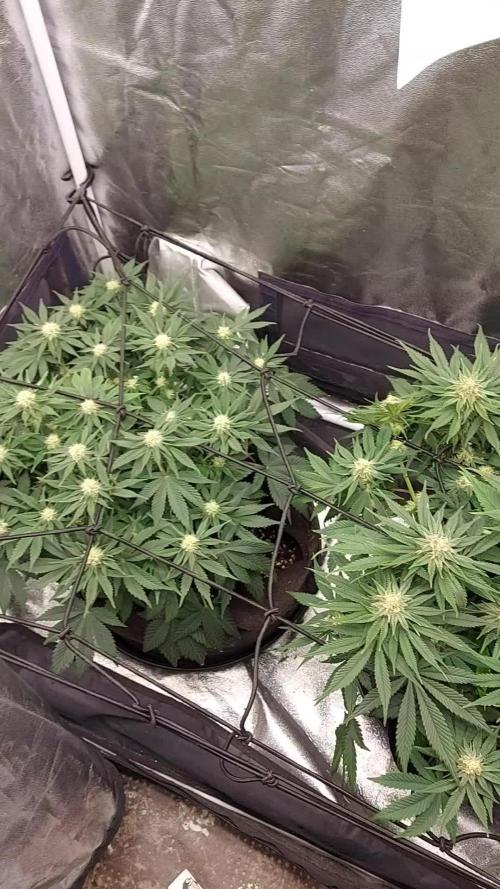
Retrait du LST : J'ai enlevé les fils rouges de palissage. Les branches sont maintenant bien rigides et la structure est parfaitement fixée. Le LST est une réussite totale.
Mise en place du filet : J'ai installé le filet (type SCROG) pour bien soutenir les têtes qui commencent à s'alourdir et homogénéiser la canopée.
🔍 Mes observations
C'est là que ça devient sérieux ! En manipulant la Plante #1 pour l'installer sous le filet, j'ai été surpris : mes doigts ressortis complètement collants. La production de résine est massive.
Niveau odeur, c'est un régal : ça sent déjà très fort le sucré, comme un bonbon. On a bien envoyé le profil terpénique de la Cherry Cola qui se met en place. La santé est au top, les feuilles sont d'un vert parfait et les têtes commencent à prendre une belle densité.
on peut remarquer que quelques feuilles commencent à perdre un peut de vert foncer très bon signe cela veut dire qu'elle puise l'azote des feuilles .et quelques légères pointes brûlées mais rien d'inquiétant cela me le fait a chaque fois lors de la transaction. mais à surveiller quand même.
22/03
ddonné 9,5 litres d'eau PH 6,3 .surface très sec .
merci à tous et à bientôt MUSIQUE DIAPO FAST BUD


Likes
33
Share


@KronicKobe
Follow
GWK: Day 68
AvT: Day 63
Notes:
-The AvT is on day 63 but for those confused why she looks the way she does, she almost died right as she entered flower and was stunted for about two weeks before ANY growth started again
-AvT looks like she could really put off a nice yield if everything keeps moving in this direction
-Planning to cut the GWK down between the 5th and 7th depending on the % of amber trichomes

Likes
18
Share


@Diips
Follow
first week of flower.
shes looking good. 👍
20/4 - 550-600 ppfd.
reading done with photone, using paper diffuser, close enough to what i was imagining it would be, with 75% at 16’.
d.45 - she grew 3 cm over 24 hours, thats pretty impressive!
d.48 - light defoliation in the bottom
Likes
3
Share


@HeavensHarvest89
Follow
week 8 was another growful week no issues to report.. No matter what I do to this thing she just continues to thrive.. i was worried some of the aggressive defoliation I was doing would stress her out but she has showed no signs even after the training accident she didn't slow her growth down a bit
Likes
4
Share

@BluntTrauma416
Follow
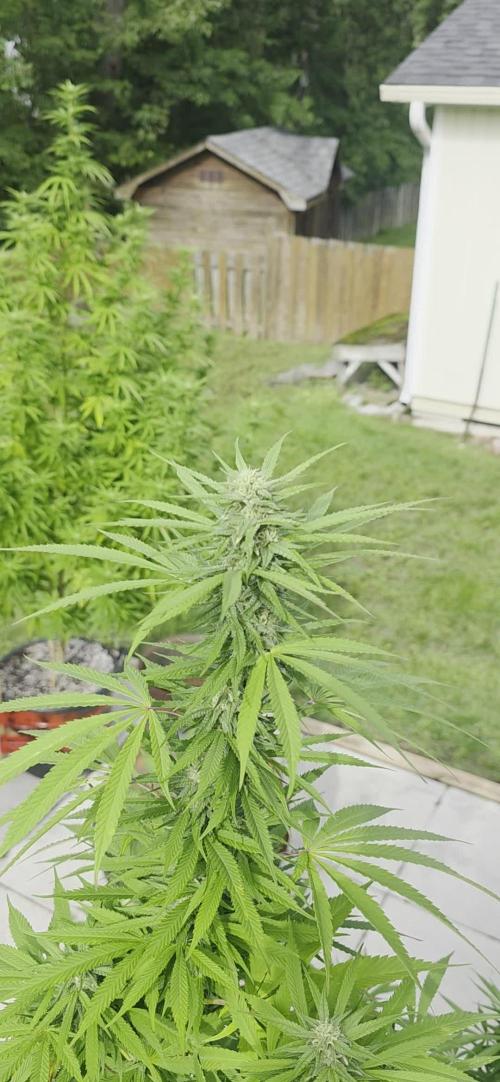
Fed gaia green bloom , 1 tbsp per gallon, thats the last top dress, gonna do a light sprinkle of worm castings. Gonna spray the caterpillar natural bacteria that kills them.. just as a preventative and continue with los cost plant therapy weekly spray.
Likes
14
Share


@MG2009
Follow
05/06/2021
All is progressing nicely and I want to see how lowering blue spectrum to only
1/4 on just enough for fan to kick on, and leave red at 100% Last picture is the 2 cuttings looking healthy.
Likes
9
Share


@MenaceFantome971
Follow
Nous sommes proche de la semaine 2, il reste 3 jours !
Les filles se développent plutôt bien à mon goût, uniquement de l’eau et le programme luminaire respecté. On peut remarquer 2 phénotypes, l’une un peu plus claire en terme de couleur des feuilles et l’autre plus foncée.
Évidement je suppose que la qualité des Leds compte.. j’ai observé par rapport à d’autre journal que la plante ne s’étire pas comme d’autre mais elles sont en bonne santé c’est l’essentiel ! À très bientôt pour la semaine 3 !
Likes
30
Share


@TightNugs
Follow
Some good progress this week,plant 1 now starting to stack,plant two now showing proper pistils.
Never had a plant flower so quick as plant 1,only around 15 days since first signs, owing to the new Voost VST 240 https://voost.com/ top L.E.D at unbeatable prices for such high spec,trust me😉 😎
Happy growing Nugz 🤞🏴🍁
🍁🍁🍁🍁
Breeder-White label purple bud
🍁🍁🍁🍁
Light-Voost VST 240 https://voost.com/ (code TightNugs 7.5% off orders over £200 excludes any sales.

Likes
40
Share


@BudXs
Follow
The coco hempy buckets continue to impress. The rate of growth is just insane compared to the conservative nature of hand watered soilless mix. The girls are getting 2 heavy feedings daily, once right before lights on, once at lights off. Responding tremendously. The largest daughter has broken 4 feet this week and hopefully the stretch is coming to a close. Good thing for my headroom. I am having difficulty with humidity this week due in part to the weather, but I feel mostly because of an underpowered ac and mucho transpiration coming from the leaves. Set for second round defoliation in three days and hopefully some break from the heat. Struggling to keep the room under 70 rh right now.


