


Likes
26
Share


@PedroAndHisPlants
Follow
Day 36:
"Hey everyone!
Just a quick update: I removed a few more leaves here and there and did one last round of LST (low stress training). 🌿 The plants are looking great, and I'm going to let them recover now before sending them into the flowering stage. I'm really excited to see them start blooming in 2-3 weeks!
Also, a quick update on our temperature issue: today, the temperature stayed below 26.8°C, which is great news! However, we still need to find a solution to keep the humidity levels up. Our 360 m³/h exhaust system isn't able to maintain the required humidity level. I've calculated that we need a humidifier that can evaporate 1800ml/h to maintain 60-70% humidity, which would help manage the temperature better.
Does anyone have tips for a good humidifier or other methods to control the humidity and temperature? Any advice would be greatly appreciated!
Day 37:
Hey everyone!
Tomorrow, we're planning to buy some Cal-Mag because we suspect the yellowing leaves might be due to a calcium-magnesium deficiency. We're also going to get a pH test kit to make sure everything is balanced properly.
Do you think this is a good idea? Any tips or suggestions would be greatly appreciated!
Day 38:
Hey everyone!
Quick update: it turns out the yellowing leaves were due to a nitrogen deficiency. We increased the fertilizer dosage today, so the plants should start looking better in 4 to 5 days. 🌿
Thanks for all the support and suggestions
Day 39:
Hey everyone!
Another quick update: after increasing the fertilizer yesterday to address the nitrogen deficiency, it should take about 4 to 5 days for the yellow leaves to turn green again. 🌿
We're already seeing improvements! The plants have grown significantly and are developing a dense canopy once more. It's great to see them bouncing back so quickly!
Day 41:
"Hey everyone!
Quick update: we've removed the bands we were using for LST (low stress training) and are now letting the plants grow freely. 🌿 We plan to keep them in the vegetative phase for about one more week before transitioning them to the flowering phase.
Excited to see how they continue to develop!"

Likes
4
Share


@TheSurfBud
Follow
Ganja Farmer Seeds
Zkitzz Auto
In @highpoweredorganics new ISLAND-BLEND.
Fed water soluble powders.
AQUA-MARINE Grow Formula 5.1.4 paired with OCEAN-POTION and RHIZO-MOJO in dechlorinated water.
Alternating ANTI-MATTER & DARK-MATTER feds weekly.
Foliar fed GREEN-SUPREME daily
Following High Powered Organics Island-Blend Feed Guide.
https://www.highpoweredorganics.com/
Happy growing friends 🇦🇺🇦🇺🇦🇺

Likes
25
Share


@Rangi_Kijani
Follow
They seem to be settling in well and starting to kick into growth mode. All but 1 of 17 had roots in the water when I brought them over from the Cloner. The 1 holdout is finally dropping roots now and they’re almost in the water. I’ve been using a syringe to wet the bottom of the net pot to encourage downward growth and to keep the emerging tips moist. A bit of root discolouration, but I’m reasonably certain this is just runoff from the Root Riot starter cubes I wrapped around the root crowns.
I’ll let them gain a bit more height then too them. I’m thinking I’ll do a clean 4 cola per plant configuration.


Likes
324
Share


@Teamdirtbag2
Follow
She is doing her thing ... smell is very sweet , supper strong at, day, dusk, night, and morning ... always !!!
I have had Neighbors say" I can smell it" . ( ironlungs)..
And I can smell it myself .. she is looking great... pics are not downloading , I got a few to load ..
Watered with tap water ( garden hose ) ... I will water in the morning again .. it's going to be hot at the end of the week .... I was hoping for a low to come (low pressure = cooler temps ) ..I need some cooler temps.. but I have no control ..buds are starting to fatten up...and getting heavy ... I inserted wood dowels to hold some colas from leaning on the sides of the cage ...I will get more ... all things considered she is very happy .... but she is on a mission.. to look beautiful ....
This grow happened by accident.. It was not planned..
It has surpassed any of my expectation's ..
I have to say " this plant is a beauty "
She is just a little clone .. born 3/15/2017
Video music from Mendo Dope 👏👏👏

Processing
Likes
15
Share


@Venabr96
Follow
Entrando na terceira semana de floraçao. Planta otima com tons violetas e com otimos galhos.
Como sao de floraçao rapida pulei algumas semanas na tabela de rega na biobizz( sem2 e sem4 ) e esta reagindo otimamente.
Dia 19 floraçao : planta muito volumosa com lindos ramos e frutos com desenvolvimento muito rapido.
Otima para o LST com bastante flexibilidade e rapido crescimento.

Likes
10
Share


@YAKDADDYDWC
Follow
started off first time grow with cyco nutrients line was struggling to maintain ph but getting the full swing from 5.6 to 6 happy days

Likes
14
Share

@Rangi_Kijani
Follow
Day 21 From Sprout - Rez Change
Overall, very happy with the development over this past week. The ones that were already looking good at now looking great!
The couple of “weirdos” (strange development of leaf/node placement) both have decent roots but are growing slowly.
The couple that initially were throwing out more “jagged” leaves seemed to have settled in and are looking good now.
Only 1 (back right corner) is iffy.
Roots are slowwwwly dropping out of the basket but not yet in the water. Going to keep
It around for now and see what happens.
Continuing with Mantis @ the “always” rate of 5 ml/L. They’re loving it!
Several of the “great ones” have 5-6 nodes developed, so I’ll top them back to the 3rd more and start training into a manifold since I’m going to give some of the others time to catch up. I’ll decide on training for them as we go.




Processing
Likes
15
Share


@DUBDOLLASIGN100
Follow
It's time for the outdoor flower stage from a 4 week veg, these girls has mature really strong and have took to its transplant like champs. At this point it's all about monitoring there growth and any deficiencies and on my part patience. Feed skip a day then water then feed then water, y'all get the pattern.
Likes
24
Share


@1_Plant_Wonder
Follow
Day 48, end of week 3 into flower 🍓🌱
Plant got a good Lollipopping 🍭and a heavy defoliation.
I've run into a big problem this week, as i noticed the plant is having a light stress..
Lots of leafs got curled up and tip burned😱🤦🏽😞
I turned the lights down to 170w, and it seems the stress on the plant has stopped.
This is my 3rd run with this light setup, and on the last 2 runs i was growing with about 220W with the same setup/tent size.
First one i grew was a Cinderella Jack auto from dutch passion, was 100% perfect with 220w!
Second was Zkittlez by FastBuds, and with her i did saw signs of light stress, but the plant came out perfect at the end.
But this OG Kush auto seems extra sensitive to strong lightning,
I just hope she will recover and produce well 😳🤞🏽🌱
Other then that the plant just keep getting bigger and bigger!! 🤯😍
Its 54 cm high (started the flower at around 30cm!) And she was topped of course,
Absolutely fantastic in that matter!✌️🏽


Likes
Comments
Share


@eldruida_lamota
Follow
Vamos familia, actualizamos la tercera semana de vida de estas Frosty tooth de Seedstockers, salieron las 5 de 5, 100% ratio éxito.
Aplicamos varios productos de Agrobeta, que son increíbles para aportar una buena alimentación a las plantas.
Temperatura y humedad dentro de los rangos correctos dentro de la etapa de crecimiento.
La tierra utilizada es al mix top crop, por cambiar.
De 5 ejemplares seleccioné los 3 mejores para completar el indoor y trasplanté directamente a macetas de 7 litros, se ven bien sanas las plantas, tienen un buen color y progresan a muy buen ritmo por el momento.
Agrobeta:
https://www.agrobeta.com/agrobetatiendaonline/36-abonos-canamo
Hasta aquí todo, Buenos humos 💨💨💨
Likes
25
Share

@eldruida_lamota
Follow
Bueno familia ya finalizamos con el proyecto de las Runtz de seedstockers, son una cepa bestial.
La verdad que el secado muy bien 9 días en Malla y a los botes, 40% humedad y 21 grados es la temperatura ambiental que han tenido en el secado, aparte deshumidificador enchufado 24 horas al día.
En resumen la cepa es muy fácil de cultivar, el germinado se me resistió igual es complicado el germinado pero el resto es simple resistente fácil de alimentar pienso que es rápida los tricomas ya estaban hechos y se me hecho el tiempo encima.
Por lo demás de miedo os la recomiendo.
Gracias a Seedstockers, Agrobeta y Mars hydro, sin ellos este proyecto no sería igual 🙏.
Agrobeta:
https://www.agrobeta.com/agrobetatiendaonline/36-abonos-canamo
Mars hydro:
Code discount: EL420
https://www.mars-hydro.com/
Buenos humos 💨💨💨
Likes
17
Share


@YorkshireGardeneruk
Follow
They popped up 2nd of January after germination. Biobizz soils mixed just using oxy plus for first couple of weeks as well as silicone
Processing
Likes
21
Share


@CBD_Sweden
Follow
2018-04-02. Week 3 day 1. It was time too upgrade the 0.1 liter pot too the 1 liter.
Did the transplant today.
They are a little bit overwatered but i will let them dry out now.
This is the newest release from DinaFem seeds.
And i will veg her under a Apollo 10 led and flower her in Growroom Nr2 under a 600 w Hps on a light mover.
Its a organic grow and i will be using BioBizz nutrients.
Strain information.
Purple Moby Dick is a child of the legendary Jack Herer that was crossed with PAK. This is a sativa dominant hybrid that contains 60% sativa and 40% indica genetics. The THC content reaches 21% and the smoking brings cerebral effects.
This potent plant develops a big structure with lots of branches and can grow up to 3m tall. The flowering period brings amazing purple hues and fruity aromas. The strain needs lots of light, enough space, proper feeding and watering. It has a good mold resistance.
The flowering period takes 10 weeks and the harvest brings good yields of 650 g/m2 indoor and 1500 g/plant outdoor. The fat dense buds are coated with mass of crystals.
The smoke brings sweet, fruity smell and aroma and potent, long-lasting cerebral effect and euphoric high.
Feminised
Genes 60% sativa / 40% indica
Genetics Jack Herer x PAK
Harvest 650 gr/m2
Flowering 9-10 weeks

Likes
8
Share

@Northern_Ent
Follow
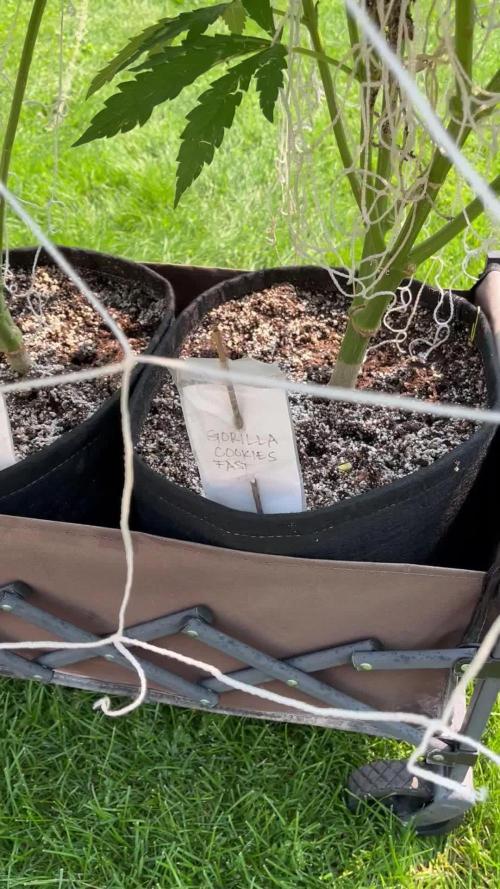
Aug 1: she’s doing great after two weeks of force flowering. In dark garage at 9 pm, few seconds of 730 nm far red light and out of garage at 7 am. This gives 10 h of darkness plus 2 h of ‘virtual’ dark by initiating dark mode faster. Like having a 26 h day which is a great trick if you have daily access to your plant.
Added another scrog net layer that is clipped to the lower net that is tied off to 500 g weights which holds things apart to let sunlight in.
Hail net was out for a brief hard rain, but no hail this time.
Likes
1
Share


@JLaser
Follow
Not much has changed since last week. Sugar leaves are developing more than the buds are.

Likes
14
Share


@555ABKY555
Follow
the residues of a rainy spring are revealed and after two days of light rain the girls responded differently while those in the smallest containers matured the largest exploded apart from a few small cuts of broken branches and an apex with little botrytis I differentiated disinfected and carefully selected always washing the pruning shears with simple water, the skywalker is beautifully cooked think I put some dried buds in the shed in toilet paper 5 days in the shed in the heat made it take effect !!😱 imagine when this tanning 6 months! I am happy with the results and I moved the plants to the GRILL!! top candy phase in massive quantities at the beginning of the week and also the last time I use it after a week no water. yes .. I hope to resist .. the gorilla glues are bad one is becoming almost perfect but I wish they would light up the trichomes they taste like candy my hands are a symphony of perfumes , even the lemon ak are incredible !! excellent seed I think I'll do it again indoors. compactness structure color UNIQUE flavor the ample bud of the critical orange punch is MONSTER as well as being double having pruned in preFLOW, I had the idea that the orange bud had surprised me that's how it was she's an alien goddess pure milky.😍
