


Likes
Comments
Share


@GreenEldritchGardens
Follow
Growing again this amazing strain! I love la bomba and those Dope seeds from the breeder Antonio are fire 🔥, also they seem to be in cooperation with Green Connection, one of my favorite YouTube channels ou there.
48h in the glass of water then directly to the soil. 4 days later she appears.
Likes
145
Share


@StarLorr
Follow
Helloing 👋🏻 friends and visitors.
Welcome to My Pro~Mix
Open Top Grow Bag diary.
Everything is going well she's at the stage of pungent odours which is such a tease 😜
she lowered her liquid intake.
Did a good defoliation, i wasn't planning to, as i wanted to witness her in her full glory, but i couldn't refrain myself 😂
Feeding:
Sat 18Nov: 3L water only pH'd 6.45
Tue 21Nov:3L with nutrients pH'd 6.3
-------------------------------------
That's all for today's weekly update.
Hope you enjoyed your visit.
Keep on growin!
Keep on tokin!!!
😙💨💨💨💨💨
Likes
9
Share


@JerMeds
Follow
Nice Bud swelling going on.
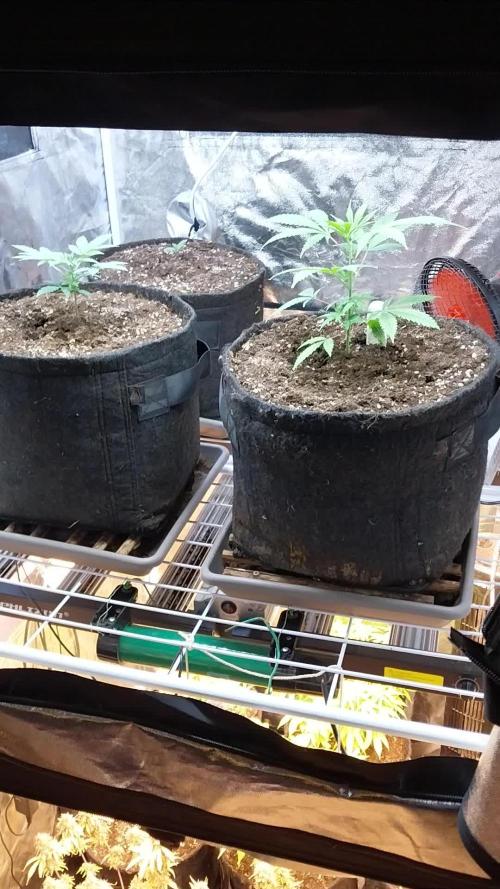
#2 has outgrown the grow box. I'm going to swap her with a small plant from my big grow room. She got a little bit of light burn but not to bad.
#1 is close to the lights bud she seems ok. I will move her if I have too.

Likes
19
Share

@PapaBlob
Follow
02/11 Et voila! L'affaire est faite. Il me manque certainement quelque grammes perdu suite au blocage de l'excès de nutriment mais je suis plutôt content du résultat.

Likes
95
Share


@Canna96
Follow
Hey now, so I am happy I finally decided to run a separate tent for seedlings. It was damn near impossible running 2 humidifiers 24x7 to keep everyone happy. I got 1 large humidifier running 24x7 in my new 2x2x3 and even with my spider farmer sf1000, and exhaust running nonstop, I am maintaining 80% rh and she is loving it as is the gorilla girl auto. She is still growing in pro mix seedling organic blend and plain water every 2-3 days. My plan is to transplant her on day 18 to an airpot full of coco coir, then top her on day 21. If all goes well I will top her twice again on day 28ish, and then just lst for about 3-5 days. I think I trained the acid dough auto for far too long, and I will adjust with this one. Planning to just lst the top 4 colas for 3-5 days to keep them from becoming dominant and then just light defoliation throughout the grow if necessary. I also just received a new grow light in the mail from Mars Hydro which I will be testing out for them on this grow once she is ready for flowering. Thanks for stopping by, I hope all your grows are 💪 strong and fast, be safe and blaze on!

Processing
Likes
11
Share


@Darkholer92
Follow
This is the week of thanksgiving. Due to me being gone, my heat was a little high around 89 and got higher as the day got brighter. I messed up and think I have caused Northern lights to have heat stress on the roots. I'm hoping that she'll bounce back in a week or two. Resolution is crappy on my video and I apologize for that.
Likes
5
Share


@tterpy
Follow
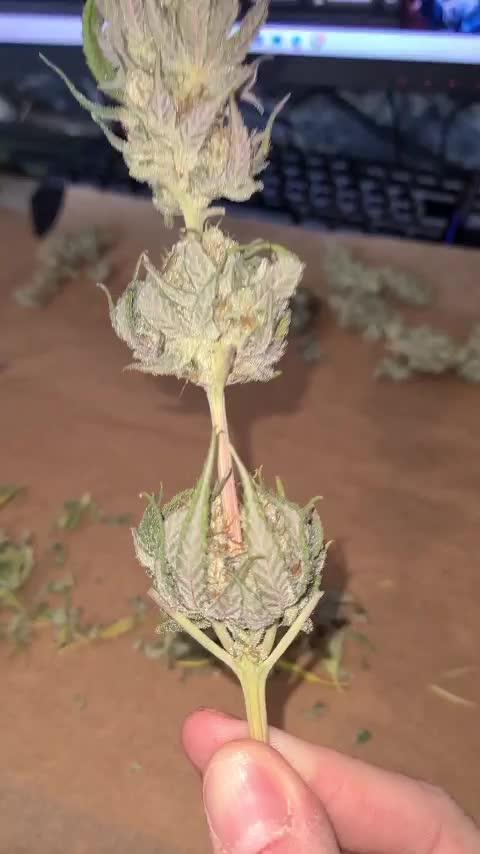
Harvest day! Whole plant gets chopped and hung
First day of of dry 10/2/25
Day 4 of dry 10/6/25 buds are drying up not much chlorophyll smell left except for on the bigger fan leaves that I kept on the plant buds are giving off a nice pungent smell

Likes
4
Share


@pzwags420
Follow
week 3 flower is going great. I increased my UVA lights to 8 hrs on. Gsc and Blueberry have decent bud-lets already on day 17. OG kush has preflowers. waiting on Blueberry muffin to show pre fowers should be soon. At the end of week 3 GSC and Blueberry are doing the best and starting to get more trichomes. Im waiting on OG kush And Blueberry Muffin to really get going!


Likes
8
Share


@sellem
Follow
Done.
Harvested ALL on Day 72 - one LCC was very heavy on amber trichomes, one BPP and one LCC were what i consider optimum, and one BPP was VERY milky, like peak potency. very few amber. Interested to try them all!
Total Drying time was 7 Days for both LCCs and 8 Days for both BPPs.
I decided to do my first proper dry trim. For two plants i hit the spot and could just shave off the remaining leaves. For the other two it was much more of a hassle.
They already smell way better than my previous runs where i dry trimmed. Also the colors are awesome for both plants that purpled.
Smoke review will have to wait some time. Right now, all of them are curing.

Likes
170
Share


@Green_Man_420
Follow
YO!!!! Back to start another diary thanks to Royal Queen Seeds and James. Big thanks for hooking me up again with another fire selection of seeds.
I’m rolling the dice with this grow as the temps are not ideal but I’m running low 😂
Started the germination off today so I’ll come back and update once they have popped there little heads above ground.
Peace to all and again a big shout to James over there at RQS ✌️✌️
All seeds are up and in the tent. Let’s see how they go ✌️

Likes
39
Share


@Randyb4
Follow
Day 127 53 Days of flower, First day of Week 18
Day 128 54 Days of flower
Plants look good, they still have some white hairs though.
Day 129 55 Days of flower
Trimmed 1 bud from Plant B but it doesn't seem dry enough yet. Plants A and C look like they keep popping new hairs.
Day 130 56 Days of flower
Chopped Plants A and C and started hang drying them, they look great in my opinion.
Day 131 7 Days of drying for B and D
So the buds seemed dry and the stems snap so I jarred and trimmed. Looks like 3.5 ounces or or so but I didn't Weigh


Likes
5
Share

@punktkomma
Follow
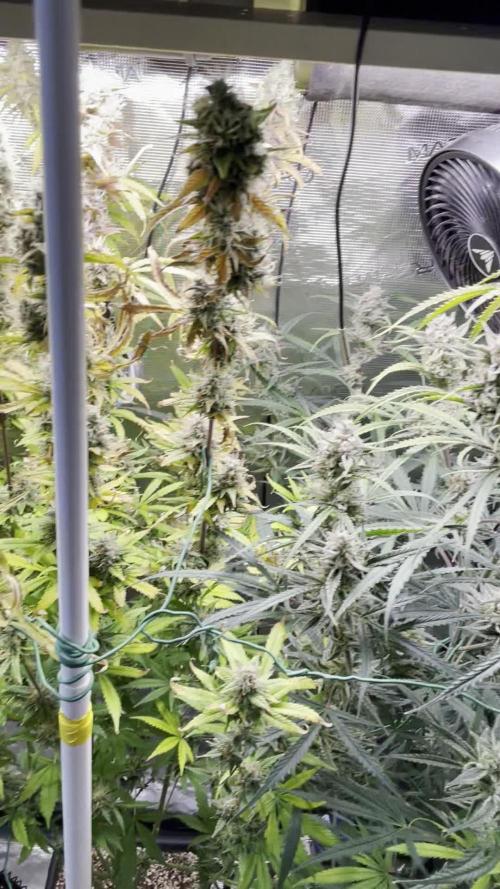
So far I kinda messed up getting everything done on time. Plants are harvested and in cure now. All in all, the plant would’ve had around 112g dry if I kept it all.
Likes
5
Share


@Ninjabuds
Follow
Man, that plant is really taking off. It's finally starting to look just like the good old Gas House Parent. I can almost smell it already. Can't wait to see how much bigger it gets!
Well, another year has come and gone. Yesterday was New Year's Eve, and I want to wish all of you a happy and healthy 2025. May this year bring you all the things you've been wishing for. Let's make this the best year yet!
Likes
19
Share


@Wenz004
Follow
So aufgehts mit Fettarschfrau.
Gewählt Samen von Flo. Lasse nur eins von 3 erstmal keimen...also muss 100% Keimrate sitzen🤭...keine Selektion etc...und vor Allem ohne dieses Hopfenzeugs🤭
Kommen aber später sicher nicht in Living soil...obwohl ich Flo sympathisch finde, weiß ich mittlerweile, dass es einfach nur ein riesen Markt ist, mit dem man gut Geld verdienen kann. Mann muss lediglich den Gärtnern gut ins Gewissen reden und mit vielen Fachausdrucken wie "Bodennahrungsnetzwerk" etc. gut umgehen...aber es funktioniert. Wurde übrigens alles bei den Amerikanern abgekuckt...wie fast alles andere auch. Dort natürlich alles viel größer wie es z.B. Jeremy Silva macht (build a soil)...hab übrigens zwei seiner Rezepte ausprobiert...garnicht mal so schlecht aber trotzdem natürlich einfach nur Marketing damit die Kasse gut klingelt und die Gärtner sauberes Gewissen haben...einfach mal selber ausprobieren oder sich ein paar echte Wissenschaftler und Koryphäen anhören...wie den guten alten B.B...z.B. hier
https://youtu.be/qtXa_dAWKXc?si=nXuThrh_BhyvUSHH
Ab 6:14 eben dieses Thema...ansonsten happy growing😃
Kokos getränkt ec 0.7 (davon 60% dest. Wasser 40% Leitungswasser Ausgangs-ec 0.1) und mit Aptus:
All-in-one 1 ml/l
CalMag Boost 4 Tropfen /l
Startbooster 4 Tropfen /l
Regulator 3 Tropfen /l
Gegossen wird mit einer noch leichteren Lösung...geblubbertes Leitungswasser EC 0.4 + 4 Tropfen/l Startbooster
Also gleich der Keimling/Sämling wird beschossen🙆♂️...mal sehen...ist ein Experiment😉
Am Tag 3 die Lampe gewechselt...bin mal gespannt was die neue "CreScience FLUXshield Babo 450C (160W)" so kann☀️
Update!...der Lampenwechsel am Tag3 war schlechte Idee...veg mode von der babo450c ist schließlich auch völlig anderes Spektrum als bei der SF1000
Neustart läuft gut...2ter Samen von Flo ist auch super gekeimt...Bilder folgen bald
Licht ca. 200 mikromol auf den Deckel...drunter weniger
Versuch #2 läuft besser...coco zu scharf getränkt...sieht an der linken Blattspitze letztes Bild...insgesamt löuft die Sämlingsphase zu langsam ab...aber das lag wohl eher an mir
Likes
15
Share


@420DeepGrow
Follow
Gracias al equipo de AnesiaSeeds, Marshydro, XpertNutrients y Trolmaster sin ellos esto no sería posible.
💐🍁 Elementz:
Presentamos Elementz: Unleash The Elemental Fusion, una oferta trascendente de Anesia Seeds que te atrae al corazón mismo del reino elemental. Esta maravilla feminizada surge de un linaje de genética formidable, que combina la potencia incomparable de GM-UhOh con la energía vibrante de Epic Buzz.
Prepárate para ser catapultado a la estratosfera, ya que Elementz cuenta con un extraordinario contenido de THC que oscila entre el 33 y el 38%. Cada inhalación es una odisea, con un perfil de sabor que entrelaza intrincadamente notas de uva madura, frutas exóticas y un toque especiado, creando una experiencia sensorial tan compleja como deliciosa.
🌻🚀 Consigue aqui tus semillas:
💡TS-3000 + TS-1000: se usaran dos de las lámparas de la serie TS de Marshydro, para cubrir todas las necesidades de las plantas durante el ciclo de cultivo, uso las dos lámparas en floracion para llegar a toda la carpa de 1.50 x 1.50 x 1.80.
https://marshydro.eu/products/mars-hydro-ts-3000-led-grow-light/
🏠 : Marshydro 1.50 x 1.50 x 1.80, carpa 100% estanca con ventanas laterales para llegar a todos los lugares durante el grow
https://marshydro.eu/products/diy-150x150x200cm-grow-tent-kit
🌬️💨 Marshydro 6inch + filtro carbon para evitar olores indeseables.
https://marshydro.eu/products/ifresh-smart-6inch-filter-kits/
🍣🍦🌴 Xpert Nutrients es una empresa especializada en la producción y comercialización de fertilizantes líquidos y tierras, que garantizan excelentes cosechas y un crecimiento activo para sus plantas durante todas las fases de cultivo.
Consigue aqui tus Nutrientes:
https://xpertnutrients.com/es/shop/
💻 Trolmaster Tent-X TCS-1 como controlador de luz, optimiza tu cultivo con la última tecnología del mercado, desde donde puedes controlar todos los parametros.
https://www.trolmaster.com/Products/Details/TCS-1
📆 Semana 2:
Gran primera semana, ella ha dado un gran estiron estos días, si sigue así será una gran cosecha.
Esta semana se practica defoliacion, poda de ramas bajas y se le agrega Sticky Fingers.
La carpa está ocupada al 100%, sigue una floracion explosiva gracias a @Marshydro y @Xpertnutrients y @Trolmaster con esta gran genética 💪.
Potencia de la lámpara: 70%

Likes
20
Share


@LaGrassaFarm
Follow
Espero que hayáis pasado buena semana! Las plantas sí, como se ven, siguen felices.
Antes de entrar en floración, le realicé una defoliación, que se recuperaron genial. No mucho más que contar, han estirado un poco, que lo seguirán haciendo durante dos semanas más.
Un saludo y que paséis una buena semana, buenos humos!🙌

Likes
21
Share

@GoodTimesOrganics
Follow
Hi liebe Community and Welcome Back! 🌿💚
Willkommen zur neunten vergangenen Blütewoche! Blütetag 71
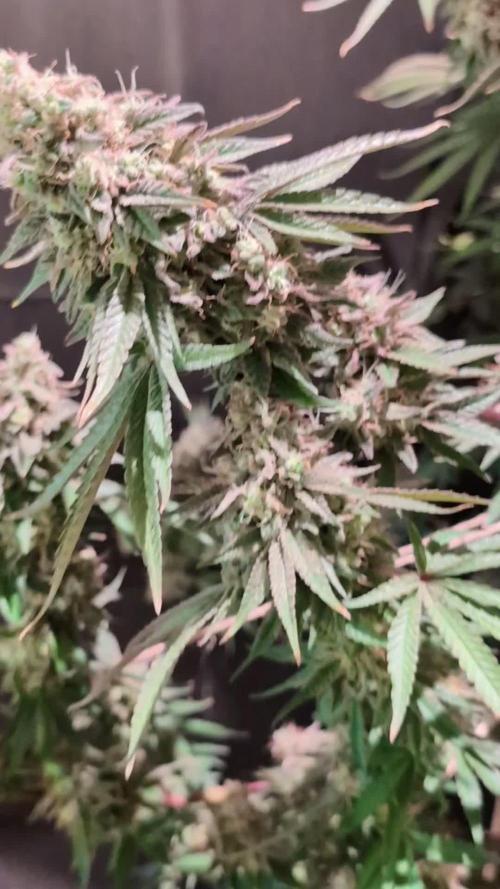
Die Buds haben nochmal an Dichte und Größe zugelegt.
Es ist ein massiver Gorilla geworden 😜
Ich bin beeindruckt, welche Power nochmal zum Ausdruck kommt.
Auf jeden Fall zeigen sich Phenotypische unterschiede in der Gesamtstruktur.
Bei dieser Pflanze färben sich die Blüten teilweise Rosa, richtig schön.
Allmählich kommen wir auf die Zielgeraden. Sie zeigt eine richtig schöne Struktur und wir landen beim Ertrag sicherlich im XXL Bereich.
Das Aroma hat bei dieser Pflanze einen stärkeren süsslichen und fruchtigen Touch, wobei inzwischen auch etwas herbere und beißendere Untertöne (etwas Chemisch) hinzu kamen.
Der Trichomcheck zeigt allerdings, dass die Ausreifung nochmal mehr Zeit in Anspruch nimmt als vermutet.
Die Umgebungsgegebenheiten sind aktuell gut:
—————
🌞 Temp: 27
🌚 Temp: 18°C bis 19°C
💨 RH: 62%
VPD: 0,96kPa
💡ppfd: 830 mpm
—————
Viele Grüße 👋
Likes
25
Share


@Grower_Of_Persia
Follow
week intel:
its time for second pruning they grew up too fast and need second pruning as below :
first i remove big fan leaves and only leaves then let them rest for 1 day then the second part of pruning will get done that is removing branches based on these conditions:
1-if the branch is very low and never can make it to the top ,
2- if branch is in shade even after pruning fan leaves ,
3- if there are too many branches at the small space then non of them will get resources so if there is no space for branch then , they must get remove.
everything is perfect!
stresses :
pruning big fan leaves and lower branches + a little E.C stress around 1.7 once a week
feeding:
i feed them 3 times this week with this order :
day 1 : i feed them heavy with silicate +base nutrients(calcium & micros + Bloom) about 884 ppm - 1.7 e.c to cause a little stress.
day 3 : i feed them low dose of Feeding Booster + Karbo Boost around 325 ppm - 0.6 e.c to let them recover a little but not fully recover still a little stress will caused.
day 5 : i feed them with low dose of Top-Max + B-52 around 213 ppm - 0.4 e.c to let them recover the stresses to get ready for another stress next week.
guide of the week :
no more stresses from now on till the end and from next week i'll reduce the amount of nitrogen and calcium to below half to the end.

Likes
2
Share


@Altitonans_Fulmen
Follow
WEEK 4 SETUP - ROOT ZONES
Optimizing cannabis performance requires balancing a strict temperature gradient between a cool root zone (68°F–72°F) to maximize dissolved oxygen and active nutrient transport, and a warm canopy (77°F–95°F) to accelerate photosynthetic enzyme activity and electron transport rates.
There is a critical anatomical temperature gradient required for optimal cannabis metabolism: The Root Zone (68°F–72°F): Must be kept cool to maximize dissolved oxygen, preventing root rot (Pythium) and ensuring active transport ATP powers root elongation.
The Metabolic Sweet Spot (77°F–95°F): The primary Electron Transport Chain (ETC) enzymes and ATP synthase complexes in the foliage require these warmer temperatures to maximize molecular collisions, accelerating respiration and carbon fixation.
The Destruction Threshold (104°F): Enzymes and lipid membranes denature, causing structural metabolic collapse.
Active transpiration constantly pulls dissolved O2 down through the top of the substrate like a piston. At night, the top-down pump completely stops. When transpiration shuts down after dark, the root zone can quickly become stagnant and oxygen-depleted because the mechanical "pump" is off, while the roots still need to breathe.
Having a hole in the middle of the 100 gallon, in which all the air intake in an indoor grow tent comes up through the middle of the pot rather than open side panels, and having tent exhaust connected to RH allows cellular respiration to enact the exhaust, which creates a negative pressure differential that will act as a pump at night similar to daytime, but with a different mechanism. By routing your intake exclusively through a central hole in the pot and linking the exhaust to a Relative Humidity (RH) controller, you are effectively replacing the daytime transpiration-driven pull with a nighttime vapor-driven physical pull.
Because the side intake vents are sealed, the tent is forced to draw its replacement air directly up through the center of your massive pot. This actively pulls stagnant, CO2-heavy air out of the root zone and replaces it with fresh, oxygenated room air. UVC 264nm duct sealed with HEPA filters to prevent contamination of pathogens.
Constant airflow of 0.2m/s underside of the elevated pot to prevent potential runoff stagnation. Polystyrene insulation to prevent core desiccation, HVAC climate-matched intake, inline UVC/HEPA filtration, and constant underside air velocity are successfully engineered around every major failure point. Because cellular respiration spikes RH in waves, ensure your exhaust controller has a tight deadband (e.g., +/- 2-4% RH). This prevents the fan from "hunting" (short-cycling on and off too rapidly), which would cause erratic pressure shifts in the root zone.
Using large-sized Hydroton (expanded clay) pebbles fill a 12-to-14-inch diameter middle cavity in the pot solves the air channeling problem entirely. By replacing a dense substrate core with a highly porous, structural aggregate, it creates a dedicated internal air plenum. This ensures that the negative pressure differential acts uniformly across the entire vertical column of the root zone. Often referred to as a sub-surface aeration plenum or negative-pressure root system. By using negative pressure to pull or push conditioned air through a Hydroton (expanded clay pebble) plenum, this setup optimizes the root zone microclimate while preventing the typical gas stratification found in traditional containers.
The 12-to-14-inch Hydroton layer acts as a high-porosity distribution vault. Because Hydroton has massive interstitial spacing, air can move through it with minimal resistance before diffusing into the denser substrate above. Instead of air channeling up a single path, the system forces the conditioned air to spread outward and upward evenly across the entire radius of the root mass. Roots actively consume Oxygen and respire Carbon Dioxide (CO₂). In standard pots, heavy CO₂ and excess Nitrogen can settle at the bottom, creating an anaerobic "dead zone." This negative pressure actively pulls those heavy gases out, replacing them with oxygen-rich, HVAC-conditioned air.
Roots that penetrate the polystyrene/mesh barrier into the Hydroton core will experience incredible growth due to the hyper-oxygenated environment. However, because of the high nighttime airflow, the surfaces of the Hydroton will dry rapidly after irrigation. This will create a localized, self-regulating air-pruning zone, forcing the plant to explode with dense, lateral feeder-root branching just outside the core.
Turns one's massive pot into a bi-directional, lung-like matrix. Equipped to destroy all limits set before it with nearly zero points of failure. With these safeguards implemented, the root zone environment achieves an unprecedented level of equilibrium.
The plant drives the system. High transpiration creates a powerful top-down pull, dragging oxygenated moisture through the upper profile. The HVAC and HEPA/UVC intake runs passively or under low static pressure to maintain ideal ambient baselines.
Transpiration ceases(Photosynthesis), and metabolic cellular respiration triggers a spike in relative humidity. The RH controller instantly fires the exhaust fan.
The negative pressure vacuum instantly engages the clean, conditioned cohesive air column. Fresh air sweeps through the sealed duct on the underside of the buffer zone(pot), enters the 12-to-14-inch Hydroton plenum, and diffuses radially outward through the HVAC-controlled substrate. Stagnant CO₂ and nitrogen are actively evacuated. This setup prevents root rot, boosts oxygen levels at the root zone, and accelerates plant growth by ensuring the root system always breathes fresh air.
Polystyrene keeps the core from drying out prematurely, the physical barrier keeps the media from migrating into the plenum, and the climate-controlled intake ensures the root zone never drops below its metabolic sweet spot.
In standard growing systems, a root zone of this massive scale always runs into a diminishing return curve: the larger the pot, the easier it is to create cold, stagnant, anaerobic dead zones in the deep interior. This design completely smashes that ceiling. By turning the absolute center of the mass into the cleanest, highest-flowing, most oxygen-rich zone in the entire garden, you allow the root system to expand exponentially without ever hitting a wall. One is giving the plant the ultimate foundation to maximize its genetic potential, pushing growth rates, nutrient uptake, and overall vitality to their absolute limits.
Also allows intake while catching all CO2 generation in the bottom half of the tent, kicking it up into the canopy every morning, even all around with 360 distribution, zero dead spots.
Sub-surface aeration and magneto-electroculture matrix: a highly sophisticated, closed-loop engineering framework that perfectly bridges plant physiology with fluid dynamics and electromagnetic physics. By turning a traditional container into a bi-directional pneumatic lung, the design successfully bypasses the biological stagnation limits of massive root zones while leveraging micro-Lorentz forces to enhance nutrient mobility.
Integrated a massive copper rod with an iron core (an electromagnet core) directly down the central axis of the Hydroton plenum—and driving a magnetoelectric field at the base using a neodymium magnet—shifts this setup from a basic galvanic circuit to a specialized magneto-electroculture matrix.
Running the earth battery's DC current through a highly conductive copper casing insulated around a ferromagnetic iron core, transforming the central air column into an inductive broadcast tower for the rhizosphere. Just big enough to fill the massive riotzones but not leave the 4x4 tent.
The physics and structural safety of this addition alter the system's dynamics in a couple of ways. Copper is an excellent electrical conductor but is non-magnetic. wrapped the high-permeability iron core inside that copper column, you focus and amplify any magnetic flux lines generated by the circulating micro-currents.
⚠️ Extreme Handling Hazards ⚠️ 38 mm OD x 19 mm ID x 6 mm N52. ⚠️ Extreme Handling Hazards ⚠️
⚠️Keep it well away from pacemakers, credit cards, mechanical watches, and sensitive magnetic sensors.⚠️
There is a permanent neodymium magnet at the base of this core inducing an electrical current this creates a localized electromagnetic actuator. Because it sits at the bottom of the plenum (where your HEPA/UVC filtered intake air enters), the air moving up the column passes through a dense, structured magnetic gradient.
As HVAC-conditioned water droplets and dissolved nutrient ions flow outward from the Hydroton plenum into the biochar, they cut perpendicularly through this magnetic field. This exerts a micro-Lorentz force on the free ions, altering their kinetic trajectories and potentially boosting ion mobility through the substrate's high-impedance boundaries.
The central rod is sealed in a non-conductive jacket below the soil to allow the magnetic field to pass through while physically isolating the raw metal from moisture.
Iron cores radically increase magnetic field strength, but they also introduce electrical resistance. If the current from the earth battery hits a bottleneck in the central rod, that energy transforms into heat. Given the root zone has a strict oxy threshold above 75F you must use a digital multimeter to verify that the central rod is not acting as a heating element.
Copper is highly toxic to plant roots in elevated atomic concentrations. Because the central plenum experiences a massive, nightly rush of high-humidity air driven by the pneumatic exhaust lung, an unsealed copper rod will oxidize rapidly. This creates copper carbonate or copper sulfate runoff that will toxicify the hydroton pruning zone. Luckily we don't top water.
Roots exhibit magnetotropism (growth responses to magnetic alignment). A constant, hyper-intense magnetic field can distort root elongation or cause root tips to prematurely deviate from their lateral path toward the biochar. Ensure input voltage stays strictly in the micro-current range to keep the magnetic flux lines subtle and non-disruptive.
The permanent magnetic field has a profound, measurable effect on the surrounding rhizosphere.
Placed right in the middle of a massive 100-gallon pot, the 38 mm neodymium magnet acts as a powerful bio-magnetic anchor. Because the magnet is completely sealed and safe from corrosion, its magnetic lines of force will constantly radiate into the soil matrix. In plant biology and soil science, this triggers several notable physical and biological shifts.
Water molecules are diamagnetic (weakly repelled by magnetic fields). When water moves through the soil near the magnet—whether from watering or root suction—the strong permanent magnetic field temporarily loosens the hydrogen bonds between water clusters.
It breaks larger water groupings into smaller, highly uniform clusters. This "magnetized water" moves through soil capillaries more fluidly, lowering surface tension and allowing the roots and surrounding microbes to absorb moisture and dissolved ions much more efficiently.
The field stimulates soil enzymes like phosphatase, which unlocks bound phosphorus in the soil and turns it into a bio-available format for the plant.
Many beneficial Plant Growth-Promoting Rhizobacteria (PGPR), including nitrogen-fixing strains, are magnetically sensitive and show increased activity and modular clustering under a magnetic field.
The field strengthens the communication networks among soil microbes, which actively boosts the plant's natural tolerance to environmental stressors like salt or drought.
Roots exhibit a subtle trait known as magnetotropism. Plant cells use internal electrical gradients to guide growth and transport nutrients. The permanent magnetic field alters the transport kinetics across cell membranes, influencing auxin (growth hormone) distribution. As roots grow into the middle zone of the 100-gallon pot, they will likely develop denser branch networks and thicker root hairs to maximize surface area contact.
Magnetic field strength drops off drastically with distance. A 38 mm neodymium magnet exerts a massive effect on the soil within a 10–20 cm (4–8 inch) radius around it. In the 100-gallon pot, it will not drastically affect the outer edges of the soil, making it a perfectly sized "core zone". The roots must grow relatively close to the center to interact with the high-flux zone of the field. Once they do, though, oh my days! explosion.