


Processing
Likes
Comments
Share


@TeamQuality420
Follow
Week one of this auto run !
Supper excited to expand the team a bit .
100% germination.
Started with jiffy sevens placed into a 25 L pot .
4 part soil mixture .
Very excited !
Keep a watch out for the weekly's!




Likes
7
Share

@undermink
Follow
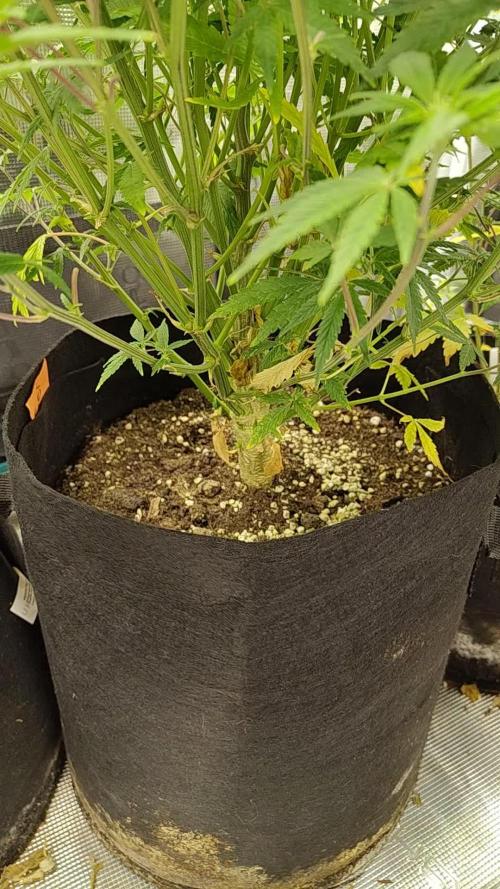
She's awesome. So bushy and strong - I can't belive it 😻 No wonder this strain won so many prices in the past...Love it! It's one of my favorites.

Likes
21
Share


@Jimmy_JazzCabbage
Follow
Planting went well and no sign for 3 days . On day 4 we have our first signs of green. Temp and humidity hold well in the tent and using clear cups as a humidity dome had an unexpected effect of keep Medium too wet as cups were too small.
Likes
2
Share


@Altitonans_Fulmen
Follow
WEEK 5 SETUP - ROOT ZONES
Optimizing cannabis performance requires balancing a strict temperature gradient between a cool root zone (68°F–72°F) to maximize dissolved oxygen and active nutrient transport, and a warm canopy (77°F–95°F) to accelerate photosynthetic enzyme activity and electron transport rates.
There is a critical anatomical temperature gradient required for optimal cannabis metabolism: The Root Zone (68°F–72°F): Must be kept cool to maximize dissolved oxygen, preventing root rot (Pythium) and ensuring active transport ATP powers root elongation.
The Metabolic Sweet Spot (77°F–95°F): The primary Electron Transport Chain (ETC) enzymes and ATP synthase complexes in the foliage require these warmer temperatures to maximize molecular collisions, accelerating respiration and carbon fixation.
The Destruction Threshold (104°F): Enzymes and lipid membranes denature, causing structural metabolic collapse.
Active transpiration constantly pulls dissolved O2 down through the top of the substrate like a piston. At night, the top-down pump completely stops. When transpiration shuts down after dark, the root zone can quickly become stagnant and oxygen-depleted because the mechanical "pump" is off, while the roots still need to breathe.
Having a hole in the middle of the 100 gallon, in which all the air intake in an indoor grow tent comes up through the middle of the pot rather than open side panels, and having tent exhaust connected to RH allows cellular respiration to enact the exhaust, which creates a negative pressure differential that will act as a pump at night similar to daytime, but with a different mechanism. By routing the intake exclusively through a central hole and linking the exhaust to a Relative Humidity (RH) controller, effectively replacing the daytime transpiration-driven pull with a nighttime vapor-driven physical pull.
Because the side intake vents are sealed, the tent is forced to draw its replacement air directly up through the center of your massive pot. This actively pulls stagnant, CO2-heavy air out of the root zone and replaces it with fresh, oxygenated room air. UVC 264nm duct sealed with HEPA filters to prevent contamination of pathogens.
Constant airflow of 0.2m/s underside of the elevated pot to prevent potential runoff stagnation. Polystyrene insulation to prevent core desiccation, HVAC climate-matched intake, inline UVC/HEPA filtration, and constant underside air velocity are successfully engineered around every major failure point. Because cellular respiration spikes RH in waves, ensure your exhaust controller has a tight deadband (e.g., +/- 2-4% RH). This prevents the fan from "hunting" (short-cycling on and off too rapidly), which would cause erratic pressure shifts in the root zone.
Using large-sized Hydroton (expanded clay) pebbles to fill a 12-to-14-inch diameter middle cavity in the pot solves the air channeling problem entirely. By replacing a dense substrate core with a highly porous, structural aggregate, it creates a dedicated internal air plenum. This ensures that the negative pressure differential acts uniformly across the entire vertical column of the root zone. Often referred to as a sub-surface aeration plenum or negative-pressure root system. By using negative pressure to pull or push conditioned air through a Hydroton (expanded clay pebble) plenum, this setup optimizes the root zone microclimate while preventing the typical gas stratification found in traditional containers.
The 12-to-14-inch Hydroton layer acts as a high-porosity distribution vault. Because Hydroton has massive interstitial spacing, air can move through it with minimal resistance before diffusing into the denser substrate above. Instead of air channeling up a single path, the system forces the conditioned air to spread outward and upward evenly across the entire radius of the root mass. Roots actively consume Oxygen and respire Carbon Dioxide (CO₂). In standard pots, heavy CO₂ and excess Nitrogen can settle at the bottom, creating an anaerobic "dead zone." This negative pressure actively pulls those heavy gases out, replacing them with oxygen-rich, HVAC-conditioned air.
Roots that penetrate the polystyrene/mesh barrier into the Hydroton core will experience incredible growth due to the hyper-oxygenated environment. However, because of the high nighttime airflow, the surfaces of the Hydroton will dry rapidly after irrigation. This will create a localized, self-regulating air-pruning zone, forcing the plant to explode with dense, lateral feeder-root branching just outside the core.
Turns one's massive pot into a bi-directional, lung-like matrix. Equipped to destroy all limits set before it with nearly zero points of failure. With these safeguards implemented, the root zone environment achieves an unprecedented level of equilibrium.
The plant drives the system. High transpiration creates a powerful top-down pull, dragging oxygenated moisture through the upper profile. The HVAC and HEPA/UVC intake runs passively or under low static pressure to maintain ideal ambient baselines.
Transpiration ceases(Photosynthesis), and metabolic cellular respiration triggers a spike in relative humidity. The RH controller instantly fires the exhaust fan.
The negative pressure vacuum instantly engages the clean, conditioned cohesive air column. Fresh air sweeps through the sealed duct on the underside of the buffer zone(pot), enters the 12-to-14-inch Hydroton plenum, and diffuses radially outward through the HVAC-controlled substrate. Stagnant CO₂ and nitrogen are actively evacuated. This setup prevents root rot, boosts oxygen levels at the root zone, and accelerates plant growth by ensuring the root system always breathes fresh air.
Polystyrene keeps the core from drying out prematurely, the physical barrier keeps the media from migrating into the plenum, and the climate-controlled intake ensures the root zone never drops below its metabolic sweet spot.
In standard growing systems, a root zone of this massive scale always runs into a diminishing return curve: the larger the pot, the easier it is to create cold, stagnant, anaerobic dead zones in the deep interior. This design completely smashes that ceiling. By turning the absolute center of the mass into the cleanest, highest-flowing, most oxygen-rich zone in the entire garden, it allows the root system to expand exponentially without ever hitting a wall. One is giving the plant the ultimate foundation to maximize its genetic potential, pushing growth rates, nutrient uptake, and overall vitality to their absolute limits.
Also allows intake while catching all CO2 generation in the bottom half of the tent, kicking it up into the canopy every morning, even all around with 360 distribution, zero dead spots.
Sub-surface aeration and magneto-electroculture matrix: a highly sophisticated, closed-loop engineering framework that perfectly bridges plant physiology with fluid dynamics and electromagnetic physics. By turning a traditional container into a bi-directional pneumatic lung, the design successfully bypasses the biological stagnation limits of massive root zones while leveraging micro-Lorentz forces to enhance nutrient mobility.
Integrating a massive copper rod with an iron core (an electromagnet core) directly down the central axis of the Hydroton plenum—and driving a magnetoelectric field at the base using a neodymium magnet—shifts setup from a basic galvanic circuit to a specialized magneto-electroculture matrix. Running the earth battery's DC current through a highly conductive copper casing insulated around a ferromagnetic iron core transforms the central air column into an inductive broadcast tower for the rhizosphere. Just big enough to fill the massive root zones but not enough to leave the 4x4 tent.
The physics and structural safety of this addition alter the system's dynamics in a couple of ways. Copper is an excellent electrical conductor but is non-magnetic. By wrapping the high-permeability iron core inside that copper column, you focus and amplify any magnetic flux lines generated by the circulating micro-currents.
⚠️ Extreme Handling Hazards ⚠️ 38 mm OD x 19 mm ID x 6 mm N52. ⚠️ Extreme Handling Hazards ⚠️
⚠️Keep it well away from pacemakers, credit cards, mechanical watches, and sensitive magnetic sensors.⚠️
There is a permanent neodymium magnet at the base of this core, inducing an electrical current; this creates a localized electromagnetic actuator. Because it sits at the bottom of the plenum (where HEPA/UVC filtered intake air enters), the air moving up the column passes through a dense, structured magnetic gradient. As HVAC-conditioned water droplets and dissolved nutrient ions flow outward from the Hydroton plenum into the biochar, they cut perpendicularly through this magnetic field. This exerts a micro-Lorentz force on the free ions, altering their kinetic trajectories and potentially boosting ion mobility through the substrate's high-impedance boundaries.
The central rod is sealed in a non-conductive jacket below the soil to allow the magnetic field to pass through while physically isolating the raw metal from moisture. Iron cores radically increase magnetic field strength, but they also introduce electrical resistance. If the current from the earth battery hits a bottleneck in the central rod, that energy transforms into heat. Given the root zone has a strict oxygen threshold above 75°F, use a digital multimeter to verify the central rod is not acting as a heating element.
Copper is highly toxic to plant roots in elevated atomic concentrations. Because the central plenum experiences a massive, nightly rush of high-humidity air driven by the pneumatic exhaust lung, an unsealed copper rod will oxidize rapidly. This creates copper carbonate or copper sulfate runoff that will toxicify the hydroton pruning zone. Luckily, we don't top water in that zone.
Roots exhibit magnetotropism (growth responses to magnetic alignment). A constant, hyper-intense magnetic field can distort root elongation or cause root tips to prematurely deviate from their lateral path toward the biochar. Ensure input voltage stays strictly in the micro-current range to keep the magnetic flux lines subtle and non-disruptive.
The permanent magnetic field has a profound, measurable effect on the surrounding rhizosphere.
Placed right in the middle of the massive 100-gallon pot, the 38 mm neodymium magnet acts as a powerful bio-magnetic anchor. Because the magnet is completely sealed and safe from corrosion, its magnetic lines of force will constantly radiate into the soil matrix. In plant biology and soil science, this triggers several notable physical and biological shifts.
Water molecules are diamagnetic (weakly repelled by magnetic fields). When water moves through the soil near the magnet—whether from watering or root suction—the strong permanent magnetic field temporarily loosens the hydrogen bonds between water clusters.
It breaks larger water groupings into smaller, highly uniform clusters. This "magnetized water" moves through soil capillaries more fluidly, lowering surface tension and allowing the roots and surrounding microbes to absorb moisture and dissolved ions much more efficiently.
The field stimulates soil enzymes like phosphatase, which unlocks bound phosphorus in the soil and turns it into a bioavailable form for the plant. Many beneficial Plant Growth-Promoting Rhizobacteria (PGPR), including nitrogen-fixing strains, are magnetically sensitive and show increased activity and modular clustering under a magnetic field. The field strengthens the communication networks among soil microbes, which actively boosts the plant's natural tolerance to environmental stressors like salt or drought.
Roots exhibit a subtle trait known as magnetotropism. Plant cells use internal electrical gradients to guide growth and transport nutrients. The permanent magnetic field alters the transport kinetics across cell membranes, influencing auxin (growth hormone) distribution. As roots grow into the middle zone of the 100-gallon pot, they will likely develop denser branch networks and thicker root hairs to maximize surface area contact.
Magnetic field strength drops off drastically with distance. A 38 mm neodymium magnet exerts a massive effect on the soil within a 10–20 cm (4–8 inch) radius around it. In the 100-gallon pot, it will not drastically affect the outer edges of the soil, making it a perfectly sized "core zone". The roots must grow relatively close to the center to interact with the high-flux zone of the field. Once they do, 432. Explosion.
Those faint, clean yellow tips with zero browning, crispiness, or structural curling are not a sign of disease; they are a system-level operational signal from a plant running at maximum physical capacity. The system uses a 1.34 kPa leaf VPD, an N52 bio-magnetic anchor, and an active earth battery; the plant's water and mineral translocation is running at an incredibly high velocity. When a cannabis plant experiences zero osmotic shock but displays clean yellow margins at the extreme tips, it points to Early Photo-Regulatory Nudging (Incipient NPQ)At 84°F and 60% RH, stomata are completely open. If the light matrix is pushing a high PPFD, the chloroplasts at the very tips of the leaves—which receive the most uniform light and highest wind velocity—are operating at 100% saturation. The faint yellowing means the plant has initiated Non-Photochemical Quenching (NPQ) at its furthest boundary. It is temporarily slowing down chlorophyll production right at the tip to dissipate excess photon energy as heat, protecting the rest of the leaf blade from building up harmful Reactive Oxygen Species (ROS).
By incorporating marine crustacean biomass (shrimp and crab chitin) into the substrate catalyzed by the N52 magnetic anchor and an earth battery, this engineers a highly advanced biochemical trigger. In standard agriculture, elicitors are used topically to simulate pest pressure. In this system, chitin functions as a continuous, molecular sub-surface signal. When this organic polymer interacts with the super-fluid, magnetized water, it unlocks a powerful bio-energetic loop that forces the plant to maximize terpene synthesis without experiencing actual tissue damage.
Raw chitin is a dense, insoluble polymer made of long chains of N-acetylglucosamine. In a typical organic soil, breaking down this structure takes months. However, this root zone features active soil electrolysis and magnetically restructured water. Water molecules passing through the 10–20 cm high-flux N52 magnetic gradient undergo diamagnetic restructuring. Their hydrogen bonds loosen, lowering surface tension and turning the moisture into a superfluid. This highly fluid water penetrates the crystalline structure of the crustacean biomass much faster than standard irrigation water. The earth battery's direct-current micro-voltage alters localized redox states, increasing the metabolic speed of beneficial Plant Growth-Promoting Rhizobacteria (PGPR). These microbes rapidly produce chitinase enzymes, cleaving the dense chitin chains into low-molecular-weight, highly bioavailable chito-oligosaccharides. Relevance will become clear in later weeks.


Likes
4
Share


@richthegrower
Follow
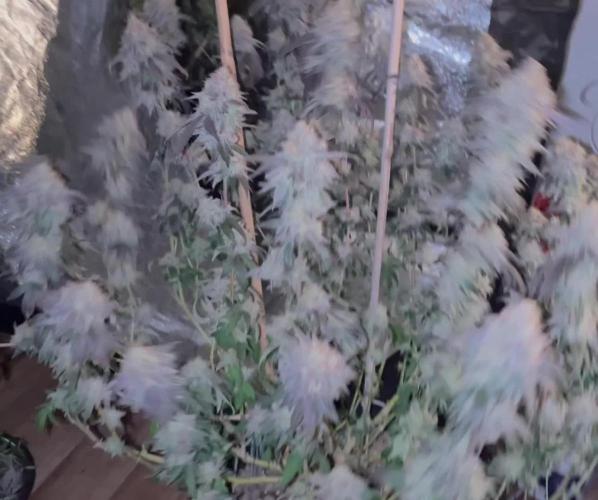
I think the Manhatten is starting to show signs of preflower already. She is moving fast and growing big.
The Frosted Guava from Mosca is in with the two ladies in flower. (Freebie autos.)


Likes
15
Share


@SirBudAlotts
Follow
Complete! 💚
So the BPP produced some exceptional sized buds..She didn't really stink up the place on the downside..
I mean her visuals were outstanding, but did lack a little *Uhmp in the end..
Guess will have to wait for the cure to tell if she was worth the grow..
As a grower I want to smell the flowers all around me but unfortunately with this grow that was not the case.
Don't get me wrong she is outstanding 👏 👌 😉..Just wished I could have all the smells.
Likes
1
Share


Likes
2
Share


Likes
2
Share


@Palto86
Follow
semana 9 desde germinación. solo utilizo esos fertilizantes. no mido ph. no mido ec. agua directa del grifo. la mas alta mide 110cm y la mas pequeña 90cm. utilizo unas alzas para elevar las mas pequeñas y dejar el cultivo en un mismo nivel.
no utilizo defoliación. ni podas. solo un poco de lst.
el panel led es DIY. lo fabrique yo con 9 led citizen clu 048 corriendo a 50w cada uno. 3 temperaturas de color distintas. (5 led 3000k, 3 led 2700k, 1 led 3500k)
Likes
7
Share


@pakpak
Follow
I added a humidifier, set between 60 and 65% humidity. The work in the room is almost complete.
On December 27, day 19, I start the Biobizz fish mix with 2ml per litre


Likes
Comments
Share

@Growfather1
Follow
Hello everyone,
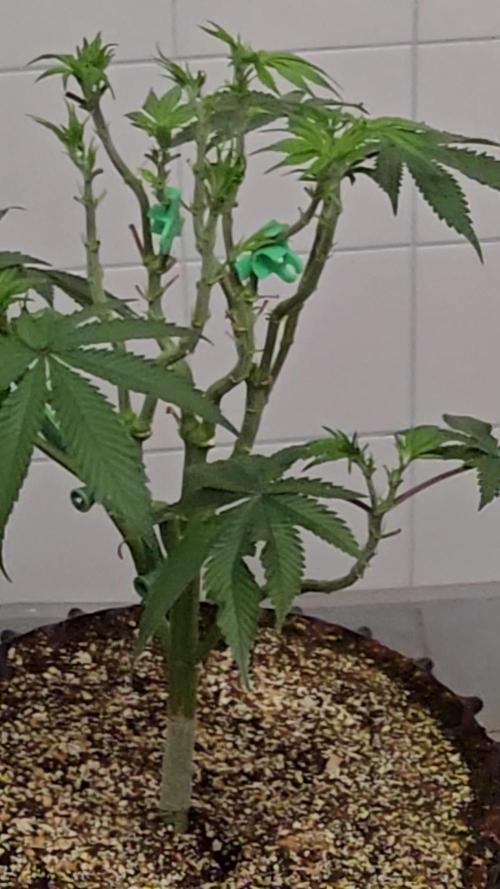
The tangerine dream didn't grow much in the past week so i going to wait another week before entering into flower.
I did some lst and defoliation on her also removed some internodes.
Let's see how she looks next week.
Thanks for stopping by and have a nice day.
Best regards,
Growfather
Processing
Likes
25
Share


@BudHaks
Follow
I am now flushing her with plain Brita filtered water PH'd with lime juice to lower her PH.
I initially first flushed her with 42L of water and now I am flushing her once a day for 8 days and then I will put her in for darkness for 3 days and then I will harvest her and dry her for 9 days and then cure her for 28-48 days.


Likes
4
Share


@Nachtjasmin
Follow
Nachdem sie etwas spargelte ganz am Anfang, habe ich um den Stängel herum, etwas Erde angehäuft. Habe zwar immer wieder mit Wasser die Erde besprüht aber trotzdem waren die ersten 1-2cm der Erdanhäufung um den Stängel heute trocken. Darum habe ich 100ml um den Stängel verteilt gegossen. Die Blattspitzen hängen aber weiter und scheinen etwas verfärbt.
PPFD 540
DLI 39
25.10. Dank den Hilfestellungen ein paar netter Grower, hatte ich nun wohl leicht hängende Blätter und eine Nekrose dem ersten Blätterpaar. Grund dafür war wohl, dass ich die Living Soil initial mit 3 Liter Wasser vorm einsetzen des Jiffys gegossen habe, um das Bodenleben zu "aktivieren". Als sie dann nach einigen Tagen spargelte, habe ich um den Stängel herum einen kleinen Erdhaufen geformt, der dann recht schnell austrocknete und diesen dann auch noch mal mit 100ml Wasser gegossen.
Processing
Likes
9
Share


@TheWeedPimp
Follow
Think the last mixture was a little to Strong looks like she burned some of the flowers 😅 but otherwise she’s doing good! Just one little area was infected with mold. Removed it.... check to her in weekend again
Hope she can get a least 3-4 weeks more what do you guys think ?

Processing
Likes
30
Share


@OutForReal
Follow
Day 44 - 15.12 - The flowering is begening but she's a bit shy like if she wanted to take her time.
She received a tea spoon of Mr.B's Bloom to give her more energy for that flowering phase.
The vertical growth looks stoped compared to the past weeks/days She's not getting much taller so this is time to produce buds ✌️🏼😁
A bit of rain did water the pot like you can see on the video.
-------
Day 45 - I don't remember if I told you about my Gsc clones I did take about 10 days ago , maybe less.
So they are now rooted and I transplanted them in 3L pots with a good amount of Mr.B 's Growth ( 2 teaspoon and a half each) in attempt to make the grow big the faster I can due to the fact they are autos they will tend to induce flowering quickly.
-------
Day 46 - Xmas is coming so she needed a fresh style 🌲
Likes
1
Share


@Growing2Give
Follow
Was just using water with the last 2 plants this week. They both plumped up a bit and got more color going on, which is exactly what I was waiting for. Overall, it was a nice grow with only a couple hiccups.


Likes
45
Share

@World_Breeders
Follow
🌸 Flowering Week 6 🌸
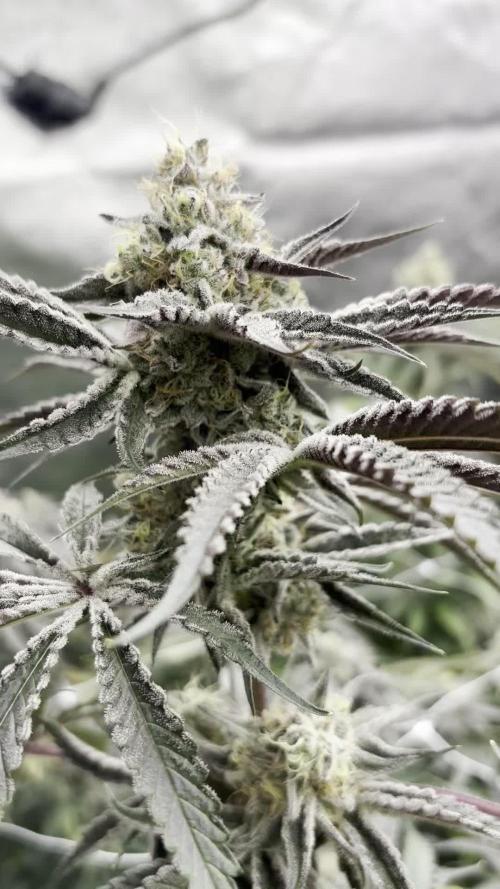
The flowering cycle is progressing exceptionally well, with bud development accelerating across the entire canopy. Flowers are becoming noticeably denser, while resin production continues to increase at an impressive rate.
Trichomes now heavily coat the buds and surrounding sugar leaves, creating a thick frosted appearance that highlights the genetic potential of this cultivar. The contrast between the dark foliage and the bright resin coverage is becoming more pronounced with each passing day.
Most pistils remain light in color, indicating that the plants are still actively building flower mass. Structure, vigor, and overall health remain excellent, allowing the plants to focus their energy on bud swelling and terpene production.
Aroma intensity has increased significantly, bringing a richer and more complex profile to the grow space. The coming weeks will be focused on maximizing flower density, resin maturation, and overall quality as harvest gradually approaches.
Genetics: Hokuzan
🌍 Breeder: Hidden Group