


Likes
Comments
Share


@DogDoctorOfficial
Follow
👑 8×8 Adventure – Week 14 🌿
Godfather OG – Pheno B 👑🔥
💪 BIG MAMA Is Still BIG MAMA — Heavy, Beautiful & Getting LOUD!
Hello everyone, and welcome back to another chapter of the 8×8 Adventure! 🌱💚
GUESS WHAT?!
😂😂😂
BIG MAMA IS STILL BIG MAMA!
And when I say BIG MAMA...
I mean BIG.
I mean HEAVY.
I mean this girl is getting to the point where the yo-yos are becoming part of the family.
😂👑💪🌿
Seriously, look at this girl.
She's big.
She's beautiful.
She's carrying some serious weight.
And she's demanding support like she owns the entire tent.
Actually...
she might have a point.
😂😂😂
This is no longer a situation where we simply look at her and admire the flowers.
We look at her, admire the flowers, check the branches, check the support, and ask ourselves:
"Okay, Big Mama... what else needs a yo-yo today?"
😂💪🌸
But honestly, I absolutely love seeing her like this.
She's a substantial plant, with beautiful flowers and a presence that's impossible to ignore.
And the aroma?
Oh, Mama...
You're doing very well in that department too!
She's not quite as aggressively loud as her sister, Godfather OG Pheno A, our famously unhappy girl who seems determined to announce her presence to the entire neighbourhood.
😂👃💨
But Big Mama has that same wonderful aromatic character.
That same kind of appeal.
That same beautiful profile.
Just with a little less volume turned up to eleven.
For now, anyway.
😂🔥
So this week, we're giving Big Mama her own spotlight again.
Because she deserves it.
Let's get into it!
────────────────────────
👑 WEEK 14 — BIG MAMA MEANS BUSINESS
If you've been following this diary, you already know this girl.
She's not exactly the kind of plant that quietly disappears into the background.
😂👑
Big Mama has presence.
She's got size.
She's got structure.
She's got flowers.
And now she's got weight.
A LOT of weight.
She's continuing to develop, and as she progresses, supporting her has become an important part of keeping those heavy branches where they need to be.
The yo-yos are doing their job.
The support is doing its job.
And we're doing ours by keeping an eye on the plant and making sure she has the support she needs.
At this stage, we're not trying to reinvent her structure.
We're not trying to force her into a different shape.
We're simply helping her carry what she's built.
And what she's built is pretty damn impressive.
💪🌸👑
Big Mama has earned her name.
No arguments.
────────────────────────
💪 HEAVY MAMA NEEDS HER YO-YOS!
Let's talk about the obvious.
This girl is heavy!
😂😂😂
The flowers have developed to the point where the branches need plenty of support.
And when I say plenty...
I mean we're using yo-yos, checking the structure, and making sure the plant is supported properly.
Because a plant can look beautiful in photographs, but when you're standing in front of her, you also have to deal with the physical reality of that structure.
Branches carry weight.
Flowers add weight.
And as the plant develops, the support system becomes part of keeping everything stable.
Big Mama is giving us a very practical reminder of that.
She's not asking us to do some elaborate training routine.
She's asking us to help support the plant she has become.
And that's exactly what we're doing.
No unnecessary drama.
No trying to turn her into something she's not.
Just supporting the structure, observing how she's carrying herself, and making adjustments when needed.
Sometimes growing isn't about doing more.
Sometimes it's about making sure the work the plant has already done doesn't become a problem.
And Big Mama has certainly done plenty of work.
😂💚💪
────────────────────────
🌸 NOT JUST BIG — BEAUTIFULLY DEVELOPED
Size is one thing.
But what I really want to appreciate here is the overall plant.
Big Mama isn't simply occupying space.
She's developed her own structure, her own flower formation, and her own expression of these Godfather OG genetics.
And that's what makes her interesting.
We've followed her through the earlier stages.
We've watched her grow.
We've watched her fill her space.
We've watched the flowers develop.
And now we're looking at a substantial plant that needs a substantial amount of support.
😂👑
She's not the same plant we were looking at weeks ago.
That's the whole point of documenting the journey.
The photographs give us the visual timeline.
The weekly updates give us the context.
And when we put them together, we can appreciate the progression rather than judging the plant from one isolated moment.
Big Mama has continued to evolve.
She's carrying plenty of weight.
She's looking beautiful.
And she's approaching the later part of her journey in her own way.
Let's give her credit for that.
────────────────────────
👃 AND THAT AROMA... MAMA KNOWS WHAT SHE'S DOING!
Okay.
Let's get to one of my favourite subjects.
The smell!
😂👃🔥
Big Mama is smelling amazing.
And I really mean that.
Her sister, Godfather OG Pheno A, has been particularly aggressive with her aroma.
That girl has been making herself known from a different postcode.
😂💨
But Big Mama?
She's giving us something very similar in character, with a little less intensity at the moment.
And I love that comparison.
Because we're not talking about two completely unrelated plants.
We're looking at two individual Godfather OG phenotypes growing in the same room.
And we're noticing similarities in their aromatic character, alongside differences in how strongly they express it.
Pheno A is louder.
Pheno B is a little more reserved.
But Big Mama is absolutely holding her own.
Her aroma is beautiful.
Her presence is there.
And she's giving us another reason to be curious about what the finished result will be like after harvest, drying, and curing.
Of course, the aroma can change throughout those stages.
What we're smelling now is part of the story, not the final verdict.
We'll wait until the journey is complete before making any final claims about her cured profile.
But right now?
I'm very happy with what she's giving us.
👑👃🌸💚
────────────────────────
👯♀️ TWO SISTERS — SIMILAR CHARACTER, DIFFERENT VOLUME
This is one of the most interesting comparisons in the Godfather OG diaries.
Godfather OG Pheno A and Godfather OG Pheno B.
Two individual plants.
Shared room.
Shared general environment.
Shared lighting ecosystem.
Shared nutritional philosophy.
And yet, each has her own personality.
Pheno A has been our famously unhappy girl.
She's had her difficulties, but she's also become incredibly aromatic.
Pheno B, our Big Mama, has her own challenges and characteristics.
She's substantial.
She's heavy.
She needs plenty of support.
And she's giving us an aroma that reminds me of her sister, even if she isn't quite as loud right now.
That's the beauty of following individual phenotypes.
We can notice the similarities without pretending they're identical.
We can appreciate the differences without automatically deciding one is better than the other.
And we can remain curious about how those differences might develop through the rest of the journey.
Same family.
Different expressions.
Two very interesting girls.
And I'm looking forward to finding out how their final stories compare.
😂👑🌸
────────────────────────
🌿 OUR JOB RIGHT NOW? SUPPORT, OBSERVE & LET HER FINISH
This week, there's no dramatic new intervention to report.
We're not trying to keep ourselves busy just for the sake of doing something.
Big Mama has already built her structure.
She's already developed her flowers.
And she's already carrying a considerable amount of weight.
So our focus is straightforward.
Observe her.
Maintain the shared environment.
Provide the support she needs.
Keep an eye on her overall development.
And let her continue toward the finish.
The yo-yos are doing their part.
We're doing ours.
And Big Mama is doing hers.
😂💪🌿
I genuinely enjoy this stage because it reminds me that being a grower isn't always about actively changing something.
Sometimes it's about recognizing what the plant needs from you at that particular moment.
Earlier in the cycle, our attention may have been on structure and development.
Now, with Big Mama carrying so much weight, support and observation are a big part of the picture.
We don't need to interfere unnecessarily.
We need to pay attention.
And when the plant needs us, we respond.
Simple.
Practical.
And very much part of growing.
────────────────────────
🔬 SAME ROOM — TWELVE INDIVIDUAL STORIES
For anyone discovering the 8×8 Adventure for the first time, here's the idea behind the project.
We're following twelve individual plants and phenotypes sharing one room.
They share the same general environmental strategy, lighting ecosystem, irrigation approach, and nutritional programme.
But they don't all develop in the same way.
Some are compact.
Some are tall.
Some develop different flower structures.
Some move faster.
Some take their time.
Some need more physical support than others.
And some make their presence known through their aroma.
Big Mama is giving us a combination of several of those characteristics.
She's substantial.
She's heavy.
She's beautiful.
She's aromatic.
And she needs plenty of support to carry the structure she's developed.
That's her story.
And it's different from her sister's story, even though they share the same genetic name.
This is why we keep individual diaries.
If we only documented the tent as a whole, we'd miss so much of what makes each plant interesting.
Twelve plants.
Twelve personalities.
One shared adventure.
🌱💚👑
────────────────────────
💡 THE ARTIFICIAL SUN — FUTURE OF GROW BLACK SERIES
Our upgraded lighting setup remains part of the 8×8 Adventure.
The Future of Grow Black Series LEDs continue providing the main lighting, with the two additional Black Series 600W fixtures supplied for this experiment included in the setup.
We've been operating the upgraded setup at approximately 59% power from the plug, with our previous upper-canopy reference around 1,500 PPFD.
Actual light intensity varies throughout the canopy depending on plant height, position, and distance from the fixtures.
And that's important when we're looking at a plant like Big Mama.
She's a substantial, three-dimensional plant, not a flat surface.
Different parts of her structure sit at different heights and receive different amounts of light.
The goal of this project is to observe how the different plants develop under the shared lighting environment, rather than assuming they'll all respond identically.
Big Mama is giving us her own answer.
She's developed a substantial structure, she's carrying plenty of weight, and she's moving through the later part of her journey.
A huge thank you to Future of Grow for supplying the additional Black Series 600W fixtures and allowing us to explore this upgraded setup across twelve different phenotypes.
More lighting capability, controlled output, and plenty of interesting differences to observe.
💡🌱💚
────────────────────────
🔴 THE RED-LIGHT UPDATE — KEEPING THE SCIENCE HONEST
As with the other reports this week, let's also talk about our additional 15-minute red-light period after the main lighting period.
We're documenting this as part of the lighting routine used in the room.
Plants respond to the spectrum and timing of light through several photoreceptor systems. One important example is the phytochrome system, which responds to red and far-red wavelengths and helps plants interpret their light environment.
Those signals can influence plant development, but the response depends on the spectrum, intensity, timing, duration, and the plant's physiological state.
That's why we need to be careful about making claims.
Our additional 15-minute red-light period is an experimental part of our routine.
We're not claiming it automatically increases yield, makes flowers denser, or guarantees a better finish.
Those outcomes would require proper comparisons and measurements.
We're documenting what we're doing, discussing the relevant science, and remaining open to what the evidence tells us.
That's the approach I prefer.
No magic promises.
No pretending we know something we haven't measured.
Just curiosity, observation, and honest documentation.
🔴🌱💡
────────────────────────
🔬 THE EMERSON EFFECT — WHY WAVELENGTHS MATTER
While we're talking about light, it's worth revisiting the Emerson effect.
The Emerson effect is an established phenomenon in photosynthesis in which combining certain red and far-red wavelengths can produce a greater-than-expected photosynthetic response under the relevant experimental conditions.
This involves the cooperation of two major photosystems:
🌿 Photosystem II (PSII)
🌿 Photosystem I (PSI)
Both are essential components of the light-dependent reactions of photosynthesis.
Their light-absorption characteristics differ, and supplying suitable wavelengths together can improve the balance between their activity under certain conditions.
That's the fascinating science behind the phenomenon.
However, the Emerson effect doesn't mean that every red-light treatment automatically produces the same response.
Red and far-red light are not interchangeable, and the results depend on the specific wavelengths, their intensity, and the conditions of exposure.
So while it's interesting to discuss the Emerson effect alongside our lighting experiments, we shouldn't automatically assume that our additional 15-minute red-light period reproduces it or provides a measurable benefit.
To establish that, we'd need suitable spectral information and controlled comparisons.
The science is real.
The potential interactions are fascinating.
But the outcome of our particular routine still needs evidence.
And I think it's much more valuable to explain that honestly than to promise results we haven't demonstrated.
🔬🌱💚
────────────────────────
🌱 NUTRITION — CONSISTENCY WHILE WE OBSERVE
The previous nutritional reference for the room was:
🌱 Plagron Pure Zym — 1 ml/L
⚗️ Plagron pH Plus — 0.03 ml/L
🍋 Plagron Lemon Kick — 0.03 ml/L
🌸 Plagron Terra Bloom — 2.0 ml/L
🌿 Plagron Power Buds — 1 ml/L
🍯 Plagron Sugar Royal — 1 ml/L
🌱 Plagron Green Sensation — 1 ml/L
The previous solution readings were approximately pH 6.04 and EC 2.05 mS/cm.
These are the last recorded room reference values, rather than a claim that every measurement was repeated this week.
We're keeping the overall approach consistent while observing the plants' individual progress.
For Big Mama, the physical side of the story is becoming particularly noticeable.
She's heavy.
She's carrying substantial flowers.
And she's asking for plenty of structural support.
That's where our attention is going right now: observing her development, supporting the plant where necessary, and allowing her to continue through the final part of her journey.
────────────────────────
🌡️ WEEK 14 — ROOM CONDITIONS
The previous shared room reference readings remain:
🌸 Flowering — Week 14
💡 Light schedule — 12/12
💡 Lighting — Future of Grow Black Series, upgraded setup
🔌 Approximate lighting output — 59% from the plug
☀️ Upper-canopy PPFD reference — ~1,500
🌡️ Day temperature — ~26.5–27°C
🌙 Night temperature — ~25–26°C
💧 Relative humidity — ~60–61%
🌱 Substrate temperature — ~25–26°C
💦 Nutrient solution temperature — ~25°C
⚗️ Previous pH reading — ~6.04
⚡ Previous EC reading — ~2.05 mS/cm
🌬️ CO₂ — ~693 ppm
💧 Previous irrigation reference — ~1.4–1.45 L per plant / 24h
🌱 Pot size — 15 L
Same general room.
Same shared environmental strategy.
Same lighting ecosystem.
But a very individual expression from Big Mama.
She's heavy, she's beautiful, and she's becoming increasingly interesting as we approach the end of the journey.
👑🌸💚
────────────────────────
📸 BIG MAMA DESERVES HER PORTRAITS
One of the things I love about these individual diaries is being able to look back through the photographs and follow the progression.
The early structure.
The development.
The flowers.
The changes.
And now, the substantial plant we're looking at today.
Big Mama has a presence that's difficult to miss.
And as she gets heavier, the support system becomes another part of her visual story.
Those yo-yos aren't there for decoration.
😂💪
They're helping support the structure she's developed.
I want to document that part of the journey too, because growing isn't only about showing beautiful flowers.
It's also about showing what it takes to keep a plant supported and stable as it develops.
The photographs preserve those details.
The weekly reports explain what we're seeing.
And together, they give us a much more complete picture of the plant.
────────────────────────
💚 BIG MAMA DOESN'T NEED TO COMPETE WITH HER SISTER
I know I've mentioned her sister's aroma several times, but I want to make one thing clear.
This isn't a competition where one phenotype has to defeat the other.
😂👑
Pheno A has her own personality.
She's had a difficult journey, and she's been incredibly expressive aromatically.
Pheno B has her own personality too.
She's substantial, heavy, beautiful, and giving us a very appealing aroma of her own.
She may not be quite as loud at the moment, but that doesn't make her less interesting.
They're individual plants.
They can share similarities without being identical.
And we can appreciate both without needing to declare a winner before the journey is complete.
I'm enjoying the comparison.
I'm enjoying the differences.
And I'm especially looking forward to seeing how their individual stories continue through harvest, drying, and curing.
Because that's where we'll get another opportunity to understand what makes each phenotype special.
────────────────────────
💬 COME JOIN THE DOG DOCTOR COMMUNITY!
If you're enjoying the 8×8 Adventure and want to discuss genetics, lighting, equipment, growing experiences, or the lessons we discover along the way, come and join us on Discord!
We welcome questions, different experiences, respectful discussions, and growers who simply enjoy learning from one another.
Whether you're following these diaries or running your own experiments, come say hello.
💚🌱
🔗 https://discord.gg/dogdoctorofficial
Bring your questions.
Bring your observations.
Bring your own growing stories.
Let's keep sharing what we learn and helping one another along the way.
Growers helping growers!
────────────────────────
❤️ FINAL THOUGHTS — BIG MAMA IS STILL BIG MAMA
Week 14.
And our Godfather OG Pheno B?
She's still BIG MAMA.
😂👑💪
She's heavy.
She's beautiful.
She's carrying plenty of weight.
She's demanding yo-yos and support.
And she's smelling absolutely amazing.
Her sister might currently be the louder one, but Big Mama has a similar aromatic character that I genuinely love.
Different volume.
Similar appeal.
Two individual phenotypes with their own expressions.
And I can't wait to see how their stories unfold from here.
This week, we're not trying to do anything dramatic.
We're supporting the plant.
We're observing.
We're maintaining the shared environment.
And we're letting her continue toward the finish.
Sometimes that's exactly what a plant needs from us.
Not more interference.
Not a new project.
Just a grower paying attention and providing the support required.
And Big Mama certainly needs that support now.
😂🌿
She's done the hard work of building herself.
Now we're helping her carry it.
So let's give her the spotlight.
Let's appreciate her size.
Let's appreciate her flowers.
Let's appreciate that beautiful aroma.
Let's appreciate the individuality of this phenotype.
And let's remember that the 8×8 Adventure isn't about making twelve plants look the same.
It's about discovering what makes each one different.
Big Mama has given us plenty to appreciate.
And she's not finished telling her story yet.
👑🌸💚
Keep shining, Big Mama.
Keep doing your thing.
We'll keep the support coming, keep the camera ready, and keep watching your progress.
You've earned your place in this jungle.
────────────────────────
🙏 THANK YOU
A huge thank you to Zamnesia for giving us the opportunity to explore these Godfather OG genetics and document the individual phenotypes throughout the 8×8 Adventure. 🌸🙏
Thank you to Plagron for supporting the nutritional side of the journey.
A massive thank you to Future of Grow for supplying the Black Series lighting and especially for providing the two additional Black Series 600W fixtures we're testing in this room. 💡🔥
Thank you to LumiFlora for adding another lighting dimension deeper into the canopy.
Thank you to TrolMaster for helping us monitor and manage the environment behind the scenes.
And, of course, thank you to everyone following the 8×8 Adventure here on GrowDiaries.
Thank you for the comments, the questions, the support, and for joining us as we document the good weeks, the difficult weeks, and everything in between.
Every plant has a story.
Every phenotype has its own personality.
And Big Mama?
She's giving us a beautiful one.
She's big.
She's heavy.
She's aromatic.
She's demanding.
She's beautiful.
And she's still very much herself.
😂👑💚
If you'd like to join the conversation, come and find us on Discord:
🔗 https://discord.gg/dogdoctorofficial
Let's keep sharing experiences, asking questions, and learning together.
Until next week...
Growers Love & Happy Growing! 🌱💚👑
Take care, everyone.
And Big Mama...
please try not to ask for every single yo-yo in the room.
😂😂😂
We've still got eleven other girls to look after!
See you next week in the 8×8 jungle.
🌿🔥👑💨

Processing
Likes
6
Share


@ProfDoty
Follow
Excited for my first Sweet Seeds run. Amazed I’ve had these seeds for almost a year now and literally jus popped them in the soil right from the pack. Lightly watered and cup misted with water on top. Took 3 days to break the medium. Only way to go is up from here!!!
My first official grow
All comments welcomed
HELP ME!!!!!! Lmao

Likes
52
Share


@Ultraviolet
Follow
Its time to prepare for war. *Blows bagpipe*
FISH SH!T THE ORGANIC SOIL CONDITIONER (used twice before and always noticed instantly)
Fish Shit is a living product! It provides a complex Microbial profile that includes thousands of different species of bacteria, fungi, and protozoa. This profile is closer to a natural ecosystem than anything you will find on the market. Fish Shit helps release essential oils and terpenes which contribute to the building of a myriad of flavonoids. Flavanoids play a key role in the development of the most potent aromas and tasteful flavors of a plant and its fruit. Fish Shit contains beneficial microorganisms that help plants maximize nutrient uptake. It does this by transforming nutrients into more usable forms and keeping these nutrients in the soil longer. During photosynthesis plants naturally produce exudates (chemicals that are secreted through their roots). Through these exudates, plants can attract the types of good bacteria that are beneficial to them at different points in their growing cycle. These good bacteria cover the roots and act as a barrier to the invasion of disease-causing organisms that may harm the plant.
What Are Enzymes?
Before we dive headfirst into how, exactly, enzymes can benefit cannabis plants, it helps to understand a little about what these microscopic proteins do. Essentially, enzymes facilitate chemical reactions. They do so by binding with a substrate and forming or breaking molecular bonds. In this context, the substrate is the molecule upon which an enzyme acts to boost the efficiency of a reaction.
•substrate /sŭb′strāt″/
•noun
•The material or substance on which an enzyme acts. A surface on which an organism grows or is attached. An underlying layer; a substratum.
Enzymes are proteins with complex 3D shapes that feature regions called active sites. When the substrate binds to these active sites, it forms an enzyme-substrate complex that causes a chemical reaction to take place, temporarily changing the structure of the enzyme and ultimately causing molecules to either come together or break apart. As a result, molecular products are released, and the enzyme returns to its original shape.
Specific enzymes are capable of binding with certain substrates, as the substrate fits into the active site more or less via a lock-and-key principle. Although, new research suggests a more accurate theory of "induced fit", in which enzymes and substrates undergo structural changes to facilitate the reaction.
If you take the human body as an example, we have an abundance of enzymes in our saliva and digestive system. These molecules bind with substrates in these regions (food particles), working to break down the food we eat into usable parts before converting them to energy.
Enzymes in cannabis work in a similar way to the example highlighted above. Typically, enzymes occur in soil naturally, but if your soil mix is lacking organic material, or you're growing hydroponically, then adding enzymes directly to the substrate is crucial.
By using them in cannabis growing, enzymes not only help break down essential nutrients into smaller, more readily available pieces, but they also support the digestion of dead root cells, clearing a direct path for nutrients.
Overall, enzymes make it easier for your cannabis plants to absorb all the elements they need to reach their full potential. For growers, a plant that reaches its full potential means a bucketload of juicy buds come harvest. This is essential if you want to reuse a pot with old systems left over like mine.
Common plant enzymes include:
•Cellulase
•Xylanase
•Beta-glucosidase
•Hemicellulase
•Amidase
Amino acids are a crucial, yet basic unit of protein, and they contain an amino group and a carboxylic group. They play an extensive role in the gene expression process, which includes an adjustment of protein functions that facilitate messenger RNA
Nitrogen, phosphorus, and potassium are the three main pillars of nutrient solutions and fertilizers, but there are countless other nutrients that your cannabis plants need to produce the best possible harvest. Amino acids are one of them.
You may have noticed that amino acids get a lot of attention from bodybuilders and other athletes. That’s because they play a key role in the synthesis of protein, which, as you probably know, is super important for sports recovery and muscle growth. Amino acids are the building blocks of protein and the foundation of both plant and animal life.
But what do amino acids do for cannabis?
WHY IS PROTEIN IMPORTANT FOR CANNABIS?
Just like proteins are important for the human body, they are equally important for the growth and development of plants.
For example, proteins help plants:
•Facilitate the growth of intracellular plant structures
•Promote energy generation
•Stimulate metabolic processes
•Facilitate the absorption and transportation of nutrients
So, where do plants get these vital proteins from? Well, unlike humans, plants can’t source proteins or amino acids from other organisms. Instead, they need to create their own amino acids, and then use these to build protein. That's why gardeners, much like athletes, go wild for amino acid supplements.
Amino acids help plants by…
• Increasing their production of chlorophyll, which ultimately improves their ability to photosynthesize
• Serving as an easily absorbable form of nitrogen
• Stimulating the synthesis of key vitamins
• Improving their resistance to pests and diseases
• Boosting the strength of their cells
Amino acids also serve as the precursors to auxins, a group of plant hormones produced in the meristems—the apex of the stems where new leaves and stems are born.
Auxins play a key role in the plant, activating genes for plant growth and development by triggering a multitude of vital plant functions. In other words, they determine what its size and architecture will look like. Auxins influence the development of branches, flowers, and roots, and even help to regulate the photoperiod response of the plant.
Some amino acids, like cysteine, also work together with antioxidants like glutathione to help cannabis plants deal with oxidative stress, which can be caused by high-intensity lighting, some nutrient solutions, and high levels of CO₂.
Unlike humans, plants can synthesize all the amino acids they need to survive and develop properly. Unfortunately, however, amino acid synthesis is a really high-energy process, and plants may struggle to produce enough amino acids when exposed to stress.
WHAT FACTORS AFFECT A PLANT’S ABILITY TO SYNTHESISE AMINO ACIDS?
Any kind of stress can affect a plant’s ability to produce enough amino acids.
This includes:
• Drought
• Temperature extremes
• Poor soil health
• Pests
• Diseases
• Poor lighting
• Lack of space
• Poor root health
WHAT DOES ALL OF THIS MEAN FOR WEED PLANTS?
If you want to push your plants to their extreme in terms of floral growth and resin production, you should look into amino acid fertilizers. By making amino acids readily available to your plants, they’ll be able to use crucial energy to grow and bloom, rather than focusing on synthesizing amino acids themselves. Game of Inches, this is another Plants can absorb amino acids via their roots and leaves. They can also benefit from amino acids during both their vegetative and flowering phases. The fastest way for plants to absorb amino acids is via their leaves. The foliar application of amino acids is believed to improve the transportation of nutrients, increase transpiration, and boost photosynthesis. Hence, I recommend feeding your plants with foliar amino acid fertilizers. When doing so, however, carefully measure the amount of fertilizer you use, as—like with any nutrient—overfeeding can damage your plants.
FOLIAR FEED AND SOIL SOAK
• 1 crushed queen anne carrot
• Add 2 tbsp of NPK Raw powdered water-soluble cane molasses
• 20ml h2o2
• 1 crushed radish
• 0.25 tsp NPK Enzymes
• 0.25 tsp NPK Amino Acids
• 50ml coconut water ( nature's own amniotic fluid packed with amino, enzymes )
+ The sound of songbirds.
Onto the predators
1250 -Green Lacewings
Lacewings are extremely voracious predatory insects that feed on several pests. In adulthood, it feeds on pollen and nectar. In the larval stage, it feeds on aphids, thrips, and mealybugs at all stages of growth. It can also attack spider mites in moderate quantities. It is initially an aphid predator, but very effectively controls thrips and mealybugs infestations. It is so voracious that in the absence of prey, it will feed on its congeners. Lacewings are cannibalistic if there is no food available for them. It is therefore important to introduce them into an infestation situation, and not just preventively.
•congener /kŏn′jə-nər/
•noun
•A member of the same kind, class, or group.
•An organism belonging to the same taxonomic genus as another organism.
•A thing of the same kind as. or nearly allied to, another; specifically, in botany and zoology, a plant or an animal belonging to the same genus as another or to one nearly allied.
Ideal temperature 20°C – 26°C
Ideal humidity 60% – 70%
Predatory stage life cycle 21 days
Introduction rate 4 weeks
Storage Refrigerator
Use Immediately
Are there any specific instructions on how to use this predator?
Lacewings are available on small paper cards that you can hang to plant stems. On the cards are dozens of eggs ready to hatch. There are also sterile eggs they can feed on once they have hatched before they are ready to disperse in the foliage. It is important to use them quickly upon receipt to avoid cannibalism. If you don't use them right away, you can store the cards in the refrigerator for 24 to 48 hours to prevent the eggs from hatching too quickly. Avoid storing them for longer than this or you risk losing eggs. 1250 eggs are divided into 7.5 cards, 2500 eggs on 15 cards, and 5000 on 30 cards. The application rate is one card per square meter of growing surface.
Is this predator best used for preventive or curative treatments?
Lacewings are used as a curative solution.
Anything else I should know?
Lacewing eggs hatch approximately 24-72 hours after the cards are exposed to room temperature. When they emerge, the lacewings are just 1.5-2 mm long. They are very small so they are difficult to see. Once hatched, they will stay on the cards for a few hours and then disperse in the foliage. You quickly lose sight of them if you have not witnessed the hatching.
They then live in the foliage for about 3 weeks. Often, you will see them towards the end of their larval cycle. After feeding for 3 weeks, they will triple and even quadruple in size. At that point, they are easier to see. But they remain very discreet insects, it is not abnormal not to see them.
Egg carcasses left behind on the cards do not disappear after the hatching has happened. It's normal to see eggs still on the cards. Visually it is very similar before and after hatching.
Also, on the boxes, there are sterile ephestia eggs which are used to feed the lacewings once hatched. Not all lacewing eggs are viable either. Only a certain percentage of lacewing eggs will hatch. Once hatched, the eggs are white. You can observe this using a magnifying glass.
With,
5000 Stratiolaelaps Scimitus
It is used to prevent or control thrips pupae, fungus gnats larvae, and root mealybugs in the soil. It can also be used for red mites in bird farms or hen houses. The adult is about 1 mm long and is medium brown with a beige triangle on its back. Another fun fact about them is they can survive without prey. They can eat algae and plant debris. This is why they can reproduce and stay in plants for long periods.
Ideal temperature 15°C – 23°C
Predatory stage life cycle 18 days
Introduction rate 2 weeks
Storage Room temperature
Use Within one week
Are there any specific instructions on how to use this predator?
Sprinkle directly on the growing media. They can live in all types of substrates like potting soil, coconut fiber, rock wool, cedar mulch, etc. Stratiolaelaps establish easily so they are permanently fighting pests. One introduction is generally enough unless you have an infestation. In this case, introduce them at least twice at a 2-week interval for best results. If you grow your plants in a 100% mineral substrate, it will have to be released more often since there is less organic matter than in traditional soil.
Do I need to take any specific precautions?
Stratiolaelaps breed in the top layer of the soil. So it is important not to disturb them in the first days following their introduction. They don't like temperatures below 8 ° C. So be sure not to introduce them in a water-saturated or cold environment. Release them 24-48 hours after your last watering. They are very sensitive to chemical acaricides and diatomaceous earth. These methods are incompatible with their use.

Likes
2
Share
@DogDoctorOfficial
Follow
8×8 Adventure – Week 11
Blueberry Muffin – Pheno A
💚 Sometimes The Best Thing We Can Do Is Watch
Hello everyone, and welcome back to another chapter of the 8×8 Adventure! 🌱💚
And if you've been following this project for a while, you already know that every week doesn't necessarily bring another big intervention.
Sometimes there are scissors.
Sometimes there is training.
Sometimes there are environmental changes.
Sometimes there are surprises.
And sometimes...
The plants simply reach a point where they don't need us doing much at all.
That's where we are this week.
Blueberry Muffin Pheno A is continuing her journey exactly as we've come to expect from her.
Compact.
Calm.
Beautiful.
And completely comfortable doing things at her own pace.
So this week, we're not going to manufacture work just so we can say we did something.
We're going to watch.
We're going to water.
We're going to provide what she asks for.
And we're going to let her flower.
Because at this stage...
That's exactly what she needs.
────────────────────────
🌸 Week 11 – The Quiet Part Of Flowering
There is something interesting about reaching this stage of a grow.
Earlier in the cycle, there is always something happening.
Training.
Defoliation.
Canopy management.
Branch positioning.
Establishing the plants.
Adjusting the environment.
Watching the plants develop.
But eventually, you reach a point where the foundation has already been built.
The plant has its structure.
The flowering sites are established.
The roots are established.
The irrigation is established.
The lighting is established.
The nutrition is established.
And now...
The plant has to do the work.
That's where Blueberry Muffin is right now.
We're not ignoring her.
Far from it.
We're watching closely.
But watching doesn't always mean touching.
And sometimes knowing when not to intervene is just as important as knowing when to intervene.
────────────────────────
🌿 12/12 From Seed – Why This Stage Is So Interesting
One of the things that makes this particular project so interesting is that these plants have been grown under 12/12 from seed.
That's very different from taking a traditionally vegetated plant and flipping it into flower after building a large vegetative structure.
With 12/12 from seed, we're allowing the plant to develop and flower under the same photoperiod from the beginning.
That means the architecture we see now is the result of the plant expressing itself under those conditions rather than being built through a long conventional vegetative period before the flip.
And that's one of the reasons I love documenting these plants individually.
We're not simply asking:
"What does this strain look like?"
We're asking:
"What does this particular phenotype decide to become under this particular growing philosophy?"
And Blueberry Muffin has answered that question pretty clearly.
She likes being compact.
She likes taking her time.
And she seems perfectly happy building flowers without trying to take over the room.
😂💚
────────────────────────
🌱 Why We're Not Doing Much Right Now
At this stage of flowering, I don't see a reason to keep manipulating the plant simply because I have scissors available.
😂
The structure is already established.
The canopy is already where we want it.
The flowers are developing.
The foliage is supporting the plant.
And there isn't anything obvious asking for intervention.
So what do we do?
We provide what she needs.
Water.
Nutrition.
Light.
Airflow.
A stable environment.
And time.
That's it.
It sounds simple.
And honestly...
It is.
But simple doesn't mean careless.
Quite the opposite.
This is the point where observation becomes extremely important.
We're watching the flowers.
We're watching the foliage.
We're watching the plant's overall posture.
We're watching how quickly she is consuming water.
We're watching environmental conditions.
And if she tells us something needs attention...
We'll respond.
Until then?
Let her be.
────────────────────────
💚 The Plant Gets The Final Vote
This has always been one of the principles behind the 8×8 Adventure.
The numbers are useful.
The equipment is useful.
The experience is useful.
But ultimately...
The plant gets the final vote.
We can measure everything.
We can record temperatures.
We can record pH.
We can record EC.
We can measure light.
We can track irrigation.
But then you look at the plant.
And sometimes she tells you more in five seconds than a spreadsheet can tell you in five hours.
Blueberry Muffin looks comfortable.
She's developing.
She's flowering.
She's maintaining healthy foliage.
And she isn't asking for anything dramatic.
So I'm listening.
────────────────────────
💡 A Major Lighting Upgrade – Two More Black Series 600W Fixtures
Now...
Although we're not doing much to the plants themselves...
We did make a pretty significant change to the lighting environment this week.
Future of Grow provided us with two additional Black Series 600W fixtures for us to test and see how the plants respond.
And when we added them...
Well...
The plants suddenly had access to a lot more light.
😂💡
The PPFD increased more than I wanted initially.
So rather than simply running the fixtures at maximum power because we had the available wattage, we adjusted the output.
We brought the fixtures down in power to find a level that made more sense for the room and the plants.
We're currently running at approximately 59% power from the plug.
At this setting, we're seeing an average of approximately 1,500 PPFD across the upper canopy, with the actual intensity naturally becoming lower depending on plant height and position.
And honestly?
I'm very happy with that.
────────────────────────
🔌 More Power Doesn't Automatically Mean Better
This is something I think is worth emphasizing.
Just because you have more lighting available doesn't mean you have to run everything at maximum output.
We added two more powerful fixtures.
The PPFD went higher than I wanted.
So we turned them down.
Simple.
😂
There is no prize for running the LEDs at 100%.
The objective is to create an environment where the plants can actually make good use of the light being provided.
And by lowering the output, we're also reducing unnecessary electrical consumption.
That's a win in several directions.
Less electricity.
Less unnecessary stress on the fixtures.
Less unnecessary heat from running equipment harder than necessary.
And we're still providing a very strong light environment.
So sometimes...
Turning the dial down is actually the smart move.
────────────────────────
💡 1,500 PPFD At The Top – Then Naturally Less Below
The approximately 1,500 PPFD average across the top canopy is just that:
An upper-canopy measurement.
Not every flower on the plant receives the same intensity.
Plant height changes things.
Canopy position changes things.
Leaf angle changes things.
Distance from the fixtures changes things.
And that's perfectly normal.
This is also where the layered lighting philosophy of the 8×8 Adventure becomes interesting.
We're not trying to make every single part of the plant receive exactly the same amount of light.
We're trying to create a useful overall light environment.
And with these additional Future of Grow fixtures now in place, we have considerably more lighting capability available to us.
We can control it.
We can adjust it.
And we can find the level that makes sense.
That's much more useful than simply having more watts for the sake of having more watts.
────────────────────────
🙏 A Huge Shout-Out To Future Of Grow
I want to give Future of Grow a particularly big thank you this week.
Providing these two additional Black Series 600W fixtures gives us the opportunity to test something that I find extremely interesting:
What happens when we substantially increase the available lighting power...
and then control it to find the level we actually want?
That's a much more interesting experiment than simply turning everything to maximum and calling it a day.
We're going to watch.
We're going to compare.
We're going to see how the plants respond.
And we're going to document the results.
That's exactly what I enjoy about this project.
We're not just growing.
We're experimenting.
We're observing.
And we're learning.
────────────────────────
🌸 Blueberry Muffin Under The New Light
And Blueberry Muffin?
She's taking it beautifully.
Her compact architecture makes her particularly interesting to watch under this new lighting environment.
The flowers are continuing to develop.
The foliage remains healthy.
And the plant isn't giving me any reason to start changing things simply for the sake of changing them.
So we're going to leave her alone.
The lights are doing their job.
The roots are doing their job.
The plant is doing her job.
My job is simply to make sure everything around her continues functioning properly.
And honestly...
I really enjoy that part.
────────────────────────
💚 The Quiet Personality Of Pheno A
If you've been following this diary from the beginning, you'll know that Blueberry Muffin Pheno A has never been the loudest personality in the room.
She didn't try to become the tallest.
She didn't demand constant training.
She didn't explode vertically.
She simply established her own rhythm.
And that rhythm continues.
She's compact.
She's controlled.
She's quietly productive.
And now she's entering the later part of flowering with a beautiful collection of developing flowers.
There is something really satisfying about that.
She hasn't needed to be pushed.
She hasn't needed to be forced.
She's simply been allowed to become what she wanted to become.
And I think that's one of the most interesting things about phenotype hunting.
Sometimes the plant tells you exactly who she is.
You just have to pay attention.
────────────────────────
🌿 What We've Done To Get Here
It's also worth remembering that this quiet week didn't happen by accident.
There was a lot of work before we reached this point.
We established the plants.
We developed the structure.
We trained where necessary.
We managed the canopy.
We maintained the environment.
We established the irrigation.
We built the nutritional program.
We adjusted lighting.
We observed the plant.
And eventually...
All that preparation brings you to a stage where the plant doesn't need constant intervention anymore.
That's the payoff.
The work doesn't disappear.
It simply changes.
Earlier:
"What do I need to do?"
Now:
"What is she telling me?"
And those are very different questions.
────────────────────────
💧 Nutrition & Irrigation – A Small Step Forward
The flowering nutrition has been increased slightly this week.
We're not making a dramatic change.
We're simply moving Terra Bloom from 2.2 ml/L to 2.3 ml/L.
The current recipe is:
• Terra Bloom — 2.3 ml/L
• Pure Zym — 1 ml/L
• Power Buds — 1 ml/L
• Sugar Royal — 1 ml/L
• pH Plus — 0.03 ml/L
• Lemon Kick — 0.03 ml/L
That small increase in Terra Bloom has brought the EC up slightly as well.
We're now sitting around 2.14 mS/cm.
Nothing dramatic.
Just a small, measured increase as the plants continue progressing through flowering.
I like these kinds of adjustments.
We're not suddenly changing the entire program.
We're simply giving the plants a little more support and watching how they respond.
Irrigation is currently around:
1.45 L per plant / 24 hours.
And as always...
The plant gets the final vote.
────────────────────────
🌡️ Week 11 – Current Conditions
This week's recorded conditions are:
• 🌡️ Day Temperature: 26.5°C
• 🌙 Night Temperature: 26°C
• 💧 Relative Humidity: 61%
• 🥥 Substrate Temperature: 25°C
• 💦 Nutrient Solution Temperature: 25°C
• ⚗️ pH: 6.02
• ⚡ EC: 2.14 mS/cm
• 💨 CO₂: approximately 693 ppm
• 💡 Light Schedule: 12/12
• 💧 Irrigation: approximately 1.45 L/plant/24h
• ? Pot Size: 15 L
• 📏 Plant Height: approximately 75 cm
The environment remains stable, and Blueberry Muffin continues responding beautifully.
Summer is still capable of giving us small fluctuations, of course, but we're keeping the important variables controlled and avoiding unnecessary swings.
At this stage, stability is more valuable than constantly chasing perfection.
────────────────────────
🔬 This Is Where Observation Becomes Everything
At this stage, the diary becomes less about describing something dramatic that happened and more about documenting subtle changes.
Are the flowers gaining size?
Are the pistils progressing?
Is the foliage maintaining its colour?
Is the plant drinking differently?
Is the structure changing?
Is resin development becoming more obvious?
Those little observations become increasingly important as flowering progresses.
And that's why I still love taking the photographs every week.
Because sometimes the change isn't obvious when you're standing in front of the plant every day.
Then you put two photographs next to each other...
And suddenly:
There it is.
She's changed.
She's matured.
She's moved forward.
That's the beauty of documentation.
────────────────────────
🔮 Looking Ahead – What Happens Now?
From here, I don't expect dramatic changes.
And that's actually a good thing.
The coming weeks are about maturity.
The plant will continue developing the flowers she has already established.
We'll watch them gain size and density.
We'll watch the pistils change.
We'll watch the resin develop.
We'll continue monitoring the foliage.
And we'll keep providing whatever she asks for.
The new Future of Grow lighting gives us another variable to observe as well.
We've increased our lighting capability substantially, then brought the output down to a level we're comfortable with.
Now we'll watch what the plants do with that available light.
And Blueberry Muffin?
She gets to continue being Blueberry Muffin.
Quiet.
Compact.
Patient.
And increasingly floral.
💚🌸
────────────────────────
💚 Final Thoughts – Let The Girl Finish
There is something I really enjoy about this stage of a grow.
You reach a point where you realize:
We've done enough.
Not because we're finished.
But because the plant has reached the point where more intervention isn't necessarily better.
She's got her structure.
She's got her roots.
She's got her flowers.
She's got her light.
She's got her nutrition.
She's got her water.
She's got her environment.
Now...
She needs time.
And I think that's especially true with a 12/12-from-seed plant like Blueberry Muffin.
We've watched her develop under this philosophy from the beginning.
We haven't tried to turn her into something she's not.
We've allowed her compact personality to remain.
And now we're getting to see what that personality produces when given enough time to finish.
So no...
There isn't a huge training story this week.
There isn't a dramatic intervention.
There isn't a crisis.
And honestly?
I'm perfectly happy about that.
😂💚
Sometimes the best update is:
She's happy.
She's flowering.
She's developing beautifully.
And we're letting her do it.
That's Blueberry Muffin Pheno A.
Quietly getting the job done.
────────────────────────
🙏 Thank You
A huge thank you to Zamnesia for giving us the opportunity to explore these Blueberry Muffin genetics and follow this beautiful phenotype throughout her journey.
A heartfelt thank you to Plagron for the nutrition supporting this flowering cycle and helping us keep the plants moving forward consistently.
A massive thank you to Future of Grow for not only providing the Black Series lighting we've already been using, but now also for providing two additional Black Series 600W fixtures for us to test in the 8×8 Adventure.
Having the opportunity to increase the available lighting power and then dial it back to find the level that makes sense for the plants is exactly the kind of real-world testing I enjoy documenting.
And a special thank you to Lumiflora for the additional lighting support deeper within the canopy.
Thank you as well to everyone following this crazy 8×8 Adventure on GrowDiaries.
Every plant continues writing her own story.
Some are loud.
Some are fast.
Some demand attention.
And some...
like Blueberry Muffin...
simply keep their heads down and quietly get the job done.
This week, there's not much more I want to do to her.
And that's okay.
Sometimes cultivation is about knowing when to intervene.
And sometimes...
it's about knowing when to step back.
Blueberry Muffin is flowering.
She's healthy.
She's developing.
She's getting the photons.
She's getting a little more nutrition.
And now we're going to give her the one thing no grower can manufacture:
time.
💚🌸
Until next week...
Keep doing your thing, beautiful girl.
I'll be watching.
Growers Love, happy growing, and take care everyone! 🌱💚
Likes
13
Share


@High_Grade_Dadli
Follow
She looking good very resistant dogs damage her while playing guess they wanna be farmers too😂🤣...did more good than bad tho👍.....gonna introduce more bloom food up coming week...roots should have full out or at least close to full out the extra space I gave them last week


Likes
4
Share


@TS_Greens23
Follow
It’s been a busy week with defoliation,,exposing the flowers to as much light as possible,,,couple of close together branches,,so taking the leaves off,,exposé’s the tight spots,,keeping up her food to maximum strength,,and keeping her hydrated is key for now,,,she is starting to let off some awesome aroma,,👍👍👍👍🙏💚💚

Likes
39
Share


@Roberts
Follow
Bubble OG Gum auto is looking great. Super frosty colas on her. She has a sweet smell with a bubble Gum smell. Trichromes were still overall clear. I will leave her in feed a few more days. Then go to ph water for her flush week. She looks good, and smells great. Thank you Spider Farmer, Athena, and Ganja Farmer. 🤜🏻🤛🏻🌱🌱🌱
Thank you grow diaries community for the 👇likes👇, follows, comments, and subscriptions on my YouTube channel👇. ❄️🌱🍻
Happy Growing 🌱🌱🌱
https://youtube.com/channel/UCAhN7yRzWLpcaRHhMIQ7X4g


Likes
35
Share


@eldruida_lamota
Follow
Vamos familia con la quinta semana de vida y primera semana de floración de estás Cereal Milk de RoyalQueenSeeds.
La temperatura está un poco alta en 27 y la humedad actualmente está en 55%
Aplicamos 0.1ml de Flash root
Tucán 0.1, Gold joker 0.01, Silver 0.1, Génesis 0.5, de Agrobeta todo.
0.5 blue line B , la base de floración de Agrobeta.
La cantidad de agua cada 48h entre riegos no cambia, y por supuesto controlando el Ph entre riegos alrededor de 6.5 - 6.2.
Ya se ven bien sanas estas 5 cereal milk, tienen un color y una salud espectacular, vemos si siguen progresando estas próximas semanas así.
Mars hydro:
Code discount: EL420
https://www.mars-hydro.com/
Agrobeta:
https://www.agrobeta.com/agrobetatiendaonline/36-abonos-canamo
Hasta aquí todo, Buenos humos 💨💨💨

Likes
3
Share


@Margoulin
Follow
2/04
Very nice strain by Weed seed shop, first time 100% indoor. Growed Fems and Autos outdoor from their bank few times in the past, and it was also nice.
Loved the colours, very homogeneous plant.
Manicure made just before the harvest
I will weight flowers after drying, before curing and add infos and photos


Likes
14
Share


@Rock_n_Roll_Randy
Follow
ALL THE PHOTOPERIODS ARE IN THE 8X8 NOW. DID SOME MAJOR DEFOLIATION BECAUSE THEY ARE TOO BIG NOW. THEY ARE SWITCHED TO FLOWER AND THE STRIVE NUTRIENTS IS INSANE.. BEST FERTILIZER PRODUCTS EVER MADE. I USED IT 4 TIMES IN 13 DAYS AT FULL STRENGTH AND THERE IS NO NUTRIENT BURN AT ALL AND THEY EXPLODED. AND I HAD A FEW THAT WERE TURNING YELLOW, I THOUGHT IT WAS ROOTBOUND OR CALMAG DEFICIENCY BUT THE STRIVE NUTRIENTS BROUGHT THEM BACK AND THEY ARE SUPER HEALTHY AGAIN....
ATTENTION GROWERS:::::: YOU MUST TRY STRIVE NUTRIENTS. BY FAR THE BEST FERTILIZER PRODUCTS EVER.. I PROMISE YOU THAT AND IF YOU USE IT YOU WILL NEVER USE ANYTHING ELSE
FOR EVERYTHING MARS HYDRO VISIT:
www.mars-hydro.com
www.marshydroled.ca
PROMO CODE: rocknroll
VISIT THE ALIEXPRESS STORE:
@marshydro_aliexpress
Instagram: @marshydropenny
https://youtube.com/channel/UChU5ZWwNi-DvnO3oWVU3ceA
(NEW) STRIVE NUTRIENTS 💪
Thanks for taking the time to read and check out my diary🤜🤛
FC-E6500 LED GROW LIGHT:
FC-E6500 grow light with 3978pcs OSRAM BridgeLux Diodes & Moso Driver, market-leading PPF 2.7 µmol/J, Max 2.5g yield/watt with 30% higher Average PPE, more cost-effective when compared to same style type lights. Only consumes 650W, perfectly cover 5x5ft (personal), 4x4ft (commercial) grow space. Innovative Precise Uniform Lighting-Built-in removable bars interval & dimmability enable the exact & dynamic PPFD control over each of the plant growing stages, FC-E6500 detachable bars deliverSuperior Heat Dissipation: Real Aluminum heatsink together with 6 slim profile passive cooled bars (THINNER & LARGER surface) and detachable Meanwell Driver, create less heat. save 50% hydro than other old grow lights! Driver can be mounted remotely on the side of a grow tent/rack or on an adjacent wall to remove heat from grow space. Full Spectrum UV IR LED: With Yield Max spectrum (660nm Osram enhanced Deep Red,2800k-5000k,730-740nm IR,380-410nm UV LEDs), Average PPFD the FC-E6500 LED grow lamp enables cultivators to produce BIG FAT Dense Buds, perfect for full-cycle hydroponic, soil, grow tent/grow room.
Dimmable Commercial Grow Light: Cost-efficient, easy dimming & daisy chain With a max up to 20 lights, IP65 Waterproof, master light easily controls the rest. Perfect for commercial & home horticulture.
FC4800 LED GROW LIGHT:
GET THE MAX FROM MARS👍: Welcome one of the newest members of the Mars Hydro family🤜🤛🤘. The Mars Hydro FC 4800 480W LED Grow Light can accommodate up to a 4' x 4' area for flowering. It has OVER 2000 LED chips consisting of the best selling Samsung LM301B diodes which has a Luminous Efficacy of: 220 lm/W
0.2 W, 3 V mid power,
Osram 660nm Diodes, Infrared light and UV LIGHT👍. It boasts the incredible efficiency of 2.8 µmol/J, maximum 2.5gram yield per watt with 30% higher Average PPFD. This High-intensity spectrum is beneficial for plants at all stages - from veg to bloom, and creates Big dense Buds👍. achieve 50% higher yields & quality compared with the old lights! Only consumes 480W for 4x4ft personal grows, and 3x3ft for commerical grow. It comes with a dimmer and daisy chain function with a maximum of up to 15 lights, the master light controls the rest👍. Wide 6-bar design offers even & wide canopy coverage and can maximizes your grow space. slim 180° FOLDABLE DESIGN... YES I SAID FOLDABLE🤘🤣 , making it compact and easy to install, it's IP65 WATERPROOF and will give you no worries while growing in a humid environment and makes it a flexible high performance commercial grow light for enormous SUPER FROSTY yields.😛😛😛. MARS GETS EM FROSTY BOYS👍
AWESOME HEAT DISSIPATION: The Low energy consumption FC4800 growing light has 6 passive-cooled bars and an aluminum heat-sink a removable driver you can upgrade later or have it outside your tent. with zero noise you can save up to 50% in your electricity bill compared to HID's or HPS lights!
It also has a removable driver so you can upgrade it in the future or have it outside your grow space for better heat control in your growroom👍
UPGRADED FULL SPECTRUM: Yield Max Spectrum with enhanced red (Top-Bin Samsung 3000k-5000knm, Osram 660nm Deep Red), speed up blooming & fruiting, perfectly suited for full-cycle growing. The FC4800 LED grow lamp was born for Big Buds, perfect for commercial, grow tent, grow room, hydroponics, and all soil grows.👍
THE BEST SAMSUNG DIODES: THE FC4800 has Top Bin genuine Samsung Osram Diodes, combined with remarkable 2.8 µmol/J Efficacy, 30% higher Average PPFD, 50% less energy consumption, to maximize your yields. They give you a TRUSTED 3 years warranty 100% Satisfactory guaranteed!!!
TSW2000 LED GROW LIGHT:
INCREASE YIELD AND CROP QUALITY WITH MARS HYDRO LED GROW LIGHTS: NEWEST SMD LED technology provides the highest PAR/LUMEN output (1122umol@18") and can make you get 30% higher yield compared to OLD blurple led lights. Max 2.5g yield per wattage and achieve maximum quality and quantity, much better than traditional HPS grow systems
LOW ENERGY CONSUMPTION LED GROW LIGHT: Consuming only 300W true output with 684 LEDS! It saves up to 50% energy than other led grow lights. Perfect for 3.5x3.5ft bloom stage, 4x4ft veg stage. Over 90% light energy can be absorbed by plants, it will have higher intensity in a MARS HYDRO grow tent with diamond design mylar, or by crossing over using multiple TSW2000
HIGH EFFICIENCY FULL SPECTRUM INDOOR GROW: 3000K 5000K and IR 660nm 760nm RED, makes it close to natural light, highly engineered to provide improved growing performance for plants at all stages of growing, rapid plant response from seed to flower; Uniform and wide-beam light distribution for your plant's optimal growth
8x8 1680D GROW TENT
The MARS HYDRO 8x8 Grow Tent interior is made of a unique diamond design mylar which is highly reflective. (Other companies mylar and reflective rate is as low as 50%, and it won't provide efficient light. They use thick 1680D oxford canvas, and being double stitched, it is tear proof and perfect for locking in the light. Their grow tent keeps 100% of the light inside the tent and helps your plants absorb more light. EXTRA-THICK material means No light leaks or rips at all.👍
Strong Stable metal corner adapters and poles are the trustful supporters of the tent. It's very sturdy, neither rusting or paint flaking off. quick and easy tool-free setup. They use heavy-duty metal zippers, with double layer black lining, by far the best on the market which creates a light-proof seal.
The Easy observation windows are made by double layers of cloth. Observe the growing conditions of your plants without opening the tent and avoid disturbing your plants. The observation windows also serves to dissipate heat and ventilate the air.
The tent includes 2 removable waterproof floor trays to hold soil and water. The removable tray can be taken out to wash easily.
They guarantee the grow tents are easy to install even if you've never done something like this before. Clear Instructions and no tools needed! They also offer 30-day unconditional refunds for quality problems. Just contact their friendly 24 hours customer service 👍
Likes
34
Share


@Hexus
Follow
Day 22 - She's doing okay! Had a minor PH issue the other day due to a cheap meter, which has been replaced. Her bottom first fan leaves are a tiny bit brown as a result. Her roots are clean and nice looking, thanks to the Hydroguard. She seems to be doing all around very well. Definitely have to check and adjust PH daily to keep her under control, however.
Day 26 - So I moved her to a new, non-visible home. Not because of any failure of the visible setup, but because at one gallon, it was just plain too small. She was going through water so quickly that I was having to redo her whole tank every two days. Was becoming too much maintenance. If I can put together a three gallon clear setup I will move her over to it. That is the plan at least. If not, she'll be a bucket girl. She's doing well and thriving, so everything is cool on that front.

Processing
Likes
10
Share


@PisBaked
Follow
Week 5.5 for PE, GSC (small one), & both GG's. Week 6 for everything else!
Everything looks great other than the one GSC.. What I thought was light burn is apparently nute burn.... Run off PPM is about 100ppm higher than the rest... Gave the whole crop a little flush, and gave them half strength feedings for 2 days. Obviously the burnt tips won't recover, but it doesn't seem to be getting worse. Right now she's at a whopping FOURTY EIGHT inches... She is the most developed, and has officially begun producing buds. Scent def. resembles GSC, no question at all.
Next best is the LSD25, growth is amazingly healthy, and is starting to form buds.
Everything else is doing great, but going at pretty normal speed compared to the LSD & GSC
Healthy white roots are exploding out the bottom of every pot; something I've never seen growing in soil.

Likes
1
Share


@BruWeed
Follow
Se secaron rápido. Los cocos son pegajosos y tienen aroma muy fuerte.
En humedo me dio 150g en total. Tengo que esperar que se sequen para ya saber el resultado final.

Likes
9
Share

@GreenEldritchGardens
Follow
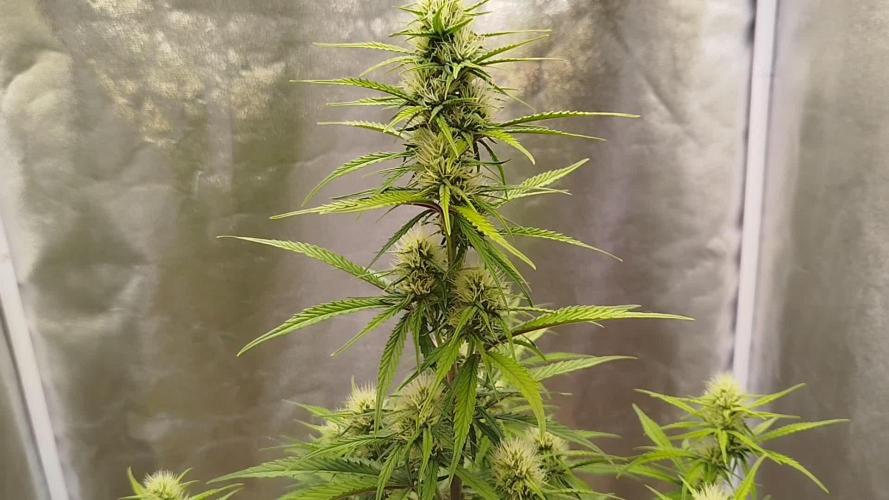
Another push this week in her stretch, growing tall now in the growbox and it's because she is making place for her big fat buds that she is growing.
This week also marks the appearance of more thrichomes and a more intense sour Diesel + flowery smell.
Likes
5
Share


@Northstar_cannabis
Follow
Biggest buds in the tent! Banana purple punch wastes no time bud building, look nice and dense already. This one will smoke nice!


Likes
22
Share


@dillande3
Follow
Hello, Day 40 and day 42, Flower Phase , PGK, After Nute Burn problem, i did a good flush as a solution and its works, Edges burn seems stops. Now after 10 Days I am going to use new correct NPK dose (0.6-3-3), Hope everything is gona ok Thanks Guys
Day 40 - 13/12/22
Day 42 - 15/12/22


Likes
4
Share


@BioGrowBayer
Follow
Nach dem Umtopfen ging es direkt weiter mit einem ordentlichen Wachstumsschub – richtig schön anzusehen! Die Pflanzen haben den Wechsel super weggesteckt und legen jetzt ordentlich zu. Alles verläuft bisher nach Plan, ohne nennenswerte Komplikationen.
Die Symptome des Calciummangels sind komplett verschwunden – die neuen Blätter sehen gesund und kräftig aus. Offensichtlich zeigt die angepasste Düngung Wirkung.
Auch die Thripse scheinen erfolgreich bekämpft worden zu sein. Ich konnte bisher keine neuen Spuren entdecken – hoffentlich bleibt das so.
Heute stand noch ein wenig Entlaubung auf dem Programm, um Licht und Luft besser ins Innere der Pflanze zu bringen und die Schimmelgefahr weiter zu minimieren.