


Likes
Comments
Share


@DTHEREID
Follow
Chopped the big tooth since she was flushed earlier due to issues. Also have the purple gorilla auto chopped and drying.
Still flushing strawberry eclair and critical jack to come down next.


Likes
8
Share


@Area420
Follow
definitely a tough plant because she's had it a little rough. Starting to see a deficiency or maybe excess not sure but Any suggestions appreciated. Probably a little tiger bloom this week. Just ordered cal mag and pH up down. She really streaching this week.

Likes
144
Share


@TOTEM
Follow
She’s still stretching!
This week I removed Voodoo Juice, Tarantula and Piranha, and added B-52 and Bud Factor X (never tried this one before). Since the princess loves this 2ml/L dosage for NPK nutes, I’ll not be touching that for the moment. That seems to be the optimal dosage for a sativa like this. Very nice!

Likes
8
Share


@Bread_n_Buds
Follow
Our Gush Mintz have undergone a small revolution and are still super beautiful, even more than before.
One of the plants was damaged during the main lining I broke a brunch and it was transformed into a very very beautiful LST plant, it could remain small but I wouldn't swear it has a truly spectacular shape.
In this diary therefore you will find the plant worked without techniques that require cutting but only with a LST this time also on the main stem and very aggressive to give a beautiful shape.
The comparison is the salt of the experience so the plant in the other diary will be worked very differently.
We have started the Plagron fertilization program, we are in 100% organic configuration, the soil is recycled Promix + 1/3 fresh soil + 10% Perlite + RQS Mycorrhiza Mix (4 g in the mix, 1 g under the small fiber pot).
We are administering // 1 ml/l Power Roots - 1 ml/l Pure Zym - 1 ml/l Sugar Royal - 3 ml/l Alga Grow
https://plagron.com/en
The doubts about the compatibility between Pure Zym and mycorrhizae have been dispelled, they can get along according to Plagron experts. If someone tells you that enzymes eat mycorrhizae, which in principle may seem possible, explain to them that it is not true.
https://www.royalqueenseeds.it/growing/452-easy-roots-mix-di-micorrhize.html
Try this strain, it's a top strain of the last few years very high thc level
------------------------------------------------------------------- https://www.zamnesia.io/it/11234-zamnesia-seeds-gush-mintz-automatic.html
Brief description of Zamnesia // Gush Mintz Auto is a relaxing hybrid strain that derives from the original Gush Mintz and a high-performance ruderalis specimen. This cross produced a plant with 70% indica and 30% sativa genetics. Her parents have given her a range of interesting traits, including mint and candy flavors and a high THC content of 20%. Smoking these buds provides creative vibes, a sense of euphoria and a pleasant sensation from head to toe. In addition to its enticing flavors and powerful effects, Gush Mintz Auto produces large yields of compact buds in just 9–10 weeks from germination.
Gush Mintz Auto is extremely easy to grow, with plants reaching an average height of 70cm indoors and 120cm outdoors, making her ideal for discreet grows or limited spaces both indoors and outdoors. This strain is well suited to LST (Low Stress Training) and performs best in a ScrOG setup (a technique that optimizes light exposure to maximize yields).
Punching aromas and deeply relaxing effects
As she grows, Gush Mintz Auto's aroma intensifies, releasing sweet and minty notes. This refreshing flavor profile really comes into its own when smoked, offering an inviting combination of minty freshness and sweetness. The effects are deeply relaxing, enveloping the body in a pleasant well-being without being too sedative. Gush Mintz Auto is perfect for those seeking creative inspiration, making writing, painting or music-making sessions smoother and more inspiring.
At Zamnesia you can find the whole world of growing and much more. Take a tour around the site and you will find "all the best that nature has to offer" in various shapes and colors.
The new strains are amazing and the old ones are no exception... p.s. for now zero Hermaphrodites, growers, can you say the same?
--- // www.zamnesia.com
Likes
44
Share


@ElRojo
Follow
Day 60, week 9 a Little video update, i switched to 12-12 and seems working, the lady Is growing a lot during night time.
Day 61, what the fuck Is wrong with this leaf, what i can do? I was checking the lady and found this leaf on the main cola, i cutted It Off and now i'm worried could be some fungus 😟
Day 63 end of week 9, today i feeded calmag let's see how the lady turn out


Likes
17
Share

@Northern_Ent
Follow
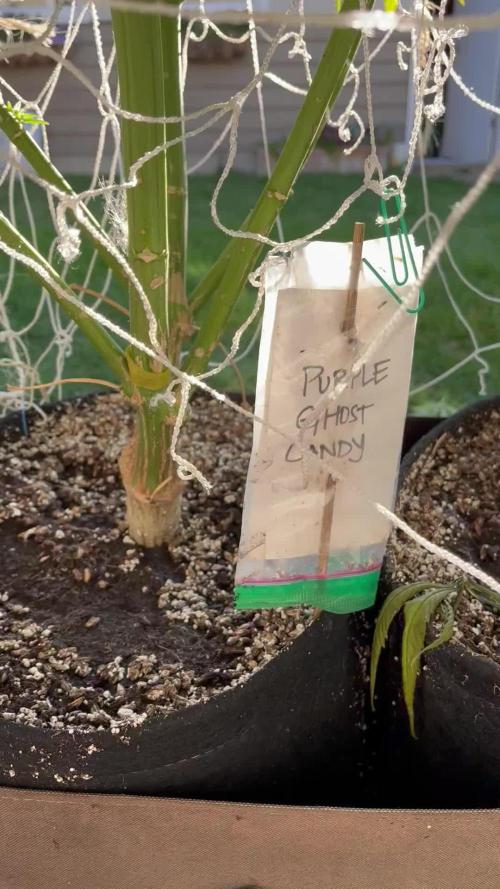
Sep 19: Purple Ghost Candy is the star plant this year. Big 16 cola manifold with really nice sativa phenotype. Looks great and the buds are getting close to ready.
Sep 21: flash pics right before 730 nm far red light for a few seconds at dusk (timed to Civil Twilight as listed for my location on timeanddate.com). Don’t take flash pics of your buds unless you follow up with the red light to ‘reset’ it into dark mode.
Sep 25: cool and rainy weather moving in so I took the first round from PGC. Took 469 g Grade A buds and 740 g Grade A- to B+ fresh frozen for hashmaking. Total 1209 g wet so far equivalent to about 300 g dried. Still lots to go so she will be over a pound of dried buds total which is always cool. 😎 👍

Likes
8
Share


@emeraldlabs
Follow
Deep breaths... alright well things changed rapidly this week. She went downhill quick. Signs of potassium deficiency, but that shouldn’t be a problem. Thinking, after checking runoff, she faded a little too acidic (I had stopped checking regularly as I’ve had minimal issues on previous 5 grows). She got a nice flush, with final run off reading at 6.4. She only has 2 weeks or so to go, so not panicking; if anything just a learning experience. Her flush was yesterday; she’s scheduled for feeding on Tuesday, so we will see how things go.
Video/photos taken 63 days after breaking soil.

Likes
8
Share


@Esjey
Follow
Hello, the second week of flowering has begun. From information from outside I have learned that they are fine, except that F1 hybrids are not very suitable for training due to the fact that there is no time for regeneration... maybe there is something to it because mine are almost dimensional :p they get a full set of vitamins but only for three doses. I do not know what will come of it, that is why I do not intend to waste nutrients...
Best regards.
Smoke weed every day ✌️🤘


Likes
12
Share


@Cultiuherba
Follow
Mantengo luz al 75% y pulverizo bloom foliar de floraflex. Inicio pequeñas defoliaciones en ramas bajas.
Siguen creciendo fuertes y sanas, han estirado mucho esta semana.

Likes
6
Share


@momsbasement_exotics
Follow
little bit of nute burn but im still happy with how they look going to begin flushing them soon with just water and a little calmag every other water.
Likes
92
Share


@Roberts
Follow
Apple Fritter is doing really well. She has stretched a bit. Looking really happy. Hopefully she produces a nice yield. I am doing a solution change ever 4 to 5 days. She is in a New Level Hydro bucket, under a Spider Farmer SE5000 light at 80 percent. Thank you New Level Hydro, Spider Farmer, and Amsterdam Marijuana Seeds. 💪🤜🤛🌱
Http://amsterdammarijuanaseeds.com
Thank you grow diaries community for the 👇likes👇, follows, comments, and subscriptions on my YouTube channel👇. ❄️🌱🍻 Happy Growing 🌱🌱🌱
https://youtube.com/channel/UCAhN7yRzWLpcaRHhMIQ7X4g
SE5000
https://amzn.to/3qFpAML
Spider Farmer Official Website Links:
US&Worldwide: https://www.spider-farmer.com
UK: https://spiderfarmer.co.uk
CA: https://spiderfarmer.ca
EU: https://spiderfarmer.eu
AU: https://spiderfarmer.com.au
Coupon Code: saveurcash
Www.newlevelhydro.com
Www.hygrozyme.com

Likes
184
Share


@Still_Smoq
Follow
#seedsman420growoff and #SeedsmanSeeds
📆 Week 3, 11-17 May 2024
11 May - Increased light power to 60%.
12-17 May - Observed and let the plant grow.
📑 Increased light power to 60% to get DLI 25 coverage on the plant. Made adjustments to lower branches moving them through leaves. The plant seems to be on its way to keeping a uniform height without any training.
🍶 11 May nutrient solution changed
🍽️ 11 May feeding schedule updated
💧 Using reverse osmosis water with EC/TDS at 0
🐉 Nutrient Solution EC 1.6 at 70 degree F
🔆 Light power 60%, DLI 25 canopy coverage at 18hrs
😤 Using General Hydroponics, HGC728040, Dual Diaphragm Air Pump, 320 GPH
That is it for this week. Thanks for the look, read and stopping by.
Likes
11
Share


@Ninjabuds
Follow
The Blackberry moonrocks plants are beasts. They're so thick and sturdy, and they're covered in buds. They're not stretching much, so it's gonna be a really tight bud on top. I'm excited to see how they turn out.
Well, it's Christmas again. This year feels a little different, though. Maybe it's the snow blanketing everything, or the way the tree lights up the whole living room. Either way, it's cozy and warm, even when it's freezing outside. I'm really looking forward to seeing what Santa brings. I hope I get that new video game I've been wanting. But most of all, I can't wait to spend time with my family. We always have so much fun
This past week was a good one for the plants. They started the first week of their stretch, and they've already grown a decent amount. I can really see them filling out. It's cool to watch them grow so fast. I can't wait to see how big they get by the end
I always get a little worried at this stage, like they're not gonna get as big as I want them to. But then I remember how they always end up surprising me. By the end, they're always perfect.

Likes
31
Share


@scotch_egg
Follow
Welcome back to the conclusion of the Lemons! Day 56 from seed on the dot and these two girls came down, which is crazy fast! I had originally planned to let these girls run for another week, but the stem snapping on LP#2 put an end to that as she wasn't recovering well by the next day and I thought better to harvest now. The trichomes are in a good spot anyway, so I don't feel like I've lost out at all. The wet weight is good, but massively inflated due to the stems, so I expect to lose at least 75% of that, but I still think these girls yielded reasonably well.
I like to dry in 2 stages in order to slow down that initial dry as the humidity is naturally quite low here. By leaving the stems and most of the leaves until Stage 2 I can control my dry time a little better. I leave the buds on the stems until they go into jars. There's no hard rule to how long I leave between stage 1 and 2, it depends entirely on how a particular dry is going and I judge it as it goes.
Dry took 6 days total, trimmed large leaves at day 3, the rest at day 6.
Likes
39
Share


@Master_weeda
Follow
Bonjour à tous les padawans et maîtres jedis
Tout d'abord merci à greenhouse de me permettre de faire cette culture en m'offrant le feeding greenhouse et des graines
Je rappelle que cultive simultanément 9 pots de 10 et 11 litres dans une box prévu pour 4 et que je n'utilise que le strict minimum du matériel nécessaire à une culture correcte au prix le plus bas possible
MATÉRIEL CONFIGURATION
Box 80×80×160
Lampe led Lampwin 300 watts ×2
Ventilateur à pince 15 watts
Xiaomi Deerma humidificateurs 5L
Hygrometre thermomètre
Extracteur PROFAN 107 m3/h - 100
Prise programmable électronique ×2
1 pot carré noir 10 litres
Green house feeding enhancer
Green house feeding biobloom
Green house feeding biogrow
Substrat biobizz ligthmix
Fil de fer et pince coupante
Microscope
Petite balance de précision
CULTURE ÉTAPE PAR ÉTAPE
J'ai tout dabord fais germé ma graine avec le easy start de Royal queen seed et je suis agréablement surpris car franchement le taux de réussite est très élevé (17 graines sur 19) simple d'utilisation et très efficace.
Une fois la plantule sortie et d'une hauteur de 2 ou 3 centimètres je la prend délicatement et la place directement dans son pot définitif. Je préconise des pots allant entre 10 litres et 15 litres pour des autofloraisons cultivées en intérieur.
Le pot aura été préalablement préparé (video dans diarie) avec 30 grammes d'engrais greenhouse feeding biobloom et 30 grammes de greenhouse feeding biogrow, soit l'équivalent de 3 grammes par litre de substrat.
Je dépose donc la plantule dans son pot définitif je recouvre un peu de avec de la terre je tasse légèrement et j'arrose pour garder le substrat humide pas plus
Je place ma lampe led 300watts à environ 90 centimètres de la plantule avec un cycle de lumière de 24/24 pendant une semaine. Au début de la semaine 2 le cycle de lumière passera en 20/4 grace a un programmateur car c'est pour moi le cycle de lumière qui offre le meilleur rendement pour une autofloraison.
Jour1: léger arrosage
Jour2: léger arrosage
Jour3: la plantule commence à être plus vigoureuse mise en place de la ventilation pour augmenter sa masse racinaire et léger arrosage
Jour4: arrosage avec un litre et demi d'eau ph6.3 à laquelle j'ai ajouté 0.9 gramme de greenhouse feeding enhancer (soit 0.6 gramme par litre d'eau)
Jour5: aucune technique spéciale
Jour6: aucune technique spéciale
Semaine agréablement calme sans problème ni carence apparente
Que la force soit avec vous !

Likes
8
Share


@Maggie_de_Block
Follow
Recovered nicely from last week's defoliation, defoliated a lil again to expose top bud sites.
Think she's completely finished stretching now
Starting to smell a little bit as well
Likes
13
Share


@Alpha_Green
Follow
Some of you may have wondered:
Why do I use CO2 at average 950 ppfd μmol/m2/s (moral flow)?
The answer is quite simple. Because of lack of space in some regions of my cultivation area, I simply cannot keep the ideal distance to my Sanlight high-performance lamp, due to some height growth of various strains. And so some of the main colas have ppfd values of 1250 μmol/m2/s and even more...
So this is how I manage to achieve and compensate for such high radiation levels even with a CO 2 balance. And I have to say, my strategy to avoid various light stress symptoms works just fabulously. In combination with CO 2 implementation, my babies are simply unbeatably insensitive to light. Thats it!
Beginning of 3rd week flowering:
Again feeding my babies by 36 hours fermented potions of Bio Tabs Kompost Tea PK-Booster (15 g pro Liter) and added:
5ml Orgatrex/Liter
1 Spoon of Bactrex
1 Spoon of Mycotrex
1 Spoon of Mycco-Vital
1 Spoon of Dynomyco
A little tip for those who are interested in small modifications that have a big difference or influence - on the result - effect - beauty - health - taste! Before adding microorganisms or beneficial bacteria or Mycorrizae and Trichodermas, please use oxygen-saturated water. On the one hand, unwanted chlorine gases evaporate and the small world of the microbiome becomes even faster and more rewarding in compost tea to sprout.
Last but not least for this week, I would like to introduce my reasons, why I prefer growing biologically and sustainably.
First of all, it’s something which suits very well in these times/days we are living now. Sustainability is a big need and task for our planet. 🌎 Nature means life. Our home, the air we breathe and everything that surrounds us. Not just today. Hopefully tomorrow as well.
Maybe I'm starting to protect our environment on a small scale, but maybe I can also make a big difference at all.
If you change the way you look at things, the things you look at change...
I thought about what’s the difference, between Mineral Feeding and Super Soil Feeding.
It’s very easy. Biologically Growing is a similar process than the natural soil activities out there in the lap of nature’s. So plants has to work and interact with the microorganisms and microbiomic communities in the soil. So the plants will never get lazy like the lazy ones of mineral feeding growers.
If you grow biologically, you will feed the soil first and the microorganisms will support every parameter next to your plant conditions. And that will generate an unbelievable spectrum of Terpenes and Trichomes you will never forget.
It’s the same comparison, when you daily visit McDonalds and you eat only fast food. How does your body and mind react on this shit for money?!?!
May I invite you to think about it…
See you next week dear Growmies! Have a nice Weekend and take care…
Peace out!
Addendum for Day 53:
At the moment we unfortunately have another winter onset here in Germany. This means that I am forced to take additional heating measures due to structural facts in order to be able to keep the temperatures constant. After all, just tonight the thermometer climbs again to -1 degree Celsius.
In addition, my exhaust air system runs out of my bedroom terrace and I therefore grow winter and summer with the patio door open. Well, sometimes I experience real weather-related challenges. But all in all, no problem...
"Where there's a will, there's a way."
Addendum to pouring out the fermented PK tea: I always administer half a liter of lukewarm aerated water with 3.5 ml of cannazyme per liter to each plant. This means that the "root machine" is not supplied with supplies unprepared and the nutrient solution can thus also be better distributed in the soil. Since I also work with cloth shoes, I spray them evenly moistened everywhere with water that is also warm before pouring them out from the outside. This has the advantage that the moisture stays where it should: in the pot!
... I did the math today ;-) We are still in week 7 until this Friday. And week 8 starts on Friday! OMG... still so much time yeahh!
Today my Fast Buds Sour Jealousy and Sweet Seeds Big Devil and Dark Devil Automatics arrived. I'm looking forward to it.
This time Fast Buds next Time Sweet Seeds. Love them too. Very beautiful genetics.
Today a review video of the beginning of week 3.
At the time of the pictures, I had minor signs of nitrogen excess. (Light peaks first at the crown of the roof and then slightly continuing to the middle section.) I then painstakingly racked my brains as to why this could be. I found that very slight dry spots had formed and therefore the root found small accumulations of nitrogen that caused its problems. But then, when I carefully homogeneously checked the moisture content in the substrate, the problem evaporated again. However, they had not shown any loss of growth rate during this time. Nevertheless, they developed as expected.
They Strawnanas had no problem with that.
In the end, I always have a hard time killing them. But I guess that's the way things go.
We live and die.
We come and go.
But it's not there yet. ;-)
Tomorrow is day 56.
Tomorrow’s updating day!
Can't wait to see their progress.
Have a good time and see you tomorrow… 🏽🕊️
🏽 ☮️🕊️
