





@GoodTimesOrganics
Follow
Willkommen zurück liebe Community 🌱💚
Frozen Biscotti von Dutch Passion on the Run!
Die zweite Blütewoche ist vorbei
🍀Wachtumstag 49 | 🌺Blütetag: 14
Ein wahnsinns Überraschungdpaket, der Stretch ist nun eher schon wieder vorbei. Allerdings habe ich letzte Woche noch Biegeelemente eingespannt um die Triebe etwas in die Breite zu bekommen.
Hat wohl funktioniert💚
Sie ist aktuell immernoch 119cm hoch und das Verhältnis hat sich nur durch zweimaliges nachbessern pro Woche, in den Griff kriegen lassen.
Jetzt hat die Pflanze doch eine sehr schöne Form.
Ich muss schon sagen, ihr Wuchsverhältnis ist bisher eher etwas anstrengend.
Ich hoffe das hat sich jetzt erledigt und wir bekommen eine schöne Blütezeit🙏
Schauen wir einmal, was sich nun daraus entwickelt.
Die Umgebungsgegebenheiten sind aktuell top!
—————
🌞 Temp: 26
🌚 Temp: 18°C bis 19°C
💨 RH: 56%
VPD: 1,1 kPa
💡ppfd: 630 mpm
—————
Viele Grüße 👋




@Ultraviolet
Follow
The cannabis strain Grape Guava can be a purple strain, depending on its specific phenotype and genetic makeup. While not all phenotypes of Grape Guava are purple, some variations, such as the Zatix Grape Guava, are noted for their striking purple appearance due to the genetic expression of anthocyanin pigments.
Grand Cru Genetics is a cannabis seed bank that emerged in 2018 from a group of breeders in Madrid to provide a satisfactory experience to all cannabis users.
"If we do things, we do them well. Due to our experience in the sector and our taste for excellence, we know high quality and we seek it in everything we propose and do."
"We have a “cultivate without giving up” philosophy that we apply to everything we do. We do not give up, we are friends of change, and we adapt as necessary in a still restricted sector."
"We speak relaxed because we know how to relax. We are not intense or preachy; we accept everyone as they are, and we understand that farming is not for everyone. But for those who do, we are here to accompany you. We like to do it and tell it. We are experts in the field because we are the first to do it. We speak from experience and connect with others because we share the passion for cultivation."
"Cannabis has the ability to show us a world of possibilities. When you cultivate and live its growth process, you enjoy a path full of emotions and not just the final destination. At Grand Cru we find beauty in small things. We are attentive, observant, detail-oriented and aware of everyday things, and we savor them without rushing."
In a garden of green, Grape Guava gleams,
With its fruity aroma, enchanting dreams.
Clusters of grapes, guava's sweetness ignite,
A strain so divine, in purple and white.
Euphoria whispers, a lush fruity haze,
Grape Guava's embrace, a tranquil daze.
Off and away.@1400ppm. The increased CO2 allows plants to thrive at higher temperatures, which in turn necessitates higher humidity to maintain the ideal VPD for healthy growth and transpiration. 80F -5F = 75F LST with 70% RH = 0.72 kPa. Higher temperatures and humidity promote rapid growth, nutrient uptake, and photosynthesis while maintaining a lower stress level. Temperature influences the rate of enzymatic reactions involved in aerobic respiration. Enzymes, such as those involved in glycolysis, the Krebs cycle, and the electron transport chain, work most efficiently at an optimal temperature range. In low temperatures, enzymatic activity will slow down, thus reducing the rate of aerobic respiration. In high temperatures, enzymes can become denatured, thus impairing their function and stopping the process of aerobic respiration. Glucose is the primary fuel for aerobic respiration. The rate of aerobic respiration increases with the availability of glucose, as it is the starting point for glycolysis. If glucose levels are low, cells may rely on alternative energy sources such as fatty acids or amino acids , but these processes may yield less ATP or be less efficient. To determine this effect, carbon dioxide volume was measured (as carbon dioxide is an output of aerobic respiration)
18/6 with the 6 being IR. The near infrared (IR-a) borders around 700nm up to 1400nm @ photon par flux density of 1.8 instead of darkness, keeping temps overnight a neat 77F-80F.
I think of my tent as a lung. What goes in must come out. When the rate of air going out exceeds the amount of air coming in, it creates a negative pressure. Tent concaves (bends in). If set up correctly, the RH will begin to drop slowly to the desired level I set, and the extraction turns off when it reaches the desired RH. The plant, as it performs cellular respiration, will always release more water into the air; therefore, the RH% of the tent overnight will increase, as long as oxidative phosphorylation is occurring. As soon as the RH% creeps back up to 55%, the extraction turns back on, over and over. This creates a strong pressure differential, which will work wonders with mass flow. Replicating high and low-pressure fronts in nature. Critical for oxygen diffusion at the critical time of peak cellular respiratory function..
Moisture will not transfer from a saturated atmosphere to another if that air is already at or above its saturation point, meaning the air can't hold any more water vapor. Once I understood that water is produced as a by product during cellular respiration, specifically at the very end of the electron transport chain (ETC) where electrons are finally transferred to molecular oxygen, the higher the RH of the air, the more resistance there is for more moisture to be added to that environment, and effects the ease with which it does so. But none of that water comes from the pot; it's pulled from the air. If you run high daytime RH, your medium/pot is 100% reliant on transpirational root pull to move water. ZERO evaporation happens across the atmosphere if the tent air has high RH%, the medium cannot release its water through evaporation. Once a canopy develops, light no longer slowly wicks and evaporates from the topsoil. The Soil-Plant-Atmosphere Continuum (SPAC) describes the continuous pathway and process of water movement, driven by a gradient in water potential, from the soil, through the plant's roots, stem, and leaves, and finally evaporating into the atmosphere through transpiration. There is evaporation, there is transpiration, and then there is evapotranspiration; Evapotranspiration (ET) is the combined total of two processes: evaporation (water lost directly from soil and surface water into the atmosphere) and transpiration (water released from plants to the atmosphere through their leaves). Evapotranspiration represents the total amount of water that moves from the medium into the air. There is no such thing as a medium with too much water, only a medium that retains too much for too long.
The water must always flow efficiently from one atmosphere(Medium) to another(Air) in a timely manner. Moisture is a critical factor for bacterial growth and decay. Dictating how long it's allowed to sit in any one location for any given period is a key preferred control. To ensure a net reduction in a bacterial population, the rate of removal (ET) must exceed the rate of bacterial growth (decay rate), which is often modeled as a growth rate for the specific bacterium under the given conditions. By optimizing daytime VPD, we also optimize conditions for bacterial growth to explode exponentially above 77°F.. If water is allowed to sit in a medium without an escape within a timeframe, nothing good will happen. IF High RH is maintained overnight as well as during the day, placing 100% of water movement at the behest of daytime transpiration, roots can only pull where they can reach, and if soil is compressed above a certain point, moisture will become trapped in a medium with no way of moving day or night. This will begin the countdown for decay to take hold. When water stagnates in a medium, it loses oxygen, creating anaerobic conditions that foster the growth of harmful microorganisms like bacteria and fungi, which can produce toxins and disease vectors.
Thigmomorphogenesis, the process by which plants respond to mechanical stimuli like touch by altering their growth and development, results in significant morphological changes to improve survival against mechanical perturbations. This complex response involves sensing touch and initiating physiological and genetic responses, leading to changes in form and structure over days or weeks. The process is triggered by physical forces such as wind, rain, or touch. Plants adapt to these stimuli by changing their shape and structure, which may include slower growth, thickened stems, or altered leaf development. Plants possess sophisticated mechanisms to detect even subtle mechanical stimuli and initiate responses. A variety of molecules, including calcium ions, jasmonates, ethylene, and nitric oxide, are involved in signaling these mechanical inputs. Touch can induce the expression of genes that encode proteins for calcium sensing, cell wall modification, and defense mechanisms. A plant exposed to constant wind may become shorter and sturdier. A plant that is touched frequently might grow more slowly to conserve energy and develop thicker cell walls. These changes increase a plant's resilience and ability to survive in harsh environments.
Let's get Thiggy with it.


@Barcelona_Farmers710
Follow
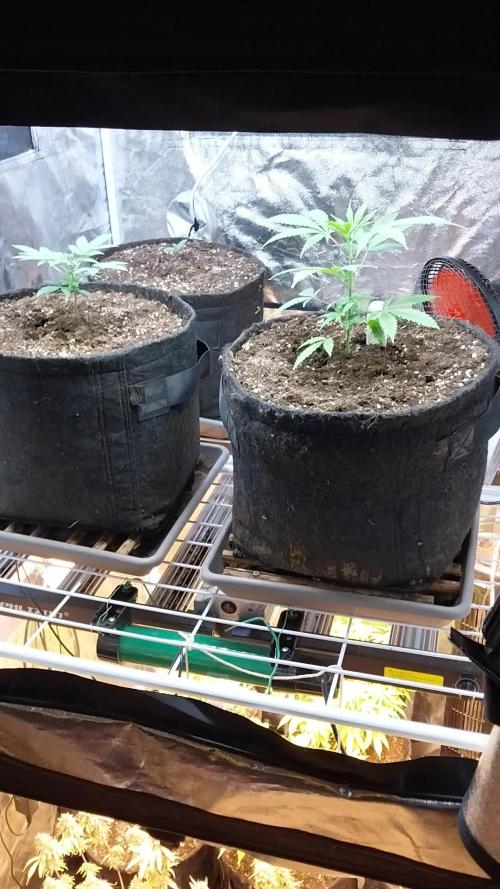
Ya empieza tener buena pinta esto farmers!! Una semana después de transplantar las niñas ya están recuperadas, menos un par que tiene carencias de nitrógeno... el resto bien,esta vez conseguiremos que no se vayan de madre para arriba como la última vez! Me encanta las nuevas genéticas de royal queens seeds!💚



@PapaBlob
Follow
02/11 Elle se porte assez bien je pense. 😁👍
Merci encore à Divine Seeds pour toutes ces superbes souches. Que l'ont peut trouver là : Divine Seeds : https://divineseeds.net/


@CannaBossBizz
Follow
The Moby Dick ist doing great. Getting bigger every day! I Hope she'll Go on Like that! Maybe one more nod and i'll top her maybe Not. Gonna think about it. Stay tuned! 🤙🏽


@Wenz004
Follow
No4 (feeded wit biobizz) causes a lot of problems and needs a lot of attention...started with Ca deficiency...after this came toxicity of nitrogen and now some Mg deficiency...but the grow is very good.
Same strain in Pot No2 in super living soil is doing good...grows a little slower but I have zero work and zero problems there.
So far I would prefer living soil in the future. But let see what happens for the rest of the grow.
Increasing light to 650-700 micromol/m2/s in week 5 (for No2, No3 and No4) was a bad idea...decreased to 500-550 now the vitality is coming back


@ShiftyGaijin
Follow
Running a partial flush this week to see if anything helps with the Caramelino leaf discoloration that continues to advance. I know I’m close, but being my first grow, getting jumpy to pull the trigger. Haven’t seen any amber trichomes yet. But getting a decent amount of opaque. The smells are absolutely out of this world. 😌✌️🏻


@MeaCulpa
Follow
Happy new year!
I switch to water in a week and then rinse for 2 weeks. Everything looks good so far.
The only thing that worry me a little is the high humidity.
In the small tent I have almost always under 50% humidity in the evening,
In the large tent it is rarely below 60%-65%. Although my filter is supposed to make 243m³/h, my tent construction is probably too much for it.
With 90% outside humidity since weeks, it's really a battle against windmills.
I hope nothing gets moldy.


@Chubbs
Follow
Weekly update for these 3 lovely ladies. They're progressing nicely and smelling like cake when you rub the stems. Did a defoliation this week giving them some more light at the lower sites. All in all Happy


@UnitedStrainsGermany
Follow
Dieses Mal wurden beide defoliert zum letzten Mal vor der Blüte ich werde beide voraussichtlich in einer Woche in die Blüte schicken beide sind sehr potent und sehr gesund !




@DogDoctorOfficial
Follow
🌱 8×8 Adventure – Folder 10
Frosted Guava – Plant A | Week 4 | The Compact Contender Begins to Bloom
Every phenotype tells its own story, and that is exactly why this 8×8 Adventure continues to fascinate me. Growing twelve different genetics under the same environment using the 12/12 From Seed technique has become a constant lesson in how differently each cultivar interprets identical conditions. Some immediately stretch toward the light, while others choose patience, investing their energy into structure before committing to vertical growth.
Frosted Guava Plant A clearly belongs to the second group.
Rather than racing upward, she has spent these first weeks building an incredibly dense, compact framework. Looking at her today, it’s easy to understand why this phenotype caught my attention. Every internode remains tight, every branch is stacked close together, and the entire plant carries an impressive amount of healthy foliage without sacrificing vigor. She may not be the tallest lady in the tent, but she’s quietly building what looks to become an exceptionally productive little bush.
The most exciting part?
Despite her compact stature, she has officially begun announcing that flowering is just around the corner.
⸻
🌱 Building a Foundation Before the Stretch
One of the things I enjoy most about documenting these grows is watching personality emerge before flowers ever appear.
Frosted Guava Plant A has developed into exactly the kind of plant that rewards patience.
Instead of producing long internodal spacing, she has focused on creating a dense network of future flowering sites. Looking closely, nearly every node is alive with vigorous new growth, and fresh shoots are beginning to compete for dominance. The canopy is naturally uniform, making future light penetration much easier than on taller, more open phenotypes.
Sometimes growers become concerned when a plant doesn’t stretch early under 12/12, but genetics ultimately decide how that energy is distributed.
In this case, the energy has clearly gone underground first into the roots, then into stem thickness, branching, and node production before committing to vertical growth.
The result is a plant that already feels mature despite standing only around 25 cm tall.
⸻
✂️ Gentle Low Stress Training
Instead of aggressive manipulation, this phenotype has been guided with a much softer approach.
Throughout the week I continued using simple leaf bending, leaf tucking and gentle repositioning to expose hidden growth tips. No unnecessary stress, no heavy defoliation—just encouraging light to reach every developing branch naturally.
This technique has worked beautifully.
Rather than removing valuable solar panels, the larger fan leaves are simply moved out of the way, allowing the lower shoots to receive enough light to become future flowering tops.
Sometimes the simplest training methods are also the most effective.
The goal isn’t forcing the plant into shape.
The goal is helping her discover her own.
⸻
🌸 The First Signs of Flower
One of the most enjoyable moments during a 12/12 From Seed project is seeing that unmistakable transition.
This week those first pre-flower structures have become impossible to ignore.
Tiny clusters are beginning to form across the upper nodes, the apical growth has changed shape, and the plant is slowly shifting away from vegetative expansion toward reproductive development.
She isn’t waiting.
Exactly as expected with this cultivation method, Frosted Guava is entering bloom while still maintaining a beautifully compact architecture.
If the coming stretch remains moderate, this could easily become one of the densest canopies inside the entire 8×8 tent.
⸻
🌡️ Environmental Conditions
This week the room remained remarkably stable despite the warm summer conditions.
Grow Environment
• 🌡️ Day Temperature: 33°C
• 🌙 Night Temperature: 25°C
• 💧 Relative Humidity: 63%
• 🌱 Substrate Temperature: 21°C
• 💦 Nutrient Solution Temperature: 26°C
• ⚡ EC: 1.35 mS/cm
• ⚗️ pH: 6.1
• ☁️ CO₂: 639 ppm
• 💧 Daily Water Consumption: 1.1 L
• ? Pot Size: 15 L
• ☀️ Light Schedule: 12/12
Although daytime temperatures continue to push higher than ideal, the plants have responded exceptionally well. Healthy leaf posture, rich coloration, vigorous growth and strong transpiration all suggest that root-zone conditions remain stable enough to offset the environmental heat.
Sometimes plants tell you far more than any environmental sensor can.
And these leaves are telling me they’re happy.
⸻
Feeding Program
The nutrition program remained intentionally balanced to support both continued vegetative development and the beginning of flower initiation.
This week’s recipe consisted of:
• Terra Grow — 1.8 ml/L
• Power Roots — 1 ml/L
• Pure Zym — 1 ml/L
• Sugar Royal — 1 ml/L
• pH Plus — 0.03 ml/L
• Lemon Kick — 0.03 ml/L
With an EC of 1.35, the feeding remains moderate while supplying everything needed to sustain healthy growth without pushing the plant harder than necessary.
The rich green foliage suggests the balance is right where it should be.
⸻
🔬 Phenotype Notes
Looking over this week’s photographs, several characteristics stand out.
The stem has thickened noticeably and provides an excellent foundation for future flower weight. Branch spacing remains extremely tight, giving the plant a naturally bushy appearance without requiring topping or more invasive training.
The new growth is vibrant, healthy and full of energy, while the canopy remains surprisingly symmetrical despite only using leaf tucking.
Perhaps the most interesting observation is just how many future flowering sites are already visible. Nearly every branch tip appears ready to contribute to the final canopy.
She may not be trying to become the biggest plant.
She may simply be trying to become one of the fullest.
Sometimes that’s an even better strategy.
⸻
🔮 Looking Ahead
The coming week should be one of the most exciting yet.
With flowering now beginning, I expect Frosted Guava Plant A to enter her stretch phase while continuing to produce additional flowering sites throughout the canopy.
Training will remain gentle, focusing on canopy management rather than forcing structure. If she maintains this compact architecture while adding vertical growth, she could develop into one of the easiest plants in the room to manage.
Every day she becomes a little more confident.
And every week she gives another reason to be excited about what’s coming next.
⸻
💚 Final Thoughts
Projects like this remind me why I love growing.
No two plants ever read the same script.
Even when sharing identical lighting, nutrition, temperatures and care, every genetic line chooses its own path. Frosted Guava Plant A has decided that patience comes first—building strength before height, structure before stretch, and now finally revealing the first signs that flowering has officially begun.
Watching those decisions unfold is one of the greatest rewards of documenting every week of this journey.
A huge thank you to Zamnesia for providing these exciting Frosted Guava genetics, Plagron for the reliable soil and nutrient line that keeps this entire project thriving, and Future of Grow LED for delivering the powerful, even lighting that allows every phenotype to express its full potential.
As always, thank you to the incredible GrowDiaries platform for giving growers around the world a place to learn from one another, and to everyone who follows this 8×8 Adventure week after week. Your encouragement, questions, advice and enthusiasm continue to make this journey even more rewarding.
Growers Love and see you all next week, as Frosted Guava Plant A takes her first real steps into bloom. 🌱💚


@JreyBudz
Follow
She is growing amazing and very fast. I did some training on the lower branches to get them some light and did some defoliation on unneeded leaves. I’m watering every other day now still only adding nutrients every third watering. I’m ready to see some of these buds start stacking!!!


@MistaOC
Follow
Final Week – Late Flower
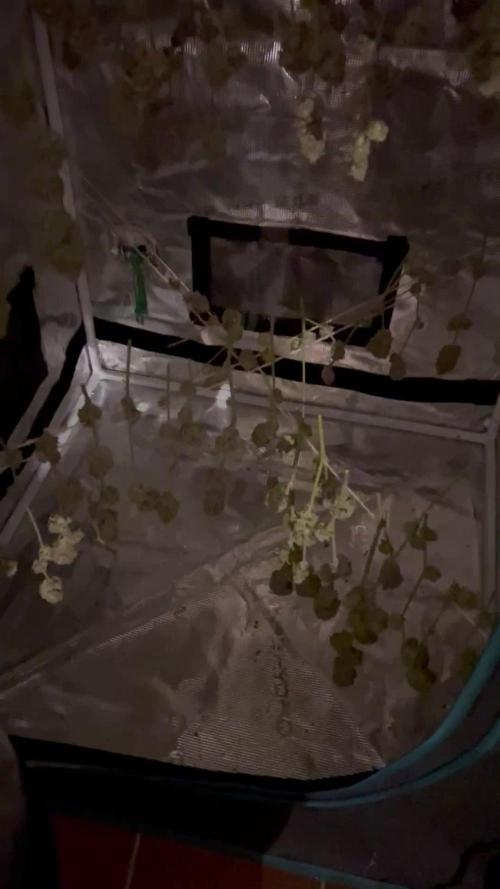
The final week was essentially a clean finish to the run. The buds swelled further, becoming dense and well structured. Despite the ongoing mildew issue, the situation remained controlled and never spiraled out of hand.
Lowering nighttime humidity below 50 % clearly helped slow down further spread. The focus was on maintaining stable conditions and consistently removing affected leaves.
Overall, the positives clearly outweigh the negatives: strong plants, solid bud development, and very relaxed handling thanks to Biotabs and the automatic irrigation system.
Now it’s simply about finishing strong and harvesting.


@Insaniac_0
Follow
All feeds with nutes use either a whole ratio or combination of "Veg Mix" and "Bloom Mix"concentrates DILUTED in water until a total ppm of add in is reached using a (Total Dissolved Solids)TDS Meter measured in PPM (parts per million). The "Veg Mix" concentrate will eventually be added in smaller ratios and "Bloom Mix" concentrate what will eventually replace the "Veg Mix" concentrate entirely with the ppm and ratios listed when I feed. Veg mix recipe is on week 3. Bloom Mix recipe is on week 5.
Day 28
Just a quick update for this morning since I had to move the ties a little. LST, I now have them above the 3rd node branches. Stats are normal and the growth tips are turning upward now.
Stats 73F/ 63% RH /IL Vent at 33% - Lights also same as before 345ppfd highest, 330 center, and 315 at lowest. No need for adjustment.
She seems to be taking the training well.
Day 29
Water day - checked last night and decided it was time again - Water by weight again so no runoff to measure at about 4 cups. (4 days since last feed by weight)
13lbs even par is 15lbs 4oz so I prepared 2lbs 4oz of water.
Tested my meter and discovered it needed calibration (the temp is off and cant be calibrated - so I used a trusty meat thermometer.
started with 4ppm and added 300ppm of epsom and vegmix ph balanced to 6.34 at 69.8F - then splashed with H2O2. Poured around roots and splashed the stem base - sprayed some on the leaves and use the whole amount.
Had to adjust lights now to be brighter so I brought them down to 18.5" and ppfd is now 375highest 360 center and 345 at lowest.
VPD is normal at 1.0 with 73F /63% RH /33% IL Vent - fans are pointed to directly now as the leaves are starting to get rough feeling - so I moved them a bit to blow less directly
Training is doing good nice upward turn on the training (making small LST movements with the ties other than than... just letting it make new branches.
Day 30
Checked PH and got 5.0 on my meter(+1.25 tested differential = 6.25) Stats normal too - 73F /64% RH /33% IL Vent - Lights at 385highest 370 center and 355 at lowest
Removed cross ties since they are no longer needed to hold the fan leaves- training still looking nice as the new nodes are formed with 2nd node leaves growing already.
Day 31
Identified an issue this morning - went back through my pictures, identified the start, looked at the day before, and noted my changes that I took notes on at that time. Went to google to diagnose a few possible hypothesis and am now testing with a treatment. (suggestions from more experienced growers welcome)
This morning the issue was brown spots on the older fan leaves. Mostly just the left fan leaf. Seems to have started 2 days ago (day 29) when I changed the lights and fed her. When I fed her, I left water droplets on the leaves instead of drying them off after a short time (I had been drying them with a tissue after a wet pic. The fans were also adjusted after the lights were dropped closer as well.
Hypothesis:
I think the water was magnifying the light and caused light stress at the those spots. I dont think the wind of the fan had much to do with it other than they helped dry the leaves faster as noted by the water being completely gone by the time I took pictures later that night for measurements.
Test: Raised my lights to a max of 350ppfd (from 385 highest reading this morning) Had to adjust fans again since they rest on my lights.
Will observe looking for improvement over the next few days.
... another possibility was given to me by Guru @Roberts (thank you) as it possibly being a ph issue locking out calcium. So I thought I might test ph and then try diluted cal/mag in a spray if my soil is too low (also looked at pics and seen VERY close similarities in my pics and those)
and so on that advice, I tested/calibrated my soil meter (it FINALLY calibrated for me!)I found my soil was avg of 3 readings at 5.153 (5.08,5.09,and 5.29) NOT GOOD - potentially locking out most all nutes.
I weighed out about 2 cups of purified water with and added about half ml of CalMag, ph balanced the water to 6.5 at 69.7F (my research shows Calcium lockout starting at 6.3 or lower) and splashed with H2O2 - I poured most around the base and sprayed the leaves too. I made sure to use the whole solution by pouring the last of the solution in the spray bottle over the stem and stem base.
EOD follow-up
Found a possible calcium blockade in my ph and on my leaves (of which are now starting to curl so I placed my fans on oscillate to ensure they aren't doing more damage) --- fully documented now.
otherwise measurements are now documented too. -- second node is starting to pull away from the last top so I will be looking to top again (3rd of possibly 4 total) and then HST and bind in a new spot
Day 32
Doing a morning and evening check her now while I see this issue resolved.
So far no sign of improvement since last night - might have gotten worse in comparison (will check pics side by side today) but I think because it's a immobile micronutrient so it should take time to stop then reverse.
So in the mean time I am doing a slurry test as a 2nd test for my soil before I treat it. I took soil from 3 different spots and made sure I got some from about 4 inches deep in each spot
(ensured calibrations were still good with buffer tests) 1st test is a PH meter tested directly in the soil. After using the 2 cups of 6.3 yesterday I got 3 readings today = 5.47, 5.32, and 5.5 to avg 5.43 - (yesterday's readings prior to treatment were 5.08, 5.09, and 5.29 to avg 5.153) - still far below the normal 6 to 7 for soil and the requirement of 6.3 and above for calcium to enter roots. suggesting again lockout.
So while I am checking the plant conditions I also looked at the new nodes - 2nd node is starting to pull away from the first, but not quite enough to top yet - thinking I will be able to top tomorrow evening - should be able to correct the ph tonight, so I can see if there's results in that by then as well.
I also set the fans to oscillate last night, so here's a video for that now.
Measurements, ppfd, and vpd will be in tonight's check-up
Day 32
So I started this evening by testing the run off with 2 meters, 5.7 and 5.67 - prepared 1 gallon of 7.5 ph water and splashed with H2O2 (checked with both meters)
Before flushing, I documented the leaves again - still curled and look very dry but they still have some flexibility with them - they dont seem to getting any worse so the spray may have gotten enough to the leaves most affected. The new nodes and growth tips seem to be okay but not growing as fast as they were. That would still mean that the soil needs treatment before the roots begin to die off and I end up with stunted growth overall.
SO I flushed the whole gallon and noted the runoff from the sides and bottom. I then tested the soil directly with 3 readings 5.95, 5.8, and 5.73 for avg 5.826 and tested the runoff water with 2 separate meters for 5.91 and 5.85
Not sure if I should feed dunk in 7.5 still or just use that number on the next feed in like 3 or 4 days. will discuss
Other than that ppfd highest is 360, 350 at center, and 330 at lowest.
VPD was 1.0 with temp at 74F /63% RH /33% IL Vent
Growth tips could be ready to top again tomorrow night, but I would like the get the ph taken care of first.
Day 33
Started the day by noticing the lower branches seem to stop turning and the next level branches seemed to have finally turned but nearly as fast as the first. (Noticed them having a start yesterday) Newer branches dont have any signs of issues.
So the plan today is to make Bloom Juice for later. Feed Dunk with 100% Veg Juice at a ph of 7.3 test runoff and ppm. Top the 4 nodes and remove the lower leaves. Calcium issue or not, that was always the plan with main-linning the plant. However, because of the health issues, I dont think I am going to go past these 8 colas - rather instead I will simply stop here and do some HST to set them how I want them to grow and let her recover and finish her veg for about two or three weeks.
Dunk had 300ppm of Epsom, Veg juice, in a little over 3 gallons of purified water. I had 7.4 ph and splashed with h2o2.
I pushed the entire plant into the water and soaked for a few seconds. Drained by hanging the pot up for about 10 minutes and the stream started dripping instead.
Checked the runoff with 2 meters 6.01 and 5.93 with 2580ppm.
Then I topped all four nodes and removed the fan leaves from under my mainline. I used LST to finger press the new branches apart into the direction I plan to move them to get the nodes powering up.
Next I will wait for a day to do HST on those new branches. Tonight I will simply let her rest.
VPD still at 1.0 - 73F /63% RH /33% IL Vent -
Lights are at 365 highest, 355 center, and 335 lowest.
No need to measure for growth now as I dont plan to top anymore
Day 34
Early entry to day for HST the morning after topping.
So I started off the morning checking stats and health. PH levels are still low. 3 soil meter tests 5.41, 5.41, and 5.44 for an avg of 5.42 - kinda at a loss here but can only monitor now.
VPD and lights are mostly the same - 74F /63% RH / 33% IL Vent - VPD not relevant today as the settings are the same and I am using HST to change the plant position.
leaves are noted for future reference - all four lower fan leaves have signs of calcium deficiency but not progressing nearly as fast as the first two did, so I think my attempts via higher ph water and feed may have helped. (I know the microbes in the soil are supposed to help get past ph issues , but mine seem to not be heathy)
HST
used a cuticle rod from my wife's nail case and a paint stick to press the rod against the branches and smash the inside of the elbows I want to bend.
LST
I then cut 4 strips of garden wire at the same length, hooked the ends like candy canes and aligned them about 1/2 inch above the new node and into the soil. From the side they look level but have the leaves now facing sideways. They will turn in a day or two.
shorts_status_processing


@Lazuli
Follow
21 July: start flowering
i took clones 4days ago that will veg bigger but for now i want to flower early as i think this plant will stretch more then the indicas im used to.


@I_Identify_As_A_Dan
Follow
Week 4 for Kalini Asia by zamnesia seeds,
Shes doing pretty good considering her age.. Ill be topping her again fairly soon just giving her some growing space.


@MrJones
Follow
Mr-Jones Shockwave F2
🔹🔹🔹🔹🔹🔹WEEKLY GOALS🔹🔹🔹🔹🔹🔹
🌞Environment - 75/80℉ and 45/50% Humidity
💧 Feeding - Using "Super Coco" amended soil. compost teas, Dechlorinated H20 PH/6.5 Fish Fertilizer, Started feeding the plants because they are only in 1-gallon pots.
🍃Training / towards the end of the week will be Schwazzing the plants, along with cleaning out the bottoms,.
🕷️ IPM - Will be using Green Cleaner" 1 OZ per Gallon, and CannControl from Mammoth alternating between product each month for Integrated Pest Management.
💡Mars Hydro FC 4800 / 480W Led Grow Light - "Instagram: MarsHydro_Aliexpress"💡
🔹🔹🔹🔹🔹🔹🔹🔹🔹🔹🔹🔹🔹🔹🔹🔹🔹🔹
📜- Rambling - Yay! Looks like plants are responding well to the Earth Juice, decided to Re-Veg 3 of these ladies for an experiment, after harvest, will be transplanting them into 7-gallon pots and see what I can shake out of the,
🔹🔹🔹🔹🔹🔹🔹🔹🔹🔹🔹🔹🔹🔹🔹🔹🔹🔹
▶️Sunday 12.20.20 / Last BioBix feeding, this product is great!
▶️Monday 12.21.20 / So moving to Earth Juice Sea Blast Bloom, 3-26-22 will make sure PH is in the proper range around 6.5
▶️Tuesday 12.22.20 / Day 2 with just using Earth Juice, the heavy P-K should start to become noticeable good or bad by week's end.
▶️Wednesday 12.23.20 / Day 3 with just using Earth Juice
▶️Thursday 12.24.20 / Day 4 with just using Earth Juice, you have to look close but the heavy Nitrogen greens in the leaves are just starting to fade, and the buds are still stacking, I am sure if these ladies were in 7-gal pots it would be different.
▶️Friday 12.25.20 / Continuing with the Earth Juice, the heavier P=K is doing well and the buds are still blowing up!
▶️Saturday 12.26.20 / Continuing with the Earth Juice these girls are specked to flower 7/9.5 weeks, so closing out week 6 of flower I would think we are right on target! See you next week! I am also very happy with the Mars Hydro Light the FC-4800 is rocking it!
🔹🔹🔹🔹🔹🔹🔹🔹🔹🔹🔹🔹🔹🔹🔹🔹🔹🔹
