


Likes
Comments
Share


@TegridyFarm
Follow
Was a very good week, the height growth was expected and all 3 are in good health

Likes
10
Share


@JeyGanesha
Follow
Questa panty punch inizia a ingrossare i fiorellini.bene bene...
Ancora non si sentono profumi ma la prossima settimana esploderà di buoni odori in tutto il box😜💪👍

Likes
77
Share


@cheetah844
Follow
I'm so excited I have a purple phenotype!
I've wanted one for the past year 💜
The flowers are coming along - putting that carbon filter to use 😁
*I hope I'm not infringing on any rules about the music video.
I'm very excited about a purple phenotype - I put some music on while updating my GD & this song started playing on YouTube autoplay. 🤣 I had to edit it & add it.*

Likes
19
Share


@Haoss
Follow
I gave this beautiful girl LST and defoliation, let's see how she copes with the sters, She feels good

Likes
10
Share


@Dirty_rich
Follow
Pistilos mayormente marrones y más importante aún; tricomas 100% blanco lechosos. Esperare una oleada más de resina o al menos cosecha con tricomas 50% blancos 50% ámbar.

Processing
Likes
12
Share


@Dancegirl
Follow
Realy pleased with how healthy it's looking .Still not seen much happening getting a bit wider an a few branches but still super short .will give it some food next time I water it ,the soil is meant to feed it for 3 weeks but it's not doing much so I'm going to start early can't stop checking it then Google images to see if I'm at the right size .


Likes
33
Share


@Oyziphar
Follow
GROW 😁
As you may already know, I have 2 varieties in my growroom. 👍
I have 4 pots of each species with 4 plants in each pot. So 16 plants Mother Gorilla and 16 plants Triple G. 👽
In the first weeks, the Triple G plants were the fastest growers. But since flowering, most Mother Gorillas are now higher in length than the Triple Gs.
The 16 Triple G vary in length.
On DAY 26 these are the various lengths (in cm) : 47, 51, 66, 71, 74, 76, 78, 81, 83, 83, 83, 85, 91, 95, 96, 102
The drastic pruning in week 2 has stimulated the plants enormously. The plants have been multiplied by 2 to 2.5 times in height since flowering
--------------------------------------------------------------------------------------------------------------------------------------------------------------------------------------------------
BLOOM 😍
The plants are now busy making new flowers. The plants with the most Sativa genes do not yet have that many flowers. But the plants with more Indica genes are already working hard to string the flowers together to thick buds. The scent of the flowers is fantastic.
--------------------------------------------------------------------------------------------------------------------------------------------------------------------------------------------------
WATER / HUMIDITY 😰
I have lowered the desired humidity again this week by 5% 👇 and the temperature is increased by 1 degree. 👆👇
The plants have made many new leaves. Every day (24 hours) the 4 pots (16 plants) get about 7 liters of water to drink. 😂
Most of the water evaporates through the leaves and therefore the humidifiers evaporate less and less water. At the beginning of the week, I had to fill the two humidifiers with 7 liters of water every 24 hours, now every 40 hours. 👌

Processing
Likes
56
Share


@Ganjagrandaddy
Follow
Day 49 flowering: Hi all , I hope your all well and healthy.
I think I have made a few miscalculation errors of flowering weeks here.lol
I began timing their flowering period a little later than had been flowering I think. Seeing how advanced the #2 has been the entire grow followed very closely by the #1 , and adding the natural fading and leaves dying off that is very obvious too , these are very near their ripen time. looking back over the diary to when I began timing , the buds are fairly well in process so must have begun earlier but I missed the switch with the other seedling dramas I had going on at the time. oops. I am using the time line to keep the other Gorilla girl (#4) and the switch cheese at least on track timing wise ( sort of .lol) I expect the #2 girl will be ready within 2 weeks now but will show as an early harvest on the days. I have added the Shogun Dragon Force into their feed now for a week ( 2 more feeds at least) and then its a mild feeding of the Megacrop till finish. I do love their products and have been impressed by the dragon forces result on trichs. These Darker Gorilla (#2 +#4) girls are so trich laden already and very tacky to touch with a beautiful fruity smell pushing out too. The pictures just don't compare to the live and direct context with these buds but I tried to catch their best anyway. I haven't seen any pictures on sweets seeds grows of gorilla girls that are this dark purple at all and their examples are more akin to the #1 and #3 i have . I live them appearance of the dark phenos and a sure fire selling point for them ?. @sweetseeds ?. you seen these beautiful girls guys ?.
With that said the younger ladies are also doing brilliantly with the #4 starting to swell and frost up similar to her older sister#2. Her structure was set slightly looser than the other 3 to see how it altered their bud production compared. She has wider node gaps that have their own clusters with them and she has grown taller from less ties obviously but , it also created a more airy frame for the density of the buds which is a bonus in a smaller environment. I don't feel as worried about bud rot with her as I do the other 3. I plan to brutal defol one of the next autos being run to see how this affects the final result. using the same strains should be a fair comparison.
The Sweet cheese has also allowed me to satisfy my curiosity and try a natural untouched grow. She has some beautiful coloured on her tight single stemmed main and the side branching is attempting to keep up with the main but nowhere near as productive . while she is a capable height , i prefer the L.S.T for shape and working on so far. Being so hands off is a new one for me too.lol Her diesel smell is really evident now and even the lowers are getting a nice chalky appearance of trichs hiding the pink hues she has going on all over. Inhave enjoyed this grow with the sweet girls and only wish I hadn't lost so many of the other strains so early on. A breeder to re visit without doubt. enjoy the pics and video folks . keep well and loved ..
Likes
3
Share

@matthewmccartney
Follow
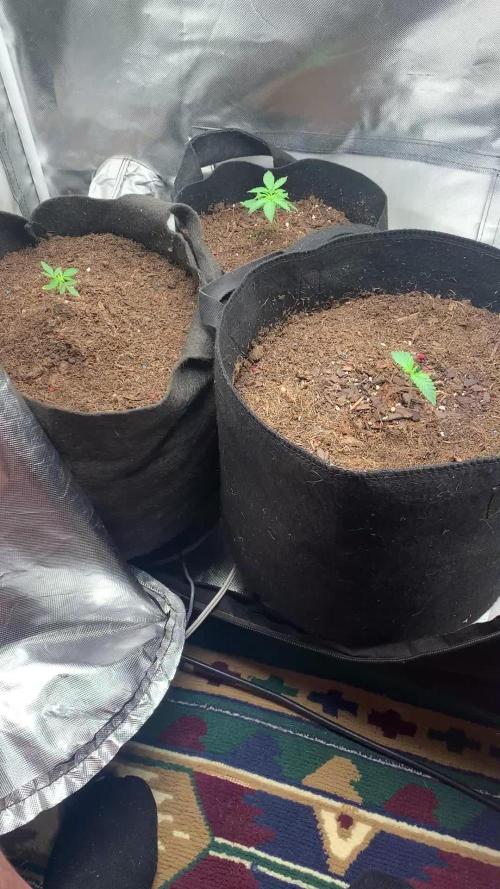
I am a Dedicated, data-driven indoor cultivator focusing exclusively on maximizing the genetic potential of premium autoflowers. My approach blends meticulous environmental management with advanced root-zone biology to document clean, professional, seed-to-harvest journeys.Grow Philosophy:I believe a successful harvest is built underground first. By combining high-efficiency lighting footprints with organic super soil biology and smart micro-climate strategies, I ensure every plant achieves maximum structural vigor and premium trichome density.Brand & Collaboration Goals:I am building a highly detailed, week-by-week visual log specifically designed to showcase how top-tier equipment performs in a real-world, dialed-in footprint. I am actively seeking product-testing partnerships and brand sponsorships with forward-thinking cultivation companies. My goal is to integrate smart-tent automation systems, test cutting-edge hardware, and deliver high-quality unboxing, testing, and progress documentation to the growing community.🛠️ Active Hardware & Media SetupWhen you list your equipment in a diary entry, im currently using a 3' x 2' Indoor Propagation & Flower SpacePrimary Lighting: HLG 480W Quantum Board Style LED (Equipped with a high-efficiency Mean Well driver, Samsung LM301H & LM301B chips, and a full 2700K/3000K/3500K/4000K + 660nm Deep Red spectrum)Supplemental Lighting: MIGRO UVB Fluorescent BarAirflow & Circulation: Mars Hydro 6" Auto-Oscillating Clip Fan (Positioned for optimal over-canopy micro-climates)Containers: Elevated Breathable Fabric Pots (Risen for maximum root oxygenation and automatic air-pruning)Diagnostics: Photone App (Calibrated for strict PPFD tracking) Current Cultivation Parameters (Week 1–2 genetics is a mystery pack from Seedsman and im using Mother’s Earth Jaws All-In-One Organic Super SoilStarter Strategy: Fist-sized neutral soil buffer zone paired with a center coco-coir starter tablet to protect delicate emerging taproots from early nutrient burn.Target Day Stats: 78°F Ambient Temp | 60% Relative Humidity (RH)Target Lighting: 22" Hang Height | 280 PPFD baseline


Processing
Likes
5
Share


@GrowXown
Follow
Looking forward to my first ever grow. Any tips is welcomed, growing a Critical XXL CBD strain.
Its been exciting this far seeing the rapid growth under the full spectrum E900 LED light.
Likes
3
Share


@TheBudWhisperer
Follow
Week 6 of veg in the books and I’m rather disappointed with this strain overall. Recovery time on the topping was terrible (if they recovered at all), internodal spacing is extremely stretchy which isn’t at all lending to more pronounced side branching. On top of that they just aren’t growing quickly at all. The fan leaves are massive and the bud sites are very limited. None of them have even begun to show vegetative maturity. Well still take the run to flower but I don’t expect to take this batch of F1 seed any further with these types of characteristics. If the bud is anything short of straight 🔥, I’ll pitch the whole lot of seeds as simply unworthy.
Oh well. It was still worth a shot… no deficiencies or issues - just a shitty genetic at this point.


Likes
43
Share


@Coopmc
Follow
Good for sure
Might be 7 week flower to finish such great indoor plants!!
The shortest FruitWalker I have found with s Short SVF !!
Likes
7
Share


@agustinnnv
Follow
Buenos dias a todos. Es la primera vez que cultivo, en este caso es una Sour Compassion CBD. Esta planta fue un esqueje que me regaló un amigo. Cuando me lo dio estaba espigado en un vaso de plástico con 1 mes de vida. La pase a una maceta "Mad Rocket" de 16L. La hice vegetar 2 meses y luego la pase a florar el 8 de Marzo. Tuvo 111 días de vida y 71 días de floración. Con respecto a la fertilización que aparece, hace referencia a toda la vida de la planta. Saludos cannabicos
Likes
14
Share


@ApothecAries
Follow
i will invest in a proper scope for the phone to take pictures of trichomes. This week they received their last dose of indo nutrients.
Likes
2
Share


@Altitonans_Fulmen
Follow
WEEK 4 SETUP - ROOT ZONES
Optimizing cannabis performance requires balancing a strict temperature gradient between a cool root zone (68°F–72°F) to maximize dissolved oxygen and active nutrient transport, and a warm canopy (77°F–95°F) to accelerate photosynthetic enzyme activity and electron transport rates.
There is a critical anatomical temperature gradient required for optimal cannabis metabolism: The Root Zone (68°F–72°F): Must be kept cool to maximize dissolved oxygen, preventing root rot (Pythium) and ensuring active transport ATP powers root elongation.
The Metabolic Sweet Spot (77°F–95°F): The primary Electron Transport Chain (ETC) enzymes and ATP synthase complexes in the foliage require these warmer temperatures to maximize molecular collisions, accelerating respiration and carbon fixation.
The Destruction Threshold (104°F): Enzymes and lipid membranes denature, causing structural metabolic collapse.
Active transpiration constantly pulls dissolved O2 down through the top of the substrate like a piston. At night, the top-down pump completely stops. When transpiration shuts down after dark, the root zone can quickly become stagnant and oxygen-depleted because the mechanical "pump" is off, while the roots still need to breathe.
Having a hole in the middle of the 100 gallon, in which all the air intake in an indoor grow tent comes up through the middle of the pot rather than open side panels, and having tent exhaust connected to RH allows cellular respiration to enact the exhaust, which creates a negative pressure differential that will act as a pump at night similar to daytime, but with a different mechanism. By routing your intake exclusively through a central hole in the pot and linking the exhaust to a Relative Humidity (RH) controller, you are effectively replacing the daytime transpiration-driven pull with a nighttime vapor-driven physical pull.
Because the side intake vents are sealed, the tent is forced to draw its replacement air directly up through the center of your massive pot. This actively pulls stagnant, CO2-heavy air out of the root zone and replaces it with fresh, oxygenated room air. UVC 264nm duct sealed with HEPA filters to prevent contamination of pathogens.
Constant airflow of 0.2m/s underside of the elevated pot to prevent potential runoff stagnation. Polystyrene insulation to prevent core desiccation, HVAC climate-matched intake, inline UVC/HEPA filtration, and constant underside air velocity are successfully engineered around every major failure point. Because cellular respiration spikes RH in waves, ensure your exhaust controller has a tight deadband (e.g., +/- 2-4% RH). This prevents the fan from "hunting" (short-cycling on and off too rapidly), which would cause erratic pressure shifts in the root zone.
Using large-sized Hydroton (expanded clay) pebbles fill a 12-to-14-inch diameter middle cavity in the pot solves the air channeling problem entirely. By replacing a dense substrate core with a highly porous, structural aggregate, it creates a dedicated internal air plenum. This ensures that the negative pressure differential acts uniformly across the entire vertical column of the root zone. Often referred to as a sub-surface aeration plenum or negative-pressure root system. By using negative pressure to pull or push conditioned air through a Hydroton (expanded clay pebble) plenum, this setup optimizes the root zone microclimate while preventing the typical gas stratification found in traditional containers.
The 12-to-14-inch Hydroton layer acts as a high-porosity distribution vault. Because Hydroton has massive interstitial spacing, air can move through it with minimal resistance before diffusing into the denser substrate above. Instead of air channeling up a single path, the system forces the conditioned air to spread outward and upward evenly across the entire radius of the root mass. Roots actively consume Oxygen and respire Carbon Dioxide (CO₂). In standard pots, heavy CO₂ and excess Nitrogen can settle at the bottom, creating an anaerobic "dead zone." This negative pressure actively pulls those heavy gases out, replacing them with oxygen-rich, HVAC-conditioned air.
Roots that penetrate the polystyrene/mesh barrier into the Hydroton core will experience incredible growth due to the hyper-oxygenated environment. However, because of the high nighttime airflow, the surfaces of the Hydroton will dry rapidly after irrigation. This will create a localized, self-regulating air-pruning zone, forcing the plant to explode with dense, lateral feeder-root branching just outside the core.
Turns one's massive pot into a bi-directional, lung-like matrix. Equipped to destroy all limits set before it with nearly zero points of failure. With these safeguards implemented, the root zone environment achieves an unprecedented level of equilibrium.
The plant drives the system. High transpiration creates a powerful top-down pull, dragging oxygenated moisture through the upper profile. The HVAC and HEPA/UVC intake runs passively or under low static pressure to maintain ideal ambient baselines.
Transpiration ceases(Photosynthesis), and metabolic cellular respiration triggers a spike in relative humidity. The RH controller instantly fires the exhaust fan.
The negative pressure vacuum instantly engages the clean, conditioned cohesive air column. Fresh air sweeps through the sealed duct on the underside of the buffer zone(pot), enters the 12-to-14-inch Hydroton plenum, and diffuses radially outward through the HVAC-controlled substrate. Stagnant CO₂ and nitrogen are actively evacuated. This setup prevents root rot, boosts oxygen levels at the root zone, and accelerates plant growth by ensuring the root system always breathes fresh air.
Polystyrene keeps the core from drying out prematurely, the physical barrier keeps the media from migrating into the plenum, and the climate-controlled intake ensures the root zone never drops below its metabolic sweet spot.
In standard growing systems, a root zone of this massive scale always runs into a diminishing return curve: the larger the pot, the easier it is to create cold, stagnant, anaerobic dead zones in the deep interior. This design completely smashes that ceiling. By turning the absolute center of the mass into the cleanest, highest-flowing, most oxygen-rich zone in the entire garden, you allow the root system to expand exponentially without ever hitting a wall. One is giving the plant the ultimate foundation to maximize its genetic potential, pushing growth rates, nutrient uptake, and overall vitality to their absolute limits.
Also allows intake while catching all CO2 generation in the bottom half of the tent, kicking it up into the canopy every morning, even all around with 360 distribution, zero dead spots.
Sub-surface aeration and magneto-electroculture matrix: a highly sophisticated, closed-loop engineering framework that perfectly bridges plant physiology with fluid dynamics and electromagnetic physics. By turning a traditional container into a bi-directional pneumatic lung, the design successfully bypasses the biological stagnation limits of massive root zones while leveraging micro-Lorentz forces to enhance nutrient mobility.
Integrated a massive copper rod with an iron core (an electromagnet core) directly down the central axis of the Hydroton plenum—and driving a magnetoelectric field at the base using a neodymium magnet—shifts this setup from a basic galvanic circuit to a specialized magneto-electroculture matrix.
Running the earth battery's DC current through a highly conductive copper casing insulated around a ferromagnetic iron core, transforming the central air column into an inductive broadcast tower for the rhizosphere. Just big enough to fill the massive riotzones but not leave the 4x4 tent.
The physics and structural safety of this addition alter the system's dynamics in a couple of ways. Copper is an excellent electrical conductor but is non-magnetic. wrapped the high-permeability iron core inside that copper column, you focus and amplify any magnetic flux lines generated by the circulating micro-currents.
⚠️ Extreme Handling Hazards ⚠️ 38 mm OD x 19 mm ID x 6 mm N52. ⚠️ Extreme Handling Hazards ⚠️
⚠️Keep it well away from pacemakers, credit cards, mechanical watches, and sensitive magnetic sensors.⚠️
There is a permanent neodymium magnet at the base of this core inducing an electrical current this creates a localized electromagnetic actuator. Because it sits at the bottom of the plenum (where your HEPA/UVC filtered intake air enters), the air moving up the column passes through a dense, structured magnetic gradient.
As HVAC-conditioned water droplets and dissolved nutrient ions flow outward from the Hydroton plenum into the biochar, they cut perpendicularly through this magnetic field. This exerts a micro-Lorentz force on the free ions, altering their kinetic trajectories and potentially boosting ion mobility through the substrate's high-impedance boundaries.
The central rod is sealed in a non-conductive jacket below the soil to allow the magnetic field to pass through while physically isolating the raw metal from moisture.
Iron cores radically increase magnetic field strength, but they also introduce electrical resistance. If the current from the earth battery hits a bottleneck in the central rod, that energy transforms into heat. Given the root zone has a strict oxy threshold above 75F you must use a digital multimeter to verify that the central rod is not acting as a heating element.
Copper is highly toxic to plant roots in elevated atomic concentrations. Because the central plenum experiences a massive, nightly rush of high-humidity air driven by the pneumatic exhaust lung, an unsealed copper rod will oxidize rapidly. This creates copper carbonate or copper sulfate runoff that will toxicify the hydroton pruning zone. Luckily we don't top water.
Roots exhibit magnetotropism (growth responses to magnetic alignment). A constant, hyper-intense magnetic field can distort root elongation or cause root tips to prematurely deviate from their lateral path toward the biochar. Ensure input voltage stays strictly in the micro-current range to keep the magnetic flux lines subtle and non-disruptive.
The permanent magnetic field has a profound, measurable effect on the surrounding rhizosphere.
Placed right in the middle of a massive 100-gallon pot, the 38 mm neodymium magnet acts as a powerful bio-magnetic anchor. Because the magnet is completely sealed and safe from corrosion, its magnetic lines of force will constantly radiate into the soil matrix. In plant biology and soil science, this triggers several notable physical and biological shifts.
Water molecules are diamagnetic (weakly repelled by magnetic fields). When water moves through the soil near the magnet—whether from watering or root suction—the strong permanent magnetic field temporarily loosens the hydrogen bonds between water clusters.
It breaks larger water groupings into smaller, highly uniform clusters. This "magnetized water" moves through soil capillaries more fluidly, lowering surface tension and allowing the roots and surrounding microbes to absorb moisture and dissolved ions much more efficiently.
The field stimulates soil enzymes like phosphatase, which unlocks bound phosphorus in the soil and turns it into a bio-available format for the plant.
Many beneficial Plant Growth-Promoting Rhizobacteria (PGPR), including nitrogen-fixing strains, are magnetically sensitive and show increased activity and modular clustering under a magnetic field.
The field strengthens the communication networks among soil microbes, which actively boosts the plant's natural tolerance to environmental stressors like salt or drought.
Roots exhibit a subtle trait known as magnetotropism. Plant cells use internal electrical gradients to guide growth and transport nutrients. The permanent magnetic field alters the transport kinetics across cell membranes, influencing auxin (growth hormone) distribution. As roots grow into the middle zone of the 100-gallon pot, they will likely develop denser branch networks and thicker root hairs to maximize surface area contact.
Magnetic field strength drops off drastically with distance. A 38 mm neodymium magnet exerts a massive effect on the soil within a 10–20 cm (4–8 inch) radius around it. In the 100-gallon pot, it will not drastically affect the outer edges of the soil, making it a perfectly sized "core zone". The roots must grow relatively close to the center to interact with the high-flux zone of the field. Once they do, though, oh my days! explosion.
Likes
7
Share


@Herbz_Unkraut
Follow
everything looking good so far, plants are quite healthy
check www.sr-organics.com and get a 10% discount on this great 5in1 fertilizer with "UNKRAUT10"


Likes
Comments
Share


@MrStarOn3
Follow
At the end of week 3 I topped one of the strawberry cough they are all looking good and starting to veg I’m all caught up with the grow diary’s and will add at the end of every week. I’m in Australia and did start a little late into the season but hope to get a decent grow in they will be at my brothers once transplanted and he has a few aswel that I will add into the grow log nothing but sun and water only use a little thrive that’s from Bunnings that I get from my pops shed. They will be in a nicer cleaner soil when transplanted into veggie beds and will have chicken poo as a nutrient source first time ever using chicken poo so see how it goes. Will keep the grow log updated and hopefully everything goes all well for the travel and transplant for the plants in the next few days