


Processing
Likes
Comments
Share


Processing
Likes
39
Share


@Vincenzo
Follow
Il profumo è inebriante e forte, la resina aumenta di gg in gg. Il raccolto lo farò Venerdì o Sabato✌️🏻😉🌞✌️🏻

Likes
Comments
Share

@LegacyGrow
Follow
Englischversion below
Deutsch:
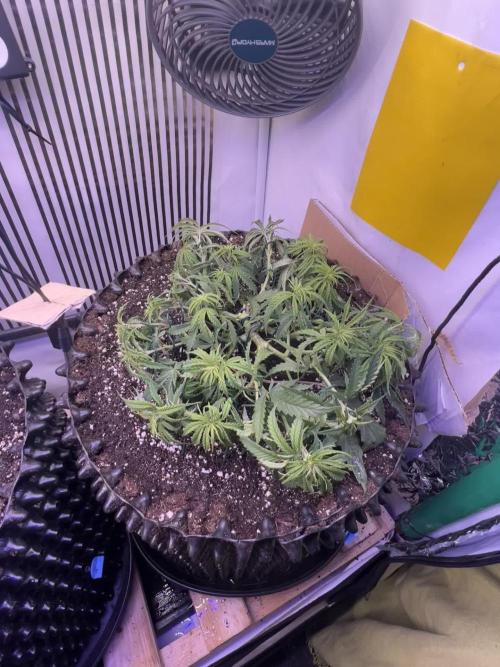
Tag 36 Veg:
Das Umtopfen bereitet den Damen noch sichtbar Schwierigkeiten. Auch der Temperaturunterschied stresst die Damen sichtbar. Der VPD muss angepasst werden, da sich die Temperatur von im Schnitt 28,5 Grad auf im Schnitt 22,5 Grad gesenkt hat. Die Blattoberflächentemperatur liegt im Schnitt bei 20,5 wodurch die RLF% bei ca 60-65% gehalten wird.
Heute wurden die Damen auch vollständig mit ca 8,5L mit einem PH von 6,3 und 0,5 ml/L CalMag gegossen.
Ein leichtes LST hat die Fürsorge heute abgerundet. Ziel ist es mit einer wider gesunden Pflanze an den Rand des Topes zu kommen.
Tag 39 Veg:
Die Ladies erholen sich sichtbar - die Kälte über nach hat für leichte lila Verfärbungen an Blattspitzen und Stämmen geführt. Wie fast jeden 2-3 Tag wurde auch am Tag 39 LST durchgeführt. Die Temperatur ist Tagsüber zwischen 22-26 Gard und nachts 19-21 Grad.
Viel ist nicht zu tun - wir warten jetzt auf den SOG
--------------------------------------------------------------------------------------------------------------------------------------------
Day 36 – Vegetative Phase:
The transplant is still visibly causing stress to the plants. The temperature difference is also clearly stressing them. The VPD needs to be adjusted, as the average air temperature has dropped from around 28.5 °C to approximately 22.5 °C. Leaf surface temperature averages about 20.5 °C, which requires relative humidity to be maintained at roughly 60–65%.
Today, the plants were fully watered with approximately 8.5 liters per pot, adjusted to a pH of 6.3 and supplemented with 0.5 ml/L Cal-Mag.
Light LST was also applied today to round off plant care. The goal is to reach the edge of the pot again with healthy, stable plants.
Day 39 – Vegetative Phase:
The plants are visibly recovering. The cooler nighttime temperatures have led to slight purple discoloration at the leaf tips and stems. As on nearly every second to third day, LST was performed again on day 39. Daytime temperatures range between 22–26 °C, while nighttime temperatures are between 19–21 °C.
There is not much to do at this stage — we are now waiting to initiate the SOG.

Likes
2
Share


@Naujas
Follow
The girl has experienced some interesting changes outside this week, from +30 days to +3 nights, but it seems she is still thriving. I have done a main flower cut because I am going on vacation and will leave the girls alone for 10 days and therefore I don't want them to grow out, it all depends on the weather conditions :) good luck to everyone.
Likes
13
Share


@Dunk_Junk
Follow
She only grew 8cm this week. The stretch is slowing down a lot now.
She's doing well. Nothing else to the report as I'm just letting her do her own thing.
Still loving her Sativa-like leaves!! 😍 They are as thin as a blade!
For nutrients I'm using 15g of 20-20-20 powder mixed with 10L of water. Also added 4ml/L of both Cannazym and Terpinator. This brings it to around 1600ppm including ~300ppm for my clean water.
Timelapse Sequence:
*** Blue Dream ***
Auto Jack
Pineapple Express
CBD Compassion
*** BLue Dream ***
Auto Jack
Pineapple Express
CBD Compassion

Likes
35
Share


@NorCalCloset
Follow
At day 98 from seed, 52 days since the switch to 12-12, she is looking fine to me. Based on a 10 week flowering period, assuming it starts from when I switched her to 12-12, she is 18 days from harvest. If you assume the 10 weeks started when I observed the first flowers, she is 35 days from harvest. I'm guessing the actual harvest is somewhere in the middle. I'm guessing she'll be ready in more than 3 but less than 5 weeks from now. Time will tell. I'll mainly be using trichomes to tell when she's ready. For now, she's not even close.

Likes
37
Share


@Reyden
Follow
Non pensavo che queste Fast Flowering potessero crescere così velocemente! E sono curioso di vedere come prenderanno spazio le radici ora che le ho travasate nei loro vasi finali! Anche qui le piccole macchie sulle foglie sono di zeolite pure 10 micrometri di Dogma Organics e il terriccio è stato preparato con il loro 4 componenti Super Soil che è una vera bomba…diversi guani, letame bovino, micorrize, vermi compost arricchito con acidi umici e fulvici, Cal Mag fatto di rocce triturate meccanicamente, ceneri arboree e febacee tritate ecc…ditemi voi se non è un Super Terriccio questo!? In attesa delle prossime settimane 👀


Processing
Likes
7
Share


@gablmo
Follow
Another never ending vege week. I took clones and did more trellis work. The PH was up more than usual, they are still alive. I'm glad.

Likes
18
Share


@MadeInGermany
Follow
Info:
Unfortunately, I had to find out that my account is used for fake pages in social media.
I am only active here on growdiaries.
I am not on facebook instagram twitter etc All accounts except this one are fake.
Have fun with the update.
Flowering day 33
since time change
to 12/12 h.
Hey everyone 😃.
Another wonderful week goes by :-).
The lady is developing very well.
The flowers begin to develop properly and already smell very nice 🙂.
The day before yesterday was the last time 1 g of GHSC Powder Feeding per L substrate was added :-).
That should last to the end now.
Of course, she continues to receive GHSC enhancers 👍 every 14 days.
The tent was cleaned every day just like the humidifier was refilled every day.
I am very curious how it will develop in the coming week and until then I wish you a lot of fun with the new update.
Stay healthy 🙏🏻 and let it grow 🍀🙏🏻
You can buy this Strain at :
https://sweetseeds.es/de/red-mandarine-f1-fast-version/
Type:
Red Mandarine F1 Fast Version
☝️🏼
Genetics:
Red Poison Auto®️ (SWS39)
X
Tangie (California Orange x Hybrid Skunk)
👍
Vega lamp:
2 x Todogrow Led
Quantum Board 100 W
💡
Bloom Lamp :
2 x Todogrow Led
Cxb 3590 COB 3500 K 205W
💡💡☝️🏼
Soil :
Canna Coco Professional +
☝️🏼
Fertilizer:
Green House Powder Feeding
☝️🏼🌱
Water:
Osmosis water mixed with normal water (24 hours stale that the chlorine evaporates) to 0.2 EC. Add Cal / Mag to 0.4 Ec Ph with Organic Ph - to 5.5 - 5.8 .
Likes
24
Share

@DE_BW
Follow
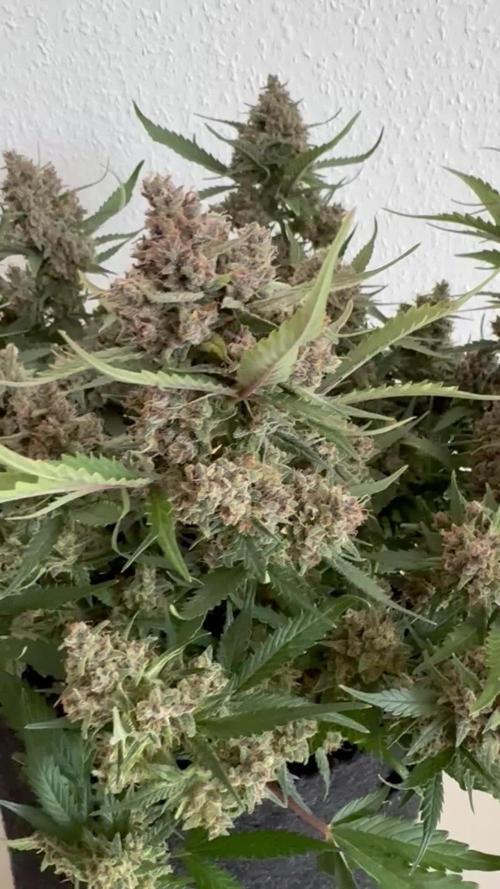
After flushing, the plant was left standing until the pot fully dried out before harvest. Buds developed nicely with strong resin production, resulting in a satisfying yield despite some airy lower growth.
Likes
6
Share


@masterofsmeagol
Follow
4/13 10TH planet is doing phenomenal under those aerogarden lights. I'll wait a little bit then I'll bring them over with the others. I'm comparing the growth to the growth of the mk ultra and the chem dog as they are of a more similar age. I watered the 2 mk ultra and the chem dog #4. The others looked alright so I'll check later on. The three in the middle will probably be culled. The may recover but if they don't it doesn't really matter. I'll have what I need. I'm super excited for this season. I shouldve done more 10th planet. The "kush" seedlings are starting to take off. The leaves are finally starting to get bigger and they are developing new growth.
WENT BACK OVER AT 1:30. PLANTS WILL NEED TO BE WATERED IN THE MORNING. ONE PLANT WAS DOWN TO 199 GRAMS BUT IT HAS A LITTLE LESS SOIL IN THE CUP. THEY ARE GROWING AT A MORE RAPID PACE AND I DONT WANT TO INTERRUPT THAT. OTHER CUPS WERE LOW BUT NOT READY TO BE WATERED. I THINK EITHER WAY IT WOULD BE FINE BUT IM ERRING ON THE EDGE OF CAUTION. I MAYBE SHOULDVE WATERED THE DRY ONE BUT HINDSIGHT IS 20/20 AND I KIND OF WANT THEM TO BE ON A SIMILAR SCHEDULE. I GRABVED A TACK AND CHECKED THE DRAIMAGE IN THE BOTTOM. I ADDED A FEW MORE HOLES OB THE BOTTOM SIDE. I MAY JUST HAVE TO JUNK THAT MIDDLE ROW OF 3 I STRESSED BY DOING EXACTLY WHAT THE LIGHT MANUAL SAID TO DO. OH WELL I PLANNED FOR THAT WITH THE 2 MK ULTRAS AND THE CHEM DOG #4. ALL ARE DOING GREAT. SOME OF THE SOECIAL AND PINK KUSH ARE GETTING THEIR TERTIARY SET OF LEAVES SO THEY ARE PULLING OUT AND GOING TO TOWN. THE ITHER ONES (MK ULTRA, CHEM DOG, 10TH PLANET) THAT DIDNT GET STRESSED SEEM TO BE GROWING AT A FASTER RATE. I THINK I MIGHT TRY AN AUTO THIS YEAR. I HAVE A FEW BEANS. ILL THINK ABOUT IT BUT IT WOULD BE NICE TO HAVE FRESH WEED HALF-WAY THROUGH THE SUMMER.
4/14 WATERED ALL THE KUSH WITH A SHOT GLASS. THEY WERE VERY DRY. ONE WAS IN THE 180'S. I FOUND THAT ONE OF THE PLANTS THAT WAS STINTED HAS FALLEN OVER AND WAS LIMP AGAINST THE CUP. I IMMEDIATELY REMOVED TGE TWO SEEDLINGS THAT WERE BY FAR THE WORST AND I ASSUMED I WAS LOSING. I TOOK THE PEAT PELLET OUT AND THE TAPROOT HAD BARELY PENETRATED ONE AND HADN'T PENETRATED IT AT ALL ON THE OTHER ONE. IM NOT USING THOSE PEAT PELLETS AGAIN. ITS WIERD. I'VE NEVER HAD THIS PROBLEM BEFORE. PLANTS SEEM TO BE DOING GOOD. IM CONSIDERING STARTING ANOTHER SEED OR TWO. MAYBE AN AUTO.
Edit. I added mykos amd happy happy frog to the 10th planet in the solo cups. They are already to the top. I watered them with a shot glass of water amd some mykos.
4/15 I added soil to the top of the cup on kush plants and watered them with a shot glass. It seems like I may need to up the water as it's only lasting about a day. I'm seeing some slight stretching but I have no idea why. They are just seedlings and it's a 150watt hps light! Last year I used 2! I think they needed to stay under the cfl's a little longer and thatci nightve stressed them prematurelyremoving some helmet heads. Or maybe they are having problems breaking through the pear netting. I'll tell you one thing im NEVER using peat pellets again. I have other seeds and autos I could start if needed. I have what i need but if I lose a few more I'll be pissed. Maybe better to startca couole more. Those 10thvplanet are doing amazing and blowing past everything else. They look so healthy. I'm going to download a light meter on dad's iPhone and get some readings with all the different lights today.
4/16 I was able to download a FREE app for a light meter. Apple has one bit you have to pay for readings of any of the "good" lights. I had a very hurried morning and didn't take any pictures. That one special kush that was burned like the other two I threw away (or damaged when I removed the helmet head) is starting to look like it has some NEW growth. I've kept it but a little ways away from the others. I weighed all cups and they didn't seem to need water. I AGAIN packed dry soil into a cup to get a reading. Still 200. When they get within 10 grams of dry weight I'll water them. I measured and found I had the light further away than it should be. I lowered it to approx 3ft from the top of the canopy. I'll try to map the area and see what I'm getting for results. Then I'll plug in my L.E.D and see what I get. I only lowered the light because readings (that may be inaccurate) say it's not enough and two years ago when I used this light i used two. That is unnecessary I think for seedlings. I'm just trying to get them through seedling phase intact so I can move to veg and switch my light. Transplantvinto one gallons. This is where patience comes in. I'm sure everything will be fine. I just am a worrier.
4/17 I used that light meter to check the ppfd. It says it should be between 100-200 but it was only reading at like 65 and this was after I lowered the light. I'd need to go down a ways to get anywhere close. I tried to check my l.e.d and that was low so I can switch back fine. Especially with the light meter app. However the plants seem to be doing better and have tertiary leaves so I'm hesitant to change things when they seem like they are having a growth spurt. I may take the 2 mk ultras and put them with 10th planet since they are doing so good. Won't let me upload pictures. WATERED ALL THE KUSH WITH A SHOT GLASS.
EDIT: WENT BACK OVER AND USED THE PHONE APP METER ON THE LATEST IPHONE. I LOWERED THE LIGHT RO A LITTLE UNDER THREE FEET. THAT GAVE ME ABOUT 100-120 ON THE HOTTEST SPOT AND LESS FURTHER AWAY OBVIOUSLY. IM TAKING THIS WITH A GRAIN OF SALT. I MEASURED ME 100 WATT LED AND WITH BOTH SWITCHES ON I CAN REACH OVER 100 EASY FROM FAIRLY FAR AWAY. ILL BE MONITORING GROWTH AND DECIDING HOW TO MOVE FORWARD FROM THERE. I TOOK THE DOMES OFF THE 19TH PLANET BUT THE LEAF TIPS STARTED TO CURL. THE NEED TO BE HARDWNED OFF. THE CFL WAS TO CLOEE AND BRIGHT BUT MORE SO WAS THE RH OF THIS BUILDING WHICH IS PRACTICALLY NOTHING. ILL HAVE TO MOCE THEM WITH THE OTHERS. UNTIL THEN I POKED HOLES WITH A TAC ALL OVER THE DOME. THAT WAY IT CAN VENT A LITTLE BIT. I'LL SLOWLY ACCLIMATE UT TO THE LOW RH INDOORS BEFORE THE GO TO THE 100RH OUTDOORS LOL.
4/18 Didn't water this morning because things were over 20grams dry weight. Came back around one and weighed and most were within the 20 grams. One was under 200. I can see more growth since the light adjustment but I still see some stretching. But I've seen noticeable growth in a short period. I'm contemplating waiting to see what happens for a few days or to just switch to my l.e.d using my meter as a guide. Even though the box tells you how far to hang it. I'm bringing the aerogarden over to the grow tomorrow. I have a few more as well. I'm going to check that with the light meter and am considering putting the mk ultras and maybe the chem dog under that. I mean those are doing great. I poked more holes in the dome and have been exposing the plants to low rh and increased light. They don't have immediate effects anymore. I have the domes popped open too. They are gett9ng acclimated. Realistically I'm wondering if I should just pop more 10th planet or mk ultra or an auto but looking through my other diaries things will be fine. I worry to much and I usually grow clones. Outdoors. Plus most of my stuff was stolen so I'm making use of things the best I can. My money is going into good soil. I also checked the temperature at the hottest spot under the light and it was 80 degrees. This is telling my I can't really lower my light anymore. I've got some thinking to do.
EDIT: 10th Planet has done well all day without a humidity dome in this extremely low rh. I'm going to bring them and the aerogarden to the grow tomorrow. I have my l.e.d setup to test. I plan to use the light meter to see what is closest to the correct ppfd. A lot of it will be gut feeling too. I'm interested to see the reading on the new aerogarden bulbs. Those seedlings are doing awesome.
4/19 Didn't water this morning I don't think. I was hurried. Got back and found one seedling that had been growing some bigger leaves just flat on the cup. Luckily I had noticed it drooping (should've watered) and picked up a straw on the way home. It weighed 180 grams. Everything was low and I MAY have watered yesterday bit I don't think so. With this hps so close its bringing the temp up to 80. I checked the cfl aerogarden lights. Wow are those bright! I had to raise them to get in range. I put the mk ultra and chemdog under the aerogardeb light. It's about 300 bit it has a couple hot spots that bring it up to like 4k-5k. The 10th planet's loved it though and did great. I held my hand over the plants and it seemed ok. Now for the hps light and the pink kush and special kush #1. I put my tatu 100 watt (1000 watt equivelant lol) 248ns above the seedlings I had just watered. Since that hps dried everything out so much I gave them 2 shot glasses. I'll keep monitoring things. I feel like this is the best bet for me. If I fuck something up I'll have to pop more 10th planet and mk ultra ect. But I've got to make sure things are in the right range. If it stretches a little I'll just have to repot it a little sooner than the others. When they outgrow the solos they go to 1 gallon. Tomorrow I'm picking up AT LEAST a bag of fox farm ocean forest so I'll be ready for transplant when necessary. I need to get all my pots together and bring the other hps to my cousin to fix. However when they get bigger I might just use the l.e.d AND the hps if I had too.


Likes
3
Share


@Mr_Di
Follow
Today, 05-26-2020:
Switch date: 04-28-20
Phase at 05-26-20 middle fowering (day 28 from switch after 48 hours of total darkbess to reset photoperiod)
Few days and i will add more co2 cause i’ve 29 ‘C during day
Now , i will increase p-k
Rise down N and More aminoacids
Keep on growing
Likes
3
Share


@Mr_nugs_lover_David
Follow
Big lady, what a wonderful bush full of sweet and fat black cherry punch flowers I'm growing man, I'm so happy to be able to grow this strain 2 phenos are a little small but very sticky and full of quality, super sweet aroma very fruity, I love this strain, I hope to be able to select some phenos with this genetic in the future, very recomended guys!


Likes
25
Share


@EBxAH
Follow
Well week 3 started on Monday, I'm late to the party, lol. Everything is going pretty decent so far. One surprise though...they have a smell. They didn't at this stage last time. Weird, lol. I gave them a slight trim and will be done with that until flowering. They seem very happy!
✌️❤️😁🍀🎶
EB

Likes
100
Share


Likes
117
Share


@FoTwenny
Follow
Fo' Twenny Back with another update on our Orange Sherbert from Barney's Farm!
She is looking really good this week. She did start to show some deficiencies after flushing Friday 8/28. Otherwise she looks super healthy with leaves "praying" to the canna-gods!
Now, on with the deets!
LIGHTING:
Increased lighting at dimmer last week with good results. Was about 70k LUX on average @ Canopy.
Turning it up a bit more this week.
8 Outer Boards @ 665.5w
6 Inner Boards @ 601w
LUX APP MAXES OUT READING 78750 LUX @ Canopy. Lets hope its not too much!
RHIZOSPHERE:
If you didn't tune into the last update, I had just flushed pots due to high PPM runoff. pH of runoff was at 6.3. PPM and pH are tested using 2 separate calibrated BlueLab meters.
All Water/Fertilizer is shared by 3.25 plants (.25 because autoflower gets less than a quarter the volume of the larger plants)
2 GAL PLAIN H20 w/fungicide prior to feed
PH to 6.0
1 tsp/gal of Southern AG Garden Friendly Fungicide - Bacillus bacteria known as Bacillus Amyloliquefaciens (OMRI Organic Bacterial Innocclant/compare to Hydroguard)
Waited 15 minutes after plain H2O and fungicide
5 gallon tap H20 through 2 KDF filters
START PH: 7.5 (taken from reservoir that contains impurities/residue from previous feeds)
START PPM: 500 (also taken from reservoir)
TEMP: 76°F
.125 tsp Ascorbic Acid added to help reduce chlorine/chloramine
WEEK 4 FEED SCHEDULE:
.5 tsp/gal Sledgehammer (Surfactant)
.125 tsp/gal Gringo Rasta Cal-Mag
1 tsp/gal BIG Bloom
.5 tsp/gal Grow Big
.5 tsp/gal Tiger Bloom
.25 tsp/gal Kelp Me Kelp You
.75 tsp/gal BEMBE
.25 tsp/gal Beastie Blooms (Increased due to low ppm of solution)
PPM: 1150
Added to Increase PPM
.5 tsp/gal Tiger Bloom
PPM: 1350
PH: 5.8
1 tsp/gal RECHARGE
.6 ml/gal MAMMOTH P
PH: 5.9
PPM: 1490
Thanks for checking out my diary. If you liked this diary, check out my other diaries and give me a follow!
Until next time...
Peace ☮️,
Love 💚,
And Frosty Nugs ❄️🌲!
-Fo'Twenny
Likes
22
Share


@EhJay
Follow
D23 Looks like the calcium deficiency affected the growth on #2 a bit as it is a little behind #1
D24 I cut off the infected fan leaves on #2 also it's looking really yellow
D28 #1 really thriving compared to #2. Going forward I will be posting pictures of #1 only
Made a newbie mistake and fed my girls without checking the ph level.... hopefully no major side effects pop up

Likes
6
Share


@valiotoro
Follow
Easy trim✂️
The buds are rock solid🤩
The smell citrus & earthy 🍋
See you in 2025 for the smoke report
Take care

Likes
11
Share


@merchandise91
Follow
Just on day 22 now the video taken this morning had few issues very strong through week one, then week 2 I believe nitrogen toxicity as iv done lots and lots of research.... started watering twice in between each feed.. showing pistils now.. plants were tied down day 14.. I am happy with progress overall any tips welcome
Pic of individual plant seems to be behind and leaf curling going to give water today and hopefully that will sort it out
Day 23 - decided to do some defoliation as the growth since yesterday is very noticeable and starting to see signs of budlets at apex.. going to feed them tomorrow 8th strength grow, 8th strength bloom then by day 30 ish just quarter strength bloom is the plan then continue to up dose until half strength bloom at which point I’ll also add some boost.. any pointers appreciated 👌
