


Likes
Comments
Share


@Kushizlez
Follow
Day 28-35 (May 28th - June 4th)
(Day 29) My rooted blackberry #3 clone looks like it’s finally starting to reveg. It’s starting to stretch it’s internodes but no new growth yet. Nearly all 9 are pushing roots now. What a waste of time taking clones in flower! Won’t ever do that again.
Grapefruit #1 has a twin! I thought it was just an odd formation on the taproot but two seedlings are pushing out. I wonder if it will be genetically identical. It’s definitely slower growing than the other one so who knows. I will try to train them apart when the time comes.
(Day 30) I think the EC/PPMs are too high on nearly every plant including my veggies. The promix is actually really hot for a “blank” medium coming in at 1800. Adding compost and amendments to that is probably raising it to 2500+ at least. It should self balance the more I water it but I know for a fact I can get better growth by leaching the soil around each plant. Next time I use promix for anything, I’m going to prewash it like coco coir and add a dash of oyster shell flour for pH and calcium.
(Day 32) Purple tuna is now big enough to start lst on now. I’m going to wait a little while for the slurricanes.
(Day 33) One of the grapefruits has a twin that actually popped... I’m going to leave it and see how she turns out
(Day 35) I’m going to prune off the lower leaves on each plant. I was going to lst Purple tuna but it’s so vigorous I may as well just top/mainline it.
Autoflowers are looking established and should be taking off this week. I wonder if this will give them enough time to veg into decent sized plants before they flower. I won’t be topping or even doing lst. My goal is 22 big spear colas from each plant.
I’m going to get all my rooted clones into 1.7 gallon pots over the next week or so.


Processing
Likes
4
Share


@ROOPOO
Follow
BREED:
1 x Royal Moby
1 x Critical
1 x Amnesia Haze
INDOOR KIT:
0.8 x 0.8 x 1.8 indoor grow tent
2 x desk fan
1 x boost exhaust fan
Method 7 glasses
16L Garden Master Backpack High Pressure Sprayer
Nova LED 180W
(https://gthydro.co.za/products/417-nova-led-s4-180w.html?search_query=LED&results=102 x desk fans)

Likes
6
Share


@frankterpenes
Follow
D35- PX, the lady double in height this week with lot of stretching.
The fimming gave me 3 tops, hopefully they will stretch still to get nice height and good spacing from bud to bud.
I like how she is growing and Im happy with that I didnt break her like the first I grew. The budsites are multiplicating and the lady seems to be healthy.
D35 AHO- The lady is outside to give her some natural light, I will let her grow outside for the entire grow from now.
She seems to love the sun, She was at 13,5' before I bend the main to let some chance to the side branches to get some height.
She is growing nicely too and budlets forming everywhere.
From now I think the output will be slighty lower thn the Px cuz she is smaller, but lets hope Im wrong and they will do great both of them.
If you see something wrong on pics, please tell me, im here to learn


Likes
25
Share


@Aleks555
Follow
Anesia Seeds - Chimera Cut - Day 80 Our Chimera Cut from Anesia Seeds has reached day 80, with 32 days of flowering, and it looks absolutely stunning. The buds are dense and fully covered with a thick layer of trichomes, giving it a frosty shine and promising incredible potency. The vibrant green leaves remain healthy and lush, showing that the plant is thriving and getting everything it needs. Its structure is strong, and resin production is off the charts — every day it gets covered with more and more trichomes. We are very pleased with how this plant is developing, and it's clear that Chimera Cut is a true masterpiece from Anesia Seeds. The results speak for themselves: strong growth, excellent health, and incredible visual appeal.
We eagerly await the final product, continuing to feed it with Xpert Nutrients, which have helped it achieve such a level of perfection!

Processing
Likes
6
Share


Likes
23
Share


@HydroHerb420
Follow
Nearly gave up on these as the whole tent door ripped. Tried various ways to fix it but failed. Temps and humidity were all over the place and they really suffered. Managed to rig up a temporary door out of Kingspan and some roofing membrane and I’m kinda glad I did now as there looks like there’s some buds on these. Dont think yield will be massive but glad I didn’t pull the plug.


Likes
8
Share


@HeartStrong_Garden
Follow
WOW! I'm sure these two have reached the nutes because they sure have taken off. The second one finally came into herself after I backed down the water. Hopefully I'll be able to just refill the autopot when needed for now. I can really see the growth every day. Just a little fan leaf tucking. I put the lower fan on now too add a breeze and strengthen branches.
Likes
1
Share


@BeyondConcrete
Follow
Day 47: The Ladies are starting to fade a little. Some of them are showing their potential to get some beautiful colors.


Likes
11
Share


@GorillaZativus
Follow
Videos:
10 días despertando , transplante 12 días , algunos sistemas radiculares y despertando post transplante .
🌱Solución de riego a micorrizas :
Mycochum y luego riego completo cuando despierten .
Ocupamos granular y great white en polvo para transplante , mitad y mitad.
Ph: 6,0
Ec: 0,7
🌱Solución riego a foleo 1 hora antes que despierten :
1 litro : proactive 5,0 ml y knactive 2 ml.
Ec : 0,5
Ph: 6,0
🌱Sumamos alfalfa alrededor de los tréboles
👑Actualización Jardin 18-19 días .
⌛️Videos :
🎥18 días , con hambre y sueño.
🎥19 días antes de dormir
🎥19 días despertando post foleo y post preventivo de tierra de diatomeas , listas para transplante en 1 semana .
🌱Solución foleo 2 litros :
knactive + proactive (4,0 ml ) y ( 0,8 de proactive ( melazas , quitina , etc ) Y sumamos preventivo después que se secó el foleo.
Ec : 0,4
Ph: 6,1
🌱metimos amarres al central y full lst .
Likes
11
Share


@Buddyhighs
Follow
Day 13 from seed and she growing up so fast
No feeds this week. Little water now n then, had to top up the soil as she was getting a little bit leggy.
Lights running 50% at 45cm from to of plant 18 hour days.
Extractor fan turned on today on low fire day light hours for now.
Got a few fungus gnats, they are annoying but when don’t you get them.
Let’s get it 💪🏽

Likes
15
Share


@MrGrowMan
Follow
week 14-15
1 nutrient water
1 non nutrient water
LsT and Scrog
Diesel and Mimosa Harvest
day 62 start 12/12 light period (genetically damaged plants)
2 break up cake day 67 start flowering

Likes
16
Share


@Symbiosis_420
Follow
Ok, so it's slowly getting thicker and frostier. At week seven my girl could be ready in anywhere from two weeks to four weeks more.
The light was dropped closer to the top of the canopy. I decided to try 15 cm of distance, as well four 50W LEDs are not as powerful as the 600W HID or LED panels that are usually used in grow tents. I will of course keep an eye for signs of light and heat stress, but I suspect that won't be a problem.
Update Day 89.
Today I decided to turn the plant around to see the back colas and their growth. Then I found some mites under the leaves after examining weird spots in a couple of leaves. It seems to me that there was not enough airflow to deter the mites from making home in the back leaves, when compared to the front leaves of my plant. Lesson learnt, rotate plant often, ensure good and even airflow.
I didn't find any webs beside a really small one seen on the video (most affected leaf). So, I think I found them mites early. I only found this kind of damage on very few leaves, and each leave contained less than 8 mites (at least that I could see) and a couple of eggs. So it seems that paying close attention to my leaves saved me from an out of control infestation.
Anyhow... I removed all of the leaves that had even a single mite, or a single mark of discoloration.
Also, I disinfected the grow tent, top of soil and lower part of the branches by spraying them with a 1/4 tbsp of bleach per liter of water.
After that was completely dry, I mixed one part rubbing alcohol with 9 parts water and misted both sides of the leaves and even the buds directly (ethanol evaporates easily, so there shouldn't be residues left after it dries completely).
I got these remedies from https://www.growweedeasy.com/cannabis-plant-problems/how-to-get-rid-of-spider-mites
I will apply them every 3-4 days and keep a good eye on the leaves.
Prevention is key, and some aspects I could've considered before are:
1. not grow any other plant next to my cannabis
2. Don't come into my indoor growtent after tending my outdoor plants.
3. Ensure even and plenty airflow.
So, I attacked back strongly. I cut more leaves than those that showed damage, to increase airflow. I will be on the watch for pests and will rotate my plant often, as well as spraying a few times every week, just to make sure they don't come back.
I also am going to build a kind of metal wire cage to separate the colas further and make it harder for any pest to spread.
Its only my second grow, but from what I've read online about mites, it's way more costly (time and money) to deal with an infestation than to strike them hard early. I guess that specially now that I noticed them before they even made webs.
Look closely at your girls growbros !
Update day 90.
So this morning I. Becker the trichomes and they seem to have gotten more cloudy. I am not an expert at that, but they are starting to be fewer clear and more milky. I will keep an eye on them, but it think harvest might be here very soon, probably closer to the 9 week mark than to the 12 week one (I'm about to finish the 7th week)...
Likes
8
Share


@Cannabot
Follow
Started harvesting,flushed the past few days.Will finish chopping tmw.Almost sad to see her go,she really was the most unique strain I've ever grown and I'm confident the bud is gna be top shelf.Everything is covered in thick velvet fur man I tell u,sticky smelly u name it.Thanks Barneys Farms,awesome strain.

Processing
Likes
3
Share


@Ogbangbang2981
Follow
indoor plant looks healthy average height for a 2 week old plant no nutrients just bat poo tea and water let's see what's up .....
Likes
8
Share

@Ex0PaNiK
Follow
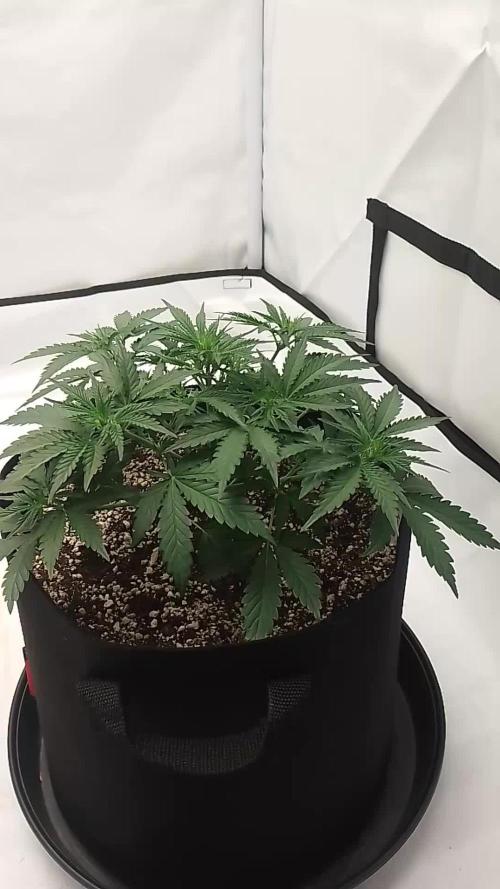
Die erste Anzeichen für den Blüh Modus lässt sich langsam erkennen :) Habe mich nun doch entschlossen vor 3 Tagen die großen Blätter zu entfernen und habe nun heute den Rest weg genommen. Sie haben einfach zu viel Schatten geworfen.