


Likes
Comments
Share


@matthiasbmg
Follow
Left Plant Buds are getting bigger and bigger Right plants not so much yet

Likes
2
Share


@KronicAquaponic
Follow
Looking sweet again this week!! Buds are super dense and covered in trichomes. Super stinky!!


Likes
27
Share


@Reaper
Follow
next time i have to veg more then 4 weeks to increase yield. it finishes quickly and big yield for the short veg time. im also very happy with the optic 4 wich made the buds dense from top to bottom. i might upgrade to cocos or hydro next grow, or maybe both ;)


Likes
11
Share


@Bluemels
Follow
Tag 67: In den letzten Tagen ist der stretch bei der Chocolate Haze langsamer geworden 😌
Ende nächster Woche werde ich dann mal noch bisschen was wegnehmen, dann hat die Chocolate Haze sich hoffentlich zu Ende gestreckt 😅
Tag 71: Ordentlich entlaubt habe ich die Chocolate Haze 😬
Tag 72: Ich hab wohl bisschen viel weggeschnitten 😬 nicht mehr viel übrig 😲


Likes
35
Share


@eldruida_lamota
Follow
Vamos familia con la cuarta semana y última de crecimiento, estás Cereal Milk de RoyalQueenSeeds.
La temperatura está un poco alta en 28 y la humedad actualmente está en 60%
Aplicamos 0.1ml de Flash root
Tucán 0.1 y Gold joker 0.01 de Agrobeta
0.5 blue line A , la base de crecimiento de Agrobeta.
La cantidad de agua cada 48h entre riegos no cambia.
Mars hydro:
Code discount: EL420
https://www.mars-hydro.com/
Agrobeta:
https://www.agrobeta.com/agrobetatiendaonline/36-abonos-canamo
Hasta aquí todo, Buenos humos 💨💨💨
Likes
1
Share


@Liquido
Follow
Seconda settimana, ancora niente pistilli ma si sta allungando lentamente.
Sto avendo tantissima difficoltà a gestire la temperatura ho paura che dipenda anche da quello.
Edit.
La GMO ha preso 10cm rispetto alle altre che vedo ancora molto più compatte.
Spero in un recupero, ci sono pochi pistilli ancora

Likes
Comments
Share


@MisterGroot420
Follow
16ый день от каски,полив такой же,2 минуты,два раза в день,думаю завтра поменяю компот,так как растишки покушали ппм, постараюсь завтра сообразить девайс для лст и гоу трениться
17ый день от каски,сменил сегодня компот,не стал пока прибавлять,ну вот теперь хорошо пошло в рост,видимо корневую наращивают, хотя Оранжина(справа,вдаль) пока не особо хочет заниматься развитием,ждите обязательно завтра,купил девайс для трени,так что будем двигаться вперед
Кана Блокбастер
Let's Fucking Grow
Эпизод номер 3 (Восхождение)
18 дней от каски
Режим 18/6
Ну вот и подходящее время для начальных испытаний,растишки хорошо себя обнаружили,взял канализационную трубу,диаметр 160,была метр,отрезал 55см,хорошо помыл и обработал перекисью Правительство,пусть лучше будет так,как представить этот путь дальше, конечно хочется сделать это побыстрее,но я как буду обычно
делать долгий гров,приятного просмотра
19 дней от каски,на первом плане Папайя Колер,сразу заметно,что она преобладает в росте над другими,пока не трогал ростки,чтобы не тревожить,но в целом они хорошо от отклики на трени, дальше посмотрим
21 день от каски,ну вот наконец растишки пошли в хороший рост,компот пока не меняю,завтра это сделаю и как раз добавлю ппм,ждите обязательно,на следующей неделе приедет интересный девайс для грова
Likes
27
Share


@ButterfliesLittleFarm
Follow
Hello Diary.
Finished and the third week of flowering, Haze Berry looks really impressive. Tall and stocky :). 😎
The flowers apparently bloom and begin to cover entire branches. The smell is not as intense as that of his roommate Fat Banana, but on my small farm there is a real fruit fantasy. 😋
In the Growbox to his left is his brother, another Haze Berry who is a little late but by all accounts will not catch up with his big brother.
Watering is approximately every three days when I prepare 7 liters of water and with that amount evenly water all three plants. I preventively add CalMg and add BioBizz every other time.
Here’s what he looked like all week.
02/11/2020 - Day 39.
Watering. I added BioBizz and prevention CalMg. p.H. I adjusted to 6.5 with Plagron’s Lemon Kick.
Temp / Humidity on the farm - 26.7 degrees and 42% humidity.
05/11/2020 - Day 42.
Photographing and watering. This time I just regulated p.H. at 6.4 and I didn’t add anything else. The plants look really beautiful so I took photos on a black background at the beginning of flowering.
Temp / Humidity on the farm - 25.6 degrees and 41% humidity.
For now, everything is going great, the plants look happy and I look forward to following further development. See you soon.
Likes
2
Share


@Saintvicious
Follow
Can't Lst this thing enough. Seems like every other day it needs readjusting. Autos are crazy when they start going.
Likes
23
Share


@Encephalopathy
Follow
Next week completed.
Kicked off with lst on autoflowers and blue.
Blue growing very fast and big altough lack of side branches on radar. Suspected to be male.
One bahamian has been FIMMED, growing nice and bushy. Im very happy with HPS light.
Stared using rhizotonic and cannazym along with canna vega.blue showed a little small symptoms of being overfed, sorted out with clean water. Now Im watering with nutrients every second time.
Small plants have new home, im trying out a few different pot sizes and training styles just for my own experience.
Please rate my setup in the comments and point out failures, suggestions always welcome.
Peace


Likes
40
Share


@BudXs
Follow
A little bit of defoliation and LST to day to give the wrangly clones some shape and some mains. These girls will bush out this week, hoping for about 10 to 14 days before I switch to 12/12.
Feeding at 1000ec, some calmag, twice daily top feed drain to waste. The roots are sitting in aerated water all day thanks to the hempy's.
Follow my son Budxless on his first GrowDiaries journey
I go live in the Scroggernaut Sundays at 9:00pm EST- budxsmedical on insta

Likes
6
Share

@kdifiori_
Follow
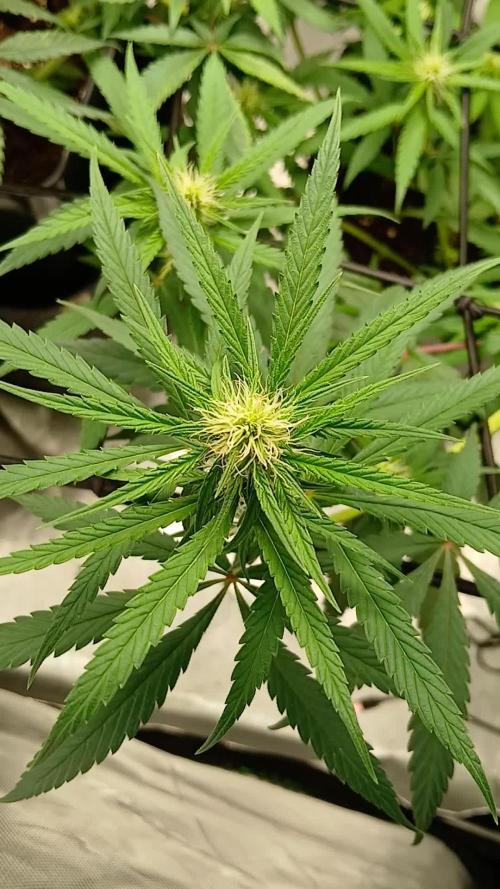
Week number seven for my little monster 💚
This week I set up the Scrog net to make it as wide as possible.
This beauty needs space! 🌳
Three good liters of nutrient-rich water for her this week. So far, I’m really happy with the results 💥
As always, stay tuned! ♣️

Likes
10
Share


@MoMedicalAlchemist
Follow
Week 1 of flower everything looks great and green fed full strength Emerald Harvest full strength. A little bit of there terms are coming out now and they smell good already


Likes
6
Share


@4MReviews
Follow
DAY 57 - 10/11/24 - Everything is looking good. I am noticing the bud sites are growing taller and thicker. I rotated and placed the plants for optimal light. I lowered the light a bit more. The feed is flowing, but very slowly. I wonder if there is a clog? The individual reses are full, the coco is wet. I am unsure what this all means.
NIGHT (12-2AM)
AVE: T 74.0 H 53.3 V 1.34
DAY
AVE: T 76.2 H 53.5 V 1.43
DAY 58 - 10/12/24 - Rotated plants, res moving on down. Plants feeding, loving life. Temps a little higher than I would like. I spread and tucked the plants. They are making great progress. There is no more burnt rubber band smell. It has given way to a sweet, kind of citrus, bubblegum, cotton candy scent. All throughout. The bud sites are swelling and blasting out terpenes. Plants are due for another haircut in the next few days. Lots of moisture and stickiness deep within the plants. Top leaves are all healthy dark green, some slight nute burn at the very tips like I want, some slight dry burn spots on the already noted plants, no changes there. I still plan on cutting all the gross leave off. Maybe later today?. The bottom leaves, the newest, light protected growth are all bright light green, like the weird extra little baby arms on the scientist in that one episode of The Venture Bros. Some of the random “bigger” leaves that I left last time are now jutting through the middle of the plant, searching for light. I am trying to tuck more mobile lower branches on top of the thicker and more rigid branches. This will expose the lower sites to more light, and gently bend the bigger stalks until they accommodate the smaller ones.
I believe the flowers are finally starting to effect my allergies. Exciting!! And kind of annoying, but maybe this way I will build up a tolerance now that I know it’s coming. I will start additional allergy medicine to mitigate the sneezing.
I want the feed to run almost empty before I refill. Res has bout 1.5-2.5 gals remaining. The individual reses are still filling. When the feed is nearly empty, hopefully later tonight, I am going to check the sponge spout for clogs. I might dump the nute feed out and wash out the res. I am considering working the Kelp down to nothing. I need to do some research on solutions for this or if running kelp through a hydro system is just a bad idea altogether.
NIGHT (12-2AM)
AVE: T 72.5 H 60.1 V 1.09
DAY
AVE: T 76.1 H 53.5 V 1.43
DAY 59 - 10/13/24 - I dumped the nute feed when there was about a gallon left. I tossed and replaced with 1 gal of pure, PH’d down water. I tried to wash the sides of the res down. I let that run down for a few hours then replaces with 6 gals of regular feed.
I am also exploring the Dynamic Wind settings. I want to reduce the stress on my fans.
New Feed Mix: 1 Gal:
Runclean: 0.4ml
Silica: 1ml
Kelp: 1ml
Cal/Mag: 5ml
CropSalt A: 5.1g OR 37ml
CropSalt B: 2.6g OR 37ml
FEED: 6 gal water, 2.4ml CS RC, 6ml Silica, 6ml Kelp, 30ml CalMag, 210ml CS A/B Bloom.
NIGHT (12-2AM)
AVE: T 71.8 H 56.1 V 1.17
DAY
AVE: T 74.7 H 51.6 V 1.42
DAY 60 - 10/14/24 - Spent a lot of time over the past few days defoliating and trimming fan leaves. I hope I left enough. I don’t think the growth has slowed down and I do not notice any signs of stress. I believe the plants are nearly done stretching, now they should swell, and then condense as harvest comes nearer. Less than a month now.
I also moved the vornado van out of the front right vent towards the back of the room. Then I closed the vent. Temps are noticeably cooler. The inline and exhaust fans are can work a little lower now.
NIGHT (12-2AM)
AVE: T 72.1 H 54.4 V 1.22
DAY
AVE: T 75.7 H 50.1 V 1.51
DAY 61 - 10/15/24 - Plants are drinking heavy again. I meant to mix up more feed last night, but I had to prioritize a gig that popped up. I fed a gallon of water between feeds. Not quite a flush, more of a nutrient stretch. I added 6 gals of proper feed in the early afternoon. I am very happy with how the plants look and smell and stick. I love the Autopots, I love Cropsalt, and Dynomyco, and I especially love Speedrun Seeds. Good companies. Good products.
Noticed a small leak, leading to an autopot individual res overflow on Back Right. I think I fixed it, but I need to double check tomorrow AM. The water blowing over the water will help cool the tent at least.
The tent smells so good, the flowers are getting so pretty.
FEED: 1 gal tap water, no PH
FEED: 6 gal water, 2.4ml CS RC, 6ml Kelp, 6ml Silica, 30ml CalMag, 210ml CS A/B Bloom, PH’d TO 5.6.
NIGHT (12-2AM)
AVE: T 70.7 H 55.2 V 1.14
DAY
AVE: T 74.3 H 52.6 V 1.37
DAY 62 - 10/16/24 - The leak seems resolved. Feeding normally now. A little moist in the tent from all the water evaporating. But everything is otherwise fine. I rotated and tucked and measured the light (no change recently). The feed lines seem good. The flower is packing and stacking. I wonder if it would be even more so if I got the veg nutes right. I assume the plant would have more plant to utilize in Flower. Maybe it would pack more and higher. I wonder about the difference in density.
For my next run I am going to run 4 of the dame plants, but grow them with different methods: no touching, Mainline, LST + Defoliating, and Topping + LST + Defoliating. I may choose slightly different methods, but this is where my curiosity is taking me right now.
Ok. There was another slight leak. I believe it is fixed now. I may want to consider taping the lines closed for my next run. Autopots are surely the way to go, but they do have weaknesses that can be mitigated with proper forethought,
NIGHT (12-2AM)
AVE: T 69.3 H 57.7 V 1.03
DAY
AVE: T 74.2 H 52.6 V 1.37
DAY 63 - 10/17/24 - The leak may have not been 100% capped. It should be now. I rotated and tucked the plants. Raised the light 2 clicks. New feed. NO MORE Silica or Kelp. Only CalMag and Bloom Until Cake (last two weeks) where I will drop the CalMag.
FEED: 6 gal water, 2.4ml CS RC, 30ml CalMag, 210ml CS A/B Bloom, PH’d TO 5.4.

Likes
2
Share


@420BigBudXXL
Follow
Até aqui sem problemas, respondendo muito bem a lenta defoliação para cause o mínimo de stress possível, agora vai seguir assim até o final da floração, ansioso para ver esse Top Bud.🚀🚀🚀
Likes
4
Share

@MandaleApical
Follow
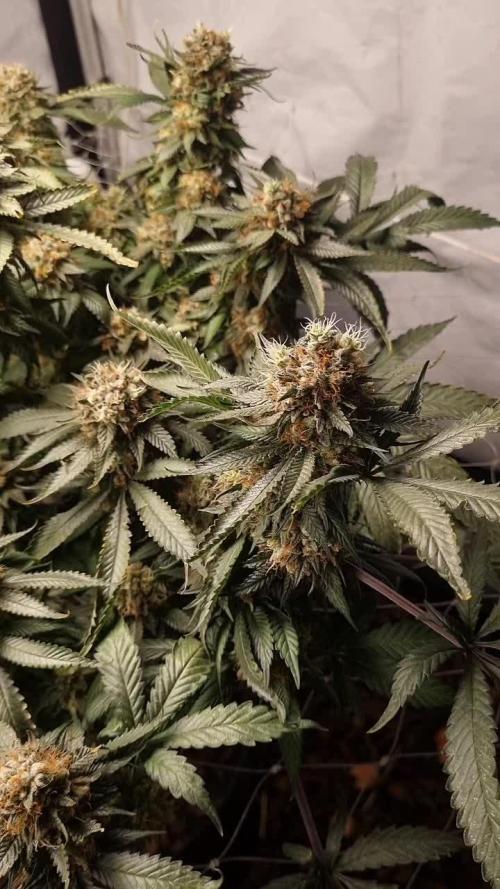
Ultima Semana! Logramos un cultivo exitoso. Aparecio botritys debido a que no controlamos el clima. Por falta de recursos económicos.
Pero la planta aguanto bien 2 semanas con mucha humedad. Excelente planta gran variedad mejor banco.

Processing
Likes
5
Share


@Ensign420
Follow
Week 02 Introduction
This week has been a bit of a struggle. Had my first experience dealing with slime and brown algae. But I think adding enzymes and increasing the beneficial bacteria helped to fix the issue. Also experienced nutrient burn for the first time. My nutrient solution strength got as high as 671 PPMs. So backed it down to about 430 PPMs during the end-of-week reservoir change. Also cut Hydroguard (expired?), CaliMagic, and Superthrive from this grow. Now she's still stunted, but is starting to recover. Hopefully...
[START OF WEEK 02]
Day 01 - Monday - 08/10/20 - Total Days: 008
-----------------------------------
- [0830]: Still looks a bit yellow. But getting larger!
--- Solution strength was at 248 PPMs.
--- Just topped off with a bit of distilled water
--- PH went up to 6.1 so PH'd down to 5.8
--- Ran the top feed for a bit to wet the hydroton.
- [2130]: She's looking even more yellow now.
--- Even the new leaves are really yellow.
--- Decided to add more base nutes.
--- Added 4ml of Sensi A
--- Added 4ml of Sensi B
--- Now at about
--- Solution Strength went up to 304 PPM.
--- PH was at 6,
--- Also raised the water level a bit more.
--- I really hope it's a nutrient deficiency and not an over-watering issue.
--- Please live!
Day 02 - Tuesday - 08/11/20 - Total Days: 009
-----------------------------------
- [0830]: Looking less droopy. But still yellow.
--- Decided to do a reservoir change.
--- 4.5gal of distilled water
--- 8ml of Sensi Grow A
--- 8ml of Sensi Grow B
--- 8ml of Voodoo Juice
--- 4ml of B-52
--- 4ml of CaliMagic
--- 4ml of Hydroguard
--- 4 drops of Superthrive
--- PH'd down to 5.8
--- Solution strength: 302 PPM
--- Since I didn't want to risk over-watering the rockwool, I did not to do a top feed, may do one tonight after the sleep cycle (lights are still set to go off at 10am and back on at 4pm).
--- As I was doing a reservoir change, I noticed that the tubes and bucket were a bit slimy. Didn't really stink or anything. Is this normal? Maybe due to the Hydroguard and Voodoo Juice?
--- I hope she gets better soon!
- [2215]: Getting larger! But still yellow.
--- Also can see a root growing through the net pot! Tiny little thing but it's there! Will have to start dropping water once more appear.
--- After looking over a few DWC diaries using AN nutes, seems like my solution strength is still too low. Most around this stage average around 500 PPMs with about 4ml per gallon.
--- Top fed for a minute to wet the top of the hydroton.
--- Solution strength went down to 263 PPM.
--- Added 8ml more of Sensi A
--- Added 8ml more of Sensi B
--- Now base nutes are at 16ml for 4.5 gal of water.
--- PPMs went up to 411.
--- Still lower than 500 PPMs, but that's okay.
--- PH was at 6. Not sure if I should adjust PH using AN nutes. So going to not ajdust unless PH goes above 6.1.
Day 03 - Wednesday - 08/12/20 - Total Days: 010
-----------------------------------
- [0830]: Looks like more root growth!
--- She still looks yellow. But leaves are perky.
--- PH was at 6.2 so lowered down to 5.8.
--- Solution strength was at 394 PPMs
--- Since roots are still growing, I decide to lower the water level a bit. Now water level is a bit below the net pot.
- [2200]: Root is getting longer!
--- Slime is returning. Not sure why.
--- Solution strength: 357 PPMs
--- PH: 6.1
--- Decided to add an enzyme along with more beneficial bacteria to hopefully cure the slime.
--- Added 16ml of Sensizym
--- Added 5ml of Hydroguard
--- Added 8ml of Voodoo Juice
--- New solution strength: 430 PPMs
--- New PH: 6.1
--- Top fed for a minute.
--- This slimy residue is really freaking me out! I hope the added enzymes will help eliminate the slime.
--- Going to do a full reservoir sterilization/nutrient change over the weekend. Please survive until then girl!
Day 04 - Thursday - 08/13/20 - Total Days: 011
-----------------------------------
- [0930]: I think the enzymes worked! There is little to no slime now!
--- Although I think the root was also dissolved in the process. It's now just a little stub sticking just below the net pot. The enzyme is also suppose to dissolved dead roots too but guess that root was too weak? Not sure what happened there. But I think the slime is cured!
--- Solution strength went down to 395 PPMs. Decided to add more base nutrients.
--- Added 8ml of Sensi A
--- Added 8ml of Sensi B
--- Added 4ml of B-52
--- Solution strength went up to 598 PPMs.
--- PH was at 6.1
--- As long as the PH is between 5.5 and 6.3, I'm not going to use PH Up or Down. But still will monitor PH levels.
- [1715]: Checked up on her after her nap and shes looking alive but stunted. But no slime!
--- Decided to add some sugars to help maintain the enzymes and beneficial bacteria.
--- Solution strength was at 587 PPMs.
--- PH was at 6.2
--- Added 8ml of Bud Candy
--- Solution strength went up to 671 PPMs.
--- PH also went up to 6.3
--- Lowered water level a bit to hopefully promote more root growth.
--- Top fed for a minute.
--- She is getting bigger, but still looks yellow.
Day 05 - Friday - 08/14/20 - Total Days: 012
-----------------------------------
- [0915]: Leaves look a little burnt on the tips. Still no slime.
--- Going to back off on the PPMs to hopefully fix the nutrient toxicity.
--- Solution strength was at 632 PPMs
--- PH was at 6.3
--- Added/Removed water until PPMs were at 536.
--- PH was still at 6.3
--- Raised water up a bit, then top fed for a minute.
- [2200]: Looking better. Still yellow though.
--- Solution strength: 514 PPMs
--- PH: 6.5
--- Added PH down.
--- New solution strength: 518 PPMs
--- New PH: 5.2
--- PH was kind of high. So decided to PH down. Had to use quite a bit to bring it down. But eventually got it to drop down to 5.3. A little low, but so far, the PH has always gone up so wanted to start it really low.
--- Ran the top feed for a minute to re-saturate the top of the hydroton.
Day 06 - Saturday - 08/15/20 - Total Days: 013
-----------------------------------
- [0830]: She looks stunted. leaves are still yellow.
--- Solution strength: 514 PPMs
--- PH: 5.6
--- Top fed for a minute.
--- Not sure what to do at this point. Going to do another reservoir change soon. Hoping she lives until then.
- [2145]: Looking pretty much the same.
--- A bit of slime has returned. Since I've been diluting the nutrient solution, the enzyme ratio has dropped. So I guess this is expected.
--- Also noticed that slime build up was on the air-stones. Never really checked the stones so not sure how long that has been there. Looks brown too, which can't be good.
--- Going to do an H202 sterilization of the system (minus the net pot) tomorrow so did not add anything.
--- Lowered the water level to below the net pot.
--- Then top fed for a minute.
Day 07 - Sunday - 08/16/20 - Total Days: 014
-----------------------------------
- [0900]: STERILIZATION DAY!
--- Decided to skip today's night cycle for a deep clean.
--- I'm hoping that skipping a night cycle won't be too stressful.
--- Temporarily moved her to a new bucket.
--- Used about a half of gallon of straight distilled water to flush out the net pot.
--- Drained the system and wiped up all the brown sludge. Also removed the air stones and cleaned up all the goo.
--- Filled the system with 2 gallons of distilled water and at least 30ml of food grade hydrogen peroxide (35% strength).
--- Yea its a lot, but since I'm not going to sterilize the system overnight, I went with a really high doseage. Basically I kept adding until I started to see little bubbles start to form.
--- Then I ran the water pump.
- [0915]: Boiled the air stones in tap water for about 10 min. Then reconnected them to the airlines.
--- I let the air stones and hose soak in the sterilization solution for about 5 minutes so the peroxide can absorb into the stones. Then ran the air stone to help mix and agitate the solution.
--- Occasionally, I'd repeat the process of turning the air pump off for a few minutes to let the stones soak.
- [1000]: Covered the top two row of holes of the net pot with some aluminum tape. Hopefully this solves the light leaking in through the hydroton.
- [1200]: Used an old toothbrush and scrubbed the pump clean. Then drained the system.
--- Refilled with more distilled water and peroxide. Again added a lot.
--- Ran system again to sterilize even more.
- [1530]: Drained the system and refilled with distilled water to rinse.
--- Ran the system for a few minutes, then drained and rinsed again.
--- Did this a few more times over about an hour.
- [1630]: Added 4 gallons of fresh distilled water.
--- Added 15ml Sensi Grow A
--- Added 15ml Sensi Grow B
--- Added 12ml of B-52
--- Added 16ml of Voodoo Juice
--- Added 16ml Sensizym
--- Solution strength was at 430 PPMs
--- PH was at 5.6
--- I was going to add Hydroguard, but I think the bottle is expired. Since 2017 or 2018!? I think Hydroguard is good for up to 2 years from the date on the bottle or 6 months after opening. So not going to use from now on. I wonder if this could have contributed to the slime build up.
--- Also removed the CaliMagic and Superthrive too. Going to only use AN products to eliminate the chance of incompatible nutrients.
--- Placed her back in the bucket and top fed for a minute.
--- Here's hoping for the best. Going to let it ride until morning! Please feel better!
[END OF WEEK 02]