




Likes
31
Share

@SmallGrowz
Follow
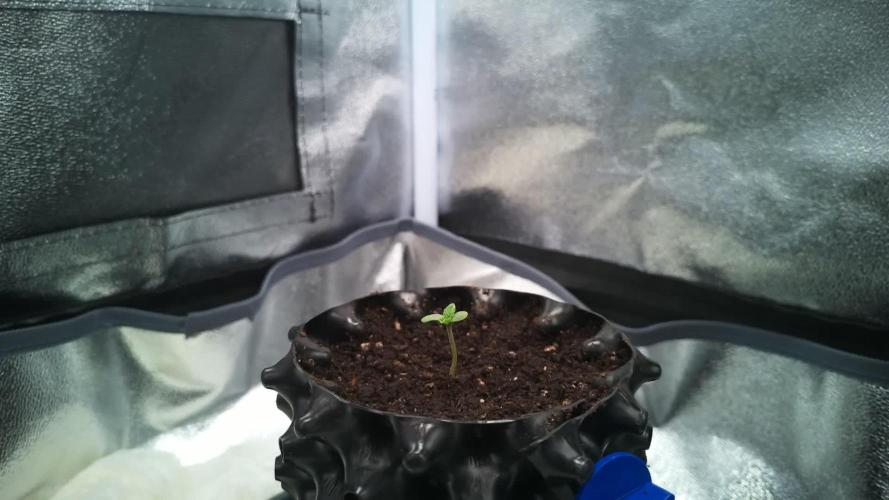
Peace Growmies💚 der erste Monat ist geschafft.
Mitte der 4. Woche wurde dann getoppt. Wie auf den Bilder zu sehen habe ich lange gewartet, da mein Kumpel versucht sich daraus einen Stecki zu machen. Die unterste Nodie habe ich abgeschnittet da die Triebe unterentwickelt waren. Letzendlich habe ich 6 Haupttriebe übrig gelassen. Sie hat das topping bestens vertragen und selbst am Abend hat man schon gesehen wie sie weiter gewachsen ist. Ich bin generell ein Freund davon spät zu toppen, somit hat die Pflanze keinen Wachstumsstopp und man muss nicht auf den push back warten. Gegossen wurde mit einem PH von 6.2, Lampe bleibt weiterhin auf 60%. Somit ca 280-300 PPFD und ein DLI von ca 17.
Likes
11
Share


@Keep_it_Cleannabis
Follow
This week I defoliated a little to allow the side branches to stretch. Just started to see bud sights, really excited to see the terp profile on this one. From now on is the exciting part

Likes
22
Share

@Marijuanaut
Follow
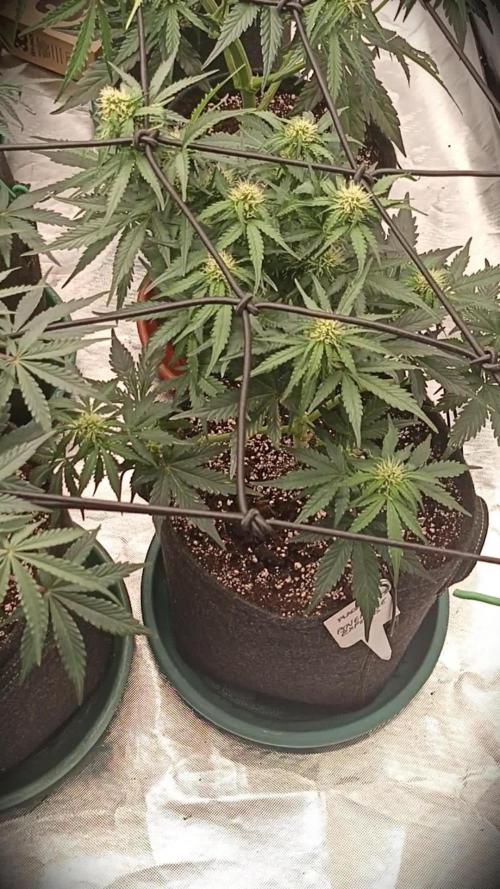
Alright... not everyone bounced back and it´s like they´re working in two speeds! 😩
Some are thriving and I´m struggling to keep up with the training and others are lagging and don´t offer me much to work with. 😅
I had to rearrange the pots to even out the canopy and did some more defoliation. 😉
Was planning to experiment with the light schedule by removing an hour a week until it reach the 12h, but its getting too cold and the temp drops a lot with the lights out. I might keep them at 17 or drop to 16/8. But definitely I´m trying it out in the summer. 😎
The damage is done and now just have to make the best of it! ✊


Likes
54
Share


@Zannabis7
Follow
Day 12 of organic grow and all is well. Seemed to have dialed in the conditions and able to keep good air movement, CO2 levels, and consistent temperatures/humidity with the ThruWall Closet Fan (Model TW108 ), and the Holmes Twin Exhaust/Intake Fan (Model HAWF-2041). Humidity is maintained with a Lovoit 6L Ultrasonic Programmable Cool Mist Humidifier (Model# LV600HH). Added a SCROG screen (just a cargo net) and bought the Sample Pack of organic nutrients from Nectar for the Gods (just pay shipping and they will send you the sample nutrients - check out the website). People say their line of nutrients make the buds smell and taste like no other! I have always been an organic Earth Juice nutrient guy, so I am going to experiment with combining the two.
Lights are on 24/0 and she has tight internodal spacing with good vertical growth. Room that closet is in is beginning to smell skunky at times, and like diesel at other times. Will begin light organic nutrients with next watering. If you made it this far, please check out my other autoflower grows.
Day 13 - Watered today with very low strength nutrients added. - Zannabis7

Processing
Likes
20
Share


Likes
120
Share


@CBD_Sweden
Follow
2017-09-11. Kl 12.00. Week 4 starts. I have cleaned the whole room for the new week and gave the girls water and nutes. Added videos and pics. Girl is 21 cm high.
----------------------------------------------------------------------------------------------------
2017-09-12. Kl 10.00. New pics and video. She has grown from 21 cm to 25 cm in 23 hours.
-------------------------------------------------------------------------------------------------------------------------------------------------------
2017-09-15. KL 10.00. New pics and video. The girl is 30 cm high and has grown 9 cm the last 4 days.
----------------------------------------------------------------------------------------------------------------------------------------------------
2017-09-16. Kl 10.00. She is growing like crazy and needs to get defoliated every morning. I added 2 new videos and gave her 2 liters of water and nutes.
----------------------------------------------------------------------------------------------------------------------------------------------------------------------------------
Likes
4
Share

@Phaleg
Follow
Howdy!
This week started as summer and ended as autumn, as for the weather conditions.
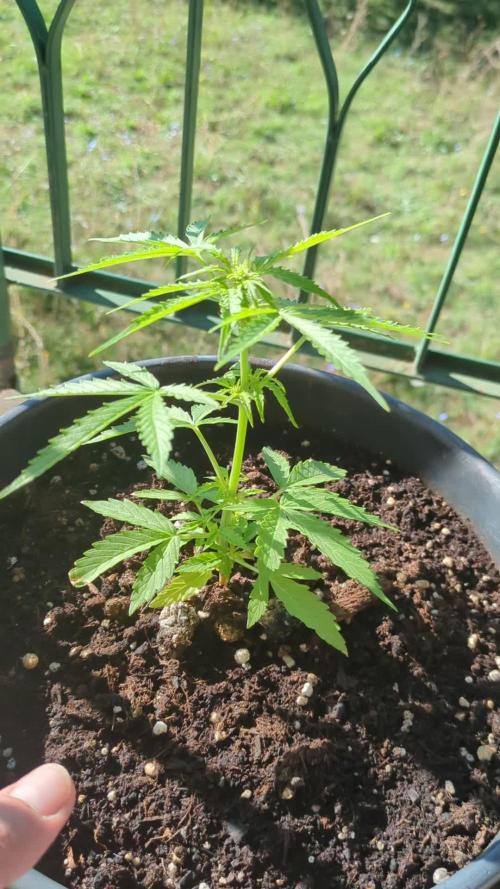
The 2 Wurlz auto increased their height and are now 18 and 19cm tall, a +10cm difference in a week
I also noticed that their leaves look slightly different in the width.
They start to show the first white barbs, does it count as flowering start or they are just showing their gender?

Likes
4
Share


Likes
17
Share


@FatalFarmer
Follow
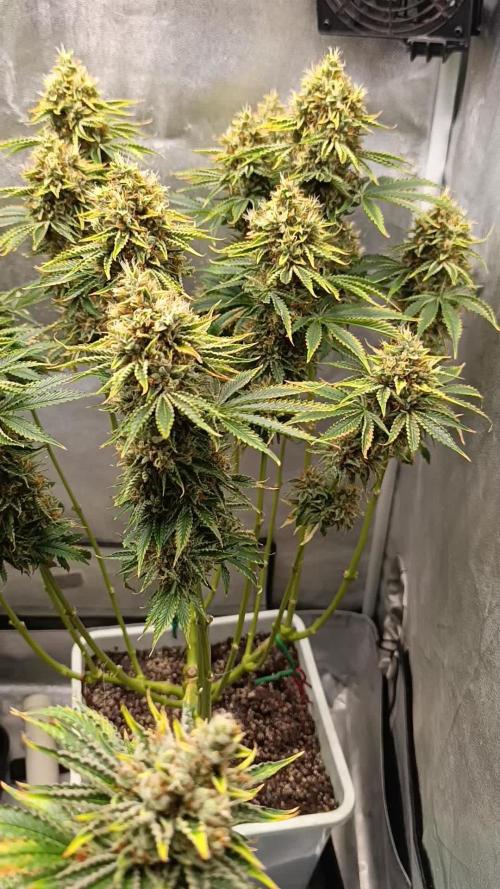
December 2nd: Week 6 has started, hopefully last week of veg, defoliating, started feeding Sweet Candy, reducing humidity... more to come
Tuesday night and it's end of week 6 or day 42, they are doing well, about 16 inches tall and bushy but I feel like another week of veg wouldn't hurt, hoping to get them all around 18 inches tall before I flip
Comments and likes appreciated, stay high

Likes
24
Share


@DeepRootsGrowTrees
Follow
GORILLA COOKIES 🍪 FF / FASTBUDS
WEEK #13 OVERALL
WEEK #5 FLOWER
This week she's doing good nothing negative to report buds are starting to dense up and get some decent trichome she got a great aroma coming off her
as she's about half way through flower!! Stay Growing!!
Thank you for stopping by and taking a look it's greatly appreciated!!
Thank you FASTBUDS!!
GORILLA COOKIES 🍪 FF / FASTBUDS

Processing
Likes
19
Share


@CookiesAndCake
Follow
Week 14
Day 92 (13/11/2020)💧:
Great start to the week with watering today and because all the girls are entering their 4th week of flower, I will again be increasing the BioBloom as per the commendations on the watering chart, but since the pH has been increased they are definitely looking great and have enough nutrients between the watering days. So today I gave the girl 4.5 ml of BioBloom, 1.5ml of BioGrow, 3ml of Calmag, and 1.5ml of TopMax for 1.5L of water. I think I will be giving the same nutrients for the rest of the week as well.
Day 93 (14/11/2020):
Not that many updates today actually. The girl is looking amazing as always
Day 94 (15/11/2020):
I wanted to check the trichomes on the girl today with a loupe to see how she is developing up closer but I have no idea where my loupe is :( Really wanted to look closer at the flowers but will have to find it first to take some close up pictures as well
Day 95 (16/11/2020)💧: We watered the girl today and gave her the same nutrients as before. They were watered with 4.5ml of BioBloom, 1.5ml of BioGrow , 3ml of CalMag, and 1.5ml of TopMax. I think the TopMax is definitely making the buds fatten up.
Day 96 (17/11/2020):
The girl is looking healthy and great, although I am noticing that the top leaves are starting to go quite yellow, which might be because it is quite close to the light, but unfortunately it is at its highest so there is not much we can do :/
Day 97 (18/11/2020):
Just can’t get enough of the smell of the SZ, she smells the best out of all the girls in the ten hands down! It is such a wonderful sweet and citrusy smell. Literally smells so much like a sweet grapefruit. Cannot wait for harvest 😍
Day 98 (19/11/2020)💧:
I keep wanting to measure the pH to make sure that it is still above 6.0 but I haven’t had enough time because it takes a while, but I will make sure to measure the pH before the next watering. So still watering with the same nutrients as at the beginning of the week with 4.5ml of BioBloom, 1.5ml of BioGrow , 3ml of CalMag, and 1.5ml of TopMax. However, I will increase the CalMag at the next watering because she is still developing the deficiency even now on the top leaves. Also it looks like she stopped stretching length-wise and started focusing on growing the buds because the height is the same as last week. But really amazing progress this week, I’ve included a video of all the girls in the tent as well so it’s easier to see how different they are!
Likes
2
Share


@SpartacaZ
Follow
L unica che mi piace sto giro sono la gorilla e la runtz....le piramidi non piacciono...


Likes
15
Share


@RamirezDusha
Follow
We had a little overdose that defected some leaves on left plant, but not too much.
We regarded this and previous week as pre-blossom, so definitely will change the composition of the additives next week.
Likes
4
Share


@Growstopher
Follow
Fastbuds seeds
Gorilla zkittles auto
Only using spring water for first week and spraying with foop mist. Going to use foop nutrients with Humboldts secret cal/mag and nectar for the gods ph up and down!
Planted right into substrate. I’m using Mother Earth coco coir/perlite mix with hydroton at bottom of pot


Likes
22
Share


@Prilyfe13
Follow
May 19, 2024 Day 29
This week we focus on training. I'm debating on doing a couple different things to see what happens. I'm definitely tying down branches. But I may top one of the taller ones and train the branches out to see how different it looks than the other tall one.
Sour Diesel A is now sitting the tallest at 11.5". Her branches aren't as long yet, but she's taller than B. Her stem is still pretty flexible, so I'll be tying her down from the top.
Sour Diesel B has lost her place as tallest plant. She sits at 11.0" tall but has wonderful side branching. Definitely ready to tie down and spread out, maybe. I think if I top any plant it will be this one. She has 7 nodes now and she's definitely old enough for it. Also, her stem is really stiff now and I don't think I can bend it at all. So I may research topping.
Sour Diesel C is the same size as D sitting at just 7" tall. Her internodal spacing is really tight still. I'm hoping she starts to grow soon. I will swap her and D out with A and B tomorrow.
She has beautiful leaves with nice deep green. Super healthy.
Sour Diesel D is actually spreading out her nodes now. She's still only 7", but I'm not expecting her to be super tall like the other 2. We'll see how tall she gets. But she has some nicely even internodes now. Great color.
All 4 ladies got a half gallon of plain water PHed to 6.1 today. And all 4 drooped just a tiny bit and not for long at all. But that half gallon seems to have done the trick. No watering for a few days.
I haven't changed the lighting yet as I still have other plants in the tent, but it will be changed soon enough. The DLI really should be at 30 mol/m²/d, but that's just not happening at the moment.
The environment is looking great for these 4. The humidity is at 65% but the temp is a bit low. I'm running the tent at 73° because of flowering plants. I've been trying to get it to 75°, but then the humidity spikes. It's pretty dry out today, so in theory, my room humidity should drop. It hasn't, but it should. That may let me get the temp up to 75° without making it too warm in my room.
Grow System Environment:
Temp: 72.5°
RH: 68.4%
VPD: 0.84 kPa
May 20, 2024
These ladies are looking absolutely great! Especially A and B. D is also starting to shape up. C is a bit lost. Maybe she needs to be moved to a different spot. I think I'll rotate her out with D.
Sour Diesel A looks magnificent. He's growing very quickly and has a bunch of nodes. The branches are starting to stretch as well. Looking good. I can start training anytime I want now. I think I'll start tomorrow with this one.
Sour Diesel B is beautiful with her long side branches and a healthy green color. I should start training her today, but I'll also wait for tomorrow.
Sour Diesel C is needing a bit of love. Not really much I can do with the space I have available at the moment, but I think I'm still able to manage. She still looks healthy and happy, just short nodes.
Sour Diesel D is coming to her own now. She is showing great signs of stretching and spreading out those nodes. She also is starting to grow branches out finally. Very healthy plant.
No watering today. Obviously, because they were watered yesterday. I'd say a good 3 days before needing another watering.
I'd also like to mention that I'm already seeing pre flowering signs. Little white pistils coming from where the bud sites will be. So I'm thinking these ladies are in pre-flower, or very close to it. It may take another week for them to really show it, but by then, they should be pretty big and alone in the tent.
The lighting is the same, but they are starting to grow into it. Well, at least A and B are. C and D will need a bit of a push when the tent opens up for them. I'm also thinking they will need risers to keep up with the other 2.
The environment is perfect for these ladies. The temp is a little low for them, but nothing crazy. 74° but the humidity is still at 65%. So we are looking good for now. It should stay this way for the next week or so. At least until I get the other 3 flowering plants out.
Grow System Environment:
Temp: 72.6°
RH: 67.7%
VPD: 0.86 kPa
May 21, 2024
A bit of a to do today. Training happened and so did pics. And some well needed environmental adjustments.
Sour Diesel A is a perfect candidate for tie down LST and so right was I. She got a perfect 90° bend just to the edge of the container. I couldn't be happier with the result.
Being as tall as she is, the bend only went about half way down the stem and didn't touch the angle of the base. Perfect.
Unfortunately, I can't tie down the side branches yet as I don't have the space to do so. But I can let the whole plant catch up before I do another tie down. I might just pull the branches out around the base of the container to make sure all the space is taken up by bud sites. I should t have a problem. It will be slightly different from what I normally do, but I can adjust when the tent frees up.
This ladies has started pre-flower now. I can't wait for the stretch to really start. Hopefully it takes a couple more days. I still have to pull another plant.
Sour Diesel B was also a neat perfect candidate for the top bend. She is much stiffer and the bend only went down about a quarter the way, but it's still a perfect 90° angle and still just inside the edge of the container. That will be a long the edge by tomorrow.
She is also in pre-flower now. 31 days makes total sense, so I'm happy.
Her side branches are beautiful and long. I'll need to start tying them down soon. No clue how I'm going to manage it with such little available space for now, but I can always adjust when the tent clears out and there's plenty of space.
Sour Diesel C is growing, but not as tall as one would think. It's just the position in the tent they are at. They are under 3 other plants and not getting enough light. As soon as I move the Tropicana Cookies out in a couple days, I'll be able to give them as much light as they need. I may even have to raise them up a bit. We'll see how things go in the next few days.
Sour Diesel D is another story. She isn't looking to shabby at all. Nice spread of nodes, she's starting to stretch a bit, but nowhere near as much as A and B. But she still isn't much taller than C.
I'll be watering all 4 ladies tomorrow I think. Each with a half gallon of water. I'm trying the wet and dry method, kinda. I'm giving a little extra water than I normally would and waiting an extra day. So far it seems to be working wonders.
In a couple weeks, they will all be bottom fed for the rest of the grow. I've found that 3 gallon containers take in about a third of a gallon a day during peak flowering time. Maybe a half gallon a day, depending on how big the plants are. And how many roots break through the bottom of the container.
I like the bottom feed because the ant takes what it needs and I can build a nice crust on the top soil for pest control and protection. The bottom feed wick system works wonders and keeps the containers between 45% and 55% saturation. It seems to be on point for cannabis. I may be wrong, but that's the reading I get for all of my plants. Especially the bigger ones.
As I said earlier, the environment got some much needed adjustments today. The central air finally kicked on and that blows out super dry conditioned air. Very clean. And keeps the humidity down. So the humidity didn't drop as low as it should have, but it takes time for the moist air to be forced out. At least the tent is at around 60%. And dropping slowly, but dropping.
At this stage, I think it should be between 55% and 60% humidity. the temp is staying at 75°. A great temp for all ladies in the tent.
Grow System Environment:
Temp: 72.7°
RH: 62.9%
VPD: 1.00 kPa
May 22, 2024
Not much going on today. Made some training adjustments and will be watering tomorrow.
Also, there's about 50 days left in the grow according to Seedsman. They say the flowering time is around 45 days. Add a few for pre-flower and there we have it. 50 days. Let's see how well I do for the next 50 days. I hope I can harvest by then.
Sour Diesel A is looking fantastic. She took quite well to her first bend, so I pulled her down just a little bit more. If course now the side branches are growing quite quickly. Very healthy and happy plant.
Sour Diesel B also looks amazing. Her side branches are all getting nice and long with really good internodal spacing. She took swimmingly to her first bend and as I did with A, I pulled her down a little bit more to keep the main top at 90°. As soon as space frees up, I'll tie all the side branches down to get a nice canopy going.
Sour Diesel C is beginning to stretch out a bit. The nodes are finally spacing out which of course means the stretch is just about to start. Huge leaves. Also overlapping the other 3 plants.
Sour Diesel D is starting to look really good. Still shorter than A and B, but catching up, especially now that they were tied down.
The light will be dropped in a couple days and I'll be adjusting the DLI. It should be at 35 mol/m²/d and it's not. So I have to lower the light about 12" and drop the power down to 60%.
The environment is great for these ladies. So far we have hit the mid 50s% humidity and are at just over 61% now. The Central Air is off for now, but will kick on anytime. Once that turns on the humidity will drop again. Currently I'm stuck using my portable AC that blows wet, room temperature air that jacks up the RH. The temp is still pretty good at 57°.
Grow System Environment:
Temp: 75.7°
RH: 59.4%
VPD: 1.20 kPa
May 23, 2024
I was going to water today, but I was really busy with my last Tropicana Cookies wet trim and harvest. The soil moisture content is around 33%, so it should be fine until tomorrow.
Speaking of harvesting, now that the Tropicana Cookies are both gone, I have plenty of space for now. They still need to be tied down and trained. I'll be harvesting the two Banana Purple Punch's in a week so when those are gone, there will be plenty of space to really train them and get myself a really nice canopy.
Sour Diesel A looks great! Her branches are reach straight up though. Definitely because of the tight quarters and light intensity. Now that she is under the light and not impeded by another plant, she should start stretching even more.
Sour Diesel B is looking amazing as ever. As with A, her branches are sticking straight up for now. That will be adjusted starting in a couple days I think, if not tomorrow.
Sour Diesel C is starting to fall a bit behind. Not by much, but a little bit. I'm sure she will bounce back in no time now that she has plenty of light. But I'll keep an eye on her. If she turns out smaller, I still have the 2x2 in a couple weeks.
Sour Diesel D looks great! She is catching up to A and B in girth. Great internodal spacing and side branching is looking good. I expect her to take off with the extra space now and more access to the light.
The lighting needs to be checked and I'll do all that tomorrow. Along with the watering and possible LST.
The environment is finally at a reasonable level for these ladies. It was kinda cool today, but the humidity is down to 52% and is just right for this stage. The temp was about 72° for most of the day. But will climb back up in a matter of a few hours.
Grow System Environment:
Temp: 75.1°
RH: 60.2%
VPD: 1.15 kPa
May 24, 2024
Watering day! Each plant got a half gallon of plain water PHed to 6.1 from the top.
The last Tropicana Cookies is now out of the tent and now there's plenty of space. I have them staggered with A in the back then D, B then C. Not too much more space, but enough for me to pull branches out a bit.
Honestly though, they are making their own level canopy, so I might do some very light training this run instead of heavy. It all depends on how they look in about a week.
Speaking of in a week, I'll be pulling the 2 Banana Purple Punch's out in a week. That opens the whole tent up and each planet gets their own quadrant. I think I have the timing right on this. Hopefully I'm right and these ladies will be able to be trained more.
Sour Diesel A looks great. Her single tie down increased the height of the side branches and she is creating her own flat canopy. I'm definitely going to have to pull branches apart and tie them down soon. Hopefully I can hold off for a week.
Sour Diesel B has a wonderful canopy going. Her branches are all falling into place around the whole plant. Opening up each top for all the sunlight they can get. It's pretty impressive. I'll definitely have to train her down soon. I may have to in less than a week as well, so this might make things pretty tight again.
Sour Diesel C got a perfect top bend today. Her branches are a little behind and she's making the standard Christmas tree structure. So this bend should fix that and give her the start of a nice level canopy.
Sour Diesel D is coming along nicely. I accidentally broke one of the main stem fan leaves. No big deal, but it was still a mistake made. Oops. Her nodes are starting to spread out a bit, but she is definitely a compact plant. It's too soon to tell how big she will get. So far it looks like she'll be stretching, so who knows. Maybe she'll get to 2 ft.
The plants have grown into the light and will need an adjustment in maybe a week. I'll be checking the DLI later today. I'm pretty sure they won't need any changes in the immediate future. We shall see.
Update: I checked the DLI and got a reading of 24 mol/m²/d. Much too low for these ladies. They should be around 35 mol/m²/d. I'll have to figure out a way to increase the intensity without hurting the other plants in the tent. They should grow right into it though. Now that stretching is about to begin. We shall see. I'll update again if I figure out a solution.
The environment is back up to 59% and the temp is around 76°. It's ok I guess, but I'd really like it down to about 55% to 50%. 50% would be great for this week to be honest.
Grow System Environment:
Temp: 72.9°
RH: 56.6%
VPD: 1.17 kPa
May 25, 2024
It's the end of the week and the weather sucks! Its rainy and humid out. Really humid. So the tent is now suffering.
Sour Diesel A looks really good. A little sparse on one side for branching. I am not a fan of when this happens. I need to pull out about 4 branches to get an even spread and I can't at the moment for two reasons. Firstly, there just isn't space yet to spread the branches out as needed. Some of the branches are fairly tall, but the top is still taller. It's really stiff so I can't bend the top down again. Maybe during the stretch I'll be able to, but not at the moment. The second reason is side branch size. I have to move 4, but only 2 of the branches are long enough so far.
Sour Diesel B is looking absolutely amazing. She has a level top and an even spread as well. I technically shouldn't have to train her, but I'm going to as soon as she has the space.
Sour Diesel C looks really good. She took perfectly to the training and has a perfect 90° bend on the top. The rest of the canopy is a little behind, so I may have to pull the top down again tomorrow. By then the side branches should have caught up.
Sour Diesel D is going to be my untrained plant for this grow. I train all my plants, so leaving this one alone is nerve racking. Lol.
She looks pretty good. Side branches aren't very far behind the top, but it's definitely going to bush up and maybe grow fairly tall. We shall see how she goes. Maybe I'll have a 3 oz top.
The environment is a mess. The temp is at 75° which is fine, but the humidity went back up to 60%. It's not bad for now, but when they hit flower, the humidity needs to go down to 50%. 55% would be ok, but I'd rather 50%.
Grow System Environment:
Temp: 75.1°
RH: 55.2%
VPD: 1.30 kPa

Likes
21
Share


@OGgrows
Follow
Due to the pandemic, I was unable to update this diary weekly, but I recorded the results of the harvest with some photos and only now managed to update the diary. Of two plants, both flowering amazing without big problems. Flowering went well despite the plants having to withstand a lot of heat. Happy Growing to all 🤜🤛🌲💪🙏💚
Likes
22
Share


@MadeInGermany
Follow
Hey guys :-) .
Today the plant was sprayed again with neem oil.
There weren't any more trips to be seen after the second application, but to be on the safe side, you did it again today get a cure.
That's why the beautiful dark shimmer on the leaves :-).
She has developed very well this week.
I will give you 7-10 days before I switch to flowering.
This week it was poured 3 times with 1 l each (nutrients see table above)
Otherwise everything was cleaned and, as always, everything was checked.
Have fun with the update and stay healthy 🙏🏻
👇🏼👇🏼👇🏼👇🏼👇🏼👇🏼👇🏼👇🏼👇🏼👇🏼👇🏼👇🏼
A thank you for this wonderful strain goes out to
Herzog
https://instagram.com/herzog030?utm_medium=copy_link
and the Exotic Seeds team
You can buy this Nutrients at :
https://greenbuzzliquids.com/en/shop/
With the discount code: Made_in_Germany you get a discount of 15% on all products from an order value of 100 euros.
You can buy this Strain at :
https://www.exoticseed.eu/
Water: Osmosis water mixed with normal water (24 hours stale that the chlorine evaporates) to 0.2 EC. Add Cal / Mag to 0.4 Ec Ph with Organic Ph - to 5.8 - 6.4
👆🏼👆🏼👆🏼👆🏼👆🏼👆🏼👆🏼👆🏼👆🏼👆🏼👆🏼👆🏼
