


Likes
Comments
Share


@APOLLO
Follow
Hello people, its been a good week Renaissance. She took well to PK 13/14 and is on Full Cruise now 🙌
There IS a slight tip burn which I am confident, will not spread further because I have already dimmed the Renaissance' side of the light to 75% brightness, besides I will lower the nutes now as well which should help.
She smells very spicy (or minty perhaps) and flowery herbal undertones and is extremely sticky, more than the white widows.
Her characteristics are supposed to be 80% Sativa. With THC content at around 10% and CBD at 4%.
PK 13/14 will be stopped now (been 7 days), with lower A & B from here on.
Take care all cya next week 🙏

Likes
78
Share


@deFharo
Follow
Bienvenidos cultivadores de marihuana clandestinos, y también, a los que tienen la fortuna de no serlo! 🖐️👨🌾... todo por la causa!
137 días de cultivo, 70 días de floración, la gitana andaluza ha cumplido con creces, después de dos días de luz sin descanso y una vez agotada la humedad de la maceta he cortado la planta!
Ha sido un cultivo fácil y provechoso, la planta tardó en arrancar, pero después se ha comportado con gran vigor, creciendo con alegría, mucha comida, luz y riegos para dar unos hermosos y densos cogollos que ahora cuelgan boca abajo... en unas semanas completaré mis comentarios sobre la cepa.
Ahora su hermana pequeña 3M ▼ La gitanilla, con seis semanas menos de vida!, promete superar a su hermana mayor, con espacio liberado en mi carpa de cultivo, he preparado un escenario de luz digno de una Reina... a jugar!
Feliz verano cultivadores!!
Hasta la cosecha...
SALUDOS A TODOS!!
=================================
Info de la cepa GYPSY KUSH: https://en.seedfinder.eu/strain-info/Gypsy_Kush/Kannabia_Seeds/
"una variedad única con un duende flamenco que no se puede aguantar y que solo puede venir del sur..." Kannabia Seeds
- Genética: Black Domina x Afghan x Ginger Ale
- Hibrido: Sativa 50% Indica 50%
- Tiempo de Floración: 58-62 días
- Rendimiento: 500 gr/m
- THC - Hasta 16%
==============

Likes
36
Share


@SAC87
Follow
Day 14 flower
Hey Growers
So day 14 of flower, I decided to defoliate as the tent was getting so overgrown. They are drying out quickly and the media is dense with roots. They are going to require daily watering very shortly. They seem quite happy and doing well. You can see in one of the pictures, the leaf edge is raised, which idk exactly what that is. I’ve decreased the light to 70% until I know how they’ll react.
Other than that just put in the trellis to support the tops.
Happy Growing 🌱

Likes
39
Share


@Silverback_Guerilla
Follow
11/20:
Harvested all 3 Gorilla Cookies. It took them a week to dry.
Dry weights:
plant A - 121g
plant B - 80g
plant C - 100g
Final thoughts:
It was easy weed to grow, and produced a lot of dense/heavy/delicious flowers. Would def grow it again.👌
Potency: 8/10
Yield: 9/10
Flavor: 9/10
Aroma: 7/10
Bag-appeal: 10/10
Bud density: 10/10
Likes
55
Share


@Max1973
Follow
Day 57 - The girls are bursting with flower....... looked abit light (the main tops looked a light green, showed signs of nutrient deficiencies), so upped the Dutch Master Gold One Flower, it's 1000 ppm now.... thinking about Defoliation... outside temperatures are middle of winter, 0oC to 20oC (32oF to 70oF) .... but typical high low is 5-15oC (40-60oF)......... surprisingly the LED's warm the tent upto 20-24oC,
this is important point.... i am running the lights, 6 pm to 6 am... 12hrs lights on all night, and all day is night mode...... during the day is the highest temps of the day... and during the lowest temps, they have the light heat .......
Day 61 - I trimmed em .... this was the third defoliation..... things are starting to get sticky..... ah i'm just going to wing it.... they are 2 months (8 wks) from seed.... idk what i'm doing.......
i did some serious stress bending today, and had to put afew tie downs in..... my theory is to hurt em as much as i can without killin em....
to make em harder, stronger, faster, more stressed, so they can survive anything..... grow em stronger......
the smell is zero in the home, but once i got them out for their 2 week haircut, they started producing some strong wet kisses, that were sticky and wet.... the
aroma of heavenly ladies was abundant...... 😎😎
idk... this tastes so good.... it's like some kind of weird berry combo goodness.... i'm vaping vanilla custard atm and this is so good with vanilla custard.... vanilla custard kush n cookies... haha
watch the video......... 😎
Likes
11
Share


@AwfulBuddy
Follow
Sorry for delay in updates, its busy season here 🕺
The goal for this grow is 10g for each clone 💪
AN sensi feed with all the booster is need
In the video other skunk clones in nft grow and you can see Mommy start Bloom

Likes
14
Share
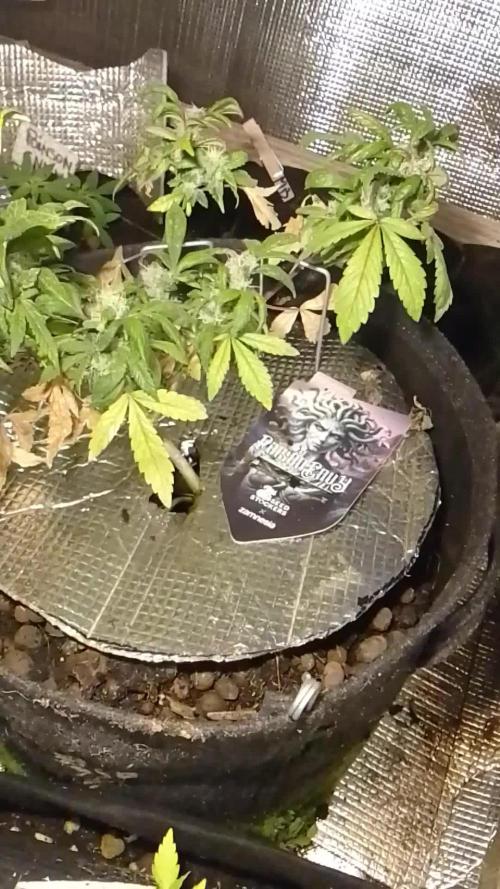

@Crazy_Doofus
Follow
The buds are starting to grow, lots of them!!
PH water and substrate between 6 and 7 👍
Looks great, slow but steady! 👍👍👍
Lamp is on at night, hope to save electricity costs
Likes
21
Share


@Peggers
Follow
Been on the straight water halfway through the week going to be keeping a close eye on them in order to time a 2 day darkness period and I would like them to be close to dry at the roots also so it's all watchy and trying to balance and time things together. One thing is for certain tho some of the buds smell like lemon cleaning products! Crazy. Should be Harvest before next week so I might pop on with some decent pictures if I can get any. Will reupdate once dried also.

Likes
19
Share


@Weedfan
Follow
Thank you #2fast4buds for these strains . So i broke all my expert friends yield per 600w hps and i used half of nutrients that was written in advanced nutrients prescription. I also used air circulator very little. A total of around 850 grams +-20 gram . Definitely i will grow again Gorilla cookies ,tropicanna cookies , strawberry gorilla and also i like a red one that probably is cherry cola from smell . I also will give another try to wedding cheesecake .
Likes
8
Share


@Alkaline_Water
Follow
Last watered on dec 10;
I eased up on the LST angle on the Larry OG. She’s looking a lot better than a couple of weeks ago. Although growth has been stunted substantially, I’ll try to nurse her back to the best of my abilities;
We’ll see if the coffee grounds cause nitrogen toxicity, or if it pays off;
The bud sites on the Mandarin Cookies have grown at least an 1 1/2in in the last week and seem to be doing well, There’s some very faint tip yellowing on the new growth so I think I’ll water with some plain ph’ed tap water and perhaps some molasses;


Likes
15
Share


@Bluemels
Follow
Tag 84: Die Triple G hat die vergangenen heiße Woche sehr gut vertragen. Ihr Geruch wird immer intensiver von Tag zu Tag.
Tag 89: Nachdem die Triple G etwas aus der Form geraten ist habe ich das Netz ein ganzes Stück nach oben geschoben, das war eine klebrige Angelegenheit 😛
Aber es hat sich gelohnt die einzelnen Triebe bekommen jetzt gleichmäßiger Licht.

Likes
13
Share


@NanoLeaf
Follow
Very happy overall, had some difficulties hitting the sweet spot through the cycle but managed to pull it through brilliantly at the end.
This is definitely a very deserty and cookie like strain. Oven baked freshness!


Likes
17
Share


@XoticGROW666
Follow
🎩🌈🍧🍨🍬
No toppin
No trainin
Jus test run
Terps on her is insane str8 candy fruity ice cream can’t wait till run her again with full toppin and trainin!! This a winter test grow outdoor so the buds won’t be that big but We will see 🤭

Likes
44
Share


@RakonGrow
Follow
Note: jegliches Equipment findet ihr in der Germinations Woche .
Day 22:
PPFD 410 * 20h = DLI 29.52
Day 23:
Day 24:
+ Dünger
+ + 0.5 Flaschenwasser
+ + + Rhizotonic
+ + + Terra Vega
+ + 0.6 Leitungswasser
+ final PH 6.5
Day 25:
Day 26:
Day 27:
+ Flaschenwasser 2.5 L (PH 7.2 EC 0.26)
+ + CanaCym
+ Final PH 6.1
= Drain : EC 1.325
Sieht bissel danach aus als hab ich etwas zuviel Urgesteinsmehr in die Erde eingearbeitet :)) Muss ich halt bissel spaarsamer mit der Düngung umgehen .
Day 28:
Das Wetter und die liebe Luftfeuchtigkeit :(( Manchmal denk ich das ich Outdoor growe :))
Im Video sieht man schön wie der kleine Zwerk sich selber mit seinen riesen Blättern SCROG mäßig den Wuchs in die Breite erzwingt :)) Die Blütentriebe müssen halt den Weg zum Licht mit aller Anstrengung erreichen .
Likes
7
Share


@growyourownstone
Follow
Added a second LED having some temperature issues. Changed my set up that brings in cool air, getting close to where I want it.


Likes
35
Share


@Sense63
Follow
Sense63
📆 Woche 11 – 15. bis 21. Dezember 2025
Blütetag 37–43 · Gesamtalter ca. Tag 74–80
Die Pflanzen befinden sich nun klar in der fortgeschrittenen Blütephase.
Der Fokus liegt sichtbar auf Blütenverdichtung, Harzproduktion und strukturellem Finish.
Vegetatives Wachstum ist nahezu eingestellt, die Energie geht vollständig in Bud-Aufbau.
🌱 Pflanzenbeobachtungen – Hauptzelt 90×90
🍋 Lemon Orange – hinten rechts
Sehr dominante Erscheinung im Zelt.
Die Hauptbuds sind deutlich angeschwollen, mit kompakter Struktur und zunehmender Dichte.
Stigmen stehen noch überwiegend hell, beginnen stellenweise leicht nachzudunkeln.
Die Blätter zeigen eine gesunde, leicht matte Oberfläche – typisch für diese Phase.
Die Pflanze wirkt stabil, trägt ihr Gewicht gut und zeigt keine Stressanzeichen.
Gesamteindruck:
Ertragsorientiert, kraftvoll, sehr gleichmäßiger Bud-Stack.
🦍 White Gorilla Haze – vorne links
Auffällig harzige Entwicklung.
Die Buds sind etwas luftiger im Aufbau als bei Lemon Orange, dafür stark mit Trichomen überzogen.
Das zuvor beobachtete einseitige Aufhellungsmuster (teilweise gelbliche Triebe/Blätter) ist weiterhin sichtbar, zeigt aber keine negative Dynamik.
Neue Blütenstände entwickeln sich normal, ohne Verformungen oder Wachstumsstopp.
Einordnung:
Sehr wahrscheinlich genetische Chimären-/Sektorvarianz oder früh entstandene Leitbahn-Asymmetrie.
Kein klassisches Mangel- oder Überdüngungsbild.
Gesamteindruck:
Sehr aromatisch wirkend, gesund in der Blüte, funktional stabil.
🍒 Cherry Poppers #1 – vorne rechts
Extrem gleichmäßige Blütenverteilung.
Alle Haupttriebe tragen kompakte, gut definierte Buds mit kurzer Internodienabfolge.
Die Pflanze nutzt den gewonnenen Raum optimal, wirkt breit und ausgeglichen.
Blätter zeigen leichte natürliche Aufhellung in tieferen Zonen – altersgerecht.
Gesamteindruck:
Sehr saubere Struktur, ideal für gleichmäßige Reife.
🌱 Pflanzenbeobachtung – Kleines Zelt 40×40
🍒 Cherry Poppers #2
Kompakter Phänotyp mit starkem Fokus auf Headbuds.
Die Hauptcola ist deutlich ausgeprägt und beginnt sichtbar an Masse zuzulegen.
Seitentriebe bleiben kürzer, tragen aber ebenfalls gut entwickelte Blüten.
Sehr gleichmäßige Harzbildung, kaum Blattüberhang – ideal für gute Luftzirkulation.
Gesamteindruck:
Klein, effizient, sehr sauberer Blütenaufbau.
🍃 Allgemeine Wochenbeobachtungen – Woche 11
Klare Phase der Bud-Verdichtung
Trichombildung nimmt sichtbar zu
Kaum neues Längenwachstum
Pflanzen tragen Gewicht stabil, kein Umknicken
Canopy bleibt offen und gut durchlüftet
Unteres Blattwerk baut sich altersgerecht zurück
Keine neuen Stressanzeichen oder Defizite
🔚 Fazit Woche 11
Die Blüte ist nun voll etabliert.
Alle Pflanzen zeigen sortentypisches Verhalten und entwickeln sich gesund, stabil und planmäßig.
Unterschiede zwischen den Strains werden jetzt klar sichtbar – sowohl im Bud-Aufbau als auch in Harz- und Strukturmerkmalen.
Eine sehr ruhige, kontrollierte Phase, die eine starke Endreife erwarten lässt.


Likes
27
Share


@Rap_a_cap
Follow
Well, my organic vegetables garden, in anticipation of growing weed has been at rest for twenty months. I started to amends with green manure from legumes and lawn mowing (expecially the last month, for ready availability of N). I've mixed 1 gallon of Vigo Plant Full (perlite, guano, peats) to improve drainage. All the roses around, the apple tree and the hedges were treated with deltamethrin so as to preventively reduce the population of aphids, whiteflies & red spiders.
My vegetables & weed eventually will receive only spraying of nettle macerated.
Now in the evening I will have to pay close attention to broadnose weevils and later to bedbugs. It will be a tough fight against the wind and heat. A whole week of full sun awaits them.
Royal Gorilla has spent the previous week outdoors night and day in her pot savoring the discrete temperature changes in my area.
She is a runner, born 9 days after the sisters and is already making up for lost time. 💪
Likes
6
Share


@MaxWax
Follow
The plant is healthy but the genetics of the seed is really not good. The leaves have only five teeth
Likes
44
Share


@I_and_I
Follow
First grow completed, turned out far better than I could ever have hoped, the plants totally bossed it for all the winging it and improvising I put them through, but we got there in the end haha,
Looking forward to next grow, can't wait to enjoy using all good genetics, already have some Bruce banner #3 seeds ready to roll out :)
Thanks for reading