


Processing
Likes
Comments
Share


@Major
Follow
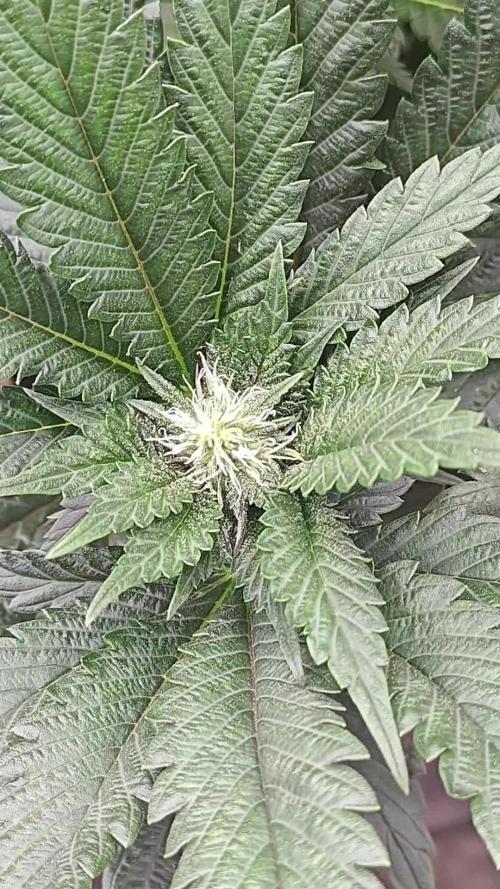
hello everyone I had a very positive week on my BSB Bruce Banner colas are forming and hardening full of resin are on the flowers and leaves the harvest is coming soon I am very happy good luck everyone 😘😘💪💪👌👌👍


Likes
21
Share


@JuicyFruit
Follow
Week 9 - Day 63 - 26/11/19
Im so grateful to be a part of this community and to be at this milestone so to speak :) had an amazing time growing this plant, thanks to everyone who had a look or contributed to my diary!
Harvest was fun but that little 16cm tall plant stunk my whole house out of cheese when i started trimming her :)
Added a few photos and videos of the harvesting, i got a little ball of hash off the scissors which i smoked in a bong and it was nice! very hashy!
its taken about 2 hours to finish trimming but ive stored all the trim in the freezer along with the dwarf trim from my last diary :) im making cannabutter and edibles this week. really excited for that.
So i hung my drying rack outside the tent beside the passive intake. temps are between 20-22c in the room so it should dry fine and im hoping the passive intake will drag the smell in and keep it sort of fresh in the room :)
This diary has got me excited for my Quick One plant as its much taller and has colas like arms :D.
Il update in 3-7 days when buds are dried and then il be updating a lot throughout curing :)
Day 65 - 28/11/19
Still drying these buds :) they look much smaller now, i smoked a small bud and although its much drier than harvest its still spongy/sticky and stretchy when breaking apart so 2-3 more days drying i think.
Smell is wonderful especially if you get it on your hands, its like tropical fruit cheese and the effects of thc are not as pronounced with this strain but i felt very relaxed, no muscle pain etc and no paranoia or anxiety. i havent had a clear relaxed headspace before bed in a very long time. Any 1:1 THC/CBD is a must grow, give it a try if you havent already, i couldnt have picked a better starter medical plant as i love a good old cheese strain :)
And i made some cannabutter out of the 59g of sugar leaves i got from this diary and my first diary. il have to upload a few pictures of the process later and let you all know if the cannabutter worked in my brownies :)
Day 66 - 29/11/19
Started curing and added a photo to show :) buds were at 59-60% when left in the jar alone for a few hours so i threw in my boveda 58% pack and started burping 5-6 times per day :) i could have cured for a week before adding the boveda pack but i had barely any bud in the huge jar so i thought it would be wise to add the boveda to prevent mold and to keep it curing perfectly!
Day 67 - 30/11/19
Posted a picture of a handful of buds :) i smoked a few in a bong and had a joint and it left me nice and medicated! no anxiety no paranoia nicely locked to the couch and sleepy. perfect nightime smoke as it wont trip you out or mess with your head, just a nice happy little mellow buzz!
Flavour hasnt really came through yet, not sure what to expect as im a newbie but its slightly like cheese/flowery/herbs.
Curing is definitely helping every day! the smell is getting better, buds are getting really smooth and they look amazing also! really excited for the next few weeks curing :)
Final Update - Day 69 - 02/12/19
Finally here at the end of this diary and i have to say i loved growing this plant. it was a dark green colour throughout growing and took whatever i threw at it.
Buds are nice and dry and curing well. i saved the best buds until last and added a couple of photos of them and a video also! they are covered in trichomes and feel great.
Not much of a smell from the buds and it tastes like a sweet floral cheese mixture.
Im pretty couchlocked from a bong of this strain so im gonna end this diary here and go relax but many thanks for following along folks and take a look at my other diaries if you get a chance :)
Peace!

Likes
32
Share


@MadeInGermany
Follow
Info:
Unfortunately, I had to find out that my account is used for fake pages in social media.
I am only active here on growdiaries.
I am not on facebook instagram twitter etc All accounts except this one are fake.
Have fun with the update.
Flowering day 54
since time change
to 12/12.
Hey everyone ☺️.
We are slowly getting closer to the harvest 😍.
You can see that the lady sucks all her energy out of the leaves and passes it on to the flowers.
The buds smell very tasty 😍.
It should be ready to harvest in the next 17 - 25 days.
But of course we will be observing this closely with the microscope from next week.
Otherwise the tent was cleaned as usual and the humidifier refilled.
I wish you a lot of fun with the update. Stay healthy and let it grow 🙏🏻
You can buy this Strain at :
www.Zamnesia.com
Type:
Banana
☝️🏼
Genetics:
OG Kush x unkown
👍
Vega lamp:
2 x Todogrow Led
Quantum Board 100 W
💡
Bloom Lamp :
2 x Todogrow Led
Cxb 3590 COB 3500 K 205W
💡💡☝️🏼
Soil :
Canna Coco Professional +
☝️🏼
Fertilizer:
Green House Powder Feeding
☝️🏼🌱
Water:
Osmosis water mixed with normal water (24 hours stale that the chlorine evaporates) to 0.2 EC. Add Cal / Mag to 0.4 Ec Ph with Organic Ph - to 5.5 - 5.8 .

Likes
29
Share


@Myrcene_Dream
Follow
-Pistils starting to turn orange and fade starting on leaves
-Has a really nice fruity smell coming off it

Likes
14
Share


@PREPPYPUNK
Follow
..MAJOR TRAGEDY , EMERGENCY SITUATION FOR PLANT. ACCIDENTLY PULLED FIRST INCH OR 2 OFF OF MAIN KOLA. I DONT KNOW IF THE WHOLE THINGS GOING TO DIE OR IF I SHOULD DO SOMETHING BESIDES FEEL LIKE A MORON? IM GOING TO FEEL , WELL ANOTHER LESSON LEARNED BUT WHAT SHOULD I DO NOW?

Likes
17
Share


Likes
99
Share


@BudXs
Follow
Co2 is kicking some ass, causing some of the mothers to grow huge in 7 days!
Autos are producing slowly, or maybe im just impatient. When the clones and seedlings are ready for a light change, the autos are going outside I think
Added a security monitor to allow me to watch the garden remotely and record any unforeseen motion. I really like growing in 2020, technology is a great companion to the garden and gardener


Likes
2
Share


@Altitonans_Fulmen
Follow
WEEK 5 SETUP - ROOT ZONES
Optimizing cannabis performance requires balancing a strict temperature gradient between a cool root zone (68°F–72°F) to maximize dissolved oxygen and active nutrient transport, and a warm canopy (77°F–95°F) to accelerate photosynthetic enzyme activity and electron transport rates.
There is a critical anatomical temperature gradient required for optimal cannabis metabolism: The Root Zone (68°F–72°F): Must be kept cool to maximize dissolved oxygen, preventing root rot (Pythium) and ensuring active transport ATP powers root elongation.
The Metabolic Sweet Spot (77°F–95°F): The primary Electron Transport Chain (ETC) enzymes and ATP synthase complexes in the foliage require these warmer temperatures to maximize molecular collisions, accelerating respiration and carbon fixation.
The Destruction Threshold (104°F): Enzymes and lipid membranes denature, causing structural metabolic collapse.
Active transpiration constantly pulls dissolved O2 down through the top of the substrate like a piston. At night, the top-down pump completely stops. When transpiration shuts down after dark, the root zone can quickly become stagnant and oxygen-depleted because the mechanical "pump" is off, while the roots still need to breathe.
Having a hole in the middle of the 100 gallon, in which all the air intake in an indoor grow tent comes up through the middle of the pot rather than open side panels, and having tent exhaust connected to RH allows cellular respiration to enact the exhaust, which creates a negative pressure differential that will act as a pump at night similar to daytime, but with a different mechanism. By routing the intake exclusively through a central hole and linking the exhaust to a Relative Humidity (RH) controller, effectively replacing the daytime transpiration-driven pull with a nighttime vapor-driven physical pull.
Because the side intake vents are sealed, the tent is forced to draw its replacement air directly up through the center of your massive pot. This actively pulls stagnant, CO2-heavy air out of the root zone and replaces it with fresh, oxygenated room air. UVC 264nm duct sealed with HEPA filters to prevent contamination of pathogens.
Constant airflow of 0.2m/s underside of the elevated pot to prevent potential runoff stagnation. Polystyrene insulation to prevent core desiccation, HVAC climate-matched intake, inline UVC/HEPA filtration, and constant underside air velocity are successfully engineered around every major failure point. Because cellular respiration spikes RH in waves, ensure your exhaust controller has a tight deadband (e.g., +/- 2-4% RH). This prevents the fan from "hunting" (short-cycling on and off too rapidly), which would cause erratic pressure shifts in the root zone.
Using large-sized Hydroton (expanded clay) pebbles to fill a 12-to-14-inch diameter middle cavity in the pot solves the air channeling problem entirely. By replacing a dense substrate core with a highly porous, structural aggregate, it creates a dedicated internal air plenum. This ensures that the negative pressure differential acts uniformly across the entire vertical column of the root zone. Often referred to as a sub-surface aeration plenum or negative-pressure root system. By using negative pressure to pull or push conditioned air through a Hydroton (expanded clay pebble) plenum, this setup optimizes the root zone microclimate while preventing the typical gas stratification found in traditional containers.
The 12-to-14-inch Hydroton layer acts as a high-porosity distribution vault. Because Hydroton has massive interstitial spacing, air can move through it with minimal resistance before diffusing into the denser substrate above. Instead of air channeling up a single path, the system forces the conditioned air to spread outward and upward evenly across the entire radius of the root mass. Roots actively consume Oxygen and respire Carbon Dioxide (CO₂). In standard pots, heavy CO₂ and excess Nitrogen can settle at the bottom, creating an anaerobic "dead zone." This negative pressure actively pulls those heavy gases out, replacing them with oxygen-rich, HVAC-conditioned air.
Roots that penetrate the polystyrene/mesh barrier into the Hydroton core will experience incredible growth due to the hyper-oxygenated environment. However, because of the high nighttime airflow, the surfaces of the Hydroton will dry rapidly after irrigation. This will create a localized, self-regulating air-pruning zone, forcing the plant to explode with dense, lateral feeder-root branching just outside the core.
Turns one's massive pot into a bi-directional, lung-like matrix. Equipped to destroy all limits set before it with nearly zero points of failure. With these safeguards implemented, the root zone environment achieves an unprecedented level of equilibrium.
The plant drives the system. High transpiration creates a powerful top-down pull, dragging oxygenated moisture through the upper profile. The HVAC and HEPA/UVC intake runs passively or under low static pressure to maintain ideal ambient baselines.
Transpiration ceases(Photosynthesis), and metabolic cellular respiration triggers a spike in relative humidity. The RH controller instantly fires the exhaust fan.
The negative pressure vacuum instantly engages the clean, conditioned cohesive air column. Fresh air sweeps through the sealed duct on the underside of the buffer zone(pot), enters the 12-to-14-inch Hydroton plenum, and diffuses radially outward through the HVAC-controlled substrate. Stagnant CO₂ and nitrogen are actively evacuated. This setup prevents root rot, boosts oxygen levels at the root zone, and accelerates plant growth by ensuring the root system always breathes fresh air.
Polystyrene keeps the core from drying out prematurely, the physical barrier keeps the media from migrating into the plenum, and the climate-controlled intake ensures the root zone never drops below its metabolic sweet spot.
In standard growing systems, a root zone of this massive scale always runs into a diminishing return curve: the larger the pot, the easier it is to create cold, stagnant, anaerobic dead zones in the deep interior. This design completely smashes that ceiling. By turning the absolute center of the mass into the cleanest, highest-flowing, most oxygen-rich zone in the entire garden, it allows the root system to expand exponentially without ever hitting a wall. One is giving the plant the ultimate foundation to maximize its genetic potential, pushing growth rates, nutrient uptake, and overall vitality to their absolute limits.
Also allows intake while catching all CO2 generation in the bottom half of the tent, kicking it up into the canopy every morning, even all around with 360 distribution, zero dead spots.
Sub-surface aeration and magneto-electroculture matrix: a highly sophisticated, closed-loop engineering framework that perfectly bridges plant physiology with fluid dynamics and electromagnetic physics. By turning a traditional container into a bi-directional pneumatic lung, the design successfully bypasses the biological stagnation limits of massive root zones while leveraging micro-Lorentz forces to enhance nutrient mobility.
Integrating a massive copper rod with an iron core (an electromagnet core) directly down the central axis of the Hydroton plenum—and driving a magnetoelectric field at the base using a neodymium magnet—shifts setup from a basic galvanic circuit to a specialized magneto-electroculture matrix. Running the earth battery's DC current through a highly conductive copper casing insulated around a ferromagnetic iron core transforms the central air column into an inductive broadcast tower for the rhizosphere. Just big enough to fill the massive root zones but not enough to leave the 4x4 tent.
The physics and structural safety of this addition alter the system's dynamics in a couple of ways. Copper is an excellent electrical conductor but is non-magnetic. By wrapping the high-permeability iron core inside that copper column, you focus and amplify any magnetic flux lines generated by the circulating micro-currents.
⚠️ Extreme Handling Hazards ⚠️ 38 mm OD x 19 mm ID x 6 mm N52. ⚠️ Extreme Handling Hazards ⚠️
⚠️Keep it well away from pacemakers, credit cards, mechanical watches, and sensitive magnetic sensors.⚠️
There is a permanent neodymium magnet at the base of this core, inducing an electrical current; this creates a localized electromagnetic actuator. Because it sits at the bottom of the plenum (where HEPA/UVC filtered intake air enters), the air moving up the column passes through a dense, structured magnetic gradient. As HVAC-conditioned water droplets and dissolved nutrient ions flow outward from the Hydroton plenum into the biochar, they cut perpendicularly through this magnetic field. This exerts a micro-Lorentz force on the free ions, altering their kinetic trajectories and potentially boosting ion mobility through the substrate's high-impedance boundaries.
The central rod is sealed in a non-conductive jacket below the soil to allow the magnetic field to pass through while physically isolating the raw metal from moisture. Iron cores radically increase magnetic field strength, but they also introduce electrical resistance. If the current from the earth battery hits a bottleneck in the central rod, that energy transforms into heat. Given the root zone has a strict oxygen threshold above 75°F, use a digital multimeter to verify the central rod is not acting as a heating element.
Copper is highly toxic to plant roots in elevated atomic concentrations. Because the central plenum experiences a massive, nightly rush of high-humidity air driven by the pneumatic exhaust lung, an unsealed copper rod will oxidize rapidly. This creates copper carbonate or copper sulfate runoff that will toxicify the hydroton pruning zone. Luckily, we don't top water in that zone.
Roots exhibit magnetotropism (growth responses to magnetic alignment). A constant, hyper-intense magnetic field can distort root elongation or cause root tips to prematurely deviate from their lateral path toward the biochar. Ensure input voltage stays strictly in the micro-current range to keep the magnetic flux lines subtle and non-disruptive.
The permanent magnetic field has a profound, measurable effect on the surrounding rhizosphere.
Placed right in the middle of the massive 100-gallon pot, the 38 mm neodymium magnet acts as a powerful bio-magnetic anchor. Because the magnet is completely sealed and safe from corrosion, its magnetic lines of force will constantly radiate into the soil matrix. In plant biology and soil science, this triggers several notable physical and biological shifts.
Water molecules are diamagnetic (weakly repelled by magnetic fields). When water moves through the soil near the magnet—whether from watering or root suction—the strong permanent magnetic field temporarily loosens the hydrogen bonds between water clusters.
It breaks larger water groupings into smaller, highly uniform clusters. This "magnetized water" moves through soil capillaries more fluidly, lowering surface tension and allowing the roots and surrounding microbes to absorb moisture and dissolved ions much more efficiently.
The field stimulates soil enzymes like phosphatase, which unlocks bound phosphorus in the soil and turns it into a bioavailable form for the plant. Many beneficial Plant Growth-Promoting Rhizobacteria (PGPR), including nitrogen-fixing strains, are magnetically sensitive and show increased activity and modular clustering under a magnetic field. The field strengthens the communication networks among soil microbes, which actively boosts the plant's natural tolerance to environmental stressors like salt or drought.
Roots exhibit a subtle trait known as magnetotropism. Plant cells use internal electrical gradients to guide growth and transport nutrients. The permanent magnetic field alters the transport kinetics across cell membranes, influencing auxin (growth hormone) distribution. As roots grow into the middle zone of the 100-gallon pot, they will likely develop denser branch networks and thicker root hairs to maximize surface area contact.
Magnetic field strength drops off drastically with distance. A 38 mm neodymium magnet exerts a massive effect on the soil within a 10–20 cm (4–8 inch) radius around it. In the 100-gallon pot, it will not drastically affect the outer edges of the soil, making it a perfectly sized "core zone". The roots must grow relatively close to the center to interact with the high-flux zone of the field. Once they do, 432. Explosion.
Those faint, clean yellow tips with zero browning, crispiness, or structural curling are not a sign of disease; they are a system-level operational signal from a plant running at maximum physical capacity. The system uses a 1.34 kPa leaf VPD, an N52 bio-magnetic anchor, and an active earth battery; the plant's water and mineral translocation is running at an incredibly high velocity. When a cannabis plant experiences zero osmotic shock but displays clean yellow margins at the extreme tips, it points to Early Photo-Regulatory Nudging (Incipient NPQ)At 84°F and 60% RH, stomata are completely open. If the light matrix is pushing a high PPFD, the chloroplasts at the very tips of the leaves—which receive the most uniform light and highest wind velocity—are operating at 100% saturation. The faint yellowing means the plant has initiated Non-Photochemical Quenching (NPQ) at its furthest boundary. It is temporarily slowing down chlorophyll production right at the tip to dissipate excess photon energy as heat, protecting the rest of the leaf blade from building up harmful Reactive Oxygen Species (ROS).
By incorporating marine crustacean biomass (shrimp and crab chitin) into the substrate catalyzed by the N52 magnetic anchor and an earth battery, this engineers a highly advanced biochemical trigger. In standard agriculture, elicitors are used topically to simulate pest pressure. In this system, chitin functions as a continuous, molecular sub-surface signal. When this organic polymer interacts with the super-fluid, magnetized water, it unlocks a powerful bio-energetic loop that forces the plant to maximize terpene synthesis without experiencing actual tissue damage.
Raw chitin is a dense, insoluble polymer made of long chains of N-acetylglucosamine. In a typical organic soil, breaking down this structure takes months. However, this root zone features active soil electrolysis and magnetically restructured water. Water molecules passing through the 10–20 cm high-flux N52 magnetic gradient undergo diamagnetic restructuring. Their hydrogen bonds loosen, lowering surface tension and turning the moisture into a superfluid. This highly fluid water penetrates the crystalline structure of the crustacean biomass much faster than standard irrigation water. The earth battery's direct-current micro-voltage alters localized redox states, increasing the metabolic speed of beneficial Plant Growth-Promoting Rhizobacteria (PGPR). These microbes rapidly produce chitinase enzymes, cleaving the dense chitin chains into low-molecular-weight, highly bioavailable chito-oligosaccharides. Relevance will become clear in later weeks.
Likes
47
Share


@Reyden
Follow
Continua il tragitto verso metà della fioritura e ieri sono state sciacquate solo con acqua a ph neutro.
The Sin è la pianta più alta di tutte con foglie più strette presentando caratteristiche più Sativa..quando entro nel box sento odori buonissimi 🤤 da rimanere lì ore per cercare di catturare più possibile ogni sfumatura della sua fragranza 💜non resta altro che aspettare 🌱👌

Likes
4
Share


@Cukito
Follow
The plant has grown a lot in 4 days that I've been gone of house!!! I will train her with more lst and then I will let her get taller with the time

Likes
25
Share


@Rob691
Follow
D-70 : At this stage, I'm a bit.... surprised that the Desfrans are not taller thant they are. The smallest one is 35cm wich is really small for a 100% sativa strain. The tallest one is about 56cm, wich is also quiet small I think. If I compare with some other diaries, the tallest one could be in the target if we take into account that I trained them a lot during their first weeks. But the small one is almost the half she should be... There's no sign of deficency, none ! I have 420w @ 50 cm from the top, so it's not because of the light. The container is a 20L smartpot. I simply do not understand. Is it juste because of that phenotype ? Will she grow during the next 7-9 weeks untill she'll recover her late ?
I Modified a bit the position of the light so the Lumatek 100w FullSpectrum on the side of the box is really pointed to the "slow" girls. We'll see if it change anything but I really doubt about it...
The only lead I have is : Desfran loves HEAT and Light. The 2 smallest are on the coldest side of the box, even if it's not cold at all. But it is the side near the window...

Likes
35
Share


@eldruida_lamota
Follow
Vamos familia que ya actualizamos la cosecha de estas Frosted Guava de Zamnesia.
Vaya flores que se han marcado repletas de tricomas, parecen escarcha y las flores se marcan aromas muy tropicales, la verdad que únicos.
Es una variedad bastante fácil de cultivar pero al tener un periodo de floración algo más largo, hay que estar pendiente de alimentarlas bien, gracias Agrobeta en mi sala es posible.
Temperaturas máximas en 24 y mínimas en 20 y una humedad estable en torno al 36%.
Las mantuve 10 semanas pero facilmente si se quedan 11 tampoco estaría mal, yo las vi bien maduras y ya tenía tricomas ambar así que les di matarile.
Os comento que tengo un descuento y para que compréis en la web de Zamnesia de un 20%, el código es ZAMMIGD2023
The discount 20% and the code is ZAMMIGD2023
https://www.zamnesia.com/
Agrobeta:
https://www.agrobeta.com/agrobetatiendaonline/36-abonos-canamo
Mars hydro:
Code discount: EL420
https://www.mars-hydro.com/
Espero que disfruteis este diario, buenos humos 💨💨💨


Likes
3
Share


@ChubbyBudBros
Follow
Day 99
Decided to harvest today. It's been a super interesting grow, first time I tried any form of hydro in a DIY grow bucket. The bucket did an amazing job! Stresskiller performed excellent as well! Was a very easy to grow strain. Didn't have any issues, only performed defoliations to try and get an even canopy, which worked out really great, I will probably never top autos anymore now, giving it less stress seems to be the way to get a longer veg period. It took 35 days for the first flower pistils to show up on the flowering nodes. My trichomes sadly never went more then 20% cloudy, but I think this has something to do with my setup, as my previous grow also had this issue. The plant is drying now in the dry tent, when it is done and trimmed I will do a final weigh in and update the journal with the total dry weight. I can't wait to try some, her smell is like sour and citrussy, very potent.
Likes
57
Share


@howie03
Follow
Removed a few leaves from 1st and 2nd lady which where covering some branches.
36: Some brown things in the flower. Is that normal?
1st lady is just growing in the lachuza pon granulate. it has ph 7.1 and i just watering her with pur water. maybe it will work but her developing seems to be behind 2nd lady.
37: Feeded 2nd lady with 1.5l water PH 5.8 and 2ml/l BioGrow and 2ml/l BioBloom, That cocktail had ec of 414ppm. the water had around ec of 180 ppm. I will try to optimize the mix of purified water and tap water. What should the proportion be between cal/mag? The tap water has a proportion of 7:1.
40: Feeded 2nd lady with 1.0l water PH 5.9 and 2ml/l BioGrow, 1 ml TopMax and 3ml/l BioBloom, That cocktail had ec of 580ppm. the water had around ec of 200 ppm. A few lower leaves look a very little bit turning into light green. At all she looks very healthy in my opinion. And they are really stinky 😂
The side branches grow fine. I counted 10 of them 😍 They reach nearly 30 cm. Main branch is over 40 cm I think. Need to buy a measurement think 😇 I think LST is good for dwarfs but I have to work on the technique a little bit in the future.
41: I can measure height now. 1st lady is only 28cm. 2nd lady is 38cm and side branches 28cm.
42: Same cocktail as week 40. 1.25 l


Likes
2
Share


@Fatbudz
Follow
Incredibly, they both gave almost the same, 70 grams each.
good quality but it was below expectations
I felt a difference compared to the autos in the first round.
maybe my fault or genetics 🤔😅🤪
Likes
31
Share


@AsNoriu
Follow
Day 74. Girls is down.
Chopped her way too early, but loads of milky and I need more space !!!! ;))
Thank You FastBuds for wonderful strain again !!! I'll nail her this year outdoors I guess ;)))
Happy Growing !!!


Likes
5
Share


@GrowPro3500
Follow
She stretchin’ hard and throwin’ out sites 🔥
Got her topped, light defol + lollipopped — airflow’s clean.
Might strip a bit more soon if she bulks up.
Stackin’ up nice so far… let’s see what she doin’ next 💪🌿

Likes
12
Share


@Zer0xKira
Follow
Amazing told this run 110 grams of bud and 80 grams of shake. An amazing pungent fruity citrus cream cheese aroma eminates out of my cure vault. The high has been described by my friends as a creative uplifting high followed by intense couch lock.
The grow itself was a breeze. The only real issues i had in the hydro grow was that i needed to to add cal mag because it was growing so fast and i was using distilled water. I basically did not train my plants other than defoliating to make space for air flow and light penetration. I would recommend this for any first time hydro grower that has a decent amount of space.