


Processing
Likes
Comments
Share


Likes
70
Share


@Kid_Colombia
Follow
Finally back to the garden after 4 weeks away.
They were really in need of love by the time I got back to take care of the garden.
BIG NEWS! Now running a California Lightworks Solarxtreme 500 as my main light.
Will add a second SX500 light into the room once I start flower.
Hit the LST on the again and just making sure they are getting fed and lots of love.
Will have to push back my starting flower by another few weeks. See how the recover


Likes
8
Share


@Mr_nugs_lover_David
Follow
Beautiful buds on this one guys! Very Short internodes,and the fragrance super sweet and flowery just like her sisters looking forward to keep working with this strain in the future

Likes
7
Share


@infamoustimmy
Follow
After having my first plant that I gave hose water and sunlight be cut in half by a caterpillar, and my first indoor plant to get botrytis. This has been my first fully successful harvest and I couldn't be happier.
Been listing to all of the GFYH podcast with Rasta Jeff and learned most of the steps through listening on repeat at work. This plant is very fun to grow, it will naturally fill it's canopy without much LST and occasionally topping.
I have no complaints about the nutrients, mostly using FoxFarm items, the trio is nice and I can see the difference when I pushed to far either way with them, the plants would respond pretty quickly and I could fix and possibly compensate for the mistake and they would bounce back like nothing. Not having experience with other brands I'll say that I am happy enough to keep it as a constant variable for my personal refinement in becoming a better grower.
I plan to continue growing this strain for a while so that I can have a way to see my improvement, and I will likely make another journal after at least a couple harvests.

Likes
20
Share


@usere
Follow
Harvest time, the flowers seem ready. The seeds were given as gifts and this was my first scrog. Given the high summer temperatures I thought I wouldn't even finish, I'm satisfied in the end. a couple of weeks to dry everything and then the fun begins.


Processing
Likes
14
Share


@PlantGod
Follow
Day 30 Feb. 18th- I feel like everything is going great
-all plants are now in final 7 gallon containers..have used a lot of soil!
-I have been tying the plants down as much as possible
-March 2nd will be 42 days and I think that is when I will switch to 12/12
-Day 35 Feb. 24th- I need trellis netting soon
I retie branches constantly for inner growth
HULKBERRY and GREEN GELATO are growing similar...LSD and ROYAL GORILLA are growing similar!
-Very interesting!!
* I have color coated the plants like I should have a couple weeks ago
-GREEN GELATO has all green pipe cleaners now...HULKBERRY has all yellow pipe cleaners.
very long branches and small inner growth
LSD is in all purple pipe cleaners. tying it down has done wonders! it has awesome inner growth!
Now the ROYAL GORILLA in all orange pipe cleaners! This plant is a pain in the ass lol. The inner growth and spacing is insanely close!!! so many shoots all tightly together. I have tied down anything I can. Unsure how it will work in budding next week


Likes
15
Share


@BusyBeeFarmer
Follow
Mid-week, I topped the plants, and #2 has been selected as the mother plant, showing growth traits closest to the Skunk phenotype. I chose this plant for its expected resilience, which I'm now starting to test. The plants are currently receiving foliar feedings three times a day and are kept in very humid conditions. #2 was exposed to intense LST, with the stem slightly bending at this young stage — there’s a chance I might need to grow a new mother plant, but we’ll see how it recovers. So far, they’re loving the conditions and growing quickly!

Likes
14
Share


@Willy_Balls
Follow
I had the most brilliant moment ever. I ve been setting up the drip system for the first time with the runoff going into the ebb and flood system reservoir. I did not take into the account the syphononing effect of the pumps and that the reservoir water level has to be below the plants. I had two hours to leave for my flight, because I was going on a vacation. So I jumped online and found a way to make pressure regulator from piece of tube and t connector. It did well for the whole 10 days I was away. I'm really proud of my self :))))
Likes
18
Share


@myrceneCB1
Follow
WEEK 11 - 29-8-2020 - 04-9-2020
02/9/2020 -
Nutrient mixed with 20 gallon filtered water. Each tank filled with 10 gallons:
Silicon - 1.5ml/gal ~ 30ml
Cal mag - 2.5ml/gal - 50ml
Micro - 5ml/gal - 100ml
Gro - 3ml/gal - 60ml
Bloom - 7ml/gal - 140ml
Hydroguard - 2ml/gal - 40ml
Nitrozyme - 5ml/10L - 40ml
Ph 6.00, Ppm 820, Temp 21
04/9/2020 - Did minor defoliation for plant 1. Heavy defoliation for plant 2. Plant 2 is really bushy. Hope after this defoliation it will stretch and get to same level as plant 1. I prefer not to supercrop plant 1. Carbon filter prefilter changed to a new one. So far the girls are looking great!

Likes
32
Share


@AsNoriu
Follow
Day 77. Forced one, noticed nanners and bud rot. So had to take fast actions !!!
Easiest trim jail ever ! ;)))
Two down, one left for extra week.
Day 82. Last one is down ! Very smelly and hairy ;)
Day 85. First two in jars !
Day 89. Last one went for curing. 347 g from 3 plants !
Happy Growing !!!


Likes
25
Share


@KivzBudz
Follow
Der Stretch geht langsam so richtig los, die guten ladies haben 25cm in der letzten Woche dazu gewonnen, ein bisschen geht da aber noch :D Samstag wurde gelollipopt


Likes
6
Share

@Krisis
Follow
Heya long time no see 💚😳
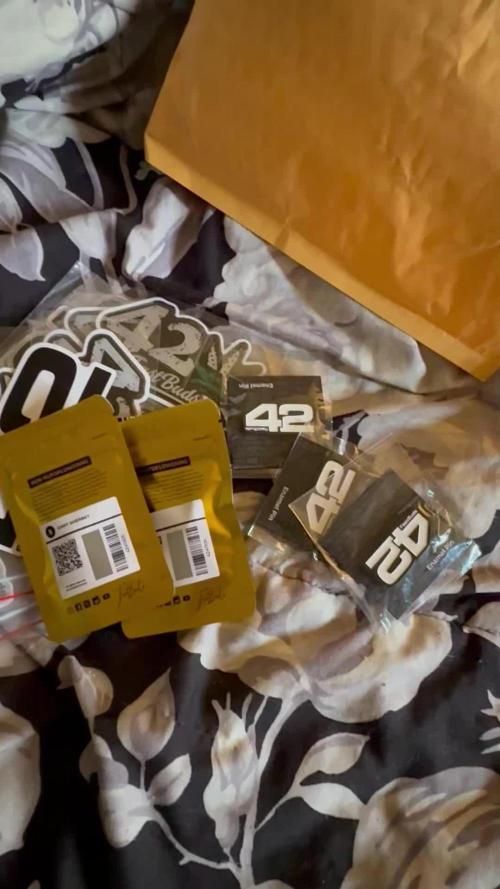
06-27-26. Popped her into a cup of happy frog soil, sprayed with water, then sprayed inside a sandwich baggie and covered the cup. Didn’t put seed deep enough and got a bit of helmet head, but she popped it mostly off. I knocked it the rest of the way.
I’m using happy frog for the seed starting, but will use Coast of Maine for transplanting. Will be first time using it. I put some information down there should you care to read it. 👇. Noted for advanced growers LOL. Well.. rip. ? 🤭
Garlic Mint Sherbet is a photoperiod line built from a Garlic Cookies (GMO) clone crossed with our selected Sherbanger phenotype (Boston Roots Seed Co). The goal behind this project was to combine the raw intensity and resin production of GMO with the layered Sherbet-based terpene profile of Sherbanger.
The terpene profile is complex and evolving. At first, it leans toward a soft Sherbet sweetness, but as it develops, it opens into something much deeper: fresh garlic notes combined with a spicy, refreshing minty edge. It’s a profile that keeps changing the more you smell and work with it, moving from creamy to sharp, from sweet to pungent and cooling.
Structurally, plants produce large flowers with heavy trichome coverage, making this one of the highest resin-producing lines in our catalog. It performs especially well for extraction, with strong returns across different methods, and stands out as a reliable washer.Plants tend to develop dark coloration, ranging from deep green to almost black and purple tones, especially under proper conditions.
From a cultivation standpoint, this line shows medium sensitivity to environmental stress, particularly water temperature during processing and overall grow conditions. When dialed in correctly, it delivers both in yield and resin quality.The effect is powerful and body-heavy, leaning toward a strong couch-lock. Best suited for evening use, relaxation, or before sleep.
Please Note: this strain requieres experience, we recomend it only for Advanced Growers
Likes
5
Share


@Chubbs
Follow
Weekly update on these ladies. 2 of the 5 are doing amazing, super bushy and healthy as all get out. The other 3 are good but 2 aren't as bushy and the 1 that's in the Cannpot isn't liking the heat at all. But over all they're all showing growth weekly and progressing nicely. Over all they're doing good in this 100'f heat not skipping a beat.
Happy Growing.
Likes
33
Share


@Ksouth1
Follow
Last week went well once the distance was changed for the light and I added another mL per gallon of cal-mag and she is getting color back to some of the damaged leaves. I think she is back on the right track. She has needed more cal-mag than anything I have grown. Can't wait to try it out when finished. The smell is unreal. Reminds me of a super sour smelling candy like sour patch kids. She is stacking up bud nicely so far. Just smooth sailing for the next few weeks I expect. Until next time happy growing to everyone!
Likes
13
Share


@Robeeriegenetics
Follow
Second week of flowering in the bag, and they’re all looking really healthy, even healthier than when I first threw them in the flower steady as she goes
Likes
51
Share


@Seldom_Seen
Follow
Day 1: I got two of these Sweet Gelato seeds free from @Zamnesia. I’m only planting one at the moment . I’m really excited about growing it. I’ve really loved any Gelato I have tasted. I have my substrate prepared and my veg space is ready to go. I have put the seed in Ph’d water for 24hrs first and I will add to the soil tomorrow night. I’ll wet the soil down tomorrow morning with Ph’d water and I’ll put it the veg space with the lights on to warm up the soil before adding the seed.
Day 2: Seed has been moved into the substrate and pot is now in Veg Space under 40watt CFL bulbs but once the seed germinates I will switch on the 200watt CFL. This is my least favourite part of growing, the wait for the seedlings 🌱 to break through the soil. I’ve planted the seed to one side of the pot as I find this makes LST easier. The plant will be spending it’s first 2 to 3 weeks in this veg space while I wait for my Purple Punch to finish in my main grow space.
72hrs Later: Houston we have lift off 🚀
The seed first started to peed through the soil after only 48hrs. That’s the fasted I’ve ever seen, hopefully it’s a sign of things to come. Leaves still haven’t opened but it’s fully above ground now.

Likes
62
Share


@SimpleGrow
Follow
Hey guys and welcome to start of Week 8! 🌻
Today is day 21 of flower so i went ahead and cut most of the plats Fanleaves off. It took a while but now the Airmovement is improved and the humidity should also be lower. I also hope I didn‘t stress them too much. From now on they will be reseaving less and less Nitrogen going forward. I hope the colours come through as well 🤞🏻
Thanks for following along and I will keep updating the progress. Happy growing 🍀

Likes
24
Share


@PrairieFrostGrow
Follow
Week 7 Veg - January 16/21 to 22/21 *****
Week 7 will be their last week being able to take them out of the tent😟 SCROG netting going in on the weekend ahead. Not really a lot to report this week as the girls are doing well and I am just wanting their side branches to grow longer to help filling in the canopy anyway. Performed more LST this week and bending over the branches daily. Didn’t do any HST this week, will once the net is in and I have a better visual of how the branches need to bend.
They have come a long ways over the last 2 weeks when you look back at pictures. They have filled out with more side branching and other than battling a little purple striping on the main stems they seem pretty happy. Leaf colour is good and should be in good shape for the flip soon. Will go through all of week 8 before flipping so hopefully week 9 will be transition week and week 10 the start of flower.......have to get through next week first though😀👍
Switching over to tap water again. I have been struggling with calcium and magnesium deficiencies on all grows for the last year. I can’t seem to get the right amount added back to the RO water I use in all feedings. So running with straight water again now. Ppm coming out is 325 so I will work with that. Going to explore my own RO system in the house rather than bottled water, a system that adds back calcium, magnesium, and iron. It’s been flowing okay for the first week and will continue on for now. Using RO water I have been feeding full strength on the nutrients and have been working on backing them down a bit to compensate for the starting point of 325 now.
They have continued to be fed once a week roughly and supplemented with calmag and microbes.
Little more detail.......
Jan 16/21, Day 43 Veg
- 3L each of full line at full strength in RO water
- 1150ppm and 5.8pH given to the girls
- didn’t add any other nutes other than IPP line.
Jan 17/21, Day 44 Veg
- dry out day
- pulled down all the girls again tonight to train them outwards.
-
Jan 18/21, Day 45 Veg
- 3L for each girl today with tap water and CalMag @ 1ml, Microbes @ 2ml, Nature’s Candy @ 1.5ml
- 700ppm and 5.7pH is what that works out to.
- have to use a considerable amount of pH down to adjust the tap water, over 6ml in 16L
Jan 19/21, Day 46 Veg
- measured the girls today, GSCHB Is 12” tall. They were topped already😀
- dry out day for the girls.
- pulled two large fan leaves from her. They were just getting the way too much of lower branches light.
Jan 20/21, Day 47 Veg
- 2.5L each with plain tap water
- 295ppm and 5.8pH.
- all the girls are looking big and bushy today.......they are ready for flip soon.
Jan 21/21, Day 48 Veg
- dry out day for the girls.
Jan 22/21, Day 49 Veg
- pulled all the girls down again......repeating the same LST each day manually rather than tying down for now.
- this should be water day but leaving for today as I am going to lolipop the lower branches and a heavier leaf stripping tomorrow.
- will feed tomorrow as they will benefit more.
Very solid week ETS......the girls are taking off and expect to see lots of leaves popping out over the next couple of weeks😀👍
Work on the side branching to come up higher closer to the tops next week.......continue tap water and give a feed with Epsom Salts new week