


Likes
Comments
Share





Likes
1
Share

@Naujas
Follow
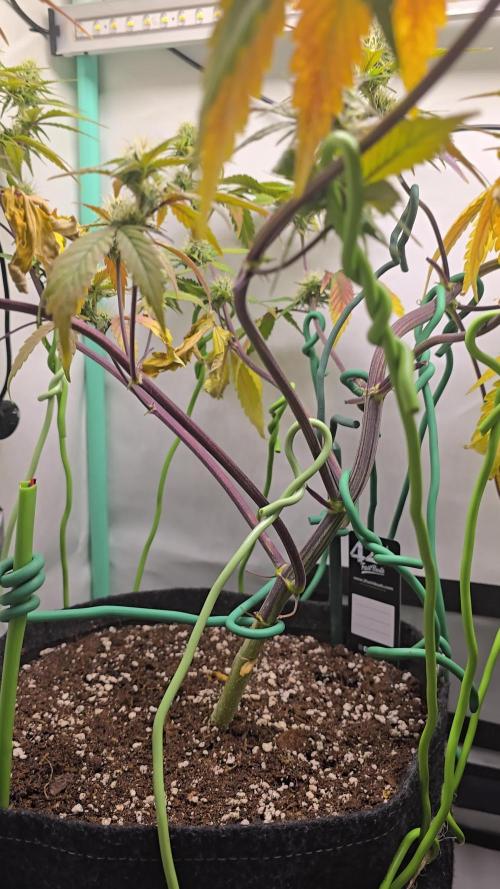
42 diena...... ir mergytei labai blogai, net nežinau, kas jai darosi, duodu jai vandens 6,3 pH oro temperatūra 27° drėgmė 55%. tai mano kaltė, nežinau, kaip auginti su tokiu dirvožemiu, teko į jį įberti perlito, ko nedariau :( tik iš viršaus matosi perlitas, giliau jo nėra :( ...... be to, dirvožemis labai maistingas, ir dar įbėriau papildomų maistinių medžiagų, tikriausiai jų padauginau......... vienu žodžiu, prastas augimas..

Likes
9
Share


@Canadian
Follow
Day 71 from seed the plant seems to be growing beautifully and now they are starting to develop beautiful flowers and they are entirely covered with white snow trichomes it is a very strong and powerful plant to grow what a beauty . I also I defoliate some of the lower branches that will not going to develop well enough because lack of light so they can use that energy on the upper buds instead of the lower ones.
thank you for reading I will continue to update have a happy grow.


Likes
8
Share


@Hempface86
Follow
Alright, guys, today is officially day 7. Which wraps up the first week of this little girl's life.. So far, she's off to a great start. I actually just before making his diary gave them they're very first feeding of just maxi bloom, but very little, maybe .05 of a tsp per gallon.. I think i'm gonna let this girl grow naturally like i did my cream and cheese.. Thank you to Kannabia Seeds for making this grow possible.. I hope everyone is doing well and so are there ladies , God bless and happy growing ✌️

Likes
12
Share


@PedroAndHisPlants
Follow
Day 43 (Second Grow, Flowering Phase):
Hey everyone!
We’re well into day 43 of our second grow and deep into the flowering phase. 🌸 The transition has been amazing to witness, with our plants showing significant bud development. The plants are producing beautiful, dense buds, and it’s incredible to see the daily changes and the rapid development.
We’ve been maintaining the humidity between 50-60%, but we’re keeping a close eye on it to prevent any issues. We’re considering whether to get a dehumidifier to bring it down to the ideal 40-50%. The SCROG net continues to work wonders, ensuring even light distribution and supporting the heavy buds. Our Timor shield mantis is still patrolling the garden, keeping pests at bay naturally. She’s become quite the guardian!
The plants are looking healthy and vibrant. We're excited to see how they continue to develop over the coming weeks. Any tips or advice for optimizing this stage? Let us know in the comments!
Likes
28
Share


@Tremojem
Follow
June 20, 2022
Watered with 3 gallons RO water with no nutrients or supplements.
This may be the last watering. I checked each cola for amber and cloudy trichomes. There are about 5% of thr trichomes that are amber. There are about 50% that are cloudy. She is getting close.
Watering Numbers
In
PH 6.65
TDS 37.1
EX 52.5
Out
PH 6.78
TDS 351
EX 496
June 22, 2022
Watered with 3 gallons RO water with no nutrients or supplements.
She is close.
Watering Numbers
In
PH 6.54
TDS 70.1
EX 98.8
Out
PH 6.69
TDS 328
EX 463
June 24, 2022
Watered with 7 gallons RO water with no nutrients or supplements.
This completes the flush, as the runoff numbers are great.
She will get her 12 hours of sun today and then immediately followed by darkness for 36 hours, then hang whole.
Still reading up on finishing techniques so I have time to decide whether or not 36 hours of darkness are beneficial.
Watering Numbers
In
PH 6.57
TDS 54.8
EX 77.2
Out
PH 6.94
TDS 108
EX 152.7
Likes
Comments
Share


@Piro420
Follow
Just flipped, looking happy. Ph slightly rising, ec static planta looking happy. Accidentally had tent canopee fans off for 3 days i don't think it will be a problem.

Likes
14
Share


@AntiWar
Follow
70 день, следим за трихомами... всё на фото
72 день, последний раз кормлю Ripen
77день, несколько янтарных трихом, скоро срежу их)))
Likes
6
Share


@Averynate
Follow
As we mark the culmination of week 4, we stand on the brink of a significant transition for our plants. This period, characterized by attentive care and meticulous cultivation, has seen our plants flourish in their vegetative stage. They have developed robust root systems and lush green foliage, which are evidence of their vitality and resilience. But in the world of plant growth, time is always of the essence. It is imperative to recognize when to shift gears and usher in the next phase. With that realization, we are poised to send these plants into their flowering stage in just a few days.
The preparations for this pivotal moment have been both detailed and extensive. Understanding the significance of this transition, we have preemptively amended the soil. Soil amendment is a cornerstone of ensuring that our plants have access to all the essential nutrients they require during the flowering stage. This period demands a different nutrient profile, with an emphasis on phosphorus and potassium, which are vital for bud development and overall flower health. Our amendments ensure that the plants won't be lacking in any crucial elements, thus setting the stage for optimal flower production.
Beyond the soil, the atmosphere in which our plants reside is equally critical. It plays a central role in determining how efficiently the plants can carry out their metabolic processes, particularly photosynthesis. Therefore, we've made the necessary adjustments to create an environment primed for 'blastoff'. By meticulously controlling factors such as temperature, humidity, and light duration, we've fostered a setting that is conducive to the onset and thriving of the flowering stage. In essence, every decision made has been in pursuit of one objective: to offer these plants the best possible conditions to blossom into their full potential. As we look forward to the weeks ahead, we anticipate a rewarding flowering phase, a testament to our diligence and the intrinsic vigor of the plants themselves.

Likes
4
Share


@GrowDutch
Follow
The smell is really intensive and Skunky now which gives back memories from high-school, apart from the Canna nutrients she receives some Tea's which is provided on interval.
Likes
4
Share


@GodZilla_Owner
Follow
Week 8 – Day 59
Flower Day 29
🔄 Looking back:
Still watering with mixed osmosis/tap water, but the drain pH remains stubbornly low, between 5.6 and 5.8 📉
🔧 I’ve decided to go back to using BioBizz pH+, which helped me correct the drain pH effectively in my last grow.
The Canna pH+ just doesn’t seem to work well in combination with Advanced Nutrients 🤔
🌿 Plant status – Mimosa Evo
📏 Height: 104 cm – stretch seems to be over, finally! 😅
💡 She’s under the same light setup as White Widow, currently running at ~950 PPFD
✅ No issues with light stress – she’s handling it very well
⚗️ Feeding at 100% of the Advanced Nutrients Masterline schedule, still no signs of deficiencies or burn
📌 Conclusion:
All plants look great – including Mimosa Evo – despite the consistently low drain pH.
→ There’s no visible damage, but I’d still prefer to raise it slightly over time.
BioBizz pH+ is on the way.


Processing
Likes
24
Share


@GrimbolTheDruid
Follow
*If anyone read through my GDP diary, this is going to be mostly the same stuff.
So, sad day friends. I got spider mites and had to throw all my plants out. This is what I think happened:
About 2-3 weeks ago I noticed some freckling on the lower leaves. I looked at it and thought it might be a cal/mag issue so I added cal/mag that week and went about my business. I saw it about a week later and it wasn't getting any better so I added more cal/mag. This continued for about 2-3 weeks until I finally took off a leaf and examined it under my microscope. I saw little bugs crawling everywhere and my stomach just dropped. My fiance did some quick research while I was panic ripping leaves off (see pictures) and she correctly diagnosed it as spider mites.
I debated with myself and my close friend and ultimately I decided to throw all the plants in my tent away. I know that there are a lot of people who will say that there are things I could have done to make it to harvest but what it came down to is the people I take care of and personal pride. I consider myself a caregiver and I give away product for free that I am not going to use to my family and close friends. I thought to myself "Would you smoke this?" and when my answer was "ehhh, I don't know", I thought about how it would feel giving it away and immediately made the decision to destroy them. I take an immense amount of pride in my product and this hobby and if I am not going to stand behind it I would rather just start over. I grow from my heart (shout out to the Grow From Your Heart Podcast!) to help people and make sure my family is not getting unsafe product from sketchy people. To spray pesticides in flower that may hurt people and have little bug carcasses in there just goes against that in every way and is just wrong in my opinion if you are giving it away to others. If you are the only one smoking it then it is one thing to take that risk but not with your patients. I want my medicine to help people, not create or exacerbate health issues.
It is also important to note that the mites had moved from my flower tent into my veg space and took over my auto berry as well. Damn things are crafty and fast.
So that is why I made the decision to destroy them all after 3+ months of res changes, pruning, and manifolding on a slow vegging strain. Feel free to chime in with your opinion but I do not regret my decision. I threw out my new clones, mother plant, and auto berry I had on my veg side as well. Shout out to all the other growers out there that do the right thing by their patients. Caregivers > Cash croppers.
For anyone curious, I removed everything from my tent and scrubbed it all with a 20% bleach/water solution. All equipment has been wiped down and stored in the garage away from any organic materials. I will give them until tomorrow (2 days) to air out and dry and then I will wipe it down again with bleach and wait another 2 days. Hopefully that will make sure everything is dead and will not come back next grow. That next grow should start in about a week.
It sucks but sometimes it happens and you gotta be ready for it. Lesson learned. Never bring outdoor plants into your indoor garden even if it is after just a day or two. A bunch of people on here and Reddit warned me and I did not listen. Now I have learned the hard way and it feels like when your parents "told you so" haha.
Thanks to everyone who stopped by along the way. Stay tuned for a new grow coming soon. It is going to be some cool new limited edition Mephisto Illuminautos. I am pretty excited.
Good luck out there and always grow from your heart folks.
-Grim


Likes
Comments
Share


@ORION1_1
Follow
Still lookin happy, water only around 6.5 ph. I will start some LST next week 👍🏼 I will also give a 1/4 dose of advanced nutrients sensi cal mag next week because that's one issue I've ran into, usually nearing flower and I feel weekly small doses helps negate any issues. LED lights seem to increase the need for cal mag at least in my environment. The auxiliary shoots off the main are interesting! It's definitely going to be more of a bushy structure and fun to LST! ✌️🏼 ♥️


Processing
Likes
35
Share


@FirstTimeGrower
Follow
Hi everyone! THIs is my first grow and any tips and constructive criticism are encouraged. Right now they’re in a five gallon bucket with a 60watt cfl light in the top wth the lid closed. BLacked out walls from outside stops the light from being exposed and keps it inside. I plan on ordering a grow tent very vey soon(2x2x3) with a 1000w led grow light.
Likes
24
Share


@Brothersfromweed420
Follow
Bueno que decir de esta maravillosa genética.
Que es una planta muy productiva, tiene un olor muy fuerte entre dulce y terroso, con sólo el aroma se te hace la boca agua la volveré a probar sin duda me apetece un cultivo entero de esta maravilla de genética


Likes
6
Share


@MadeInGermany
Follow
Flowering day 22
since time change
to 12/12 h.
Hey guys :-)
Another great week that is over.
They all develop exactly as it should be 💚.
Since the last leaf and substrate application against tripse, I finally haven't seen any of the little biters 👍.
Watering was done twice this week with 1.3 l each time (see table above for nutrients).
The lowest shoots were removed so that the energy is not wasted in the lower part :-) .
Otherwise, as always, everything was cleaned and checked.
Fresh osmosis water was filled with stale tap water in a 100 L tank for the coming week 👍.
Have fun and stay healthy 💚🙏🏻
👇🏼👇🏼👇🏼👇🏼👇🏼👇🏼👇🏼👇🏼👇🏼👇🏼👇🏼👇🏼
You can buy this Nutrients at :
https://greenbuzzliquids.com/en/shop/
With the discount code: Made_in_Germany you get a discount of 15% on all products from an order value of 100 euros.
👇🏼👇🏼👇🏼👇🏼👇🏼👇🏼👇🏼👇🏼👇🏼👇🏼👇🏼👇🏼
You can buy this strain at :
Clearwater Seeds
Water 💧 💧💧
Osmosis water mixed with normal water (24 hours stale that the chlorine evaporates) to 0.2 EC. Add Cal / Mag to 0.4 Ec Ph with Organic Ph - to 5.8 - 6.5
MadeInGermany
