


Likes
Comments
Share


@greenthumb86
Follow
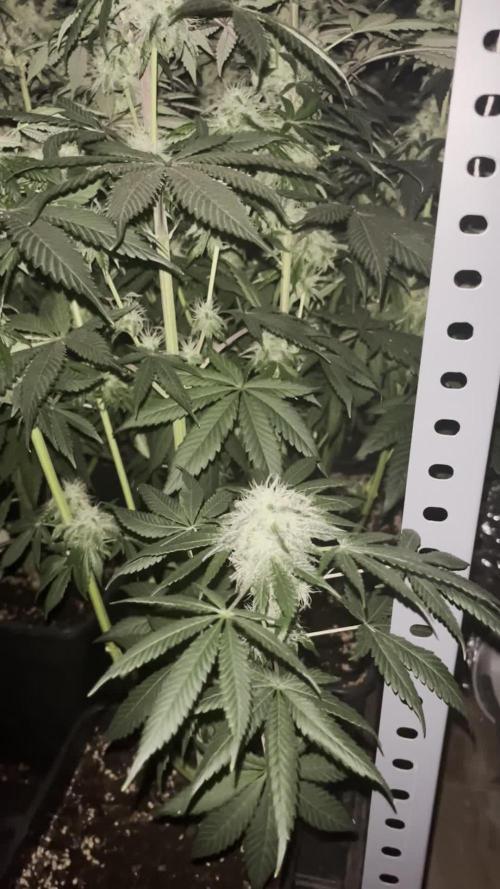
day one of flush for most of these girls 😁 : update the only one not in flush is the afghan mass


Likes
10
Share

@Ribemarti
Follow
HAY 5 EJEMPLARES QUE SON LO QUE ERAN DEL SCROG QUE ESTAN MUCHO MAS ADELANTADAS QUE LAS PLANTAS QUE NO PODAMOS EL CENTRAL,
EN 10 DIAS HAN CAMBIADO MUCHO COGOLLOS MUY GORDOS Y CARGADISIMAS LAS PLANTAS PRONTO EMPEZAREMOS A COSECHAR YA
EC 1800 PH 6,7 LAS 5 QUE ESTAN MAS ADELANTADAS YA TIENEN ECHO EL LAVADO DE RAIZES Y ESTAN REGANDOSE COM AGUA EC 500

Processing
Likes
3
Share


@Ogbangbang2981
Follow
this week I was a lil happy because I pollinate my C4matic with a Male pink kush the feminizing spray tiresias mist didn't work the way I thought it would. thank God I had a Male coming up in my outdoor garden...I can already see seeds a little more than I expected, for some reason I only wanted to pollinate 1 bud but got seeds on the main and a few lower buds still happy for that will update images .


Likes
37
Share


@Roberts
Follow
Mandarin XL auto is doing good. I had to give tge solution a nutrition boost early week. It just was not strong enough for her. She is doing good. She is ready for a solution change very soon. I was hoping she would start transitioning first to go to blooming nutrition. Everything is looking good beside that nutrition problem. Thank you Medic Grow, Gen1:11, and Ganja Farmer. 🤜🏻🤛🏻🌱🌱🌱
Thank you grow diaries community for the 👇likes👇, follows, comments, and subscriptions on my YouTube channel👇. ❄️🌱🍻
Happy Growing 🌱🌱🌱
https://youtube.com/channel/UCAhN7yRzWLpcaRHhMIQ7X4g

Likes
7
Share


@Totistefanini
Follow
Se rocío con top one y se limpió toda la.parte de abajo de la red. También se sacaron esquejes de la parte baja.

Likes
3
Share


@KushManAdam420
Follow
Phone was out of action , will try and fill up the missing weeks , 3 plants have been harvested
All photos taken day 76

Likes
42
Share


@TerpTurtle
Follow
12 day dry @ 58-63RH & 60-66F in blacked out dry tent | Glass Jar Cure
LOUD N STANKY, opening a jar gives you the duck face funk face
Early taste test & this Bud KOs leaving you in major terp sweats! Hitting like a Sumo wrestler sitting on you tickling all over! Flower hits with overwhelming squeeze & flavor like drinking a smoothie!
Breaks down chunky, greasy & has a vivivd dark purple color.


Likes
4
Share


@knnabisgrower
Follow
En la 4ta semana aumentamos la dosis del fertilizante para crecimiento, regulamos su p.h en 6.0 e hicimos una poda apical en el 4to nodo de cada una de las plantas.

Likes
13
Share


@CalimannpackZ
Follow
Sorry I didn’t upload week 5 Ngl it was a bad week i suffocated 4 plants I had to defoliate some leaves because of nutrient defeincies making the plant look diseased I managed to pull through there back healthier again I got a few yellow spots but there goint but other then them 4 there’s some nice bud and bud spots really starting to come through excuse the 4 shittier looking plants and the defoliated skimpy one! Other then those problems that I have resolved I’m happy again last week not so this week happy!!! It’s all trial and error first go I haven’t trained any plants I will do on my next grow definitely!
Likes
12
Share


@Archieballs
Follow
Auto Ultimate is an absolute BEAST!!! She’s taller than the another two by far!!! They are all flowering really well and seem to be hitting it out of the park!!! This grow is by far better then our first grow!! The plants are bigger the bud structure is looking amazing everything seems really to be on point!!! We have defoliated far more this grow and it seems to really be beneficial!!! The only thing I would have done differently is I would have LST’d sooner as these stems got super thick super fast so there was only so much bending we could do without breaking them. Had we done no LST these girls would be at the top of the tent by now especially Ultimate!!!
Likes
61
Share

@Roberts
Follow
Sweet Bourbon Kush Auto is growing really good. I did some more lst, and defoliated the top side. I have been feeding her every other day, and keeping her wet between feeds. She is looking really good. Thank you Super Sativa Seed Club. 🤜🏻🤛🏻🌱🌱🌱
Thank you grow diaries community for the 👇likes👇, follows, comments, and subscriptions on my YouTube channel👇. ❄️🌱🍻
Happy Growing 🌱🌱🌱
https://youtube.com/channel/UCAhN7yRzWLpcaRHhMIQ7X4g

Likes
15
Share


@I_Identify_As_A_Dan
Follow
Week 4 for Peyote Zkittlez by Seedsman,
Really starting to pull her own in the tent, She bounced back from the topping really nicely, Will be topping her again sometime next week im sure. Loving her symmetry across the board 😇 Still not drinking that much water only getting fed maybe 2 times a week in her 5L pot. When i have a 25L pot available i will be transplanting her. But also waiting for her roots to grow a bit to show me shes ready to switch homes.

Likes
6
Share


@MadeInGermany
Follow
Flowering day 49
since time change
to 12 / 12 h
Hey guys :-)
All ladies look very healthy and delicious :-)
We're slowly getting closer to the end.
Watering was done twice this week, each time with 1.2 l (sewing materials see table above)
At the next watering there is a very light rinse with Clean Fruits so that the last nutrients can be slowly used up.
The trichomes are now checked every day.
I'm looking for my microscope with an app so I can take pictures of it 👍.
I wish you a lot of fun with the update and stay healthy 💚🙏🏻
👇🏼👇🏼👇🏼👇🏼👇🏼👇🏼👇🏼👇🏼👇🏼👇🏼👇🏼👇🏼
You can buy this Nutrients at :
https://greenbuzzliquids.com/en/shop/
With the discount code: Made_in_Germany you get a discount of 15% on all products from an order value of 100 euros.
👇🏼👇🏼👇🏼👇🏼👇🏼👇🏼👇🏼👇🏼👇🏼👇🏼👇🏼👇🏼
You can buy this strain at :
Clearwater Seeds
Water 💧 💧💧
Osmosis water mixed with normal water (24 hours stale that the chlorine evaporates) to 0.2 EC. Add Cal / Mag to 0.4 Ec Ph with Organic Ph - to 5.8 - 6.5
MadeInGermany


Likes
12
Share


@CannaDiaries420
Follow
Week 7
Mars Hydro TS1000 has arrived.
plants starting up te flowering stage.
did some light defoliation.

Likes
3
Share


@Kinghaze
Follow
I will put up the trellis this week and defoliate them
All the plants are looking good
The black cherry gushers is stretching a lot.
Hope it will not go crazy in the stretching periode.
Likes
15
Share


@RDWCGrowing
Follow
4/6/2024 - Vegetation Week 8 Day 1- Last week in VEG, They are all looking amazing and no worry about stretch when I flip Next Saturday they are indica and I have more than 50% of distance from the top of the plant to the lights with a little more I can raise the lights if necessary. So going to really just enjoy this last week of VEG, and get my Cloning equipment ready. I will be taking 2 cuts for each this is also a PHENO hunt for HWG and he not only has the prize for the winner but he also has an additional bounty on a cut of the winner. I did have to take some from around the edges to keep them from touching.
4/7/2024 - Vegetation Week 8 Day 2- Didn't do anything today but watch them grow.. They will be getting a really good flip trim and clean up for clone material on Friday/ Saturday.
4/8/2024 - Vegetation Week 8 Day 3- Couldn't even get a picture of the #1 at first too much Foliage throughout.. So I had to clean that up and make sure they all still have some separation before flip.
4/9/2024 - Vegetation Week 8 Day 4- Huston we almost had an issue.. I looked at my Res and she was in desperate need of 10 gallons to get her through until next water change on Saturday. So I added 10 gallons and the Nutes.
I added 10 Gallons of Water
I added the following Nutes:
CalMag= 1.00Mil/Gal= 10Mil
FloraMicro = 5.4Mil/Gal= 54Mil
FloraGro= 4.2Mil/Gal= 42Mil
FLoraBloom= 4.6Mil/Gal= 46Mil
4/10/2024 - Vegetation Week 8 Day 5- Had to giver them a huge clean up today I couldn't even see the numbers in the first pic. I am also worried that #1 and #3 really, really are getting huge over the last few days.. starting to think I should have flipped them this past Saturday.. The interesting things is even though this is an Indica Strain, I might have to super crop just to keep them off the lights.
The joys and sorrows of RDWC and timing.
4/11/2024 - Vegetation Week 8 Day 6- Even though Flipping in Two days almost wish I would have gone at Week 7. I am really worried about #3, #1 and #2 are huge and when I put them in flower they are going to stretch out
4/12/2024 - Vegetation Week 8 Day 7- Day of Work.. Lots of Work.. I gave all three a Cloning/Flower cleaning.. all three got cleaned up top Inside and bottom, I took 2 cuts of each to see which one come out on top then I will kill off the other cuts once I have a winner in flower. I clean up this thoroughly before I flip because it reduces the work load on the next major clean up I do on Week 4 of Flower.and they are so much taller that it is going to be a pain in the ass to maintain canopy space for #3, we will see how it goes and adjust as necessary..