


Processing
Likes
Comments
Share


@420portois
Follow
J ai augmenté un peut les nutriments j ai des problèmes de surengraisage. Mais sava je gère


Likes
77
Share


@Ukfarmer420
Follow
Hi guys, so I chopped the little gelatocake 3 days ago and its hanging in 55% humidity and 15°f, I have taken a sample bud, you no how it is lol.
Sherbert mimosa are struggling along and going purple 💜 bit cold here lately, starting to fatten up a bit now, the baby photos are growing fast but need repoting.
Happy growing guys 💜💚💪


Likes
11
Share


@KcKoolaidMan
Follow
Getting close. Started to flush, still prob 10 days or so out but getting close. Been a long road def the longest growing strain I’ve ever messed with but they buds look like they’ll be worth it! I’ll post again here in the next week or so when we harvest. Thanks and as always 🍻

Likes
10
Share


@StonedFarm
Follow
09/28/24 - Purple Punch 👊 & Green Crack 💚
Both these girls will have the ☀️ today, and tomorrow will get a feeding with the
09/29/24 - Purple Punch 👊 - Green Crack 💚
Both these girls got the dunk, and runoffs are perfect. 1000-1100 PPM runoffs, with 6.4 Green Crack, and 6.5 Purple Punch

Likes
11
Share


@Original_Growers
Follow
Day 1.
The cuttings after being rooted in the special tray were transplanted into small jars and allowed to acclimatize in the appropriate boxes. After a few days we transplanted them into 18 L pots filled with plagron growmix, a prefertilized substrate, and then they were placed inside our cultivation box, the one in the photos. Being a prefertilized substrate we watered with only water with a pH of 6.5 until the water ran out into the saucers. As the 18 L pots are very large, no more water was needed for the first 5 days.
DAY4.
The plants were topped.


Likes
71
Share

@GERGrowDesigns
Follow
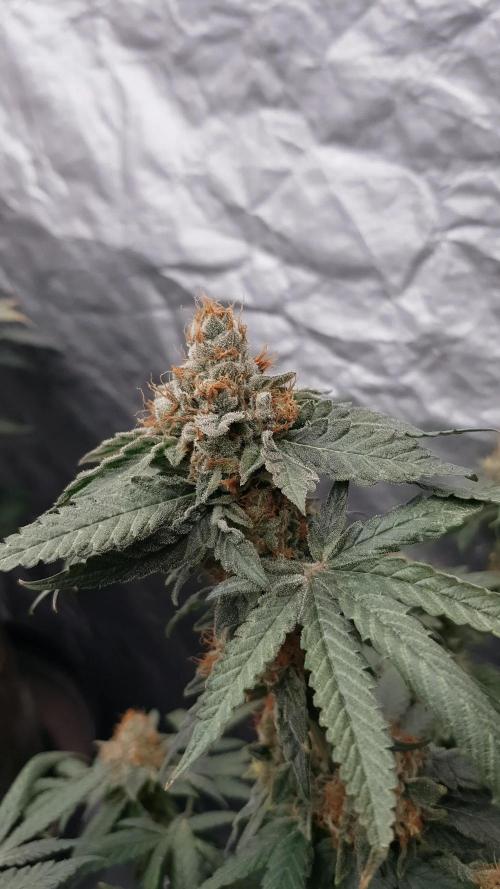
Special Project from Germany and Welcome to Harvest Week of GoodTimesGenetix Blue Cream Haze


Likes
11
Share


@Buddyhighs
Follow
So another week down and we started the scrog. As we draw closer to sexual maturity we are preparing to flip to flower.
More compost tea and knf this week really trying to bring this soil to life. The health of this plant is showing me the efforts are not in vain. How ever I have had to cut some yellowing leafs from the bottom. Maybe a calcium this so I’ve added wsc (water soluble calcium) to the pantry of nutes.
With the left over plant matter from making the fpj I added to water with a vinegar mother and she turned it into vinegar for me. I then added blended and roasted eggshells. And that’s given me my wsc.
Anyways back to the plant, this genetic seem really strong. I’m loving vegging this girl. I’m just waiting for the last branch to reach the canopy before I get her ready to flip.
Until next week let’s get it!!! 💪🏽💪🏽💪🏽

Likes
16
Share


@DevelGrow
Follow
Hallo Freunde 👋 Do-Si-Dos F1 Auto ist 42 Tage Alt und steht schön in Blüte! Es hat noch gerade gepasst das Zwei buds Links und Rechts als Kragen wachsen! Bin gespannt was sie noch zulegen wird! Keep Green and grow High ✌️🍀💙🍀


Likes
1
Share


@Urunascar
Follow
Decided to harvest since i found some rotten buds and the plant wasn't gonna get better than that since it was under attack and I rather harvest a week earlier than losing a lot of my crop (last year I tossed it all because of powdery mildew)


Likes
65
Share


@Dendegrow
Follow
Week 2 of the flowering phase flew by 🌱💨. Unfortunately, I may have overdone it with potassium or kept the water level too high – the classic signs of clawing leaves were evident. Thankfully, they seem to be recovering now and are back under control 💪🍃.
My IR night experiment is showing clear results 🌌: The plants exposed to infrared radiation at night stretched significantly more. This might be especially beneficial for this indica-dominant strain as it leads to better canopy distribution, improved airflow, and reduced risks of mold and disease. Plus, the light distribution is much more efficient now, which I’m excited to see pay off.
On the downside, my Orange Sherbert turned hermaphroditic 😔. It’s hard to pinpoint the cause – overfertilization seems unlikely since I’m using only organic nutrients. I suspect it might be linked to an E-field experiment I’ve been running. To confirm this theory, I’ll conduct a new grow with a similar strain next year to see if the electric field negatively impacts cannabis development.
Stay tuned for updates! Drop a like and follow along for more grow insights 🌿✨. See you next week!
Woche 2 der Blütephase ist wie im Flug vergangen 🌱💨. Leider habe ich wohl etwas zu viel Kalium gegeben oder den Wasserstand zu hoch gehalten – die typischen Anzeichen von Adlerkrallen waren sichtbar. Zum Glück scheinen sich diese jetzt zurückzubilden und sind wieder unter Kontrolle 💪🍃.
Mein IR-Nachtexperiment zeigt bereits deutliche Ergebnisse 🌌: Die Pflanzen, die nachts mit Infrarotstrahlung bestrahlt wurden, haben deutlich stärker gestretcht. Das ist besonders bei dieser indica-dominanten Sorte wahrscheinlich von Vorteil, da es zu einer besseren Verteilung des Blätterdachs führt. Dadurch verbessert sich die Luftzirkulation, das Risiko von Schimmel und Krankheiten wird minimiert, und die Lichtverteilung wird effizienter. Ich bin gespannt, wie sich das weiter auswirkt!
Leider hat meine Orange Sherbert gezwittert 😔. Woran das genau liegt, kann ich schwer sagen. Eine Überdüngung halte ich für unwahrscheinlich, da ich nur biologischen Dünger verwendet habe. Ich vermute, dass mein E-Feld-Experiment eine Rolle spielt. Um das zu bestätigen, werde ich nächstes Jahr einen neuen Durchlauf mit einer ähnlichen Sorte machen und prüfen, ob das elektrische Feld tatsächlich eine ungünstige Rückentwicklung der Pflanze verursacht.
Bleibt dran, lasst ein Like da und folgt mir für weitere Updates 🌿✨. Bis nächste Woche!
Likes
30
Share


@TightNugs
Follow
Some good progress this week,plant 1 now starting to stack,plant two now showing proper pistils.
Never had a plant flower so quick as plant 1,only around 15 days since first signs, owing to the new Voost VST 240 https://voost.com/ top L.E.D at unbeatable prices for such high spec,trust me😉 😎
Happy growing Nugz 🤞🏴🍁
🍁🍁🍁🍁
Breeder-White label purple bud
🍁🍁🍁🍁
Light-Voost VST 240 https://voost.com/ (code TightNugs 7.5% off orders over £200 excludes any sales.
Likes
25
Share


@The_Lonely_Farmer
Follow
So these girls are now under their fc3000 and plodding along without issues allthough I have done absolutely no training at all with these girls they are doing just fine. Now entering week 8
I'll be putting them into a more spacious space over this coming week and take a good look at these girls see if anything needs a tidy up and post some better lower images 💚
Likes
47
Share


@KilgoreTrout
Follow
Going great. Smell has become an issue this week with all the rain storms were receiving. The high humidity has my carbon filter pretty much useless. I’m in California so I’m not worried about legality. That said I live in a townhome so I’m not exactly trying to upset or advertise to my neighbors. Not too much I can do though. Getting excited and also not looking forward to trim. Looks to be about 2-3 weeks out...maybe 4-5 on the Sativa plant...or more.


Likes
4
Share

@DogDoctorOfficial
Follow
🥒 Project Blue Tent – Week 7
Pickle Lemon Haze F1 – Pheno B (Folder 14B)
Hello everyone, and welcome back to another chapter of Project Blue Tent! 💙🌱
If you're discovering this diary for the first time, welcome aboard!
Project Blue Tent follows four individual plants, each documented in its own dedicated diary from seed all the way to harvest. Every plant shares the exact same environment, lighting, irrigation, nutrition and training strategy, allowing us to observe how each phenotype develops its own personality while keeping the growing conditions as consistent as possible.
Today we're checking in with Pickle Lemon Haze F1 – Plant B.
And this week marks another important milestone.
The canopy is full.
The structure is ready.
And we're preparing these beautiful ladies for their transition into flowering.
────────────────────────
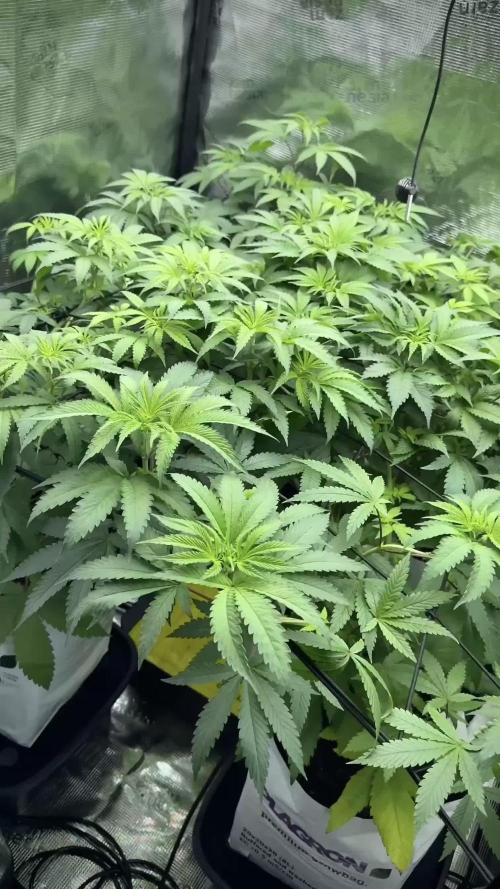
🌱 Week Seven – The Canopy Is Complete
Looking across the Blue Tent this week, it's becoming increasingly difficult to distinguish the four plants from above.
The SCROG has done exactly what we wanted it to do.
Instead of four individual plants growing vertically, we now have one remarkably even canopy spreading across the available space.
Plant B has been particularly well suited to this process.
From the beginning, she's shown a natural tendency to grow outward rather than constantly trying to reach upward. Her compact structure, strong side branching and excellent response to training have allowed her to fill her section of the screen beautifully.
After lowering and tightening the SCROG net, all four plants are now sitting at approximately 60 cm.
At this point we're no longer trying to gain height.
We're managing the surface we've created.
Every branch has found its place.
Every available section of the screen has been used.
And now it's time to prepare that canopy for what comes next.
────────────────────────
🕸️ SCROG – From Training to Flowering
For anyone joining this diary without having followed the previous weeks, SCROG stands for Screen of Green.
The purpose of the screen is to guide branches horizontally instead of allowing a few dominant tops to grow significantly taller than everything around them.
As branches reach the screen, they're gently guided into neighbouring openings.
This spreads the future flowering sites across a wider area and creates a much more uniform canopy.
It's not about forcing the plant into an unnatural shape.
It's about taking the growth the plant is already producing and distributing it more efficiently across the available space.
And after several weeks of doing exactly that, the mission has essentially been completed.
The screen is full.
The canopy is even.
Now we move into the cleanup phase.
────────────────────────
✂️ Defoliation – Preparing the Plants for Flower
This week's biggest job is defoliation.
And because this technique is often misunderstood, it's worth explaining what we're actually doing.
Defoliation isn't about stripping a plant of every leaf.
Leaves are essential to the plant. They capture light and support photosynthesis, so removing healthy foliage without a reason isn't the objective.
Instead, we're performing a deliberate canopy cleanup.
After weeks of vigorous vegetative growth and SCROG training, the interior of the plants has become extremely dense.
Leaves overlap.
Branches cross through one another.
Some areas are heavily shaded.
And airflow through the middle of the canopy becomes increasingly important.
So we're selectively removing foliage from areas where the density has become excessive.
We're opening the interior.
Creating more space between branches.
Improving airflow.
Improving visibility.
And creating a cleaner structure for the flowering cycle.
The objective isn't:
"Remove as many leaves as possible."
It's:
"Remove what is no longer helping the structure we're trying to build."
That's a very important difference.
────────────────────────
🌬️ Why Defoliate Before the Flip?
Timing is everything.
A significant defoliation is a form of stress. Even when performed correctly, the plant needs some time to adjust to the loss of foliage and return to its normal growth rhythm.
That's why we're doing this before flowering, rather than waiting until we're already well into the bloom cycle.
Right now the plants are still running an 18/6 vegetative schedule.
They have time to recover.
We can perform the cleanup.
We can watch how they respond.
We can allow fresh growth to resume.
And then we can flip the lights once the plants have settled again.
I don't want to ask the plants to deal with a major cleanup at the same time they're dealing with the physiological transition into flowering.
Instead, we're following a simple sequence:
Build the canopy.
Fill the screen.
Clean the canopy.
Recover.
Flip.
The goal is to enter flowering with healthy plants and a well-organised structure.
────────────────────────
🌿 Pickle Lemon Haze F1 – Plant B
Plant B continues showing exactly the personality we've come to know throughout this project.
She's balanced.
She's compact.
She's incredibly branchy.
And she seems perfectly happy growing sideways.
While Plant A has always shown a little more vertical ambition, Plant B has naturally concentrated her energy into lateral growth and secondary branching.
That has made her particularly enjoyable to work with under the SCROG.
Her stems have continued thickening nicely, her internodal spacing remains compact, and her foliage has developed that rich green colour we've been looking for.
The recovery from topping is now nothing more than a memory.
She's completely moved on from that stage and has spent the last few weeks concentrating on building the framework that will eventually support her flowering sites.
Looking at her now, it's easy to see how much the plant has changed.
She's no longer simply a young vegetative plant.
She's become a properly structured little bush with a full section of the canopy to her name.
And now we're preparing her for the next chapter.
────────────────────────
🥥 Feeding – Staying With What Works
The nutrient recipe remains unchanged this week.
Current feeding:
• Plagron Hydro A — 1.9 ml/L
• Plagron Hydro B — 1.9 ml/L
• Plagron Hydro Roots — 1 ml/L
Current pH:
5.8
Current EC:
1.92 mS/cm
The plants continue showing excellent colour and vigorous growth, so I don't see a reason to change the recipe simply because we're approaching flowering.
Sometimes consistency is the better decision.
We'll see how the plants respond after defoliation, and depending on their recovery and appetite, we may increase the nutrient strength next week.
For now, however, they're telling me exactly what I want to hear.
Healthy colour.
Strong growth.
Good leaf posture.
And no obvious signs that they're asking for anything different.
So...
Nothing changes.
────────────────────────
💧 Drip Irrigation – Keeping the Roots Consistent
The Mars Hydro automatic drip irrigation and drainage system continues to perform beautifully.
Each plant is receiving approximately 1.2 litres of nutrient solution per 24 hours, delivered through the automated drip system.
The slow and consistent irrigation keeps the coco supplied with fresh nutrient solution while the automatic drainage system removes the resulting runoff.
This is particularly valuable in a project like this.
Four plants are sharing the same environment.
The same nutrient recipe.
The same lighting.
The same irrigation schedule.
That consistency helps us keep another major variable under control.
And as the plants become larger, the benefit becomes even more obvious.
The irrigation system simply keeps doing its job every day.
No rushing around with watering cans.
No trying to remember which plant received what.
Just consistent irrigation while I concentrate on observing the plants themselves.
It's one of those systems that doesn't necessarily demand attention when it's working properly.
And honestly...
That's exactly how I like it.
────────────────────────
🌡️ Blue Tent Environment
The environmental conditions have remained very stable as we approach the transition into flowering.
This week's average conditions were:
• 🌡️ Day Temperature: 28°C
• 🌙 Night Temperature: 25°C
• 💧 Relative Humidity: 65%
• 🥥 Substrate Temperature: 24°C
• 💦 Nutrient Solution Temperature: 18°C
• ⚗️ pH: 5.8
• ⚡ EC: 1.92 mS/cm
• 💨 CO₂: approximately 450 ppm
• 💡 Light Schedule: 18/6
• 💧 Irrigation: approximately 1.2 L/plant/24h
• ? Pot Size: 8 L
• 📏 Height: approximately 60 cm
At this stage, stability is more important than constantly changing numbers.
The plants are healthy.
The canopy is full.
The roots are receiving consistent irrigation.
And the current nutrient strength is producing beautiful growth.
So we're staying the course.
────────────────────────
🌿 A Full Canopy Means a Different Kind of Work
One of the interesting things about reaching this stage is that the work changes completely.
Earlier in the grow, the challenge was getting the plants to occupy the space.
Now the challenge is managing everything they've produced.
When the canopy was still developing, every new branch was welcome.
Now we have to start asking different questions.
Does this leaf contribute enough?
Is this area too crowded?
Can air move through here?
Is this branch getting enough light?
Is this part of the plant going to benefit from remaining in the canopy?
That's what good canopy management is really about.
It's not simply growing as much as possible.
It's deciding what growth deserves to remain part of the final structure.
And Plant B has given us plenty to work with.
────────────────────────
Recovery Before Flowering
Once the defoliation is complete, the most important thing we can do is give the plants time.
No unnecessary additional stress.
No rushing.
No immediately piling another major intervention on top of the first one.
The plants need time to rebalance after the cleanup.
We'll watch the new growth.
We'll monitor their posture and overall appearance.
We'll keep the environment stable.
And we'll let them recover.
Once they're settled again, we'll be ready to move forward.
This is why the timing of the defoliation matters so much.
We're not trying to make the plants do everything at once.
We're preparing them step by step.
────────────────────────
👀 Looking Ahead
The next few days should be particularly interesting.
The SCROG has been filled.
The canopy has been cleaned.
The plants now have room to breathe.
And we're approaching the moment we've been working toward for weeks.
The nutrient recipe will remain unchanged for now, although we may increase it once we see how the plants respond after defoliation.
The irrigation continues at approximately 1.2 litres per plant per day.
The environment remains stable.
And most importantly...
We're not rushing the flip.
We'll allow the plants to recover properly first.
Then, when they're ready...
We flower.
🌸
────────────────────────
💙 Thank You
A huge thank you to Zamnesia for making Project Blue Tent possible and for providing these outstanding Pickle Lemon Haze F1 genetics.
A heartfelt thank you to Plagron for the Premium Growbags and Hydro nutrient line that continue supporting this beautiful growth.
A special thank you to Phytonaut for the LED lighting helping us maintain such a consistent and beautifully structured canopy throughout the Blue Tent.
And a massive thank you to Mars Hydro for the automatic drip irrigation and drainage system that continues bringing consistency and simplicity to the daily routine.
Thank you to GrowDiaries for providing growers around the world with a place to document their journeys, exchange knowledge and inspire one another.
And finally...
Thank you to everyone following Project Blue Tent.
Whether you've been here since germination, recently discovered this diary, leave comments every week or simply enjoy watching these four sisters develop...
Your support genuinely means the world to me. 💙
Plant B has spent the last several weeks quietly building herself into one beautiful, compact and incredibly well-structured phenotype.
Now the canopy is ready.
The cleanup is complete.
All that's left is to give her time to recover...
And then see what she can do.
Until next time...
Growers Love, happy growing, and take care everyone! 🌱💙
Likes
52
Share


@MeaCulpa
Follow
Happy Easter.
According to my calculations, the final week is beginning.
Or the second to last. Let's see.
I defoliate everything that has turned yellow.
I think I read once that shortly before the end it is normal for the plants to draw all their nutrients from the leaves.
So everything looks good, I think.
Oh yes, I put my fan on the ceiling “McGyver-style”.
Functions.
Have fun looking for eggs.
Likes
12
Share

@KnightRider
Follow
Hey Cannafam Happy Tuesday,
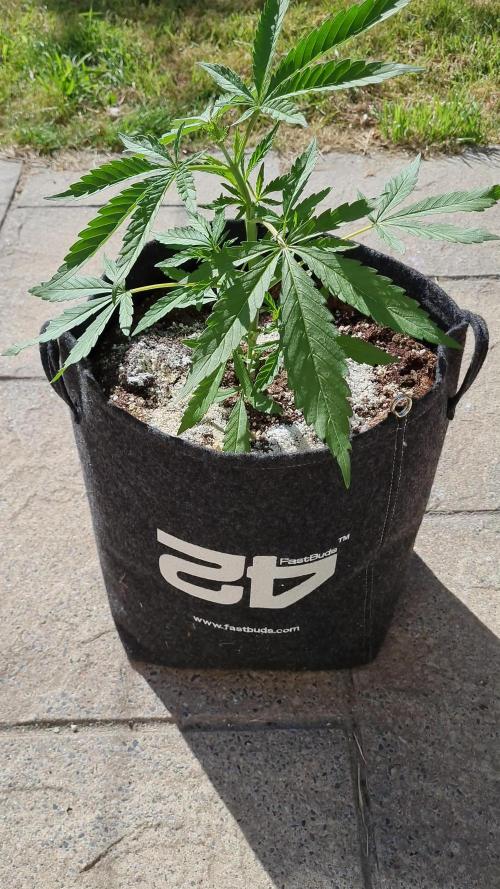
My little Guava girl has had another good week due again to good weather 😊
Although not as hot as last week its been Sunny everyday apart from a little rain Friday morning, its been really consistant with daytime temps of 21c -23c Tuesday - Sunday, yesterday thing crept up fo 25c and today things are hotting up again at 27c! nights with last days of heat are now an average 18c. Humidity has remained high in the range of 70-90% and Daylight hours are currently at 16 hrs 13 minutes.
I've been on two minds most of the week on whether or not she should receive any training, due to what seems like very short intrrnodal spacing, although i do want a low profile as it makes her blend into her surroundings easier in case unwanted visitors.
On Saturday i decided to FIM her, mainly because i've never FIMed an auto, but also topping would slow her down. Since then recovery has been fine and auxilary shoots have started growing out well, im going to train these out to the side of the pot hopefully in a nice formation. Also today shes just ticked over into flower, so hopefully any stretch should also be directed sideways.
She has been dined on this week slightly by a snail or slug but luckily i think it must have been a baby as only slight damage. This was entirely my fault as after a good watering i didn't replace the diamatous earth and she wasn't placed near my other grow which has a beer trap next to it, this has now been replenished!
All in all another solid week and really happy with our weather and her progress 😊
Have a chilled week and thanks for stoppin by ✌️💚

