


Likes
Comments
Share


@SimplyGrowLogical
Follow
I probably missed a week of pics but when your ladies explode like this there’s a lot of work to be done!


Likes
Comments
Share


@J_Law
Follow
this cycle will be godzilla glue#4 and sunset sherbet, both females. and although you see 2 sunset sherbets in the video, 1 of them was later transplanted for outdoor, which is in my other post. the GG4 was germinated 1 month AFTER the SS.
i will be feeding with BluePlanet FarmersPride organic 3-part high yield system
24 hrs in 5.5ph water and then directly into grow plug they go. 👍


Likes
18
Share


@ShowsWorld
Follow
Gorilla glue#4 x CookieWreck! Too excited can’t wait to see how she grows. Good healthy fast growing plant has already began to take off and I do mean quickly.

Likes
13
Share


@StickyFingah420
Follow
Terminando ya esta quinta semana de vida y la planta se ve bastante sana y con un buen color.
Ha sido la que ha crecido más lento en comparación a sus compañeras, pero no hay apuro, acá le damos el tiempo que necesite a cada nena para que se desarrolle de la mejor forma 💚
Buenos Humos!

Processing
Likes
166
Share


@iMeus
Follow
~ Update ~
Hello my friends, welcome back to another weekly update. I have a few issues going on so I’ll put those below in the IPN. This has been a good week so far, the girls are very happy, except the bazar mazar… Other than that it’s exciting that I’m pretty much at the halfway point :) Anyways, enjoy the update and let me know what you think in the comments, I always appreciate feedback
~ Individual Progress Notes ~
[CBD]
Notes: This is the healthiest of the bunch, nice rich green leaves and fluffy buds. I’m surprised the this little mutant is doing so well. As I said in the vlog GCS got back to me last week, I’ll keep them up to date with my grow so they know what’s going on with this girl.
[Mazar]
Notes: Burn! I’m noticing a lot of small but noticeable spots, leaf chattering, and slight yellowing at the tip of the leaves. I feel like I should just avoid feeding this girl though I’m not sure if that will help the situation. If you guys can take a look at this girl I’d really appreciate it :)
Edit: I found out thanks to my friends here on GD that I burned my Bazar Mazar :( So time for water which I might only give her water and flower fuel then flush till harvest (might be my cleanest tasting and smelling afterwards). It's hard to feed 4 different metabolisms every watering, but hey I'm learning :)
[Super Silver Haze]
Notes: The beast of the grow! What a lovely plant. Even though this girl got really hungry and started cannibalizing the lower leaves her buds are massive! I’m impressed with the total growth of this beast. Honestly, I’m cheering this girl on, might be my favorite (don’t tell the others).
[White Widow]
Notes: More like purple widow, this dense girl is showing her dark side and I like it. I planned on the purpling, still surprising to see all this purple though. I like purple buds but I don’t want this (or any of the girls) getting shocked by the cold. Hoping the I can get a few more pieces of gear to help out the next grow.
~ Final Thoughts ~
What a week, some of the girls are rocking and the Mazar, not so much :) It’s a learning experience that will take some time for me to learn how to balance all (most) of the variables. Thank you guys so much for all the love and support, I always appreciate it :)
Happy holidays and good grow’n fam, much love
Meus <3

Likes
8
Share


@Marianolst
Follow
Me fui de vacaciones y la planta creció mucho.
Tuve que volver a hacer LST por qué aún queda crecimiento y se me van muy hacia arriba lo que no puede pasar por los ladrones.
La verdad espero una gran producción si todo va bien Familia Gorilla son unas bestias


Processing
Likes
1
Share


@Organic_LarF
Follow
These 2 ladies go their separated ways, 1 stays lower but branching good and slightly paler green, the other dark green leaf and more height to it. But the branches go slower.
Rather impressed by the 2 hindus, who got like 4 to 5 days less than the sweet chees xl, and they are overtaking in growth now.
Thats it for this week
Grow tall!🍀🍀🍀
Likes
13
Share


@SillyTrippyHippy
Follow
The week was well. One of my ladies seem a little over watered. So I'll cut back on her little this week. I did top them all (yes I top earlier than most people 3rd or 4th node rather than 5th or 6th)
this week every time I watered I threw in some human acid and whatever microbes I felt like using I think I've added pnsb, & recharge and prolly the sample of fish sh!t I had this week. I'll prolly brew a tea or do a compost extract sometime this week just because I haven't done one yet.

Likes
57
Share


@DeepWaterGrower
Follow
🗓️ WEEK 8 / DAY 50-56
⚡ Light: 30 cm / 150 watt;
⌛ Schedule: 18/6;
🌡️ 24.5° C - 65% RH average;
📑 PH 6.1 - EC 2.3;
🌱 Phenotype #1 is forming beautiful flowers, for two weeks I have been rotating the plants 180° every 3 days, so as to make the buds that would receive less light also swell. Height: 48 cm;
🌱 Phenotype #2 just stopped stretching and begins the flowering stage. Height: 55 cm;
⚙️ Fan, extractor and pump ON 24/0.
👯♀️ As you can see in the pics, I have other seedlings in my grow-box, here the diaries if you want to take a look:
- White Widow (GHS): https://growdiaries.com/diaries/198827-green-house-seed-co-white-widow-grow-journal-by-deepwatergrower
- Opium (Divine seeds): https://growdiaries.com/diaries/206602-divine-seeds-opium-grow-journal-by-deepwatergrower

Likes
31
Share


@XperencdGmanXG
Follow
What can I say this thunder fuck is so smooth to smoke, I just can't stop growing it! I am in uncharted waters here because I've gone full organic no till. This will be my first time using grassroots living soil pots and first time using this brand new soil mix. Also to help with costs I decided to make a 5 gal tea reactor, to grow out the EM1 which will save me about 75% on all microbe products, and also save on feralization when used in conjunction with foliar sprays. Wish me luck!
Likes
71
Share


@Grow4Releaf
Follow
*Jan26th-#plant2 was ready to cut Tuesday she's In the dry tent goon for a few days then will jar up. *
Plant 1 is goin strong still. But they both are on a tap water diet till the end.
We're at week 14 from seed and 8th week flower so should be done growing and filling out from here on hopefully..
Just glad the tents set up fully now with exhaust and dehumidifier so no more crazy spikes (would get up to 80% rh and 55°f .. cold and humid had me freaking out lol. But that's all sorted)
All in all I'm happy with the lil test run on these, seeing how they did with minimal nutrients and light gives me hope for the next go.
Still debating on running these with growdots , my next set will be with ganja farmer seeds and growdots. Should be fun may throw in a plat jelly or two aswell. We shall see once the beans get here..
As always tho. Appreciate anyone thst may leave suggestions or feedback. Always like gearing what u see or don't see . Helps get better so its mainly why I'm here .
And thanks to anyone goin thru my rambles ,videos and photos.
Hope everyone's grows are doing well, I'll be skipping around checking out what is going on .! Till next update take care gang !

Likes
4
Share

@RatmanJR
Follow
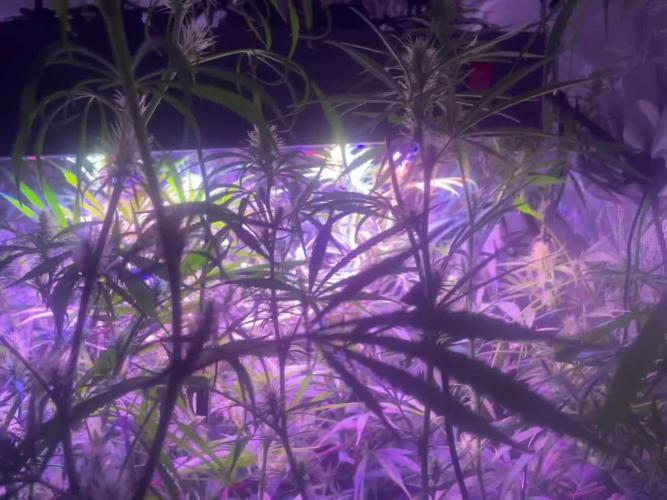
July 20th. 36 days post flip
Clones:
These things will not stop growing. I should have known with them being landraces but I am super cropping multiple tops every single day to keep the buds off the lights.
Interestingly the plants no longer seem to be burning even when they are directly touching these lights. I’ve never grown a plant this resilient in my entire life but shows what nature is capable of.
Some clones have a more modern bud structure but one of them has this crazy almost spear like structure going on. Super excited to see how they smoke in a few months.
No longer seeing any deficiency’s on any new leaves due to the nutrients last week. Will likely avoid adding anything else except some build a flower here in a week or so.
Smell is finally starting to take off. So far very peppery but also a slight off smell as well. Can’t quite put my nose on it but hopefully in a week or so will start to get even more smell.
Parents:
Parents got topped aggressively a week ago on July 12th in order to keep them small. All 4 are already showing new nodes and recovery. So far they have been in these small fabric pots for 20 weeks with no signs of deficiency.
I think the secret to that success has been low power lights limiting growth, no night cycle so the plants cannot develop the roots needed, and the fabric pots air pruning the roots so they don’t ball up.
At this point simply going to continue topping every month or so and once they start showing deficiency will move them into slightly larger pots
God bless!

Likes
17
Share


@HowtoBubatz
Follow
Today marks the second week of flowering, and I’m really excited about how well my cannabis plant is doing! Over the past few days, it’s really stretched out and has grown quite a bit taller.
The leaves are looking lush and vibrant, with a deep green color that shows how healthy the plant is.
I was a bit worried last week because the leaves were slightly droopy, but after adjusting the water and getting the levels just right, it’s looking much better now.
It feels like the plant has responded really well to the care I’ve been giving it.
I’m looking forward to seeing how it continues to develop in the next weeks.
The buds are starting to form, and I can’t wait to see them fill out. This is such an exciting process, and I’m really hopeful that everything will keep going smoothly from here on.
Fingers crossed for a successful grow!💚🌱
Likes
11
Share


@CrushedCana
Follow
La planta se estiró muy rapido y con la luz empezó a crecer hacia los lados en la noche la saco para nutrir y cada vez absorbe más agua trato de darle una vez a la semana alimento y agregó agua cuando el sustrato se seca

Processing
Likes
16
Share


@MrWolfe
Follow
What an awesome thing to walk in on starting off week three all the girls were praying and just getting so fat, I really need to strip some fan leaves off the mom.
They look great, the smaller cuts definitely aren't as good as the 4-6" cuts are, they were MAYBE 3-4" cuts and pretty small, but they are extras anyways so it doesn't matter, just seeing what they do. I'm excited for them to have all this space to stretch out when I pick up another light.
Last day of week three and I couldn't be happier, I absolutely have to cut thicker clones , these smaller ones all got a bulbous base? Not sure what that's about but we will see how they develop. They are extras anyways but still nice to figure it all out.

Likes
5
Share


@wheedtobeus420
Follow
Day 75. She’s huge and in the dark ice flushing. She smells amazing. I can not wait! 🎂🎂🎂🎂 we also added another meet Mortimer

Likes
21
Share


@NG420
Follow
Fattys are growing and seem to be thirstier.Used foliar spray to help the leaves and also started tucking. When the plant was topped pistils were seen for first time.
Likes
3
Share


@PatronEl
Follow
Now a bunch of other stuff arrived and I can finally use fans for her! Also the hygrometer arrived and I was SHOCKED! It showed a humidity of around 40% and up to 28 degree. I dont even know how she survived that long ? After I witnessed the horrifying truth I searched restless for a humidifyer that fits into the room, and where I can also see the humidity, since I could not believe my eyes with the hygrometer
Likes
31
Share


@Mr_Motalovah
Follow
Hello growers and tokers! 👋 👩🌾 🧑🌾.🔥💨
As you can see these ladies are growing nicely.
They're both at the same height 59cm but one is wider than the other.
Quite nice so far. That's 12cm in one week same as the Royal Gorilla.
Evenly spread canopy, the one that had better shape from the start now has longer colas.
Both are stacking nodes nice and tight.
They have a nice green color to them but you can't really appreciate that in the pictures.
I'm still trying to get a hand of this new phone, I might just go back to the camera. 🤔
Starting to get a little shine to them, I think this strain will be the first in forming trichomes.
They give off a nice smell but I can't put my finger on it yet.
Feeding 1,5L each, every other day. Will be increasing as they ask for more.
How do they ask for more?
When feeding if the soil is drier than normal I give a 150-200ml increment of water.
I do that until they stop feeding so much then i just maintain that amount.
I start reducing if it takes longer to dry.
That works good for me. The old finger in the dirt trick. 👍
Nothing like knowing exactly what your ladies need first hand.
**Info and pictures were taken at day 12 of flower.**
Hope you enjoyed this week's update. Stay tuned for next week. 😃
If you like this check out the other diaries of the strains in the tent. 😄
Take care and stay safe!
One love!✌️🏽


